
Last weekend, ABC Classic ran its yearly audience poll to determine what Australia’s 100 favourite pieces of Classical music are. Each year they run with a theme – last year was Piano, the year before was “Feel Good”. But this year, they went big and chose “Greatest of All Time”.
They have run three different versions of this poll, once in 2001, then again in 2011 and once more in 2026. It is therefore interesting to compare the lists and see how Australia’s classical music tastes have changed during the 21st century.
Across the two most recent polls, the winner has remained the same – Beethoven’s 9th symphony. Composed near the end of the composer’s career in 1824, this masterpiece is adored for its groundbreaking finale, which features a choir, which sings the “Ode to Joy”. alongside the orchestra. Whilst I have no doubt the finale drove the 9th’s recurrent first-place finish, I think the other three movements are just as good if not better. The whole hour-long symphony is well worth a listen start to end.
Beethoven gets a strong showing up and down the lists, getting the most pieces placed in the top 100 of both the 2011 and the 2026 polls. However, in 2001, he was only the third most prominent composer coming in third place in 2001, to Bach and Mozart equal first place. Mozart’s Clarinet Concerto took the top spot in 2001. (Yay Clarinet!)
Whilst Mozart’s Clarinet Concerto received top spot in 2001, it fell to 4th in 2011 and then to 14th in 2026. Mozart in general seems to have fallen significantly in Australia’s favour, from having 12 pieces in the top 100 in 2001, halving to 6 in 2026. His requiem, one of my favourites, dropped from 15th to 57th.
Religious music seems to have suffered more broadly in the tastes of the current era, perhaps due to a declining religious identification in Australia – Bach’s St Matthew’s passion like Mozart’s Requiem, also fell dramatically – from 12th to 64th. However, Handel’s Messiah is a prominent exception, remaining steady at 5th place in 2026.
Bach, often named the greatest composer of all time by critics, went from having 12 pieces in the top 100 in 2001 to only 4 in 2026, an even larger drop than Mozart. I believe that it’s possible his intensely contrapuntal style of baroque music is gradually becoming more distant to modern ears, making it difficult for new audiences to connect with it.
I think it is important to note that the changes between these lists is likely not driven by people changing their minds, but rather different people voting in the lists. It’s no secret that the classical music radio audience tends to skew older. In addition, the 2026 vote was heavily promoted on social media, likely drawing a structurally younger audience.
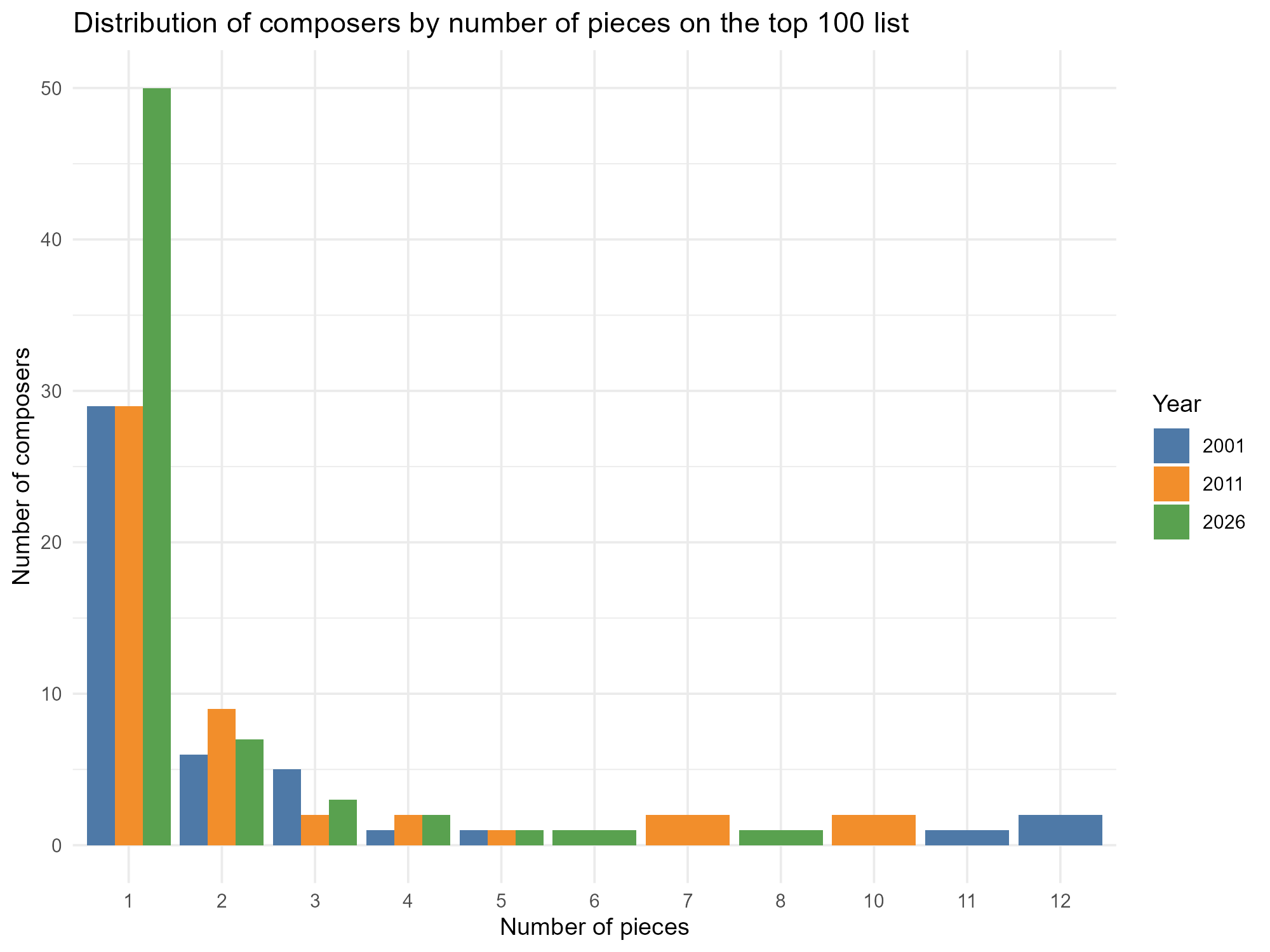
A significant change in 2026, is that there were many more composers represented by only one or two works. This contrasts with 2001, where big hitters like Bach, Mozart and Beethoven occupied a proportionally larger share of the Top 100.
I think this might reflect changing music consumption attitudes in the wake of streaming on apps such as Spotify and YouTube, where it is easier than ever to be exposed to obscure works instead of just “the great classical composers”. This also tracks with a sense that the younger generations are more interested in personal expression rather than accepting traditional aesthetic wisdom.
(Source: ABC Classic 100: Greatest of All Time — by the numbers - ABC News)
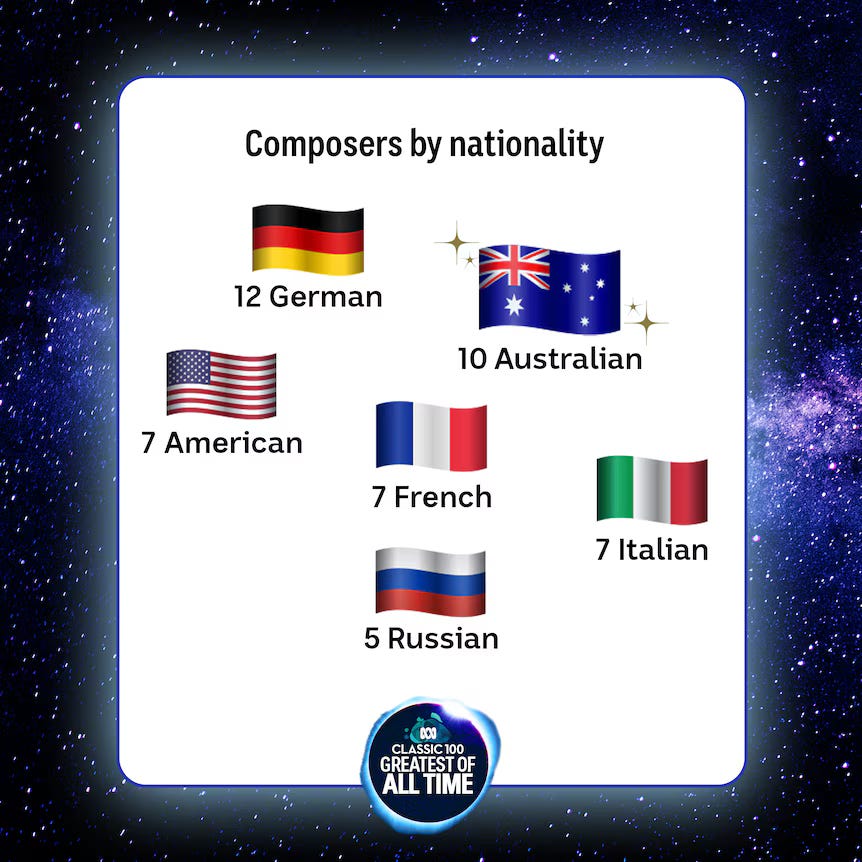
A greatly positive development in 2026 is the many Australian composers featured, many of whom being indigenous Australians or immigrant Australians, reflecting the diversity of our nation’s artistic output.
One of my favourite Australian Pieces is “Antarctica” by Nigel Westlake, derived from music the composer wrote to accompany an IMAX documentary about the frozen continent.
Soundtrack music featured prominently in 2026; 17 out of the top 100 pieces ranked in 2026 were soundtracks – the highest of any type of “accompaniment music”, beating Opera/Theatre’s 10 entries. Much of this triumph belongs to John Williams, composer of soundtracks for Star Wars, Harry Potter, and Jurassic Park, amongst many others, who went from 0 pieces on the top 100 in either 2001 or 2011, to having 5 pieces in 2026 top 100, beating Bach for 3rd place by number of pieces.
This enormous shift is in part due to prior years not even having Soundtrack music as voting options.
Some snobs will say that soundtrack music is not classical music and thus rightly not included in the 2001 and 2011 polls. I think this is a laughable sentiment. There is an idea that soundtrack music is some new imposter, not worthy of the tradition of “Classical Music”, but cinema, and by extension film soundtracks have been around since the first motion pictures over a century ago. I just don’t see what makes it different to music for Opera and Ballet.
But I don’t think soundtrack music’s popularity is only a reflection of its inclusion in the poll. It seems soundtrack music is popular with younger Australians, with many of my friends using it as background study music.
Granted – there is much soundtrack music that isn’t classical, such as the soundtracks to “Once Upon a Time in Hollywood” and “Guardians of the Galaxy’” which are jukebox selections of rock music, but this tends to be the exception rather than the norm, with at least a plurality of soundtrack music belonging to the classical genre.
Take John Williams, he is a composer who writes largely in the Romantic and 20th century traditions and his music, even though it’s for the big screen fits in this lineage. Take the “Throne Room” music from Star Wars, with its brilliant trumpet fanfare inspired by Felix Mendelssohn’s “Wedding March”, and with complex modulations that would impress Richard Wagner.
(Source: ABC Classic 100: Greatest of All Time — by the numbers - ABC News)
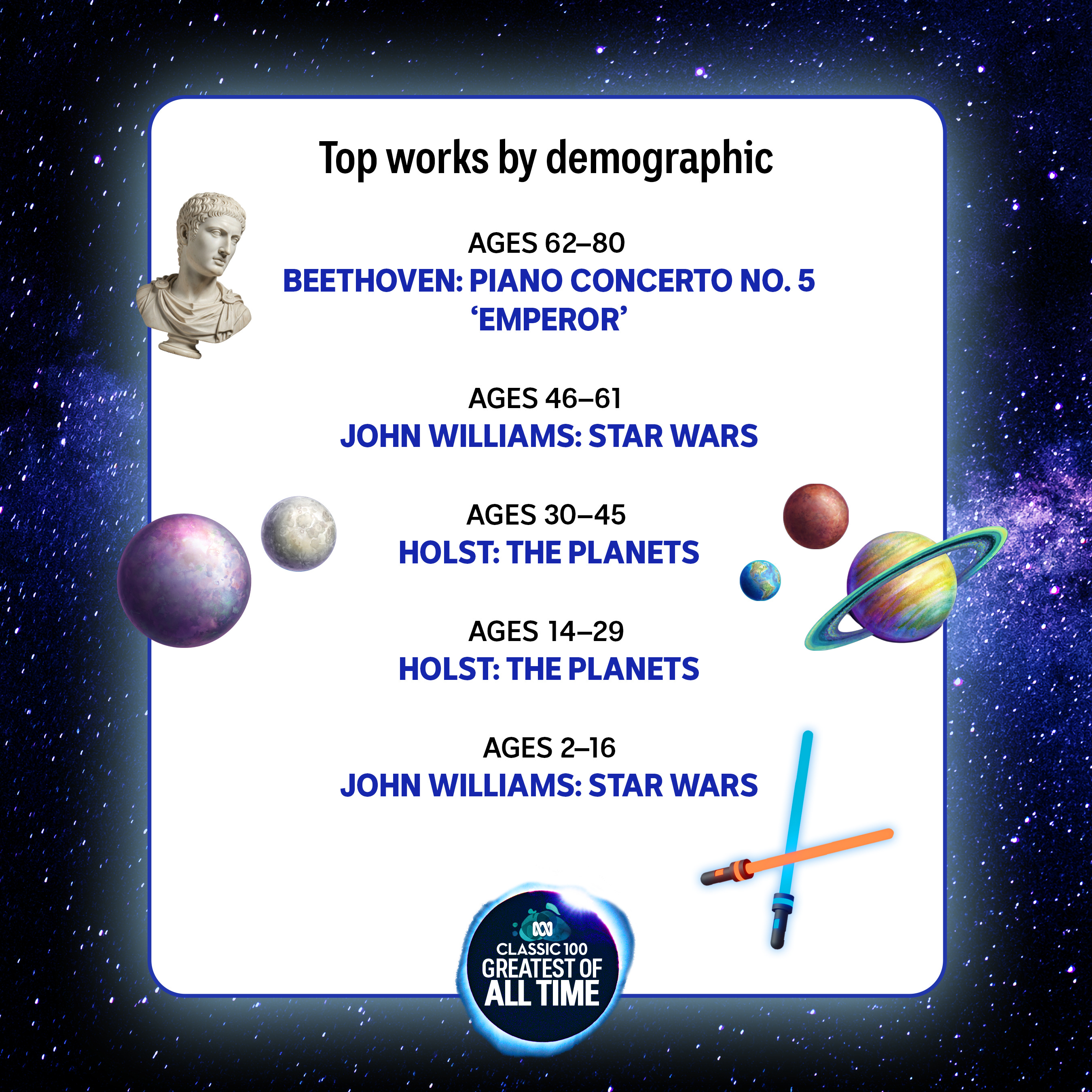
Whilst John Williams’ “Star Wars” soundtrack is resoundingly popular for Australians under 61, across people aged 14-45, the most popular piece was Gustav Holst’s “The Planets” suite. Written from 1914-1917, “The Planets” is a set of seven tone poems. These tone poems represent each of the planets (excluding Earth): Mars, Venus, Mercury, Jupiter, Uranus and Neptune.
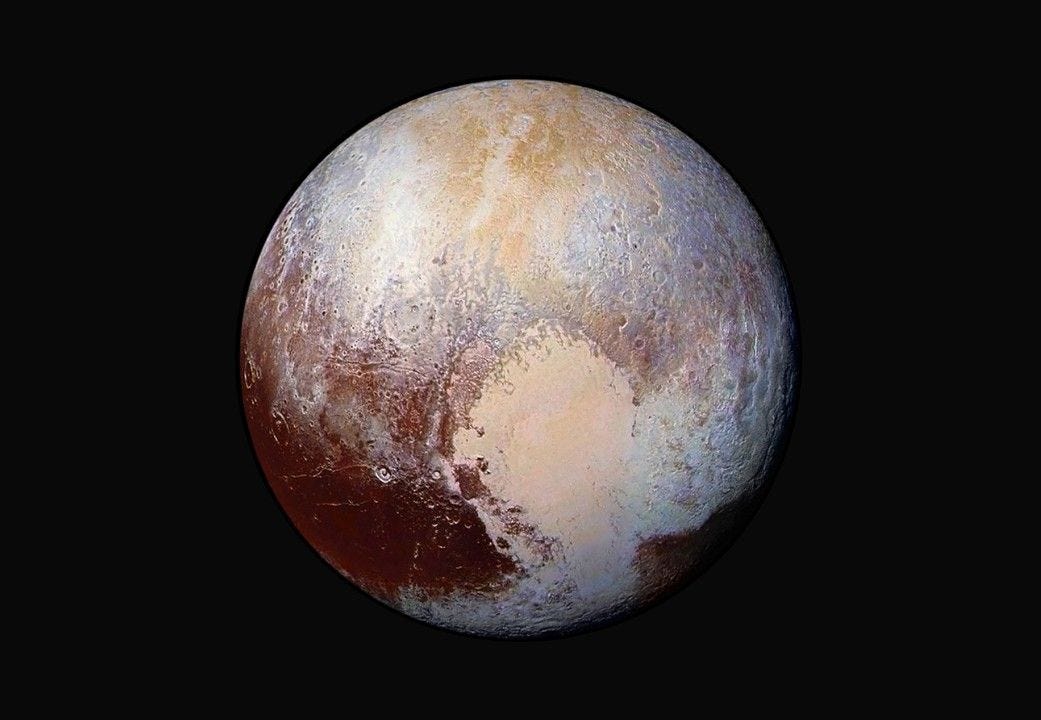
(Pluto, Source: NASA)
Of course, Holst did not have access to our satellite images in the 1910s, so instead based the movements on astrological associations. For example, “Mars”, subtitled “The Bringer of War”, is an imposing war march. He makes the violinists hit their strings with the backs of their bows to create an unsettling rumbling effect, meant to represent the storm clouds of war. This topic would have of course been on the composer’s mind during the early 1910s. Each of the 7 movements is a brilliantly evocative and distinct segment like this but in its own full-colour way. This has led to a timeless quality to the music, which may be part of its appeal for younger generations. As the baroque style has become slightly stale, “The Planets” remains fresh.
“The Planets” timeless appeal as the definitive space music might be why John Williams was so inspired by it in his “Star Wars” soundtrack. The mythology, very common in the YouTube comments, goes that John Williams stole “The Planets” to make “Star Wars”. Of course, there is nothing young people love more than to know that something their parents like is a forgery of something greater. I’m sure this status as “Star Wars” before “Star Wars” is a huge part of its broad appeal.
However, I do think this is maybe overblown. John Williams of course borrowed elements from “The Planets”, but he also borrowed from many other composers. Whilst “The Imperial March” is clearly based on “Mars” from “The Planets”, the title theme seems to be inspired by Erich Korngold’s “Kings Row”
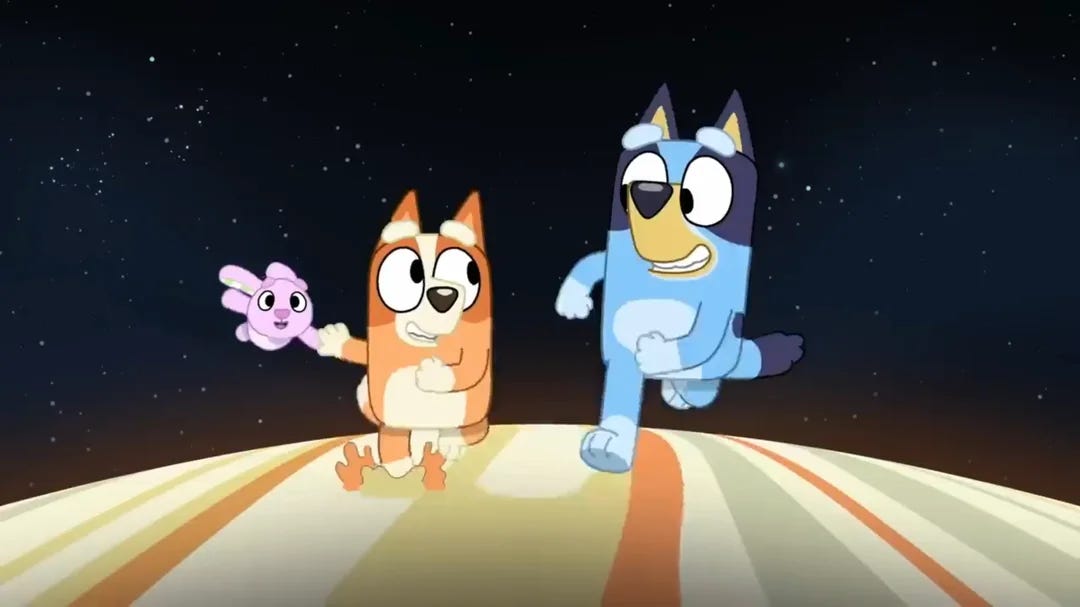
Whilst the very youngest surveyed might have picked “Star Wars” over “The Planets”, it’s 4th movement “Jupiter” makes a striking appearance in Bluey, which likely will only increase its appeal to younger generations. “Jupiter” serves as the soundtrack to “Sleepytime”, and its stirring central hymn tune is no doubt big part of that episode’s 9.7 star IMDB rating.
(Source: ABC)
I highly recommend watching this episode, even if you are an adult, it is very touching, and the feature of “The Planets” as the soundtrack is very well done.
Beethoven famously wrote 9 symphonies, and his last has always been his most popular. But where do his other symphonies fall?
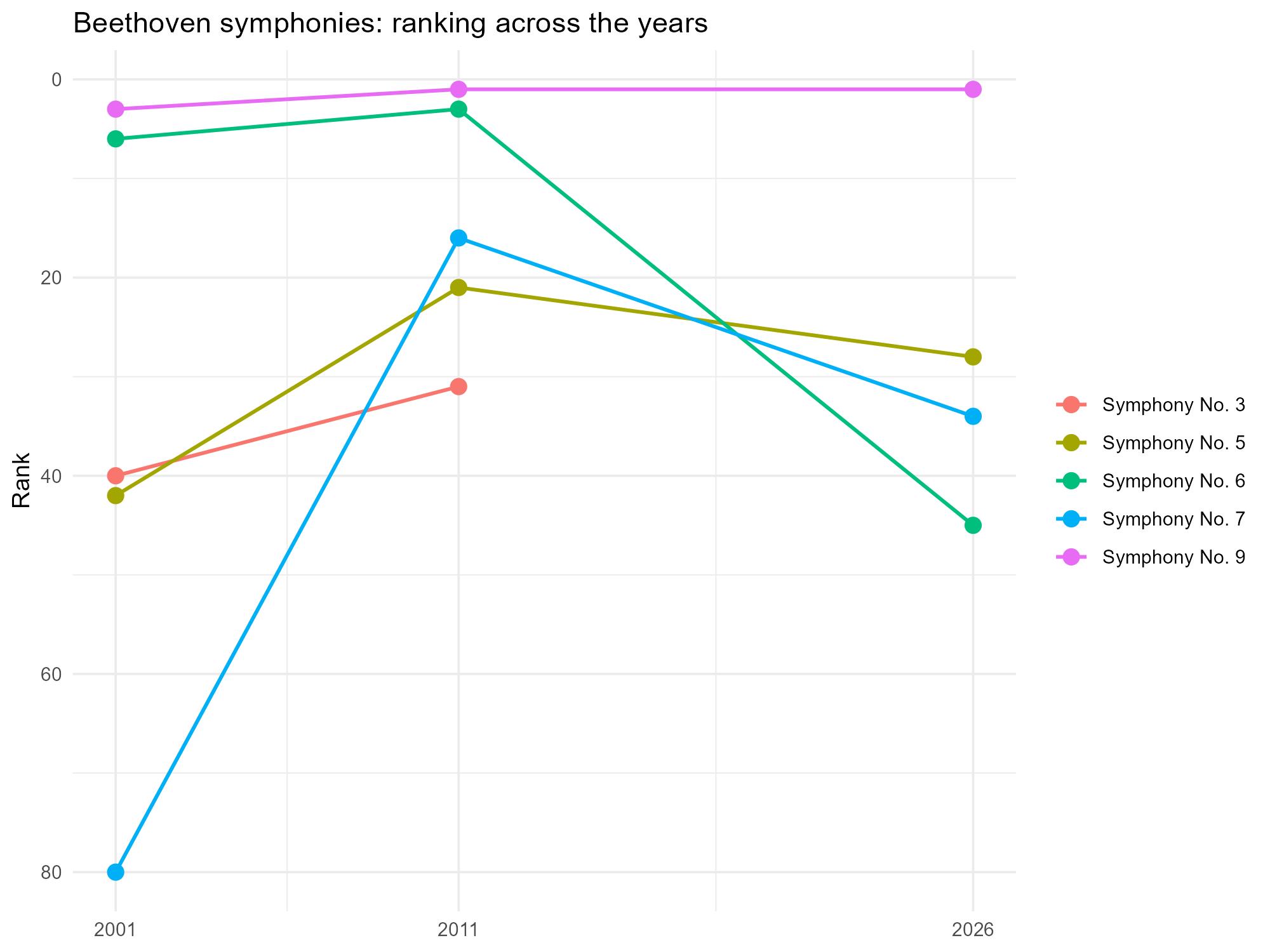
When talking about Beethoven’s Symphonies there is often a tendency to see his odd numbered symphonies as the more “dramatic” works, and for his even numbered symphonies to be considered mundane in comparison. Across the lists we see this trend, with most of the even numbered symphonies not getting a mention.
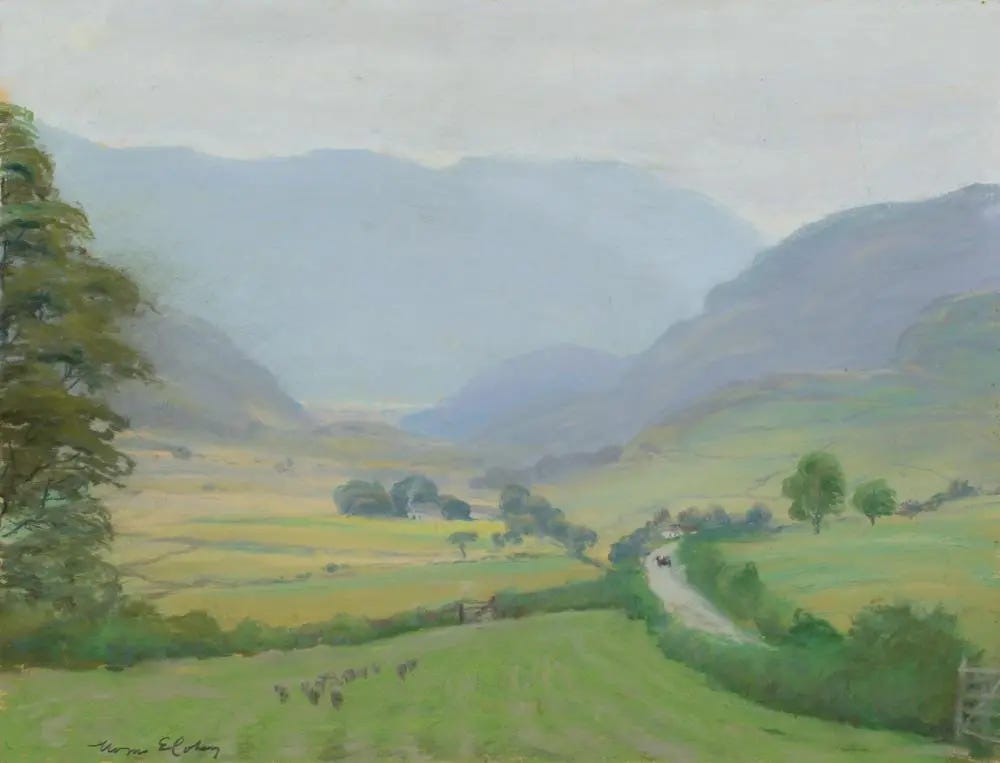
Of course, the exception to that is his 6th symphony, also known as the “Pastoral” Symphony, as it is meant to represent scenes from the countryside. In 2001 it came 4th, increasing to 3rd in 2011, before a massive drop to 45th in 2026. Perhaps younger people are true believers in odd numbered supremacy?
To speculate, I think the rural themes of the 6th might not be attractive to the younger, highly urbanised generations. In addition, the 6th is not particularly angry or forceful, instead painting a peaceful vision of idyllic life. I don’t think this resonates with us as much post-pandemic during a time when there are multiple active wars.
Another striking change is the 3rd completely falling off the list in 2026. This is fascinating to me, as it often ranks first place on critic and conductor lists of the greatest symphonies of all time. I believe there is somewhat of an academic “cult of the 3rd” which overstates its historical importance.
Perhaps modern listeners are less captured by the accepted wisdom and instead making quality decisions based on their own ears. Still, it’s a shame the 3rd didn’t get ranked at all, as I think it is stunning music, particularly its 2nd movement “Funeral March”.
I look forward to seeing future iterations of this poll to see how Australia’s taste in classical music changes. I wonder if video game music will get in the top 100 as soundtrack music has broken through, or if we will see a dramatic resurgence for the old masters.
Whatever happens, I hope that we see even more Australian composers next time in recognition of their continued contribution to the cultural life of this country,
No posts
Comments
Nothing yet. Say the first thing.
Sign in to join the conversation.