
A classic debate in the public transport space is whether speed or frequency is more important. Would it be better to give the train line an even every 5-minute service, or provide a system of expresses?
Unsurprisingly - I think it depends.
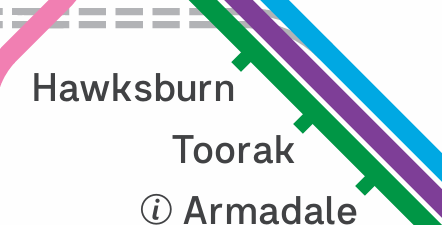
What we are really talking about when we are referring to frequency and speed and how they relate to travel choice, are two components that impact the total trip time. These are on-board travel time, which may be for instance 2 minutes, for the time between Toorak and Armadale. This is our variable which relates to “speed” on board the train.
Then there is average wait time. This can be defined as the frequency, as in “every 10 minutes” for the case of Toorak to Armadale, divided by two, making an average wait time of 5 minutes. This is our variable which relates to “frequency”
Combining these, we can create a value for total time. I want to note that it is widely considered that passengers perceive time waiting on platforms as being worse than when they are moving, so before we sum the two variables, we should adjust the average wait time with a waiting penalty constant.
\(T_t = \frac{c_{wp} \cdot f}{2} + T_m \)
… where Tm is the moving time, f is the frequency, cwp is the waiting penalty constant, and Tt is the total time.
Assuming the waiting penalty constant is 1.25 (passengers consider waiting on the platform 25% worse than being in the train), we can calculate the total adjusted travel time between Toorak and Armadale
\( \begin{aligned} T_{t(\text{toorak to armadale})} &= \frac{1.25 \cdot 10}{2} + 2 \\ T_{t(\text{toorak to armadale})} &= 6.25 + 2 \\ T_{t(\text{toorak to armadale})} &= 8.25 \end{aligned} \)
Notice how much of this trip time is defined by the frequency - in fact its more than 75% of the total trip time. This is a really short trip, so this makes sense. Let’s take a longer trip, say Pakenham to Parliament (which takes about 69 minutes).
\( \begin{aligned} T_{t(\text{pakenham to parliament})} &= \frac{1.25 \cdot 20}{2} + 69\\ T_{t(\text{pakenham to parliament})} &= 12.5+ 69\\ T_{t(\text{pakenham to parliament})} &= 81.5 \end{aligned} \)
In this longer trip, the frequency component of the total trip is far, far smaller, below 20%. This suggests clearly that for longer trips, improving the frequency becomes less proportionally effective for making the trips better. Instead, offering an express service becomes increasingly effective.
This is why it is much more acceptable that trains go to Seymour hourly, then the Upfield line having a frequency of every 20 minutes. Improving the frequency just wouldn’t mean a whole lot.
So, let’s look at our framing question. Should Pakenham and Cranbourne trains stop at Hawksburn, Toorak and Armadale?
We would want to make sure that this would have a positive impact on patronage. We can represent the impact that total travel time has on patronage as a proportion. This proportion is likely to be relatively low. Let’s say it’s around 15% just to speculate (Arbitrary I know, but DTP does not provide the data needed to properly calculate this).
\(P_c = P_iA(T_{ti} - T_{tn})\)
… where Pc is the patronage change for this station pairing, Pi is the initial patronage, A is the proportional impact that total travel time has on patronage, Tti is the initial travel time, and Ttn is the new travel time after we have changed something.
To determine the full impact of the change though, we have to sum all the patronage changes for station pairings.
\(P_{tc} = \sum_{\substack{\text{impacted} \\ \text{pairings}}} P_{iA}(T_{ti} - T_{tn}) \)
… where Ptc is the total patronage change across all impacted station pairings.
Now, what we know is that the majority of trips on our network are to and from the city, and therefore a lot of trips would be increased by 3 minutes in length. Think all trips that are between any station from South Yarra inwards and Carnegie outwards. That surely is a majority of trips.
The primary beneficiaries would be Hawksburn, Toorak and Armadale. Their frequency would change from 6 trains an hour (Frankston Line) to 12 trains an hour. This change would decrease the adjusted wait times by about 3 minutes.
Therefore, for this to be beneficial change, Hawksburn, Toorak and Armadale would have to be significant destinations for passengers coming from say Clayton, Springvale or Dandenong, to outweigh the impact of reducing the quality of city trips.
I really don’t think you can make this argument. Maybe with Malvern you can. But not Hawksburn, Toorak and Armadale.
However, a possible way this could be shown to be beneficial is if the proportional impact that time has on patronage is nonlinear, instead being logarithmic with small differences in small values having an outsized impact on the final result. I am willing to accept that this might be possible, but I doubt the effect is extreme enough to change my suspicion that this change would be bad.
Yet this is mere speculation. Whilst I have laid out a method to determine if this is true, the data needed to calculate this just isn’t published publicly. DTP publish myki touch ons, but not patronage on the station pair unit. I kinda get why because that would be almost 50 thousand data points, but it would be much appreciated if they published such a data set.
No posts
Comments
Nothing yet. Say the first thing.
Sign in to join the conversation.