
Put yourself on the deck of a merchant ship in the summer of 1250 BC.
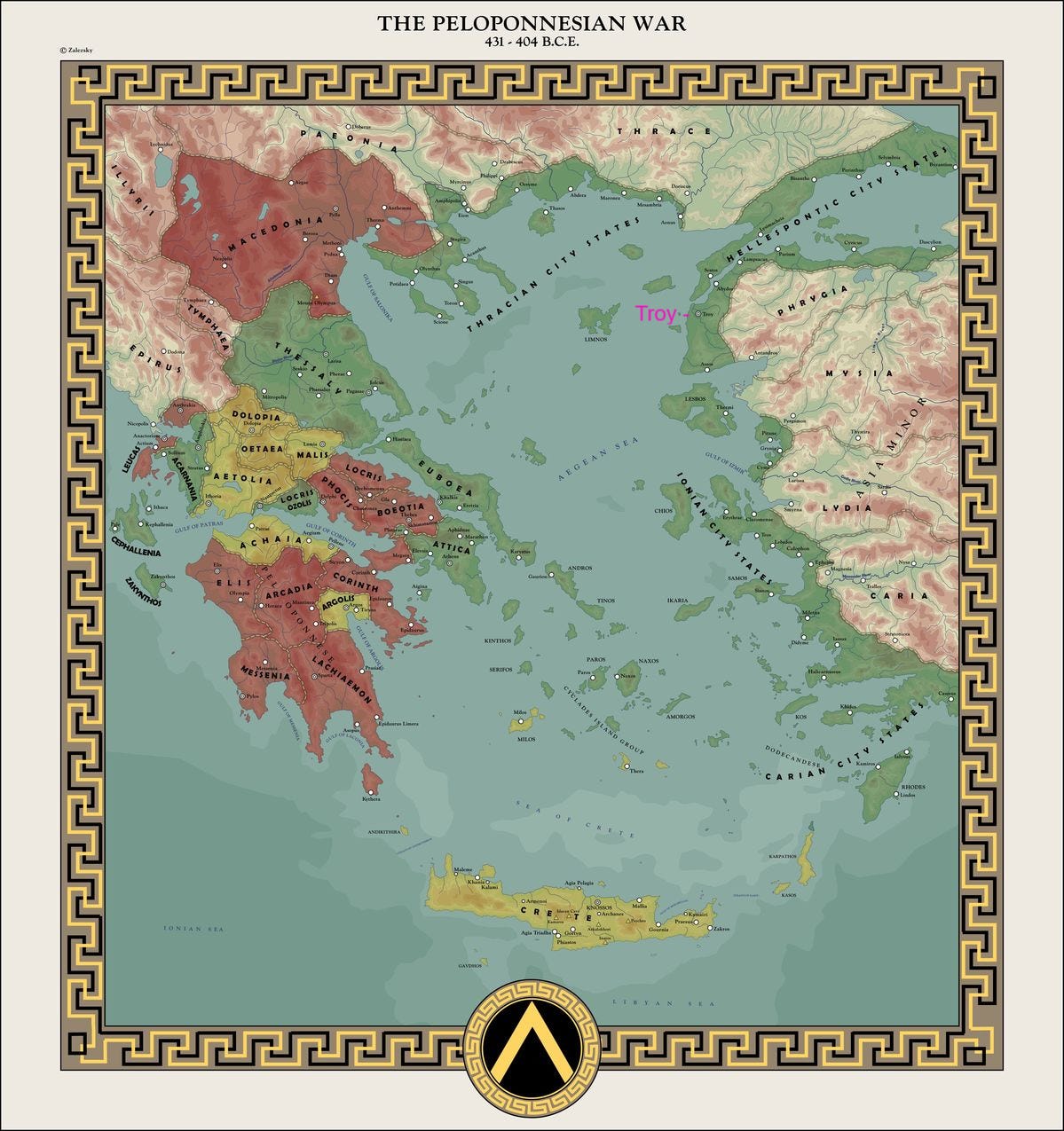
You are carrying tin, or copper ingots, or oil in stirrup jars, and you are trying to get from the Aegean into the Sea of Marmara and beyond it to the Black Sea, where the grain is and the metal is and the horses are. You have made the run up the western Anatolian coast. Ahead of you is the mouth of the Dardanelles, a strait a mile wide at its narrowest, and past it is money.
You are not going to get through today.
The water in that strait is pouring out at you. The Black Sea takes in more river water than it loses to evaporation, so the surface current runs southwest, out through the Bosporus, across the Marmara, and down the Dardanelles into the Aegean, and at the narrows it runs at two to five knots. Your hull can do maybe three under good conditions. And the conditions are not good, because it is summer, which means the Etesians are blowing, a steady northerly that comes down the strait and hits you in the face for weeks at a stretch.
Current against you. Wind against you. No engine.
So you do what every ship on that route has done since men started making the run. You put in at the sheltered bay just south of the mouth, and you wait for the wind to shift.
You might wait days. You might wait a month.
And while you wait, you buy water. You buy food. You repair rigging. You store cargo somewhere it will not be stolen. You pay somebody for the privilege of anchoring there at all, because the men who live on the hill above that bay worked out a very long time ago that they did not need to build ships or sail anywhere or produce a single tradable thing. They only needed to own the place where everyone stops.
That hill is Hisarlik. That is Troy. And that is the answer to the question nobody asks about it.
Troy was not built for glory. Troy was built because a man who controls a chokepoint gets rich, and rich men at chokepoints eventually get visitors who do not come to trade.
The walls follow from the tollbooth. Everything else follows from the walls.
Now hold that beside a second fact, and the second fact is the strange one.
Troy is the most famous city in the literature of the West. Three thousand years of poems, plays, paintings, operas, and films. Ask anyone on the street to name a city of the Bronze Age and you will get Troy, and you will probably get nothing else.
And Troy never said a word about itself.
Not a chronicle. Not an annal. Not a king list, a treaty, a tax record, a letter, a prayer, or a boundary stone. From the entire Bronze Age life of the city, across centuries of occupation, the excavated writing amounts to one small bronze seal.
Everything you know about Troy comes from somebody else. The Hittites filed paperwork about it from the east. The Greeks sang about it from the west. Archaeologists report on it from underneath. The city itself is silent, and it has been silent the entire time, and almost nobody notices because the noise other people made about it is so loud.
So let us do the thing that is rarely done with Troy. Let us treat the silence as the case, and go through the file that other people left, and see what can actually be established about who these people were, who they answered to, what gods they served, whose culture they lived inside, and why the place was there at all.
The answers are better than the legends. Some of them are much stranger.
First, clear away a confusion that has been sitting in the popular story since 1873, because you cannot follow the evidence while standing in the wrong century.
Hisarlik is not one city. It is at least nine, stacked, from around 3000 BC down to Roman times. Archaeologists number them Troy I through Troy IX, with sub-phases, and the numbering runs bottom to top, oldest to youngest, so that the deeper you dig the further back you go.
Heinrich Schliemann dug straight down through the middle of it. He was hunting Homer’s Troy and he was in a hurry, and he cut a trench through the center of the mound and threw the excavated material over the side. In 1873 he found a cache of gold, silver, and copper objects and announced them to the world as Priam’s Treasure, and had his wife photographed wearing what he called the Jewels of Helen.
The material came from Troy II.
Troy II dates to roughly 2400 BC. The destruction layer that fits the Homeric war is Troy VI or VIIa, in the neighborhood of 1180 BC. Schliemann was off by more than a thousand years, which is roughly the distance between the Norman Conquest and now, and in his haste he destroyed a great deal of the layer he was actually looking for.
That is the standard version of the story, and it is fair as far as it goes, though it flatters us. Schliemann was working before stratigraphy was a mature discipline and before anyone had a reliable chronology for the Aegean Bronze Age. He was wrong in the way a man is wrong when he is first. He also found the site, which nobody else had managed, by taking a text seriously enough to go dig where it said.
The point for our purposes is narrower. When people picture Troy, they are usually picturing an object from the wrong millennium.
The Troy that matters, Troy VI and VIIa, is a substantial fortified settlement with sloping ashlar walls, towers, and a citadel. And beginning in 1988, a team under Manfred Korfmann found what Schliemann’s trench had missed entirely: a lower city outside the citadel walls, running to something on the order of thirty hectares, with a defensive ditch cut into the bedrock to stop chariots.
That changes the character of the place. A citadel alone is a warlord’s house. A citadel with a large lower town and an outer ditch, sitting at the mouth of a strait beside a sheltered anchorage, is something else. Korfmann argued it was a trading center, an emporium, sitting on the chokepoint and living off it.
Not everyone accepts that. Frank Kolb, also of Tübingen, argued publicly and sharply that Korfmann had inflated the site’s size and commercial importance. The dispute was loud enough to become an academic scandal in Germany.
I am not going to litigate it here. Note it in one line and move on: the scale of Troy’s commerce is contested, the location is not. The city is where it is, the current runs the way it runs, and the wind blows the way it blows. A settlement at that spot was in the waiting business whether it had five thousand residents or fifteen hundred.
Now the evidence that makes this more than a story about geography, and it is genuinely remarkable evidence, because it is bureaucratic.
Roughly four hundred miles east of Hisarlik, at Boğazköy in central Turkey, lie the ruins of Hattusa, capital of the Hittite empire. In the ruins are archives. Thousands of clay tablets: treaties, letters, oracle reports, ritual instructions, royal annals. The record of a Great Power that ran Anatolia and fought Egypt to a standstill at Kadesh.
In those archives there is a place called Wilusa, in a region called Assuwa, in the west.
Wilusa is Ilios.
The identification is not a stretch, and here is why. In Homer, Troy’s other name, the one in the title of the Iliad, scans oddly in places. Certain lines only work metrically if the word once began with a consonant that had dropped out of Greek by the time the poems were written down. That consonant is the digamma, the w sound, and the reconstructed older form of Ilios is wilios.
Wilusa. Wilios. Same word, filed in a foreign chancery, four centuries before the poem was written down.
Grade that as Bedrock. It is accepted by most specialists.
Then it gets sharper. Around 1280 BC, the Hittite Great King Muwatalli II concluded a vassal treaty with the ruler of Wilusa. That ruler’s name, on the tablet, is Alaksandu.
Alaksandu is Alexandros.
In the Iliad, the Trojan prince we call Paris is also called Alexandros, repeatedly and without explanation, as though the poet inherited two names for one man and did not feel free to drop either.
This is Disputed Ground, and it is strong ground. The equation of the names is widely accepted; what it means is argued about. Nobody serious claims the treaty proves the war, and I am not claiming it. The treaty is dated a century before the destruction layer.
What it establishes is far more useful than a proof of the war. It establishes that the world of the poem was real. There was a place called Wilusa. It had kings. One of them was called Alexandros. It was a vassal of a great empire to the east, bound by written oath.
And there is more in the file. Hittite letters refer to a power called Ahhiyawa, across the water, with interests on the Anatolian coast. Ahhiyawa is now generally read as the Achaeans, which is Homer’s most common word for the Greeks. The Tawagalawa letter, from a Hittite king to a king of Ahhiyawa, refers in passing to a past quarrel between them over Wilusa, and says they have settled it.
If you value unflinching, historically grounded analysis that mainstream outlets soften or ignore, consider upgrading. Paid subscribers get:
Several new, full-length articles every week.
Carefully researched pieces you won’t find elsewhere.
Full access to the complete premium archive
Archive of in-depth writing, research, and commentary — all in one place.
Entry into the subscriber chat
A private space for serious readers and thoughtful discussion.
Comments
Nothing yet. Say the first thing.
Sign in to join the conversation.