
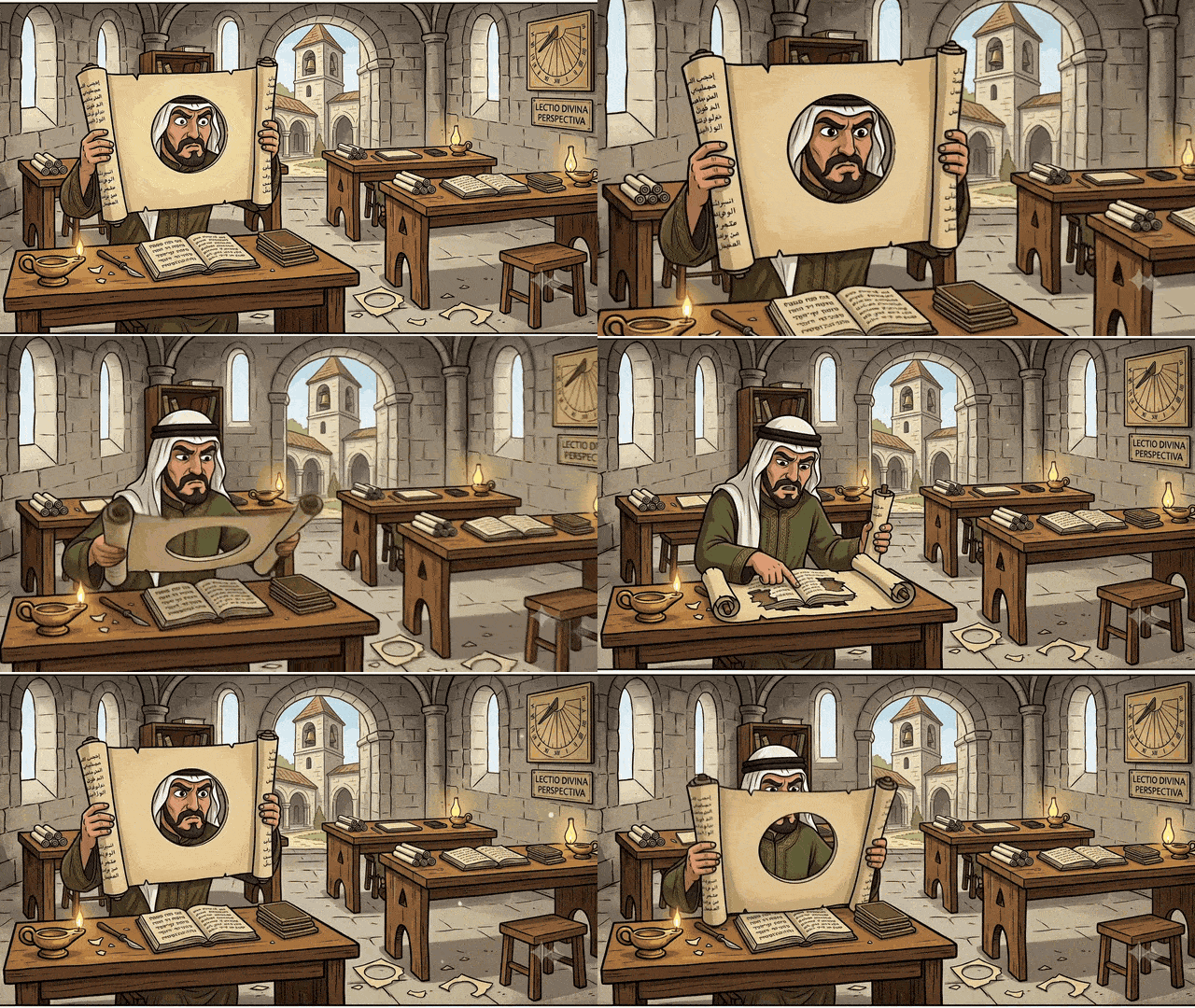
Without the Torah and the Injil, Islam has no covenant, no sacrifice, and no explanation for either.
By A. C. Rosenthal
Before anything else, I want to name what I respect, because an argument that begins in contempt has already failed.
The Quran’s insistence that God is one, uncreated, and utterly unlike anything He made is serious metaphysics, held with a consistency that shames much of modern religion. And its posture toward the earlier scriptures is more generous than most Christians realize. It does not sneer at the Torah. It calls it guidance. It does not dismiss the Gospel. It says the Gospel contains light. Whatever else is true, the Quran takes the prior revelation seriously enough to keep pointing at it.
What follows is not an attack on that posture. It is an attempt to take it at its word.
Here is a question that does not get asked often enough: if the Quran is the final, complete, and self-sufficient revelation of God, why does it assume you already know things it never explains?
Not minor things. Not peripheral details. The most fundamental things. The covenant between God and man. The meaning of sacrifice. Why blood is required. What it accomplishes. What the whole system is for.
The Quran references all of these. It never explains any of them. It speaks as though the reader already knows, because it was delivered to people who were steeped in the Torah and the Injil. Stripped of those foundations, the Quran is a building without a basement. It references a structure it did not build and cannot support on its own.
Start with what the Quran itself says about prior scripture. It does not claim to replace the Torah and the Injil. It claims to confirm them.
“And We have revealed to you the Book in truth, confirming that which preceded it of the Scripture and as a criterion over it.”
Quran 5:48“And We sent, following in their footsteps, Jesus the son of Mary, confirming that which came before him in the Torah. And We gave him the Gospel, in which was guidance and light.”
Quran 5:46“Say: O People of the Scripture, you are standing on nothing until you uphold the Torah, the Gospel, and what has been revealed to you from your Lord.”
Quran 5:68
The Quran is not shy about this. It tells its readers that the Torah and the Injil contain guidance and light. It tells the People of the Scripture they are standing on nothing unless they uphold them. It frames itself as confirmation of what came before, not replacement of it.
This creates an immediate problem for any Muslim who dismisses the Torah and the Injil as irrelevant or corrupted. The Quran itself disagrees with them. And the Quran is explicit that God’s word cannot be altered:
“There is no changing the words of Allah.”
Quran 10:64“And the word of your Lord has been fulfilled in truth and in justice. None can alter His words.”
Quran 6:115“Indeed, it is We who sent down the message, and indeed, We will be its guardian.”
Quran 15:9

If God’s words cannot be altered, and if the Torah and the Injil are God’s words, then the Torah and the Injil cannot be corrupted. The Quran nowhere says the texts were destroyed or replaced. It says people misinterpreted or concealed portions, which is a completely different claim. The books themselves, by the Quran’s own logic, remain under God’s protection.
Now here is where it gets serious. Open the Quran and search for answers to the most basic theological questions. Not peripheral questions. The ones that everything else depends on.
Why does sin create a debt that must be settled?
The Quran tells you sin is bad. It tells you God forgives whom He wills. It does not tell you why forgiveness requires anything at all, or what the moral logic is that makes the debt real. You will search the Quran for an answer and find references without explanation.
Why does God require blood?
The Quran references the Eid sacrifice commemorating Ibrahim’s willingness to offer his son. Then it explicitly says:
“Their meat will not reach Allah, nor will their blood, but what reaches Him is piety from you.”
Quran 22:37
The sacrifice accomplishes nothing. It is a gesture of piety. That is all the Quran offers. No mechanism. No logic. No explanation of why the system exists or what it is pointing toward. The Quran kept the ceremony and removed the meaning.
What is the covenant between God and man?
The Quran mentions covenants repeatedly. It references the covenant with the children of Israel, with the prophets, with humanity. It never explains the architecture of any of them. Why they were made. What they cost. What they accomplished. What happens when they are broken and who pays.
These are not small omissions. These are the load-bearing walls of the entire structure. Without them, you have commands without foundation and rituals without meaning.
The Torah, which the Quran calls guidance and which Allah commanded people to uphold, does not leave these questions unanswered.
From the very beginning, when Adam and Eve sinned, God himself made garments of skin to cover them (Genesis 3:21). Something died to cover their shame. This is not incidental. It is the first principle of the entire system: the consequence of sin is death, and covering requires a substitute.
The Torah is then explicit about the mechanism:
“For the life of the flesh is in the blood, and I have given it for you on the altar to make atonement for your souls, for it is the blood that makes atonement by the life.”
Leviticus 17:11
The Injil states the principle the Torah had been enacting for a thousand years:
“Without the shedding of blood there is no forgiveness of sins.”
Hebrews 9:22
This is not arbitrary. God is not squeamish about blood for its own sake. The principle is substitution. Life for life. The animal dies in the place of the person who should die. The debt is real, the penalty is death, and the system exists to demonstrate both the seriousness of the debt and the availability of a substitute.
If you value unflinching, historically grounded analysis that mainstream outlets soften or ignore, consider upgrading. Paid subscribers get:
Several new, full-length articles every week.
Carefully researched pieces you won’t find elsewhere.
Full access to the complete premium archive
Archive of in-depth writing, research, and commentary — all in one place.
Entry into the subscriber chat
A private space for serious readers and thoughtful discussion.
The covenant with Abraham makes this even more explicit. God made a covenant with Abraham by passing between the pieces of slaughtered animals alone (Genesis 15). In ancient covenant-making, both parties walked between the pieces, meaning both accepted the death penalty if the covenant was broken. God walked through alone. He was saying: if this covenant fails, let the penalty fall on me.
Comments
Nothing yet. Say the first thing.
Sign in to join the conversation.