
I learned it with toothpicks on a kitchen table, and nobody told me it had a body count.
The rules are simple enough that a child can follow them. Sit a number of people in a circle. Number them clockwise, one through however many you have. Person one kills person two. The next living person kills the next living person. Keep going around the ring, skipping the dead, until one is left.
That is the whole game. Now the question: if you knew the number of people in the circle before you sat down, which seat would you choose?
I want to say up front what I am and what I am not. I have no degree. What I have is a nail gun, ten trades, and somewhere north of thirteen hundred audiobooks, which means I have spent a great many hours on scaffolding with a dead Roman in my ear. That is not a credential. It is a habit. And the habit has one rule behind it, which is that when a story starts getting repeated confidently by people who have not read the source, the source is usually more interesting than the story.
That turned out to be true here in a way I did not expect.
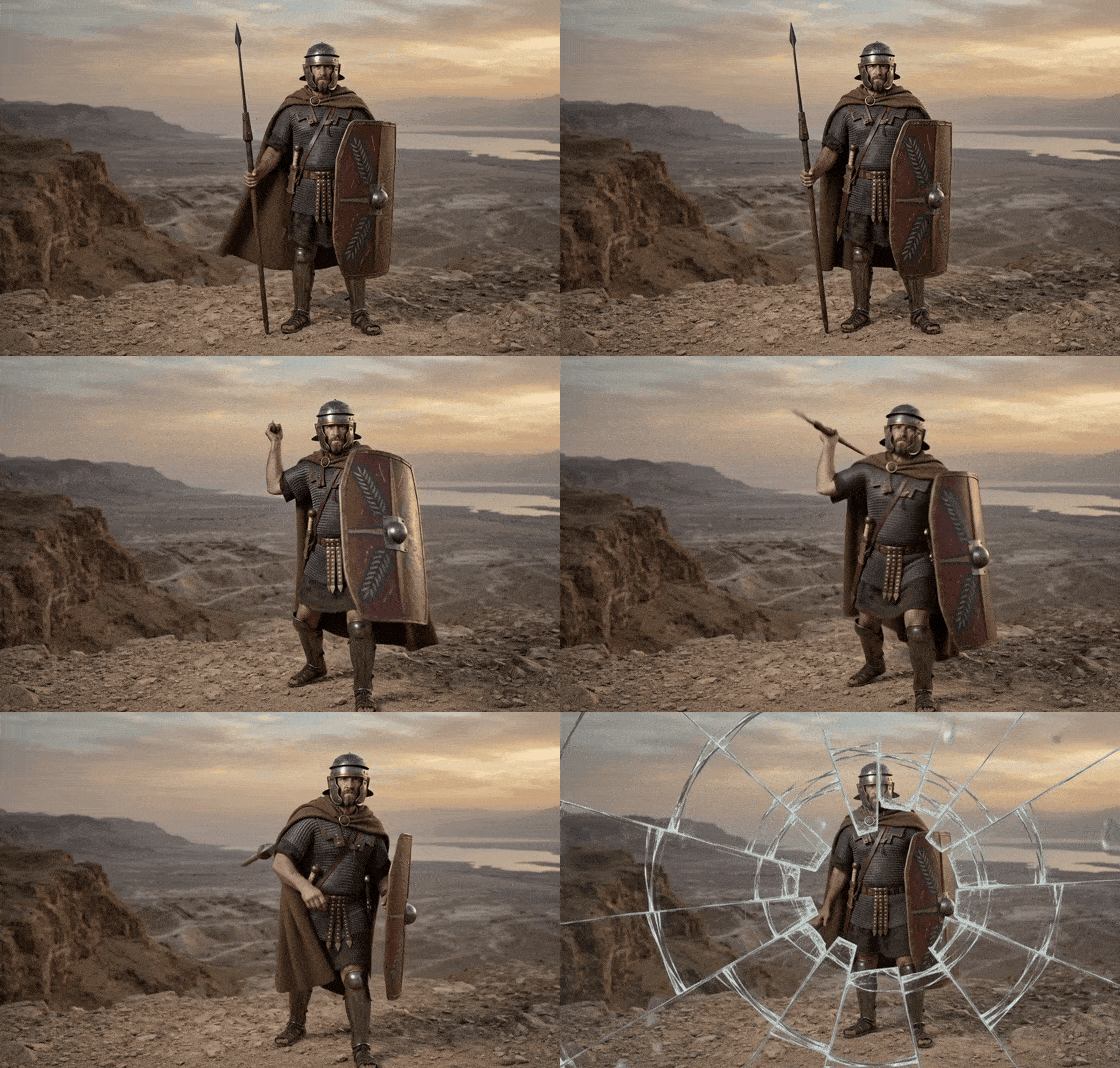
Because the puzzle has a name. It is called the Josephus Problem, and it is named after a man who was actually in a circle like that, in an actual cave, in the summer of AD 67, with the Tenth Legion outside and forty other men inside, all of them agreeing to die.
He is the reason we know almost anything about the war that ended the Jewish world of the Second Temple. He is also, in the tradition he was born into, one of the most disliked men who ever lived. Both of those are true at once, and holding them together is the beginning of this essay.
Let me say the good part first, because it is the part that gets skipped.
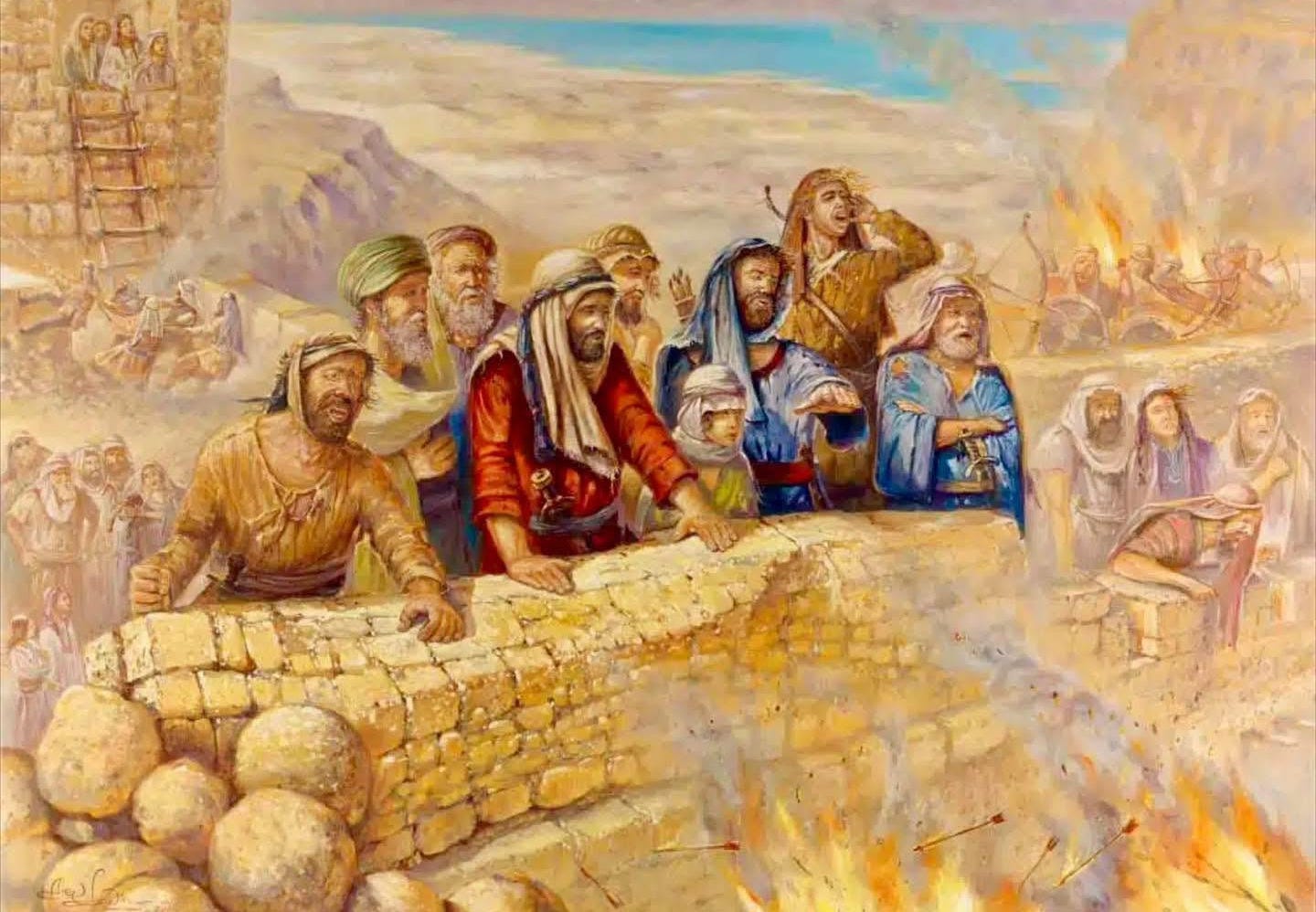
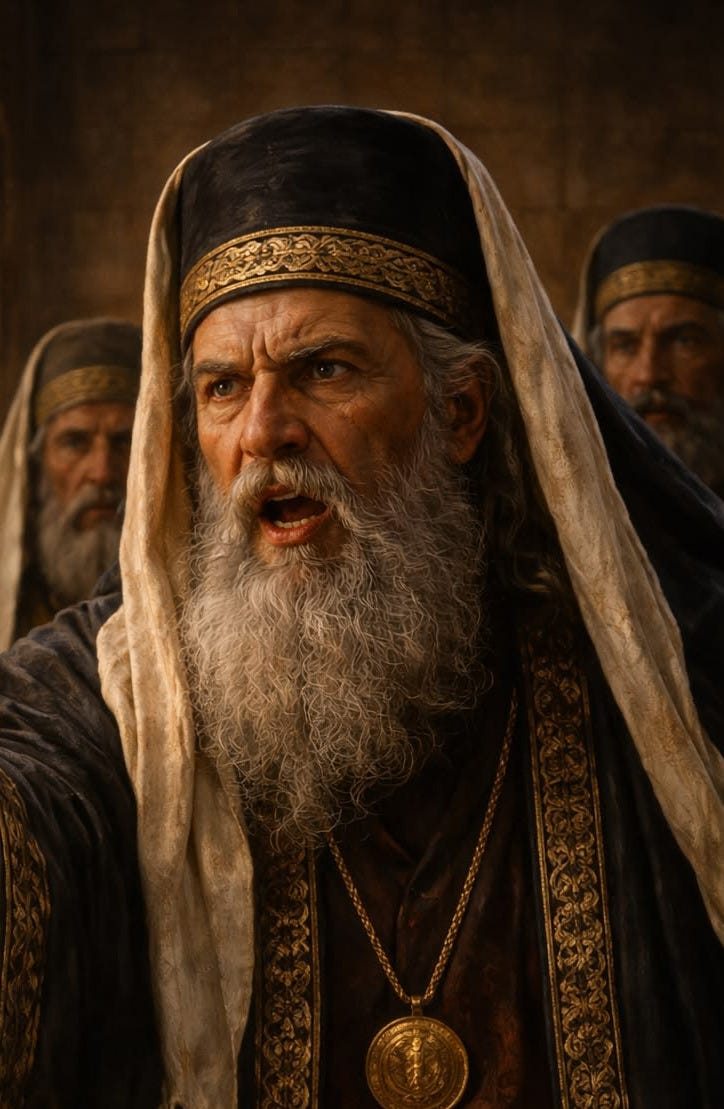
Yosef ben Matityahu was a priest from a distinguished Jerusalem family. He was appointed military commander of the Galilee by the revolutionary government at the start of the revolt against Rome, and by his own account he did not want the job, because he did not think the war could be won.
He was right. That is worth pausing on. In AD 66 the zealot faction in Jerusalem was telling the country that God would fight for them and Rome would break on the walls of the Temple. Yosef looked at the same situation and concluded that the legions would grind Judea into powder. The men who called him a coward for saying so were themselves dead within eight years, along with the Temple, the priesthood, the sacrificial system, and something close to the entire architecture of Jewish religious life as it had existed for six hundred years.
He was also, by any reasonable standard, a brave commander before he was a famous defector. He fortified the Galilean towns. He held Yodfat, also called Jotapata, a hilltop about thirteen kilometers northwest of Nazareth, for forty seven days against Vespasian in the summer heat with the water running out. Forty seven days. Rome took Jerusalem itself in about five months with the entire weight of the empire behind it. Yodfat was a village on a hill.
And when it was over, he wrote. He wrote the Jewish War. He wrote the Antiquities. Without him we do not have Herod’s building program in any detail, we do not have the Pharisees and Sadducees and Essenes described by a contemporary, we do not have the political texture of first century Judea, and we do not have the account of the last stand at Masada at all. Not a fragment. Not a rumor. The mountain would be a pile of stones in a desert with some Roman camps around it and nobody would know why.
Every Israeli soldier who has ever climbed that rock and spoken an oath at the top is speaking it because a man his tradition calls a turncoat sat down in Rome and wrote the story out.
I am not going to pretend that settles the moral ledger. He took the family name of the emperor who conquered his people. He wrote in a way that flattered his patrons. Reasonable people have called him a collaborator for two thousand years and the charge is not made up.
But I would ask you to hold on to one thing as we go, because it is the hinge of the whole piece: the man who walked out of the circle is the only reason we know about the people who stayed in it.
Here is what happened at Yodfat, told the way he tells it.
The town fell in July of AD 67, betrayed by a deserter who showed the Romans a weak point and a window of time. The slaughter was enormous. Josephus gives forty thousand dead across the whole siege and twelve hundred taken prisoner. Vespasian ordered the town razed and the forts burned.
Josephus got into a cave, or more likely a cistern connected to a cave, and found forty other survivors already there. The Romans were searching the hiding places methodically, and Vespasian in particular wanted the Galilean commander alive.
The forty had decided to die. Josephus argued against it, and here his account gets uncomfortable in a way I find weirdly credible: he says he made a case that self destruction was an offense against the God who gave the life, and the men in the cave were not persuaded, and they turned their swords toward him. The commander who wants to live is a problem for men who have agreed to die. He knew it.
So he proposed a system.
They would not kill themselves. They would draw lots, and go around in order, each man dying at the hand of the next, so that no man had to raise a blade against his own throat and no man could change his mind at the end and slip away while the rest lay cooling on the floor. It solved a theological problem and a discipline problem in one move. The men agreed.
The lots were drawn. The circle went around. And when the arithmetic was finished, Josephus was standing there with one other man alive beside him.
His own line about how that happened is one sentence, and it is a masterpiece of not answering the question. He says it was either fortune, or the providence of God, and he leaves the reader to pick. He does not say he cheated. He does not say he calculated. He does not say anything at all about how a man who argued hard against the plan happened to survive the plan.
Then he talked the last man into surrendering with him, walked out, and was brought before Vespasian, where he announced that Vespasian would be emperor. Two years later Vespasian was emperor. Josephus was released from his chains and spent the rest of the war attached to the Roman camp, shouting at the walls of Jerusalem in Aramaic, trying to get his countrymen to surrender.
They did not.
Now the math, because the math is genuinely beautiful and I do not want to rush past it.
Somewhere in the long history of this story, people stopped asking whether Josephus got lucky and started asking a better question. Forget the man. Take the circle as a machine. Given n people, where is the winning seat?
The version most people learn today comes from a Numberphile video with Daniel Erman of the University of Wisconsin, and the best thing in it is not the answer but the method, which he credits to a professor of his named Phil Hanlon. Hanlon’s advice was this: do not stare at the general problem. Gather data. Work small cases by hand until a pattern shows itself, and then, when you notice one small thing you are sure of, stop and prove that one thing, because proving the small certain thing usually unlocks the rest.
I want to flag that, because it is the same method I use on documents, and it is the same method I would defend against any expert who wants to skip it. Do not accept the summary. Run the case yourself. Then hold on to the one thing you actually verified and build outward from there.
So let us run it.
One person. Nobody to kill. Seat one wins.
Two people. One kills two. Seat one wins.
Three. One kills two. Three kills one. Seat three wins.
Four. One kills two, three kills four, one kills three. Seat one wins.
Five. One kills two, three kills four, five kills one, three kills five. Seat three wins.
Six. One kills two, three kills four, five kills six, then one kills three, five kills one. Seat five wins.
Seven. Evens go first: two, four, six. Then seven kills one, three kills five, seven kills three. Seat seven wins.
Eight. Two, four, six, eight go. Then one kills three, five kills seven, one kills five. Seat one wins.
Line them up:
People
Winning seat
1
1
2
1
3
3
4
1
5
3
6
5
7
7
8
1
9
3
10
5
The first thing anybody notices is that the winner is always odd. That one is easy to explain, and explaining it is the first real satisfaction of the problem: on the first trip around the ring, every even seat dies. If you are sitting in an even chair you are gone before the circle has completed a single revolution. Never sit in an even seat.
The second thing is the reset. The answers climb by two, one, three, five, seven, and then they slam back down to one. Look at where the resets happen. Two. Four. Eight. Sixteen.
Powers of two.
Here is the proof, and it is short enough to do in your head, which is what makes it satisfying.
Take sixteen people. Go around once. Every even seat dies. Fifteen kills sixteen, and now it is seat one’s turn again, and there are exactly eight people left.
Notice what just happened. You did not merely reduce the crowd. You reduced it by half, and you handed the knife back to the same person who started. Eight is a power of two, so do it again: all the evens on the new labeling die, four remain, and it is still seat one’s turn. Again: two remain, still seat one. Again: one remains, and it is seat one.
A power of two folds cleanly in half over and over, and the person holding the knife at the start of each fold never changes. Seat one wins every time, in every power of two, forever.
That is the small certain thing. Now watch it unlock everything else.
If you value unflinching, historically grounded analysis that mainstream outlets soften or ignore, consider upgrading. Paid subscribers get:
Several new, full-length articles every week.
Carefully researched pieces you won’t find elsewhere.
Full access to the complete premium archive
Archive of in-depth writing, research, and commentary — all in one place.
Entry into the subscriber chat
A private space for serious readers and thoughtful discussion.
Comments
Nothing yet. Say the first thing.
Sign in to join the conversation.