
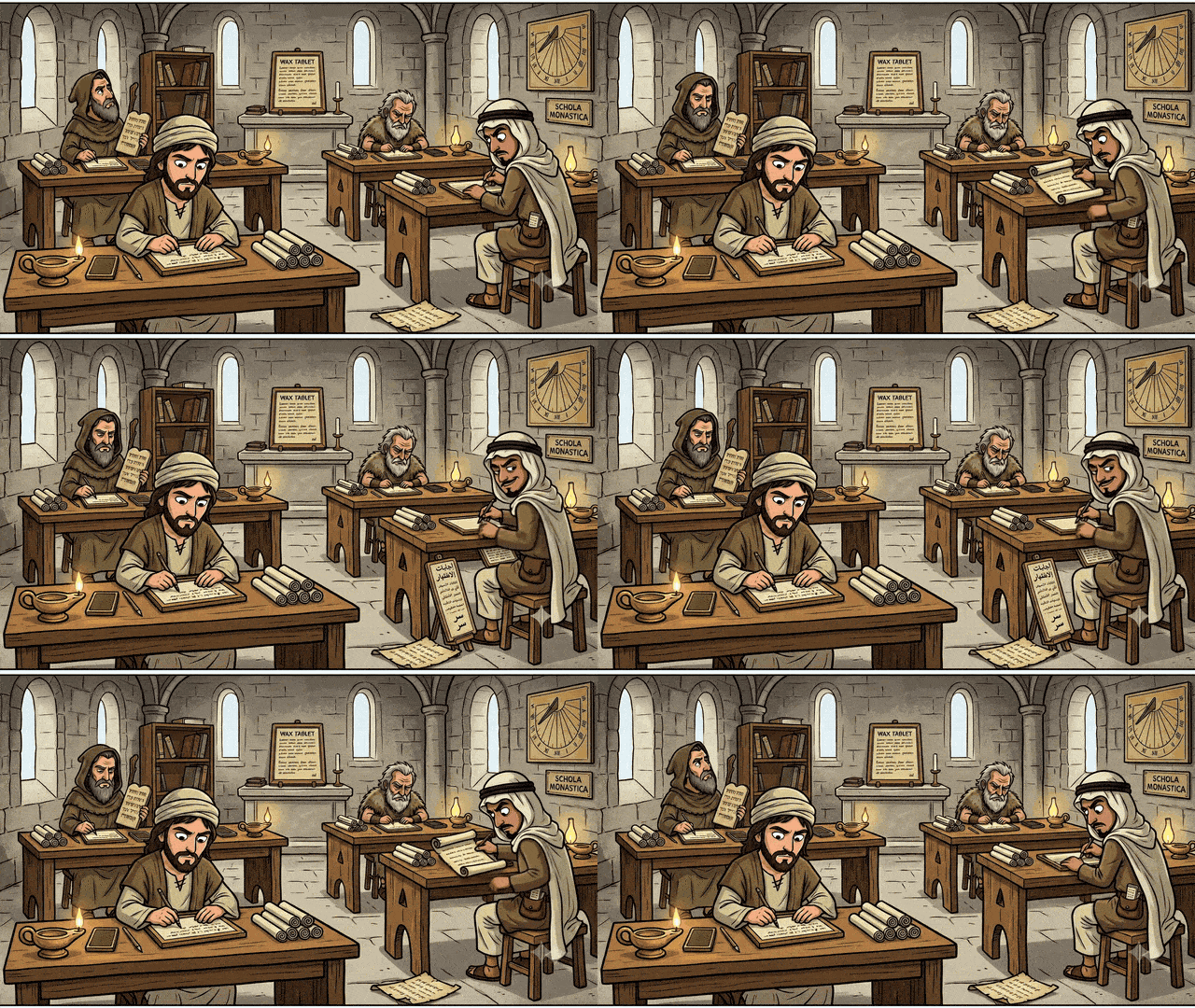
Muhammad came after the Messiah. He should have known more than all the prophets combined. He knew less than Isaiah.
By A. C. Rosenthal
Muhammad came after the Messiah. He should have known more than all the other prophets combined. He knew less than almost any of them.
Before the argument, let me say what I admire, because a man who cannot name the good in a thing he examines has not understood it.
The Quran’s reverence for Jesus is real and it is striking. It calls him the Messiah. It affirms the virgin birth in language of genuine tenderness. It records his miracles without embarrassment. In a seventh-century Arabian context saturated with idols, it insisted that this man was sinless, that he was raised to God, that he will return. No other non-Christian scripture on earth honors him so highly. Muslims who love Jesus are not confused about whether he matters. They have been taught to hold him in high regard, and they do, and I have never met one who did not speak his name with care.
That is precisely why the question that follows is worth asking. It is not asked in contempt. It is asked because a book that honors him this much ought to be able to tell you why.
There is an argument hiding in plain sight that almost nobody makes, and it is one of the most structurally devastating questions a person can ask about Islam’s claim to be the final and complete revelation of God.
Here it is in its simplest form.
The prophets of the Hebrew scriptures, Moses, David, Isaiah, Jeremiah, Ezekiel, Daniel, Zechariah, and the rest, came before the Messiah. They had never met him, never heard him teach, never seen the cross, never witnessed the resurrection. They were working from shadows, types, and glimpses of something that had not yet happened. And yet they knew an enormous amount about who he was, what he would do, and why it mattered.
Muhammad came after all of it. He lived six centuries after the Messiah walked, taught, died, and rose. He had access, at minimum, to communities that carried the Injil. The Quran itself confirms that the Injil existed, that it contained guidance and light, and that God’s word cannot be altered. Muhammad was the only prophet in history who arrived after the central event of all prophecy had already occurred.
He should have known more about Jesus than all the previous prophets combined. They had shadows. He had the substance. They had the promise. He had the fulfillment. They had the types. He had the reality.

So why does the Quran know less about Jesus than Isaiah did?
Consider what the Hebrew prophets knew about the Messiah centuries before he arrived, working with nothing but the Spirit of God and the unfolding covenant narrative.
Isaiah, writing roughly 700 years before the cross, described it in detail:
“He was pierced for our transgressions; he was crushed for our iniquities; upon him was the chastisement that brought us peace, and with his wounds we are healed. All we like sheep have gone astray; we have turned, every one, to his own way; and the Lord has laid on him the iniquity of us all.”
— Isaiah 53:5-6
“He was oppressed and he was afflicted, yet he opened not his mouth; like a lamb that is led to the slaughter, and like a sheep that before its shearers is silent, so he opened not his mouth.”
— Isaiah 53:7
“Yet it was the will of the Lord to crush him; he has put him to grief; when his soul makes an offering for guilt, he shall see his offspring; he shall prolong his days; the will of the Lord shall prosper in his hand.”
— Isaiah 53:10
If you value unflinching, historically grounded analysis that mainstream outlets soften or ignore, consider upgrading. Paid subscribers get:
Several new, full-length articles every week.
Carefully researched pieces you won’t find elsewhere.
Full access to the complete premium archive
Archive of in-depth writing, research, and commentary — all in one place.
Entry into the subscriber chat
A private space for serious readers and thoughtful discussion.
Comments
Nothing yet. Say the first thing.
Sign in to join the conversation.