
I recently read Shamanism: The Timeless Religion by Manvir Singh, a rigorously researched book about how healing practices emerged across cultures long before modern medicine. One chapter asks a quietly provocative question: Was Jesus a shaman? Not in a mystical or New Age sense, but in a functional one as someone who healed through authority, ritual, social meaning, and presence, operating centuries before germ theory, imaging, or randomized trials.
That question stuck with me, but transfigured into a satirical version about the way modern American healthcare measures value: If Jesus practiced in a modern, insured American healthcare system, what would his coding and billing look like? What follows is a facetious but methodologically earnest attempt to answer that question.
If you read the four Gospels clinically, setting theology aside for a moment, you find a surprisingly concrete case mix: paralysis, blindness, chronic hemorrhage, seizures, psychosis, edema, musculoskeletal deformity, and a few extremely high-acuity cases involving apparent death.
So, I asked: what is the collective value of his narrated healing episodes? In other words, if you treat each episode as a discrete clinical encounter, mapping the phenomenology (not the supernatural claim) to modern ICD-10 syndromes, assigning contemporary Evaluation and Management (E/M) CPT codes as a proxy for time and cognitive work, and applying 2026 CMS work RVUs (wRVU), what would Jesus’ total come out to?
Study Design: This is a retrospective narrative review of the four canonical Gospels (Gospel of Mark, Gospel of Matthew, Gospel of Luke, and Gospel of John) integrating original-language nuance (Hebrew/Aramaic terms as mediated through Greek), Second Temple Jewish context, modern medical pattern recognition, and narrative reliability (multiple attestation vs symbolic storytelling). This analysis was conducted with the assistance of ChatGPT, which was used to systematically identify and map Gospel narratives to modern ICD-10 and CPT codes and calculate aggregate wRVUs. All assumptions and framing choices were reviewed and curated by the author.
Definition of healing: Included healings, exorcisms, and resuscitations, but excluded nature miracles (water to wine, walking on water) and provisioning miracles (loaves and fishes).
Unit of analysis: Each narrated healing episode counted once. Parallel accounts across different Gospels were collapsed into a single encounter. Vague summaries like “he healed many” were treated as one clinic session, not one bill per patient.
Diagnosis mapping: ICD-10 codes reflect best-fit modern syndromes based on described signs and symptoms, not claims about etiology. “Demon possession” is mapped to contemporary neurologic or psychiatric categories where appropriate.
CPT selection: Office/outpatient E/M codes (99212–99215, 99204–99205) were used as time/complexity proxies, based on narrative detail and interaction length. Apparent deaths were mapped to critical care (99291) as the closest modern analogue.
RVUs: 2026 CMS work RVUs were used. No procedures. No modifiers. No facility fees. No inflation adjustment for first-century Judea.
This is satire, but it is methodologically robust satire.
Across 28 distinct narrated healing encounters (Table), Jesus totaled 68.27 wRVUs with a total estimated clinician time of ~16–23 hours.
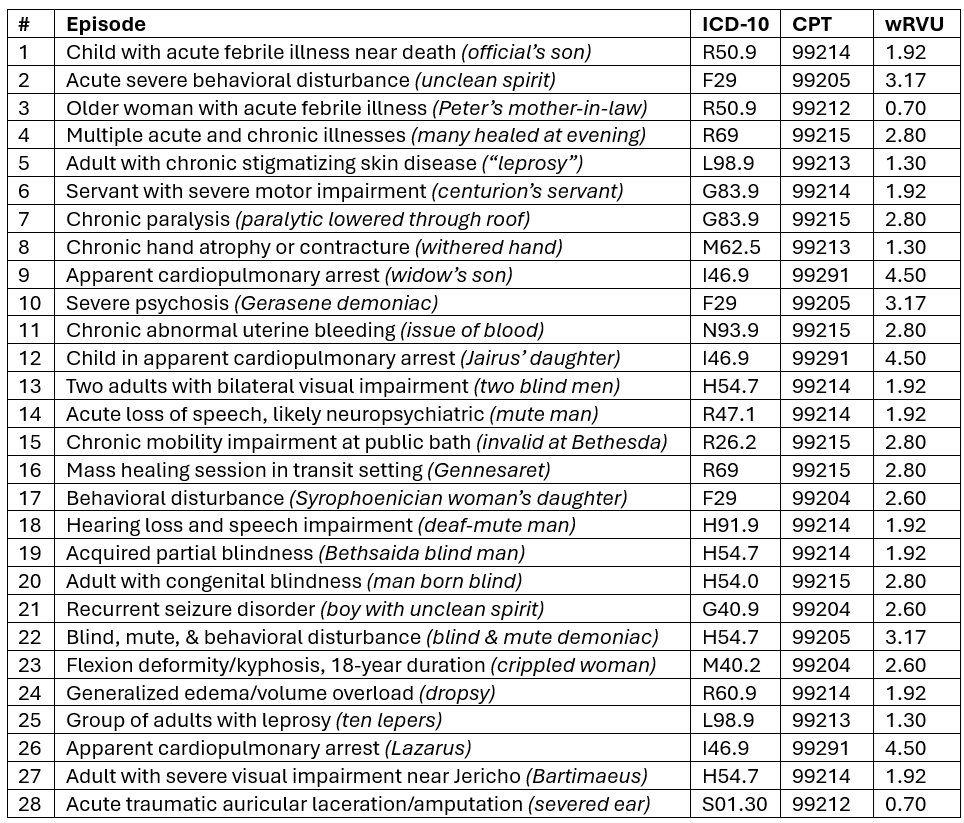
If even the most consequential healer in Western history barely exceeds 68 wRVUs, that may say more about the metric than the medicine. Three lessons follow. First, our system rewards billable inputs more reliably than meaningful outcomes. As long as the diagnoses and codes are equivalent, miraculous healing and snake oil salesmanship are not distinguishable in the logic of reimbursement. Second, much of the real work in these encounters—listening, judgment, reassurance, authority conveyed through presence—is precisely the kind of cognitive and relational effort that modern payment systems devalue relative to procedural labor. Third, our inability to measure what matters most is not a reason to overvalue what is merely easiest to count. The worth of clinicians is not captured by what can be coded and billed, but by what actually heals, restores dignity, and changes lives.
The first two commenters raised important critiques. Commenter 1 appropriately questioned the use of “established” CPT codes. Commenter 2 astutely recognized that in real world practice, time-based billing would be used. To address these thoughtful critiques, I have now added two sensitivity analyses.
In the first sensitivity analysis, I assumed that every narrated healing encounter was for a new patient rather than an established one. This remapped office visit codes from 99212–99215 to their new-patient analogues 99202–99205, while leaving encounters already coded as 99204, 99205, or 99291 unchanged. Under that assumption, the total rises from 68.27 to 79.27 work RVUs, a 16.1% increase, and the implied total clinician time rises from roughly 16–23 hours to 21–29 hours. In other words, even granting Jesus a practice full of exclusively new patients only modestly improves the billing picture.
In the second sensitivity analysis, I assumed all encounters were billed strictly by time and that Jesus documented a reasonable high-end reimbursable time for each visit. In this sensitivity analysis, I assumed every healing encounter that could legally take a prolonged-time add-on received three additional add-on time codes. That means coding all qualifying office visits as either 99215 + G2212 x3 or 99205 + G2212 x3, and all resuscitation-like encounters as 99291 + 99292 x3. Under that assumption, the total rises from 68.27 to 104.99 work RVUs, with an implied 34–38 hours of documented clinician time depending on whether one uses the minimum or upper end of the qualifying time bands. Even in this deliberately generous scenario, the billing yield remains modest relative to the cultural and moral weight of the underlying acts.
No posts
Comments
Nothing yet. Say the first thing.
Sign in to join the conversation.