
Resmetirom, a novel liver-specific thyroid hormone receptor-β agonist, received accelerated FDA approval in March 2024 for the treatment of metabolic dysfunction-associated steatohepatitis (MASH). The approval was based on the MAESTRO-NASH randomized controlled trial which showed that resmetirom improved liver scarring (fibrosis) when a sample of liver tissue was viewed under the microscope (known as histologic improvement).
The liver community was quick to embrace Resmetirom. In October 2024, the American Association for the Study of Liver Diseases (AASLD) issued expert practice guidance on its use. In 2025, a team of liver specialists (hepatologists) published their early experience of treating 110 patients.
But even as resmetirom entered practice and was warmly embraced by the hepatology community, a different story was already unfolding.
The figure below shows findings on the same surrogate endpoint of MASH resolution from three randomized trials for three different drugs.
Which drug would you choose before you even know the names?
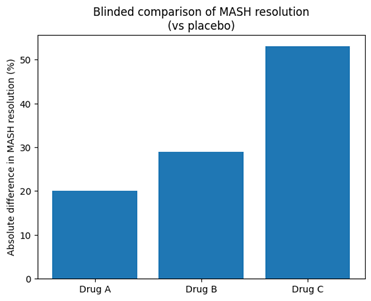
When the MAESTRO-NASH trial was published in 2024, it felt transformative. About 30% of patients experienced resolution of the active inflammation from MASH without worsening of liver scarring versus just 10% of the placebo group (Drug A in the figure above).
Furthermore, about 11% more participants in the resmetirom group showed less liver scarring by at least 1 stage on a 5-point scale (25% vs 14% of the placebo group).
Even without showing improvement in patient-centered outcomes, like symptoms from end-stage liver disease (cirrhosis), liver cancer (hepatocellular carcinoma), or living longer, FDA approval made sense. MASH had no therapies beyond the elusive lifestyle modification (aka diet & exercise).
Any credible benefit mattered. But even then, the writing was already on the wall.
Weight loss is critical for preventing and treating MASH given that morbid obesity is the main culprit for the ensuing inflammation and scarring. Diet and exercise have long been the cornerstone of therapy. Unsurprisingly to anyone who has tried, or even contemplated a New Year’s resolution to become healthier, behavior change is hard, and meaningful weight loss is uncommon. Enter GLP-1 receptor agonists, or GLP1s for short.
Over a decade of research has convincingly shown enormous weight loss (pun intended) with GLP1s (including for the newer dual and now triple agonists). This is of course largely if people stay on the medication. Several smaller trials dating back to 2020 (see this NEJM trial) also showed compellingly high rates of resolution of MASH and signals for fibrosis improvement.
So when two large confirmatory trials arrived just after MAESTRO-NASH, they didn’t surprise anyone paying attention.
SYNERGY-NASH in 2024: Tirzepatide (Drug C above) showed an absolute 53% greater MASH resolution vs placebo with fibrosis improvement in 20% more participants.
ESSENCE published in 2025: Semaglutide (Drug B above) showed an absolute 30% improvement in MASH resolution vs placebo, with fibrosis improvement in 14% more participants.
These weren’t incremental gains. Resmetirom may have secured FDA approval first, but GLP1s won the game on the same surrogate outcome, by quite a large margin.
Yes, improvement in inflammation and fibrosis are surrogate benefits which do not necessarily improve human flourishing. We’re still waiting for evidence of improvement in clinically meaningful liver outcomes that translates to living better and longer. This is why resmetirom received accelerated approval instead of full approval. But here’s what matters even more.
GLP1s not only outcompete on the same surrogate endpoint but they also substantially reduce weight, save lives, reduce heart attacks & strokes, treat type 2 diabetes, slow kidney disease progression, lessen arthritic pain, & treat sleep apnea.
Resmetirom, to a lesser extent, improves a liver biopsy endpoint and does none of the above.
In a disease defined by multisystem metabolic risk, choosing an inferior liver-specific drug over a more effective MASH drug with widespread cardiometabolic proven clinically meaningful outcome benefits requires extraordinary justification.
Resmetirom isn’t just less effective, it’s far more expensive.
The list price for Resmetirom is $4,000/month list price, with monthly copays of $1,000–1,400.
Yes, GLP-1s are still expensive, but a fraction of the cost, with copays often in the hundreds or less, and falling.
Resmetirom is inferior on histologic improvement in inflammation and fibrosis, inferior on outcomes that actually matter, and more expensive. Game, set, match.
No posts
Comments
Nothing yet. Say the first thing.
Sign in to join the conversation.