
I once cared for a woman with end-stage cirrhosis and massive ascites. Her abdomen was so distended it made breathing uncomfortable. The standard playbook is simple: drain the fluid and start diuretics to keep it from coming back.
But her sodium was chronically low at 128, low enough to portend poor prognosis in cirrhosis. With diuresis, it fell further into the mid-120s. She felt fine. She urinated more, which over time, would decrease her abdominal swelling. But her hepatologist worried we were trading short-term relief for long-term harm, potentially increasing her risk of death by worsening her hyponatremia.
So we stopped the diuretics and focused on optimizing her sodium instead. I would normally do the opposite. But since I was not going to care for her after she left the hospital, I deferred to her hepatologist who will be calling the shots after her discharge. I’ve long wondered whether that was the right call.
Hyponatremia is a classic hospital medicine conundrum. When it’s acute and symptomatic, such as nausea, confusion, and seizures, the decision is clear: correct it. But most cases aren’t like that. They’re chronic, asymptomatic, and often stem from complex, advanced disease.
Still, the reflex is powerful. You see a sodium of 124 and immediately ask: what’s the cause, how fast should I correct it? We treat it like a problem to fix. But what if it isn’t the problem at all?
Chronic hyponatremia is consistently associated with worse outcomes, including higher mortality, more readmissions, and functional decline.
The association is strongest in conditions where hyponatremia emerges late, such as advanced heart failure, cirrhosis, malignancy. In these settings, low sodium reflects a common physiology of systemic vasodilation, reduced effective arterial blood volume, and/or maladaptive neurohormonal activation driving water retention. In other words, hyponatremia is typically downstream of physiologic stress, not upstream of it.
That distinction matters. Our treatments, including fluid status manipulation, diuretics, and salt, primarily adjust water and sodium balance. They do not reverse the underlying disease processes driving the hyponatremia.
So the key question remains unsettled: Is hyponatremia causing harm, or simply a marker of it? Observational data cannot answer that.
Against this backdrop, a new pragmatic, international, multicenter RCT was published in NEJM Evidence. The trial enrolled 2,173 hospitalized adults across nine European centers with asymptomatic hyponatremia <130 mEq/L (I doth protest mmol/L).
They excluded patients with symptoms requiring urgent correction and those near the end of life, including the patients with the utmost advanced cirrhosis. Hyponatremia could develop at any point during hospitalization. So strictly speaking, “chronic” may not be in the physiologic sense, but consistent with the greater than 48-hour convention often used clinically.
Patients were randomized to either targeted sodium correction or usual care, the latter nominally guided by European guideline recommendations but ultimately left to the treating physician.
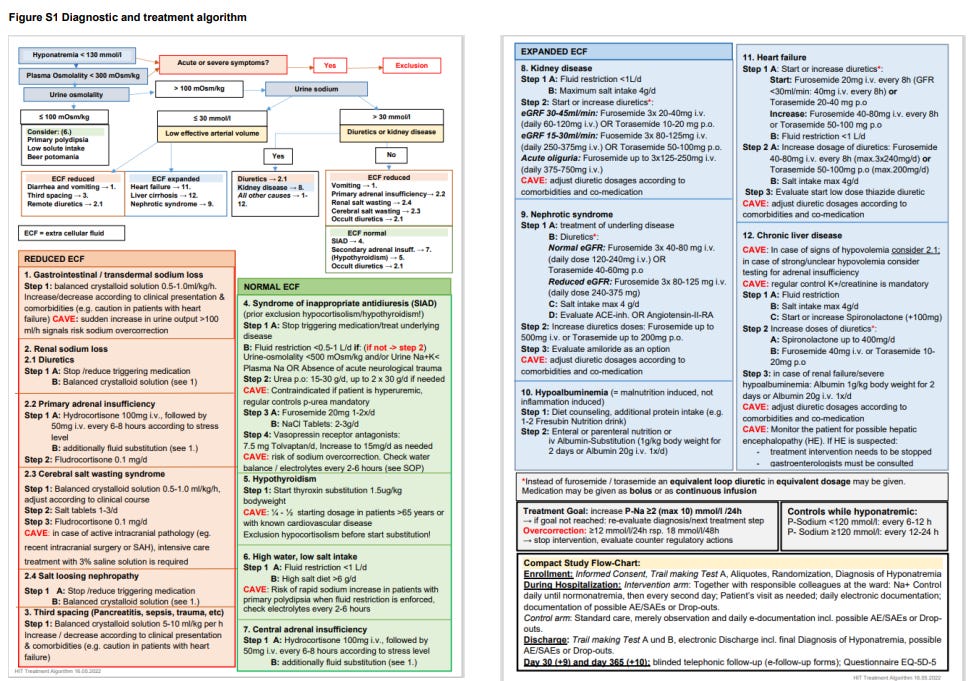
The intervention arm followed a detailed, consensus-based diagnostic and treatment protocol as captured in a dense, two-page figure (see below merely for its complexity). Despite standardization, it remains complex and highly subjective, mirroring real-world practice where diagnosis, treatment choice, and adjustments vary across clinicians.
This is notable for two reasons. First, it highlights an inherent limitation: unlike oncology or cardiology trials, there is no clean, reproducible intervention algorithm. Second, it’s a reminder of how cognitively demanding hospital medicine is (see Oanh’s AAOx2 post on hospitalists’ expertise). Hyponatremia is rarely the only problem, and often not the main one. yet it demands considerable cognitive bandwidth.
The primary outcome was a composite of death or readmission, questionably equivalent endpoints, but not unusual. The secondary outcomes were appropriately exhaustive and included a few notable ones: 30-day recurrence or persistence of hyponatremia, quality of life, and neurocognitive function at discharge. The former assesses the sustainability of the more intensive protocolized intervention group. The latter two aim to capture subtler, but still meaningful outcomes that mortality and readmission miss.
The enrolled patients look like the ones I actually treat: older, multimorbid, with high rates of cancer, heart failure, and liver disease. Nearly half were euvolemic, and a quarter developed hyponatremia in the hospital—so not “chronic” in the way I often consider it.
As expected, the intervention group received more treatment: more fluid, less fluid, and various adjuncts. In other words, more effort directed at improving the sodium.
It worked, modestly. Sodium rose in both groups, but about 1.3 mEq/L more in the intervention arm, with 14% more patients reaching eunatremia (60% vs 46%). The intervention did what it was designed to do: it moved the number. Though notably, usual care also moved the number because usual care already targets hyponatremia.
The separation persisted at discharge (56% vs 37% eunatremic), but it didn’t last. By 30 days, hyponatremia recurrence or persistence was nearly identical (42% vs 41%).
So what did we get for this transient ~3-week improvement in sodium?
Nothing. No difference in death, readmission, length of stay, falls, fractures, quality of life, or neurocognitive function.
A modestly improved number, without a better outcome.
You don’t boil the ocean in a single study. Before overcorrecting our interpretation, a few caveats matter.
First, a quarter of patients had hospital-acquired hyponatremia, so were not truly chronic. This likely dilutes relevance to the patients we worry about most, but also probably doesn’t change the message.
Second, the intervention is complex, because medicine is. The protocol depends on subjective assessments and clinical judgment, so fidelity inevitably varies. Eunatremia rates ranged from 30–70% across centers. One can reasonably assume similar variability within centers. This kind of heterogeneity biases toward the null, potentially masking a real effect.
Third, the treatment effect was modest and transient, on the order of weeks. By 30 days, sodium levels converged. If sustained correction is required to improve outcomes, this design may underestimate benefit. But there’s two fundamental issues. First, the underlying physiology driving hyponatremia remains unchanged. Second, the reflexive act of correcting sodium levels is methylated in a hospitalist’s DNA epigenetically from years of training and practice. So, the usual care arm, with these deeply ingrained habits, drifts closer to the protocolized intervention arm over time, and again, biases findings towards the null.
Despite these challenges, this trial is a breath of fresh air. It directly challenges a deeply held assumption: that correcting hyponatremia improves outcomes.
The next, more uncomfortable step would be to randomize against unusual care of doing less, or frankly, even nothing, in asymptomatic patients. If there was a Polymarket on this, I would bet on conservative management.
For my patient with cirrhosis, this trial shifts the needle slightly to corroborate my worry: that prioritizing sodium over symptom relief was ill advised.
For my own practice, I’ll still tepidly correct chronic hyponatremia, especially when the physiology is reversible.
But when it’s not, I’ll be more comfortable leaving the number alone—treating it as a prognostic marker, not a therapeutic target—and redirecting effort toward interventions that actually help people liver longer or feel better.
No posts
Comments
Nothing yet. Say the first thing.
Sign in to join the conversation.