
It’s funny how things just happen. Last week felt like complete chaos – everything under construction, jackhammers yammering, truck drivers hurling invectives at tourists on e-bikes, everyone still at work getting mad at each other, all desperate to get out of Paris in the heat – and suddenly it is the middle of August, the heatwave has broken, and the city has emptied out. This morning I went to the bakery and they seemed shocked and relieved to see another human being. You can literally hear crickets at night. When the hell can you hear crickets in a big city? Silence – it’s amazing.
Everyone’s been posting on Instagram about how it’s the twilight of summer and they have to milk the syrupy peach of it for all it’s worth. This had me a bit bummed as I felt I hadn’t had much of “a summer,” since I’ve basically been stuck here working the whole time, because summer is tourist season, and I’m a tour guide now. Although the concept of “summer” is perhaps one of capitalism’s great advertising feats, in that it produces an anxiety about having to live life to its fullest for this one period of the year, but you are not being sold anything specific, just the general concept of the pursuit of pleasure – be it beachtime, hotels, eclipses, spritzes on the Italian riviera, or travel to remote hiking locations – that, no matter what it is, is sure to involve throwing money around. Or maybe I am just being curmudgeonly. Regardless, now that it’s quiet here, I feel like it’s only just begun. Summer is just when everything’s dead in Paris.
People often ask when the best time to visit the city is (sorry if I’m starting to sound like a tour blog), and one of the answers people like to give is rentrée, or back-to-school season. There are entire articles in the New York Times about how this is a magical period, when everyone is freshly returned from vacationing at the same crammed beach resort they always pile into, and they are ready to put on their suits and scarves, whip out their backpacks or briefcases, and get back to business.
The notion that the best time to see a place is when everyone in it is bustling around frantically re-adjusting to life as part of the workforce strikes me as tragic at best. It reeks of some sort of twisted protestant-ethic perversion. But what do I know? I suppose there is probably an argument to be made that people actually ~like~ their lives of indentured servitude to the workplace, or at least the return to a normal rhythm of life that it provides – and maybe, specifically, that the people of this city like that. More on this later.
The other problem with the notion the rentrée period is a charmed one is that this hinges on an association with crisp fall days, light rains, wet leaves on the ground, a chill in the air. I remember growing up and feeling those things, but long gone are the days when this was the vibe. Now, it’s a furnace ‘til October. People get back and they are pissed off because the traffic goes right back to being terrible, none of the construction is anywhere near being finished (despite that being the whole point of doing it in August), it’s 300 degrees, and now they have to work, too. So, no. For me, the best time to be in Paris is exactly August 15th – the real ass-end of summer, when everyone is gone except for a few lost-looking tourists, half the shops and museums are closed, the few people who remain know there’s no point in making a show of looking busy or trying to dress up because there’s nobody around to witness such a performance, and you fall into a sort of time warp.
Anyway, I’ve been trying to read Louis-Ferdinand Céline’s Journey to the End of Night again this summer. It’s my third time trying to read this book. It’s one that I often think of embarking on as a ‘summer project’ (the same way I think about re-embarking on Proust just about every year), because despite being “only” about 500 pages long, the book feels like a real project-read to me.
It’s funny your relationship to certain books.
The first time I tried to read Céline was, I think, in 2013. I remember that at the now-legendary Mellow Pages Library in Brooklyn I had taken the book out while my good friend and roommate Jordan was volunteering as librarian. At the time Mellow Pages did this clever thing where they would post a picture of any book that was taken out – and of the person who was taking it out – onto Facebook, Tumblr and Instagram. (This was back in the day when Facebook & Tumblr still had any sort of currency.) Often the person would then repost the picture and this would of course help increase the library’s reach & renown.
The day I took that book out, Jordan and I had been having some dumb argument about the relative importance of French vs. American literatures. We loved to have opinions about literatures we were ostensibly knowledgeable about (we were fresh out of university, he’d studied postmodern American lit., and I had studied… whatever the fuck I’d studied). Jordan was trying to read something American and postmodern as usual, I think it was William Gaddis’s The Recognitions, and so I decided to take out Céline, which I had been meaning to read for years already at the time. Jordan posted a photo of me with the caption, Well, it’s no Recognitions, but today Oscar is taking out Céline’s Journey to the End of Night. To my absolute delight, fellow Zona Motel contributor Scott Mclanahan promptly commented on the post something to the effect of, That book blows The Recognitions right out of the fucking water! I remember feeling this dual jolt of patriotic fervor and satisfaction in the confirmation that my supposed literary proclivities were superior to that of my friend’s – I felt that pride radiate right from my pelvic floor and go reverberating all the way up into my chest. And so, I promptly went home and barely even cracked the book open.
(I think this may have been in part because the library’s copy was in English, and I was too proud to read the book in translation – I can’t be sure though, because I have failed to find this picture in the Mellow Pages online archives, so it is possible I just made the entire episode up in my mind.)
The second time I tried to read it, I don’t remember what happened exactly. I spotted a copy in French somewhere and I think it slowly disintegrated inside my tote bag where I carried it around for months without ever getting more than a few pages in.
I suspect that this is at least in part due to the fact that, I am embarrassed to say, I find Céline’s prose in French quite challenging. But at the same time, I would be too ashamed to read it in translation, precisely because I find it difficult. I blame this struggle on the fact that I have no French grandparents who would’ve taught me the way people might have talked nearly a century ago. The Journey is written in a very “how people actually talk” sort of way. As a result, it is full of the sort of slang (or ‘argot’) that people would have used around the time of the First World War, which is the period of time it spans. This means I am constantly either reaching for the dictionary (i.e. googling it) or ignoring any words I don’t understand and hoping I’ve gotten enough of the jist to power through. Unfortunately, I have an obsessive streak, so I never find the latter option very satisfying and wind up going back to words that bothered me and re-reading entire passages again and never being sure exactly where I left off. In short, it wears me out, as I am taken out of the ‘flow’ of the book, and so even though many parts of it are thoroughly enjoyable, I find the task of reading the whole thing somewhat sisyphean.
This also means that I frequently get distracted by ‘sidequests’ – such as, most recently, Nightboat books’ reissue of David Wojnarowicz’s story collection Memories that Smell like Gasoline, about cruising & dying of AIDS, which I sort of guiltily inhaled – guiltily because I remember several peers seemed annoyed by its design and to view its whole reissue as a bit of a money-grab, but I thought when else am I going to read this weird random out-of-print thing, so when I saw a copy I snagged it and read it in one sitting (though to be fair it is so short it almost challenges the notion of what a book is).
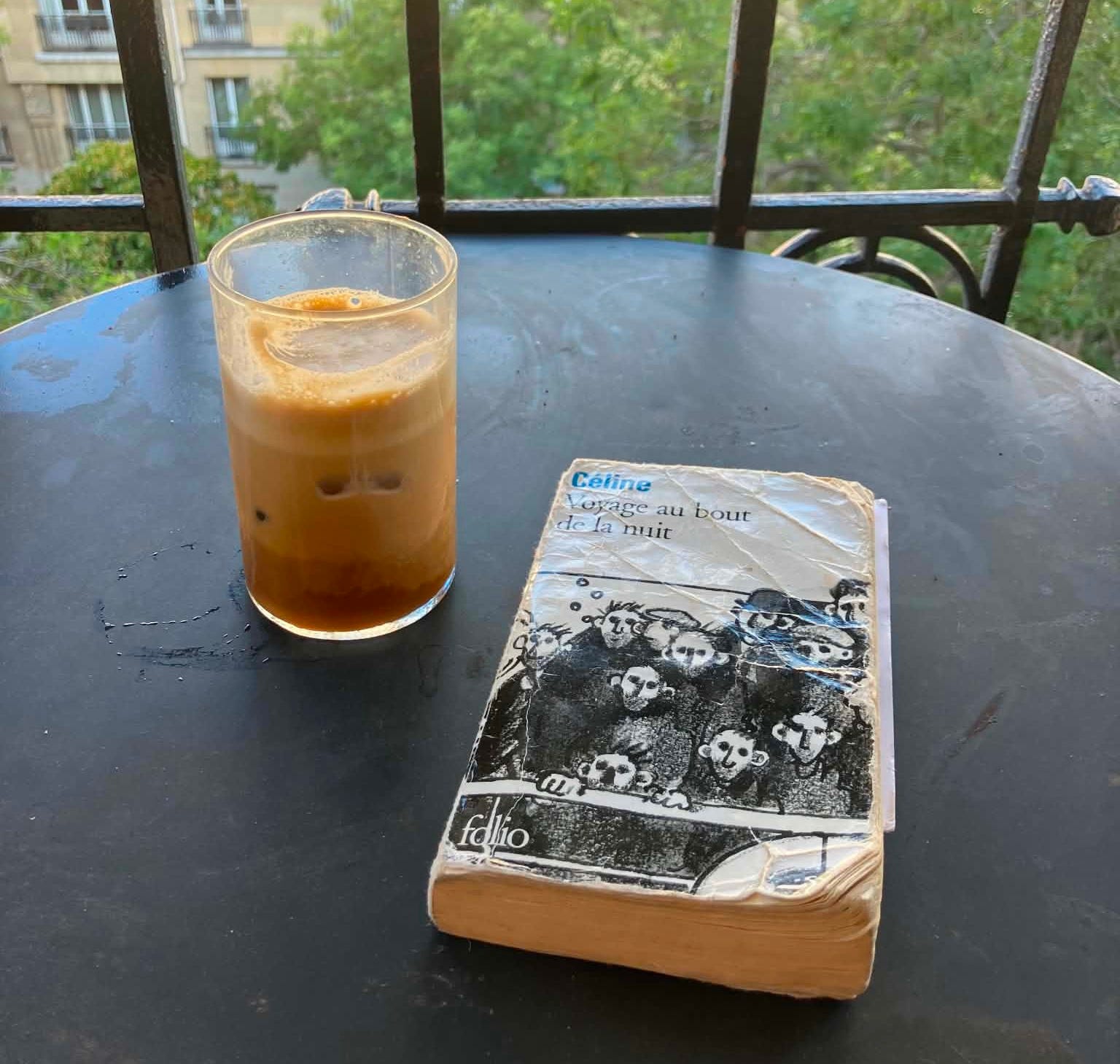
The reason I’ve chosen this summer specifically to read Céline’s Journey, however, and to get over this mental block I have with it, is because I am trying to write a book about being a tour guide in Paris. His book has nothing to do with being a tour guide. It is about being a soldier in World War I and, more specifically, about feeling like one of many nameless faces being flung like so many hunks of fresh meat at enemy lines, and about the sort of mass hysteria that can sometimes grip entire nations, like when everyone becomes convinced it is their god-given duty to butcher, be butchered, or send someone off to be butchered, and that the deaths that ensue are somehow beautiful and moving and altruistic. In short, it is about how people have a habit of coming together and going insane. In theory this has nothing at all to do with my book. I am reading it more for the vibes: because underneath this ostensible theme lies the thesis that was neatly summed up in my Shabby Doll House pressmate Kristen Felicetti’s seminal novel about being a teen in the early aughts (quoting Fiona Apple): This world is bullshit.
That is the energy that I am hoping to carry over into my book and so I am hoping to glean some of it off him.
Energy like this:
My conclusion was that the Germans could show up here, massacre, pillage, set fire to everything, the hotel, the donuts, Lola, the Tuileries, the Louvre, the Coupole, the fancy department stores, descend upon the city, throw God’s thunder at it, the fires of hell, on this rotten fairground you really couldn’t add anything more sordid to, and yet that I had nothing to lose from that, nothing, and everything to gain.
(All translations mine.)
Nobody is threatening to fling my body at German gunfire anytime soon, so in a way I shouldn’t relate at all, but nevertheless, I kind of feel like, Same, Céline.
This is an energy that he seems to maintain more or less constantly throughout the book. I confess another anxiety of mine when reading it is: how is he going to achieve this? I.e. keep this energy up for 500 pages? The mood of the book doesn’t change at all. It is relentlessly making the point, over and over again, War is bullshit, the group hallucination we accept as reality is bullshit, the fact that we are forced to kill each other is bullshit. How does he manage this? I sometimes find it almost boring or exhausting, being there along with him to maintain that energy, even as it strikes me as *so true,* and even though there are a number of passages in the book that made me cackle out loud. Blame the Instagram 6-7 second attention span brainrot.
The passages that had me sort of darkly lolling include this one, about a shopkeeper:
She could have been pretty but she was too cautious, too wary, and stopped short of being beautiful, as if she were on the edge of life, her hair a bit too combed, her smile a bit too easy and sudden to come on, making movements that were a bit too fast or too furtive. It was a pain trying to untangle what it was that was too calculated about this being and the reason why one experienced discomfort, in spite of it all, when she came near. This instinctive revulsion that salespeople inspire in those who go up to them with an awareness of it is one of the very few consolations for being so downtrodden that those who sell nothing to anybody ever experience.
Or here, where he and a friend are talking to the same person, whom they had both worked for as dogwalkers before becoming soldiers:
-Oh yes! And it’s not over yet…
-It’s terrible! we started saying together again.
-And what about the dogs? Voireuse asked, to be polite. What ever came of them? Do they still get taken for walks around the Tuileries?
-I had them put down! They were becoming a pain! It wasn’t a good look for the shop! … German shepherds!
Or there is this passage where they call someone gay for brushing his teeth:
Only one of us had any belongings whatsoever, and it all fit into a biscuit tin… In there, our fellow soldier hid cigarettes and a toothbrush, and we even all laughed about it, about that then-unusual care that he took of his teeth – and we called him, due to this quirky refinement, a “homosexual.”
It’s funny also how the way people relate to places can change over time. Céline’s ‘narrator’ convalesces for a long time after being discharged and getting PTSD (though they don’t call it that yet), and to do so he moves to the suburbs in the southwest of Paris:
The nights in Billancourt were gentle, sometimes brought to life by puerile airplane and Zeppelin alarms, thanks to which the city dwellers were able to experience enough thrills to feel vindicated. While I waited for my lover to return, I would go and walk, at nightfall, to the Grenelle bridge, where the shadows reach up from the river all the way to the metro platform, with its streetlights all strung alongside each other, beaded tautly together in the dark, and its enormous heaps of metal that go ramming their way thunderously right into the side of the big buildings on the quai de Passy.
There are certain parts of cities like that that are so stupidly ugly that one is almost always alone in them.
This is weird to me because the view he is describing – if I have the geography right, it’s possible it’s changed since WWI – is one that I have frequently bike-commuted past and it is one of the few images of the city that I actually find sort of charming, in the most cliché way possible. In fact, I often stop and take a picture of it:
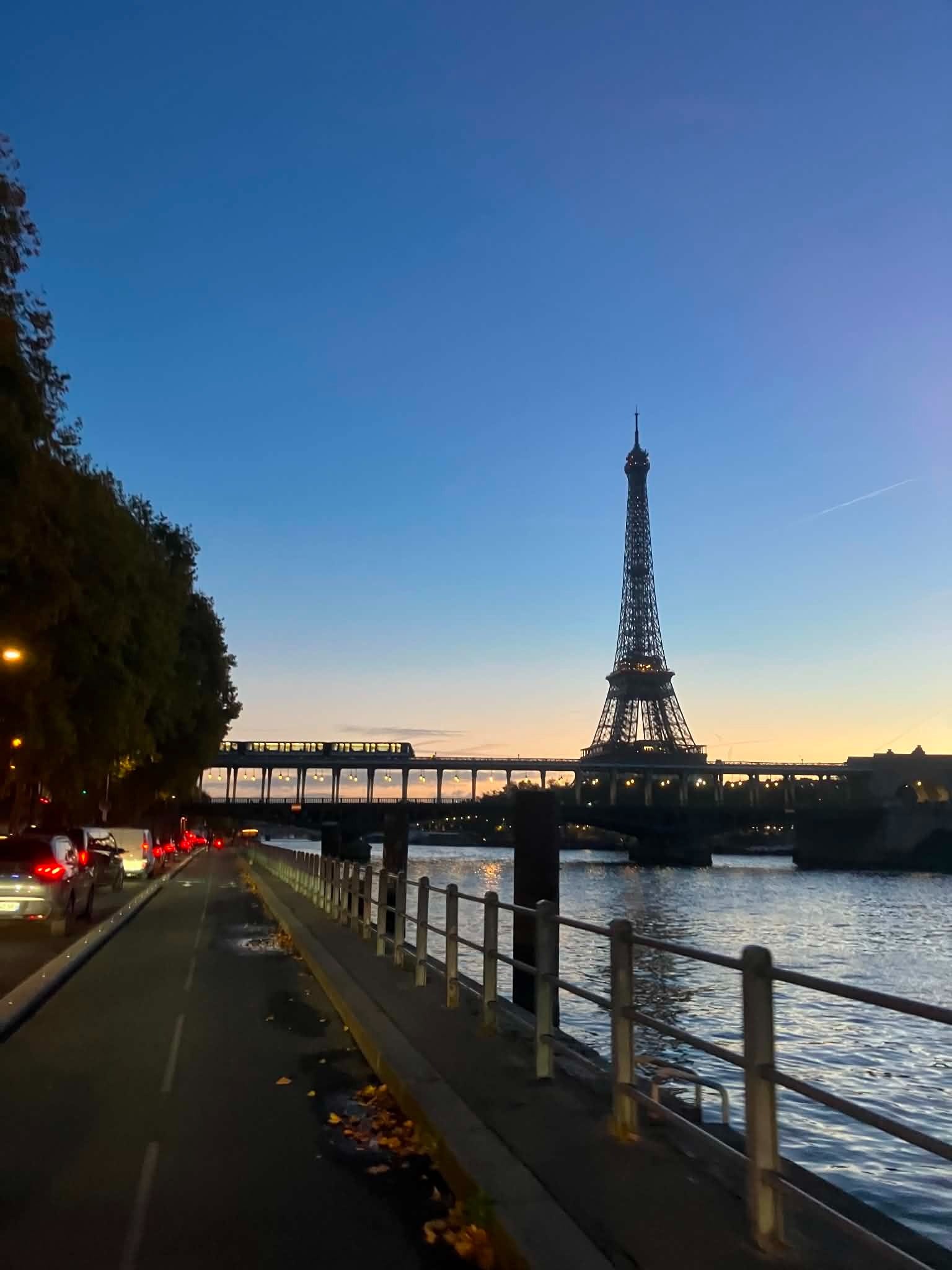
I guess the metro must have once seemed especially loud and scary.
It’s funny, finally, how people go in & out of your life. The other reason why this book has sort of loomed over me is because of this friend I had in high school who was obsessed with Céline. I don’t feel I can really talk about this book without mentioning him. He was always going on about Céline (and about how Journey wasn’t actually his best book). We both grew up in the same neighborhood, although we were from ‘different sides of the track,’ – which is to say that he grew up in the projects that flank the city, where I lived just within it – but we wound up in the same high school, where we had what can only be termed a “literary bromance.” It was a relationship I kept very separate from the rest of my life, to the extent that people would half-jokingly tell me they thought he wasn’t real. In college when I’d come home in the summers, we’d meet up at this café on a roundabout in between our homes and go smoke and talk about literature and get drunk. He later wound up working at the national archives (he was a much more serious person than me) and was always telling me about how he was jerking off into Proust’s manuscripts or whatever. At the same time, he started to seem to resent me a bit, maybe because I’d moved off to the US and begun living this other life that must have seemed very alien to him, or maybe for some other reason. I remember him telling me he felt there were two of me: one in writing (i.e. msn messenger, which is how we communicated), whom he felt was sincere and intellectually stimulating, and the other the louder, more superfluous person he felt I was in person. I remember him saying, One national literary tradition is quite enough for me, thanks. I remember he would make fun of my attachment to the Symbolist poets (i.e. Rimbaud et al.) - a teenage infatuation, he called it. Eventually I started to get a bit sick of his ‘tude, and one day we were talking online and I thought I’d give him a taste of his own medicine, so I made a mean joke saying some comment he’d made seemed a bit racist. I figured he’d take it in stride, but it seems he didn’t, because we never spoke again after that. Which maybe means we were both a bit tired of the friendship. Still, it’s hard not to wonder what’s happened to such people.
The other day I was on a train back from the place in Burgundy where I lived during Covid, after a sort of mini vacation there. The people who take this rickety local train are often a curious medley of the sorts of people who want to either escape Paris and move to its rust-belt equivalent, or their provincial counterparts with a desire for the reverse. When I got on the train, there was almost no one else in my train car except for this one sort of combination hippy and metalhead of ambiguous gender. They were wearing a hoodie that said Nataraja in metal font. This caught my eye because nataraja is one of Shiva’s epithets, used to describe him in his “dancing” form, in which he does things like create or destroy the universe. It is also the name of a yoga pose, and I used to be a big yoga-head. Anyway, this person ignored me completely when I got on and sort of stared into the distance. But as the journey progressed and more people came on, they started conversing more actively with the other people on board. A young sort of aspiring-business-looking guy sat down across the way from me and put his suitcase in the seat across from me, where I had been propping my feet. He said, You can put your feet on my suitcase if you want, it’s fine. Then, a guy with a vaguely rastafarian vibe going by seemed to recognize him, so he said hi, sat next to me and, to my despair, also asked me how I was doing. I said fine thanks and burrowed my head back into Céline. He turned to the hippy-metalhead instead, and eventually it became clear that he was looking for weed. Unlike me, however, the hippy-metalhead seemed to enjoy the chat, and they started talking about this that and the other thing. Later they engaged with a guy from Morocco who was talking about how he’d never smoked weed in his life, but might today, as he was worried about the day ahead of him, since he’d just be taking the evening train to the airport and then be wandering around it all night while he waited for his morning flight. The hippy-metal person was able to make the vibe warm and friendly, bringing all these strangers together. I’ve always been desperately jealous of people who are able to do this, step into a strange space and find commonality and easy conversation. I find the people who take this train sort of mysterious and intriguing as well, because you don’t hear all that much about their lives in the general mediasphere, yet they often strike me as far more interesting than their louder and more ambitious Parisian counterparts.
Despite him being from the suburbs of Paris, it feels like a lot of Céline’s book is about these sorts of people, the people you hear less from, the people who get thrown namelessly at wars. This is despite the fact that he was known, in addition to later becoming majorly anti-semitic and anti-freemasonry (two things that apparently go hand in hand), to be a virulent proponent of what is known as antimeridionalism. This is the hilarious notion that people from the south of France, due to their warmer climate, have it easy in life, and are therefore lazy, idle, and useless, whereas people from the north of France are inherently more Germanic about things – enthusiastic, diligent little worker bees. Antimeridionalists, who were apparently a real thing and a big deal in 1930s France, were convinced that the perverse influence of the south on the country could be chalked up to two factors: the expansion of the Roman empire, and therefore Latin culture, into Gaul, and the emergence of Joan of Arc, who prevented England and France from being yoked into a single, hardworking, northern-spirited country, the way things ought to have been.
This is funny especially because the whole vibe of Journey into the End of Night feels very much anti-work to me – at least, it feels very aware of itself as a defense of the single, faceless individual in the face of the overpowering will of the nation state. And in fact, when it was first published, Céline’s future far-right sympathies notwithstanding, many people read it as a sort of leftist call to arms, a long scream on behalf of the wretched and forgotten of the Earth. These same people – people like Sartre and de Beauvoir – would later claim that you could see the seeds of fascism in Céline’s subsequent works (like his childhood memoir Death on Credit, which my high school friend claimed was his real masterpiece), although they wouldn’t say this until much later, in the 1960s.
Anyway, I hope you’re enjoying the last bits of your summer, and chomping your way through whatever projects you may have chosen to saddle yourselves with.
In the meantime, I’ll be over here, trying my best to channel this earlier version of Céline, the one from the Journey to the End of Night, the one who doesn’t have a problem with anyone really as long as they don’t want to hack him to bits, the one who does not dream of labor.
I’ll also be trying to make my way through the rest of the book, because I haven’t quite finished it yet. As I mentioned, I keep getting distracted. So… wish me luck.
Comments
Nothing yet. Say the first thing.
Sign in to join the conversation.