
There’s a trope often used when writing about a book, film, or TV show where the location is such a prominent component to the story that the setting itself is described as a “character.”
Whether it’s Tokyo in Sofia Coppola’s Lost In Translation, Memphis in Jim Jarmusch’s Mystery Train, or Twin Peaks in Mark Frost and David Lynch’s Twin Peaks, location can influence mood or perhaps serve as a metaphor for the chaos, beauty, intertwined complications, and eclectic mysteries of life.
Filmmaker Daniel Nearing was born in Medicine Hat, Alberta, Canada, but has since made Chicago his home. After studying under writers Northrop Frye and Michael Ondaatje, Nearing received his MA in Modern and Contemporary Literature from the University of Toronto, then obtained an MFA in Film from York University. He was a documentary filmmaker on several networks, covering subjects such as juvenile homicide and Russian hockey players, but moved to dramatic films in 2008, founding his production company 9/23 Films.
After he began making his feature films in Chicago, Nearing served as the inaugural Filmmaker in Residence for the City of Chicago, became a fellow of the John Simon Guggenheim Foundation and MacDowell, and, in 2017, was named Chicagoan of the Year for Film by the Chicago Tribune.
Between 2010 and 2023, Nearing made what he has referred to as his “Chicago trilogy”: three black-and-white micro-budget art films set in the Windy City; they explore race, memory, history, and humanity. In other words, films where Chicago itself feels like a character.
And when I say “micro-budget,” I mean that the combined budgets for all three films total around $211,000, which may say something perhaps in a meta way about Chicago: people pull together to pull it off, transcending monetary compensation for the actual creative doing of a project that may have a chance at saying something bigger.
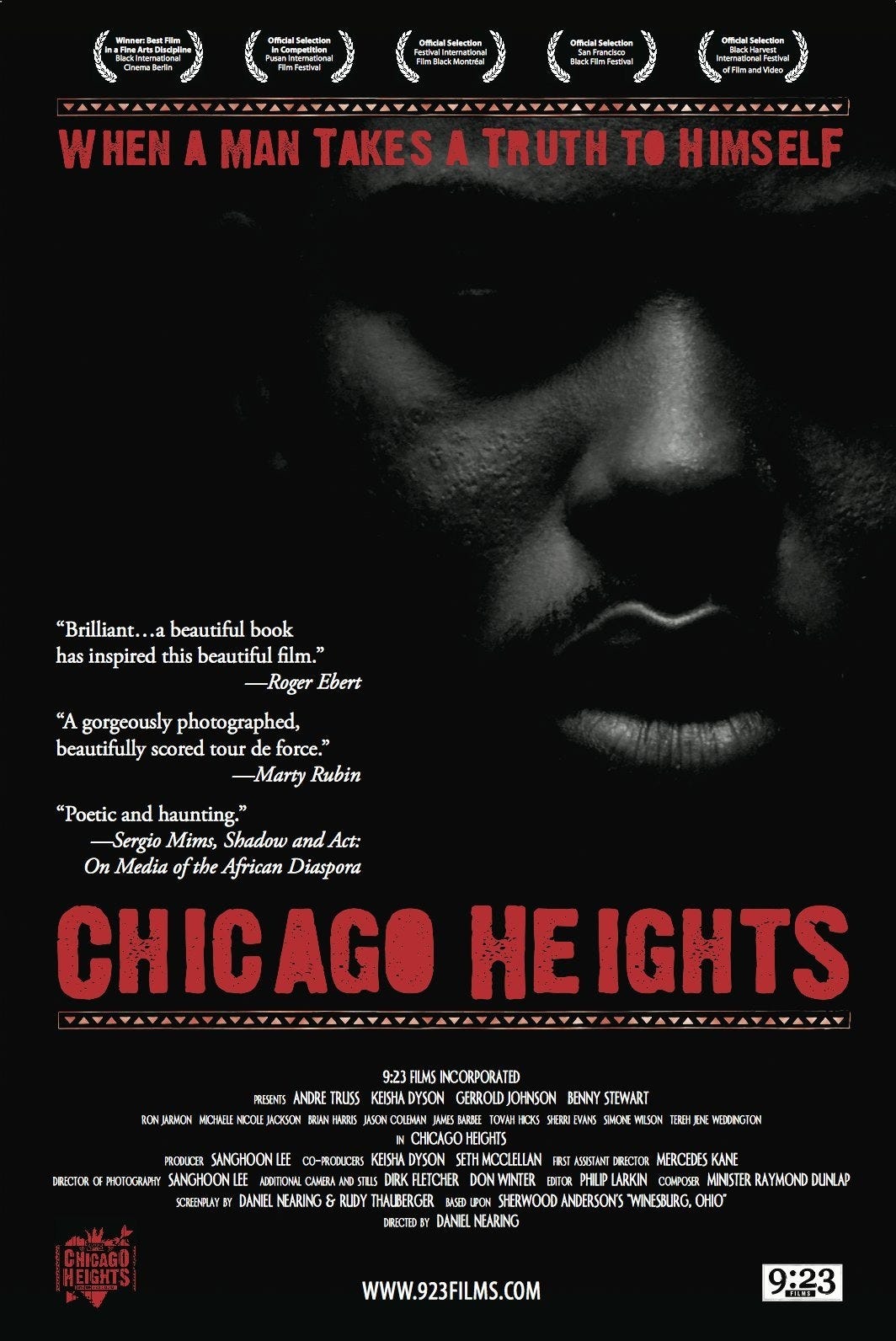
Made for just $1,000 and returning to his literary roots, Nearing’s Chicago Heights (2010) is an anachronistic adaptation of Sherwood Anderson’s novel Winesburg, Ohio, which is a collection of 22 short stories connected by a single character and set in the eponymous town. Nearing made the film “period-less”; he put together an African American cast and moved the setting to Chicago Heights, near where he was living at the time.
I found it abstract and experimental but not inaccessible. You can imagine it projected on a wall in an art museum while understanding what the characters are experiencing as an elderly man’s memories or possible dreams involving different people in his life and community play out from different time periods of his life in Chicago, floating back and forth between the personal and poetic. There’s a montage toward the end featuring some Chicago landmarks and marrying the city’s character with the human characters.
In his August 25, 2010 review in the Chicago Sun-Times, Roger Ebert said it was a “beautiful film,” and in adapting a seemingly unadaptable book, Nearing “finds an approach that in 90 minutes accomplishes the uncanny feat of distilling the book’s essence.”
The version I saw ran only 67 minutes, but there may now be a longer version of the film titled The Last Soul on a Summer Night.
In an August 10, 2014, interview in Creative Screenwriting, Nearing said of the film’s budget:
“We were up front with everyone we approached on the project, telling them it would be done on virtually no budget. Everyone sacrificed by giving us their time and talent. Our biggest problem was not with equipment, casting, or catering–we got by on a $1,000 donation for food from a Korean wig manufacturer!--but with locations, and that really was a matter of me dropping the ball. I should have made the time to get it done… You go into it thinking ‘it will be what it will be,’ and don’t let the absence of money affect your thinking. Budgets are as imaginative as original screenplays.”
Chicago Heights is available to stream on Tubi, The CW, and Xumo Play.
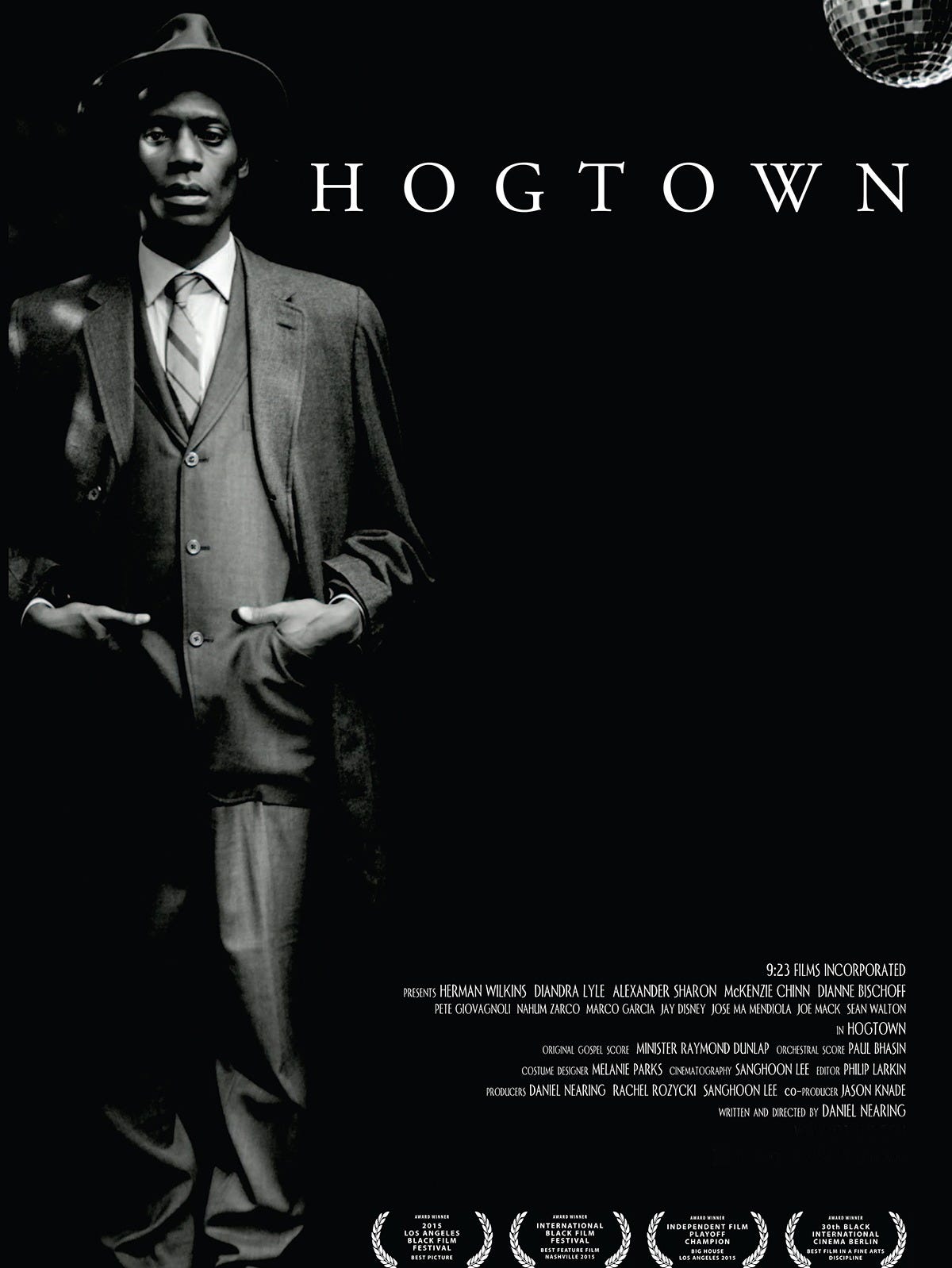
Four years later, Nearing multiplied his budget by ten for Hogtown (2014), an original dramatic narrative–once again, “period-less”—with historical elements. Sherwood Anderson is a character in the film, connecting it back to Chicago Heights, as is Ernest Hemingway, Jack Dempsey, and the character Ambrose Greenaway is based on Ambrose Small, a Chicago theater owner who disappeared in Toronto in 1919.
Beginning with an investigation into said disappearance, the film is a detective story set against the backdrop of the Chicago Race Riots, the Black Sox Scandal (a story also told in John Sayles’ 1988 film Eight Men Out) with characters based on Eugene Williams, who was killed during the mayhem as well as Dan Callahan, an injured policeman. That said, it’s not your typical detective procedural with focus on atmosphere, imagery, and experimentation to raise questions and get at something that Chicago represents.
In a February 21, 2015 Chicago Sun-Times interview, Nearing admits to the Chicago-as-a-character idea while promoting Hogtown:
“It’s a character for me. Hogtown is Chicago, the hog butcher to the world. The whole Back of the Yards thing. The whole difficulty of life. Chicago was an acquired taste for me. I came from a city that didn’t have a lot of crime and doesn’t have the racial tensions in the communities you encounter in American cities. Over time, I came to fall in love with it. I think of myself as a chronicler of the soul of Chicago. That’s what Hogtown tries to do; it tries to get at the essence of what it is to be a Chicagoan in the period in which we live and the prior generations live–a ridiculously ambitious thing to try to do.”
Furthermore, in a November 7, 2016 interview in the Chicago Reader, he adds:
“Canadians don’t have the conflicts over race and the rich and the poor in quite the same measure that we experience it down here… I love this city. I’ve grown to love it. I think it’s breathtakingly beautiful and complex, and that’s the kind of thing I want to celebrate in the films we’re making.”
Nearing shot the film in high-definition, chiaroscuro, noir-like black-and-white and assembled another largely African-American cast, while recruiting the College of William and Mary Wind Ensemble to perform the score. The film’s music also includes original gospel songs with lyrics by Nearing.
Hogtown, which was lauded by Chicago papers and called one of the ten best films of 2016 by Ben Kenigsberg of The New York Times, is available to stream on Fandor.
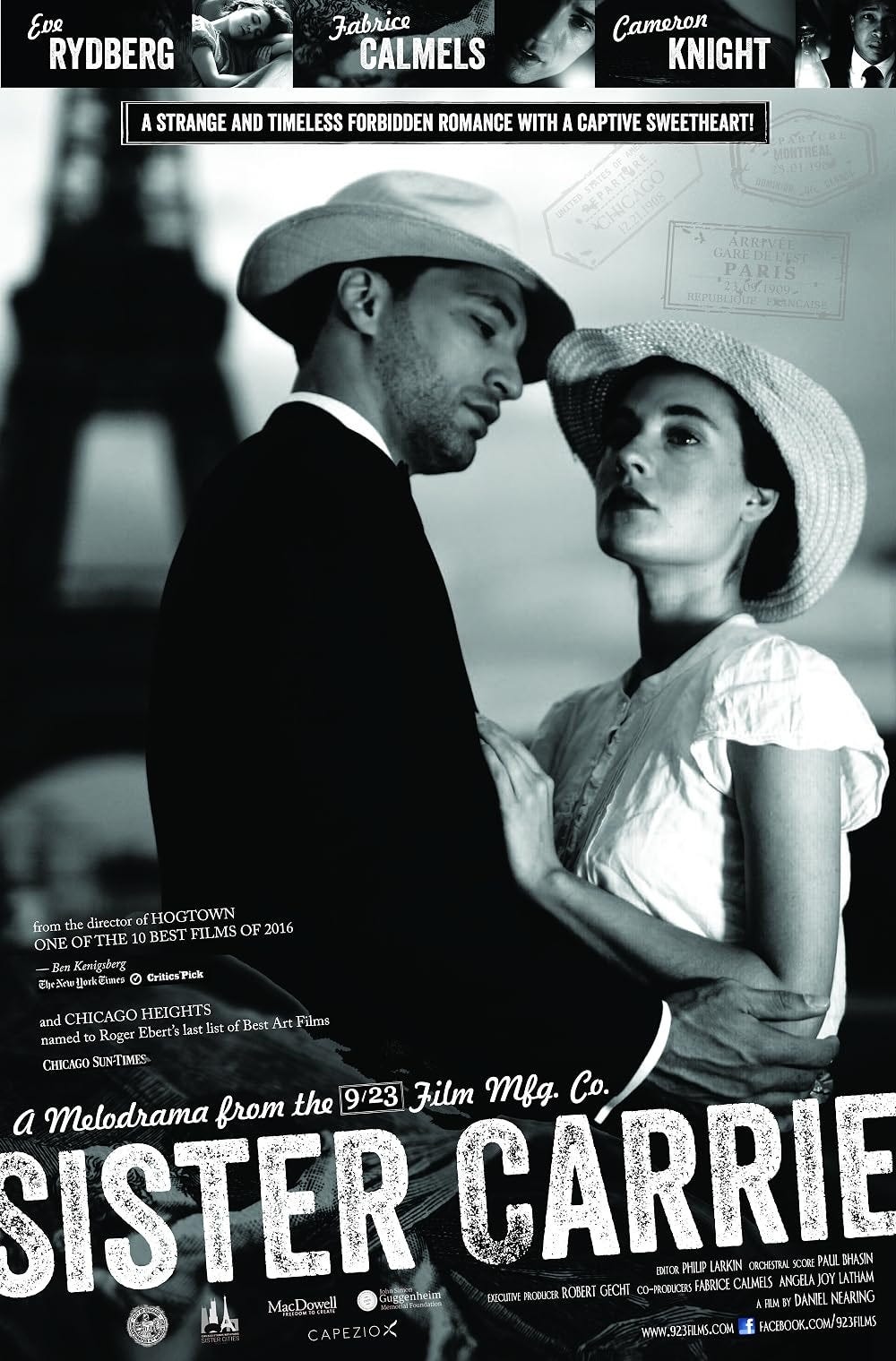
For the final film in the trilogy, Nearing’s Sister Carrie (2022) is largely based on Theodore Dreiser’s novel of the same name, but also Sherwood Anderson’s “Brothers” (there he is again), Alexandre Dumas’ The Lady of the Camellias, Abbé Prévost’s Manon Lescaut, and Phillip Larkin’s High Windows. (Chicago Heights opens with a Larkin quote: “Perhaps being old is having lighted rooms… Like a deep loss restored.”)
Sister Carrie is told through Nearing’s freeform black-and-white vignette style, just like the other two, with each shot carefully composed. The film contains silent film-style bookends, but instead of the text being on separate title cards, they’re superimposed next to the actors during their dialogue scenes.
The story is set in Chicago, of course, and in 1919 (though the book was published in 1900), but the story eventually moves to Montréal and Paris (sharing a time and setting with John Cale’s 1973 album Paris 1919). It’s a story about love, ambition, conscience, and a woman who is trying to figure out her own American dream, then gets swept away to Paris by a character played by a Joffrey Ballet dancer.
In a December 16, 2022, story in the Chicago Tribune, Nearing says he hoped his intended results would be “calling out centuries of romantic literature where women who were ostensibly the protagonists were, in fact, victims of their authors.”
Sister Carrie is streaming on Tubi and Fawesome. I noticed that writers and critics who wrote about Nearing’s Chicago trilogy didn’t really mention it was also specifically a Chicago
I recently attended the 85th anniversary of Citizen Kane, and in 1919 Charles Foster Kane caused a scandal, leaving his wife for a woman for whom he built the Chicago Opera House. Since Nearing said in the 2015 Chicago Sun-Times story that he worked closely with his Hogtown cinematographer to have their footage look like Kane cinematographer Gregg Toland’s, I’d wager Nearing is familiar with the film’s Chicago/1919 connection.
Nonetheless, Godspeed to the Daniel Nearings of the world who take their ambitions and obsessions and make what they can where they are with what they have. In his Chicago trilogy, he holds the Cloud Gate up to us emotional, searching, isolated, tragic, memory-bound humans- warping and splitting the reflection, echoing the Jonathan Safran Foer quote he uses to end Sister Carrie: “I was a prism through which sadness could be divided into its infinite spectrum.”
Comments
Nothing yet. Say the first thing.
Sign in to join the conversation.