
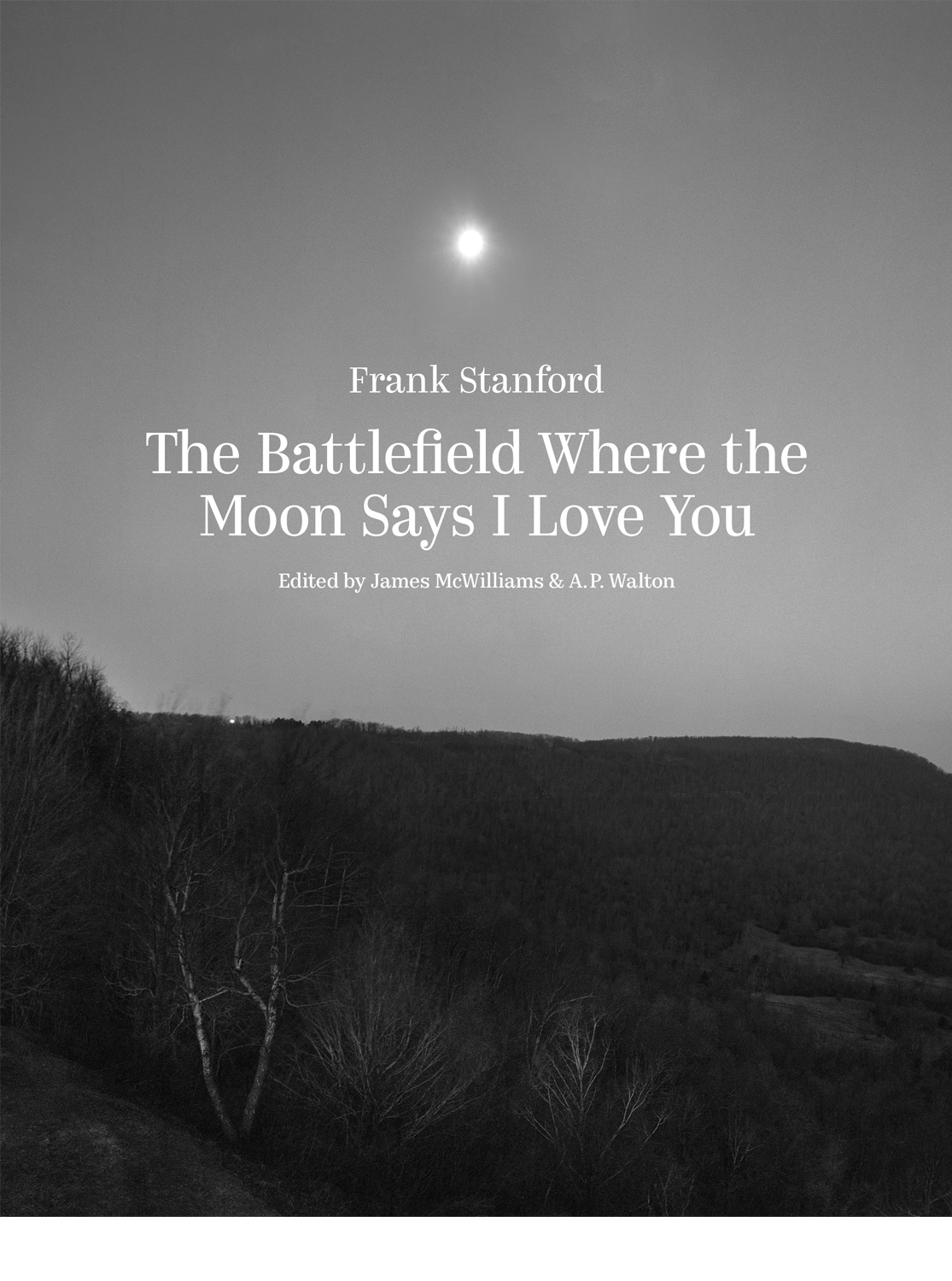
“I felt absolutely helpless to so much wildness of heart, so much fury and hilarity, such language. My skin burned, my insides hurt. I wanted to bury myself in the snow, pull the pages down on top of me. I wanted the cat to curl above me, mark the spot where we were buried, the poem and I. Never was I to be this innocent again.”
C.D. Wright, preface to the 2nd edition of The Battlefield Where The Moon Says I Love You
“and if you try to follow our wake
you’ll find yourself lost in the unknown country of the water
the country of the infants tired of carrying out the plans of the strategians
of war we will write the play the country of the infants of the forest
in the beautiful river where the hawk gave me one of his eyes”
The Battlefield Where the Moon Says I Love You, 4474-8
To write about Frank Stanford’s The Battlefield Where the Moon Says I Love You succinctly is an impossible task. I’ll resign myself to the quickest and most futile of sweeps, and the die-hards will have to deal with it.
The poem, first printed in 1978, just received a 3rd edition from the University of Arkansas Press this past March. It clocks in at 15,434 lines, possessing no stanzas and minimal punctuation. Like Ovid’s Metamorphoses, it presents a continuous flow of imagery and narrative. Unlike Ovid’s Metamorphoses, it’s told from the perspective of a 12-year-old orphan on the Mississippi and Arkansas Deltas who can read minds and traverse time and space in fits of hypnagogic incantation.
It’s written in a mix of Southern vernacular and a kind of mad, Whitmanic sprawl. It’s a poem of sadness, roguery, ribaldry, violence, and recklessness. There are brief passages in Latin, French (medieval and modern), Spanish, German, and Italian. Francis Gildart, our hero, can also speak fluent sign language and does so to great effect with the Italian Renaissance philosopher Giambattista Vico on a bus full of Freedom Riders.
Battlefield’s aim goes against what we would traditionally think of as the goal of an epic poem (if a poem can have a goal or aim at all; I’m sorry to even suggest it). That is, if epic poems are meant to cement a sense of common identity and shared purpose, then this one is meant to take a concept at the core of the American “Southern” identity—racial injustice and the violent society of gentry and yeomen that upheld the culture of Jim Crow—and blow it wide open. That last phrase is literal. In one passage, a grenade is used.
Francis Gildart lives in rural Arkansas, but he also hangs out in Memphis, a city I typically associate with Jeff Buckley’s death, Elvis, and playing Yahtzee at Christmas with my in-laws. The time period is, loosely, the early ‘60s. Francis loves breaking the law, pirates, Harpo Marx, wolves, panthers, Beowulf, the moon, death, revenge, medieval Japan, astronomy, Robert Burns, fighting, women, talking shit, etc. He hates school, liars, cowards, traitors, that smell in the corner of old hotels, newspapermen, and polite society. In an early passage, after receiving a poor grade on a test about current events, he lists everything he knows really:
“I know the rich are the only ones that had any good old days
I know the black swan
I know the pas de deux
I know drunk women shooting their husbands on Saturday night
I know what is under the cloak
I know the swordsman Miyamoto Musashi
I know the iai the daito the shoto the yoroi doshi the tanto
I know forty-seven wave men came from the left to the right
I know the disgrace and death of Lord Asano
I know the rings of saturn and the moons of jupiter
I know the black steed
I know the peg leg keeps a watch in the buzzard’s nest
I know the captain of the ghost ship
I know the cockeye with the bucket under his stump
I know had to stay after school every day for a month on account of somebody else’s lie
I know if you ask them a question they’ll tell you a lie I know all about that shit
I know what some men can’t know they gnaw
I know the scoundrels and cowards prey on one another I pray for all
I know the discounted stories
I know for those I love I’ll swim to hell and back
I know some by signs others by whispers
I know I’d rather take it on the chin than get it in the back”
Lines 241-63
What affects Francis the most, however, is the brutal injustice of the segregated world around him. His adopted father runs levee camps in rural Arkansas. There, during the summer, Francis lives alongside the campworkers and their children. He’s the boss’s son but a boy nonetheless like any other (except for the mind-reading).
This means that in the summer, Francis has grown up among Black Southerners, who make up the bulk of the poem’s major characters, his friends of many different ages who both instruct him and enable his manic outlaw lifestyle. Sometimes they are just as puzzled as the reader might be at this fast-talking pre-teen. After launching into one of his doggerel trips, meant to entertain his friend Jimmy while he sits on his outhouse throne (more than one conversation in this poem takes place at the latrine), he’s chided:
“you go get me some johnny paper Jimmy says I still don’t know what the fuck
you are talking about but I just ain’t in the mood to mess with it today”
6322-6323
His heart for his friends is matched only by his sorrow and rage at his environment, the boiling pot of the rural Delta of the 1960s. He’s besieged by the society of aristocratic White Southerners who demand conformity of thought and dogma, “the so-called good old boys that come in the middle of the night/with blood on their hands the fraternities burning up churches at ten p.m.” They represent everything he despises. Once again, that is: moral cowardice, cruelty, self-aggrandizement, school (seriously, calling the classroom desks a “regatta of coffins”), boredom, not gambling, not dueling, not drinking and cursing and telling jokes about fucking, not being a pirate or a wolf or a wise cosmic conduit seeking the wisdom of Lao Tzu, etc.
For all of its social context, the poem is anything but an exercise in documentary realism. There’s this additional layer of surreal psychedelia infusing just about every passage. It’s different eras of history and knowledge and myth superimposed, often in moments of double or triple exposure. Its greatest challenge—met in its most triumphant moments—is to tap into an unspeakable mystery beyond the powers of the tongue. It’s the primitive, pre-historical act of expression hidden within the soul’s murky depths. It’s our need to speak before our ability to speak is formed. It’s the negative capability we all share, calling its kin the rebus, the quest, and the dream:
“before men could speak they enjoyed confounding one another with signs
they this as much as a mirror enjoys an image
as much as the evening like a ship enjoys its sapphire grave
they came to this not out of folly or spite but love the love in their own eyes
like rivers of no return and the other eyes like two dead moons
so it is that some youth who had grown old before his time due to the barnacles of sleep
to the impossibility of anyone comprehending his dreams
as he remembered them at dawn
decided to retell them not as a member of a dwelling or a tribe
in grunts and the marching of hands
but in a manner where made something more than was there before
he forgot about fish between his legs and the fog in his head
he embarked on the water of his soul alone he went out among sharks
bringing things into his bosom and making them one”
6146-59
Over the past two decades or so, Stanford’s work and legacy have seen a resurgence of interest. It’s not too tough to see why. His work is singular, full of venomous duende. The myth of his persona, marked by his suicide at the age of 29, is that of a grifting, philandering, drinking, manic Southerner, lost in the Byronic sauce.
Copper Canyon issued What About This, his collected works, back in 2015. Other pieces of Stanfordalia, such as a collection of his letters edited by Stanford scholar A.P. Walton, who also contributed to Battlefield’s 3rd edition, have also been published. He counts among his fans such fedora-rocking legends as garage bluesman Jack White and crabby steampunk guy Tom Waits. A thick biography by James McWilliams was a Pulitzer Prize finalist this year (apologies to James, who I bugged with questions in Atlanta when he gave a reading at A Capella Books this past year; the book sits on my shelf valiant and unread). His lovers included C.D. Wright and Lucinda Williams. There were even two Frank Stanford festivals in Fayetteville back in 2008 and 2018. Marathon readings of Battlefield have been prone to pop up anywhere there are enough fans to bask in its deluge.
Likely, if he had appeared any later in American literary history, if he had decided not to self-publish or exist as an outsider, he would’ve been laughed out the doors of a writing workshop post-1990 for his overuse of simile and his obsession with violence and sex and all these machismo things that poets are supposed to avoid because they’ve been talked to death. Conceptualists and New York School acolytes would have called him a sentimental cornball. I would’ve called him a cornball. You get the drift.
But for any fan of Stanford’s—and I count myself as one—once you’re drawn in, it’s tough to get out. All of the reasons you want to hate him are the reasons you love him. His nonstop personification of Death, his arresting simplicity, his filthy humor, his unabashed references to Lorca and Mishima and Apollinaire and Vallejo, his distillation of a Victorian imagination from writers like Stevenson and Dickens—which older Southerners so ardently share. All of it is distilled into poems that are strong enough to stop the heart.
How does this happen? How does someone like him exist? Was he not just a collective fabrication of Fayetteville hipsters in the late ‘60s and early ‘70s? I’ve seen the ducks at The Peabody Hotel. I’ve been to Mud Island. Not a lot of people there were talking about Jean Follain or Jacques Prévert.
But beyond the mythos and the short poems, Battlefield is a different experience. Stanford’s lyric poems are shorter, some no longer than a few lines. To read Battlefield feels like the missing piece of it all. It possesses such propulsive style, an overflowing ingenuity, like a flooding river—sometimes it really does feel as if you’re losing your grip in the best of ways, especially in these extended litanies, at times astral and fiery, and at other times just delightful and bizarre:
“I’m quick like a horse
I take more wives than a kangaroo
I rove through the thunder of the blood the lightning of the skin
I cluster grand and mad like grapes
I ache like the mast in fantasia’s ship
I have the general force of the frescoes of wrestler and panting dancers
I am stout and burned not too tall and give off a strange aromatic shadow
I abandon myself to the excitement of farmers and water
I quiver with now and the wrong Phoenix below
I come out of nowhere I merge with death in the weeds
I go the extreme
I loaf in the black flowers of the red moon
rising like cornbread cooked over a bayou
I live in the cello and the flute that signal farewell to all good things
I flow with the films the fluttering strangers
I learn from the incarnate
I am the young bull in the snow
I go mistaken for fair weather
I call to the downtrodden
I grew up early I compose the great poem of death and these States”
12299-319
And already I’m running close to time. I’m sorry—it’s a sin to chop this poem up into digestible morsels, so I had to quote large chunks whenever possible. I’m still just scratching the surface. I hope you understand. So, for the record: this poem takes a bulldozer to 20th-century American poetry, to the neat and discrete politesse of CIA-funded ivory towers. It deranges the English language of schoolteachers and cowards. It pisses on the South just so the honeysuckles outside the outhouse can grow again. The Delta, mon amour, some Europeans will never see you. Some New Yorkers will never know how black the Mississippi River can get at night. Call me a suburban poser (I am!). Call it grotesque, cliché. Condescend. I don’t care. Unlike Francis Gildart, we’re not the Nijinsky of dreams. We’re just understudies of the grand ballet. Look out, here comes the song. It’s a Villon ballad, it sings: “Je congnois mort qui nous consomme.”
Comments
Nothing yet. Say the first thing.
Sign in to join the conversation.