
Hey, before we get to today’s newsletter, here’s a quick update.
Our aim at Zerodha Varsity is to make financial education simple and accessible. Apart from writing these newsletters, we also conduct free bootcamps, workshops, and online sessions across topics such as stock markets, trading, macroeconomics, and personal finance.
If you haven’t explored them yet, you can check out our online sessions here and upcoming events here.
When you hear OPEC (Organization of the Petroleum Exporting Countries), the first word that comes to mind is cartel.
And that’s because we’re conditioned to think about OPEC this way. Every media headline about OPEC calls them a cartel. Economics textbooks too use OPEC as a go-to real-world example of a cartel..
But let me give you a counterview.
What if I told you that OPEC is not a cartel?
And there’s an economic theory to it. So, let’s dive in.
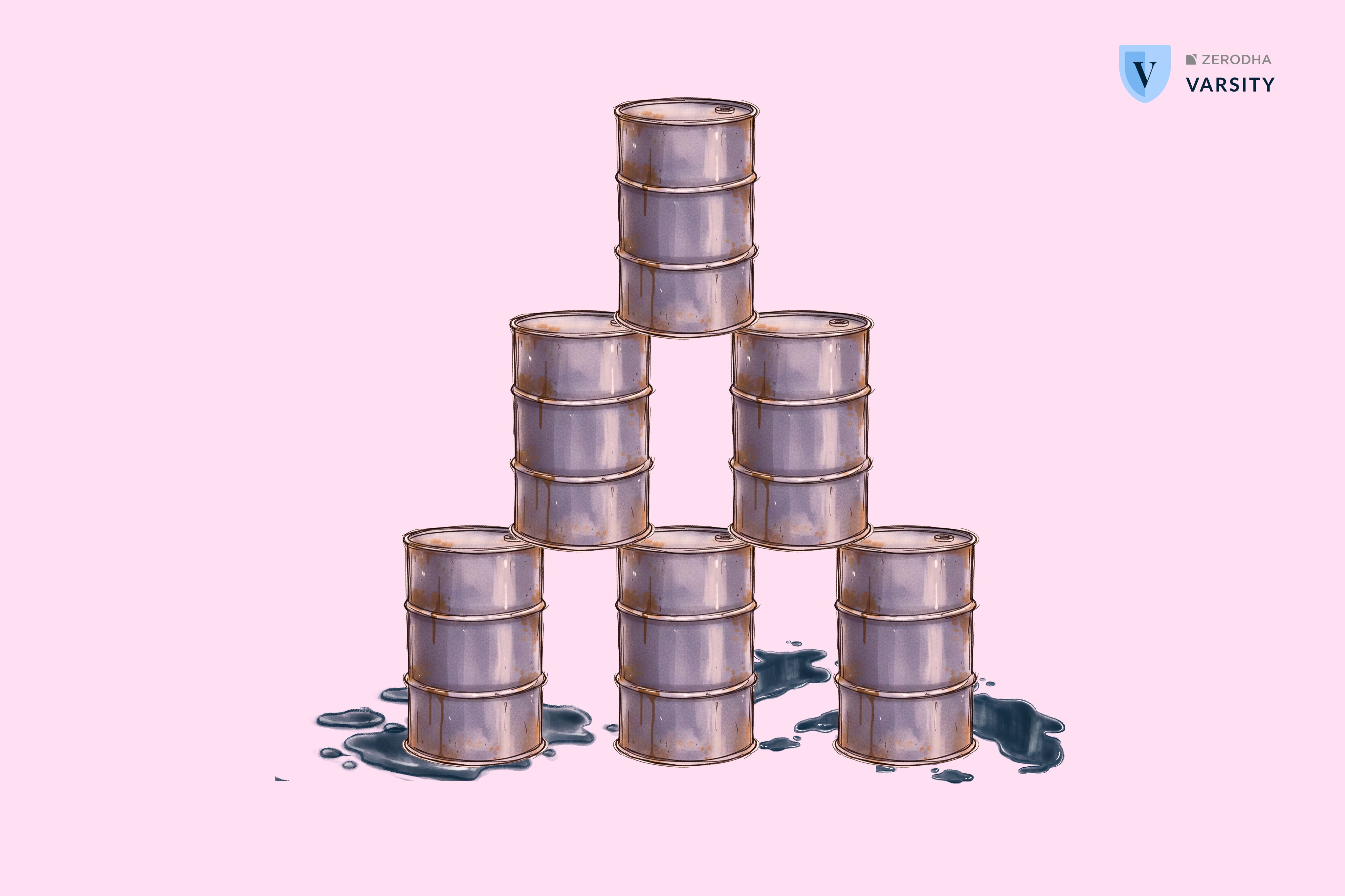
Here’s one definition:
“anticompetitive agreements, concerted practices or arrangements by actual or potential competitors to agree on prices, make rigged bids (collusive tenders), establish output restrictions or quotas, or share or divide markets by, for example, allocating customers, suppliers, territories, or lines of commerce.
That’s how the Organisation for Economic Co-operation and Development (OECD) defines it.
But put simply, a cartel is a formal agreement between entities to raise or fix prices and reduce output in order to increase profits.
Unlike in a competitive market where producers expand output, compete on price, and innovate, a cartel does the opposite. It restricts supply, distorts prices, and gets in the way of markets working normally.
This hurts consumers because it makes goods scarcer or pricier than they should be.
That does sound a lot like OPEC, doesn’t it?
Because a group of countries get together behind closed doors, debate factors affecting oil prices, and hash out the nitty gritty of how much oil each of them should produce to squeeze maximum profits for themselves.
And the end result could be increased costs for everyone.
Researchers from Duke University, KU Leuven, and UCLA claim that over the past 40 years, it wasn’t just the price of oil at the pump, but the oil industry ‘cartel’ drove up the cost of global crude oil production by some $160 billion (pdf) with their actions.
How, you ask?
Well, drilling and extracting oil is cheap in the Gulf. It costs under $7 a barrel in Saudi’s Ghawar Uthmaniyah, the world’s largest oil field. But by curtailing production in these regions, the cartel knowingly or unknowingly pushes the rest of the world to produce the oil needed to keep up. That oil could come from the frigid seas of Norway which then costs over $20 a barrel to extract.
Essentially, OPEC’s actions lead to the use of more expensive methods of oil extraction in other parts of the world and increase the costs for the industry and the world.
That’s the $160 billion the researchers estimate.
And that’s what cartels can lead to.
Okay, here’s the thing. In economic theory, to successfully pull off a cartel, it needs three pillars.
Market control and quotas: It needs control over enough global supply to actually manipulate market prices and then assign strict production limits to every member.
Transparency: There has to be ways to monitor members and ensure no one is secretly overproducing to make a quick buck on the side.
Punishments: Slap penalties on members who stray.
And we need to look at OPEC through this lens now.
OPEC controls just a little over a third of the global oil production. That’s not damning evidence that it has total market power. Especially since the US by itself now produces a fourth of all the oil.
And think about it, If OPEC possessed true market control, it would not need external allies. But in 2016, OPEC expanded. It got Russia and a bunch of other oil producing nations on board to form OPEC+.
That doesn’t scream of control.
Then there’s the matter of quotas.
OPEC’s main tool since 1982 has been assigning each member a production quota. Except members blow past their quotas constantly.
Jeff Colgan, who teaches at Brown University, has written quite comprehensively about OPEC. Even papers bluntly titled The Emperor Has No Clothes: The Limits of OPEC in the Global Oil Market. And As per Colgan’s research,
From 1982, when OPEC first introduced production quotas, to 2009, when my [Colgan] analysis ended, OPEC member countries cheated on their quotas a whopping 96 percent of the time, on a month-by-month basis.
Now a cartel has to punish erring members (don’t imagine a mafia style system). But in the case of OPEC, it doesn’t have any such power.
The only thing it has is the Compensation Mechanism.
Under this framework, if a member country exceeds its quota in a given month, it is expected to voluntarily compensate by making deeper production cuts in subsequent months to bring its cumulative output back into balance.
But it is based on an honour system; there is no financial penalty; it’s not enforceable. And that itself leaves the concept of a cartel on shaky foundations.
Colgan also looked at whether OPEC membership correlates with countries producing less oil than they otherwise would.
The answer?
No.
There was no such link. So whether they were part of OPEC or not, it didn’t seem like all those meetings really changed the way these countries would have produced oil anyway.
He even said,
If [OPEC] ceased to exist tomorrow, not much about the global oil market would change.
And he’s not the only one. A Cato Institute analysis found that from 1993 to 2022, the production volatility of Saudi Arabia, Kuwait, and the UAE — the three members with almost all of OPEC’s spare capacity — was statistically no different from that of the United States and its decentralised oil industry.
That doesn’t seem very cartel-like, does it?
Instead, an economic definition or theory that fits OPEC’s story far better than “cartel” does could be the dominant firm price leadership model.
The idea, first sketched out by economist Karl Forchheimer in 1906 describes a market with one large firm and a bunch of smaller “fringe” firms. The dominant firm sets a price it thinks is optimal, factoring in that the smaller fringe firms will supply whatever they want at that price. The fringe firms just take the price as given.
This is not a stretch for oil. It’s arguably the best-fitting model economists have found. Some researchers have found that OPEC — really, Saudi Arabia — best fits the role of price leader, while non-OPEC producers behave like the competitive fringe.
That’s meaningfully different from a cartel. A cartel needs every member to hold the line. A price-leadership model only needs one big player confident enough to move first, while everyone else free-rides off that price. Saudi Arabia, with the lowest production costs and most of the world’s spare capacity, has often played exactly that role — cutting production alone to defend a price level while everyone else pumps as much as they can and gets away with.
Which also explains the cheating problem perfectly.
If OPEC were a true cartel, cheating would eventually collapse it.
Instead, OPEC has been around for six decades precisely because it was never actually enforcing collective restraint. It was one dominant player absorbing the pain so the “cartel” narrative could survive.
Let me take you back to Colgan who has an answer for this. He says that OPEC is a “rational myth”. This simply means that while the idea is illusory, there’s a strategic incentive for people to continue perpetuating it.
For the nations that are part of OPEC or its extension, the primary benefit is for diplomacy and prestige. When others perceive you as being a part of a world organization that has the power to move prizes, they often pay more attention to you. And even create a strong image of the country to its own citizens. It’s a political power play.
And for outsiders, OPEC becomes an easy scapegoat to explain away domestic follies in managing oil price movements. Leaders simply need to say, “It’s OPEC and out of our hands.”
That’s the rational myth.
And yeah, the next time someone says OPEC is a cartel, maybe you can use this to debate why it is not actually one.
PS: A real oil cartel actually might have existed well before OPEC and maybe we’ll dive into that story soon. :)
This newsletter is written by Nithin Sasikumar
Do read, “Where to save emergency funds in India” in our Second Order newsletter.
For any feedback or topic suggestions, write to us at varsity@zerodha.com

No posts
Comments
Nothing yet. Say the first thing.
Sign in to join the conversation.