
Hey, before we get to today’s newsletters, here’s a quick update.
Our aim at Zerodha Varsity is to make financial education simple and accessible.
Apart from writing these newsletters, we also conduct free bootcamps, workshops, and online sessions across topics such as stock markets, trading, macroeconomics, and personal finance.
If you haven’t explored them yet, you can check out our online sessions here and upcoming events here.
We have all seen it, haven’t we? Growing up in an Indian household, there was always that moment. Some expense shows up that nobody planned for. An unexpected travel, a hospital bill, a wedding that can’t wait. And then your mother walks to the kitchen, reaches to the steel dabba of rice, and pulls out a rolled-up bundle of notes. Nobody knew that money was there.

I still find this fascinating. That rice dabba was, in a way, a financial product. You could access it in thirty seconds (liquid). Nobody was going to look for money inside rice (safe). And while the returns were zero, the money was there when it mattered.
Now, the physical rice dabba may be disappearing as access to financial products has become easier. But the idea behind it hasn’t. You need a stash of money that sits separately, that you don’t touch unless something genuinely goes wrong, and that is available when life decides to test you. That is what an emergency fund is.
And where you keep your emergency fund needs to meet all three criteria: liquidity, safety, and returns that aren’t eaten by taxes and inflation.
A savings account may score about 2 out of 3. Liquid and safe, yes, but after tax and inflation, your money is actually shrinking.
So which product in India scores better for the emergency fund? I will tell you what I think is the best approach. But first, let me walk you through the main candidates and how they score on these three parameters.
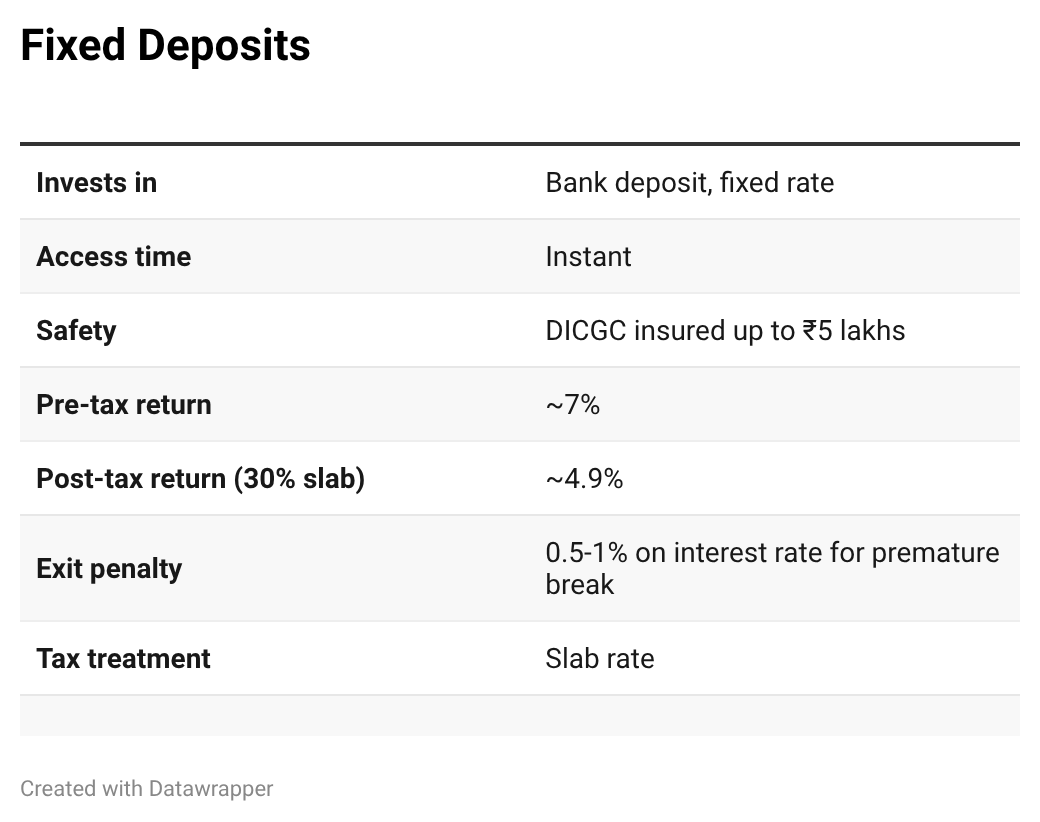
Liquidity: ✓ Instant access
Safety: ✓ DICGC insured up to ₹5 lakhs
Post-tax return: ~4.9% (Average return at 30% tax rate)
You know what an FD is. Money goes in, earns a fixed rate, and comes out at maturity. Your deposits are insured by DICGC (Deposit Insurance and Credit Guarantee Corporation) up to ₹5 lakhs per depositor per bank. If your emergency fund is larger than ₹5 lakhs, just split across two banks.
Where FDs fall short is tax efficiency. The interest is taxed at your income-tax slab rate. So, if you fall in the 30% bracket, a 7% FD effectively gives you only about 4.9% after tax.
Your return may fall further if you withdraw the FD before maturity. Say you invest in a five-year FD but withdraw it after three years. The bank will usually pay you the interest rate that was applicable to a three-year FD when you originally made the deposit, minus a premature-withdrawal penalty of around 1 percentage point.
But FDs offer something most alternatives cannot: certainty of returns and, in many cases, quick access to your money whenever you need it.
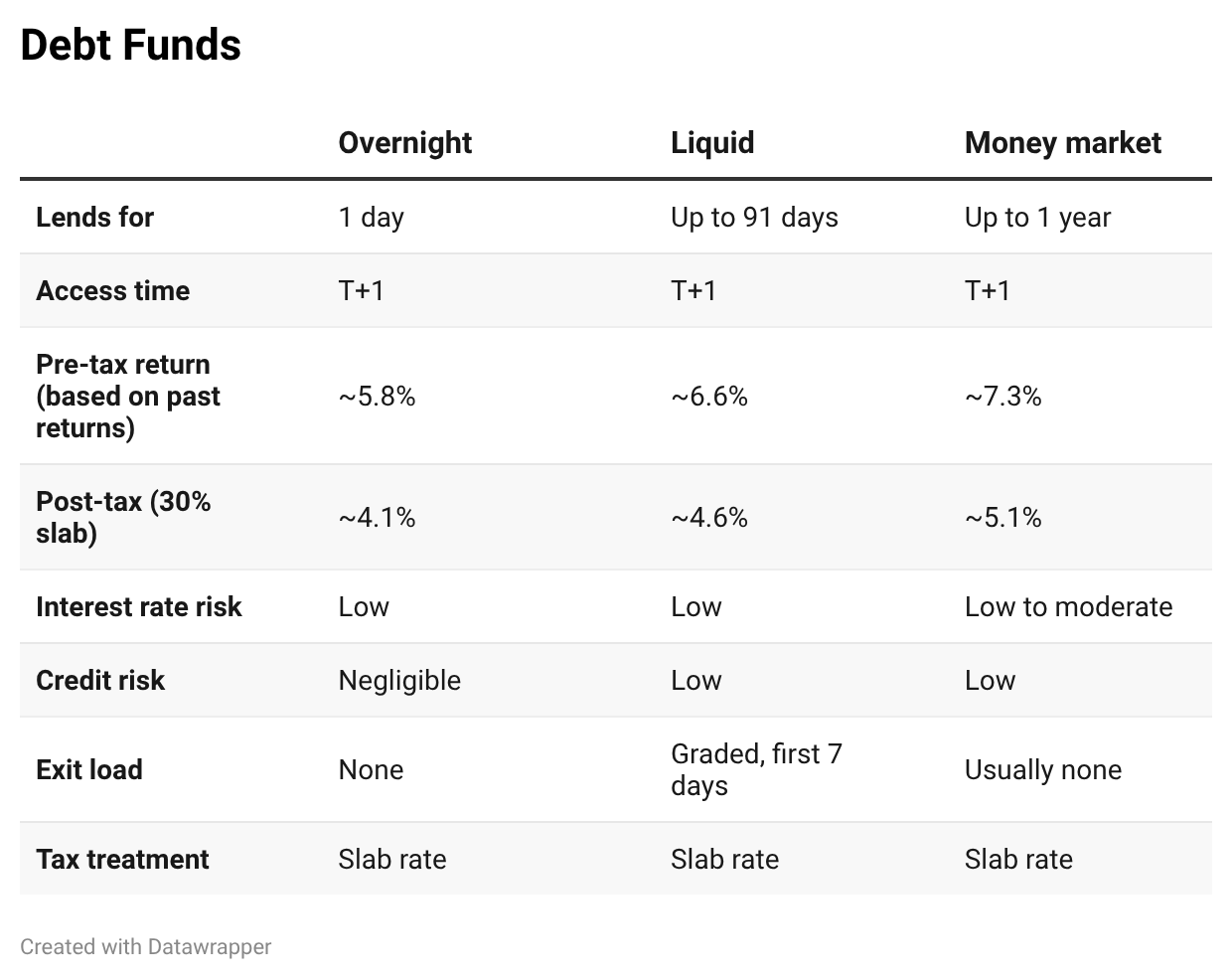
Liquidity: ✓ T+1 (next business day)
Safety: Low to Low-to-Moderate risk
Post-tax return: ~4.1% to ~5.1% (last 3-year average return at 30% tax rate)
Three categories of debt mutual funds. They earn returns by lending the money to the government and companies. They differ in how long they lend your money for.
Overnight funds are lent for exactly one day and are returned the next morning. Returns are the lowest: about 6.1% pre-tax (3-year average).
Liquid funds lend for up to 91 days, buying treasury bills, certificates of deposit, and commercial paper (which are essentially short-term loans given to the government and trusted companies). These funds delivered noticeably better returns than overnight funds, at about 7% pre-tax. What you get on liquid funds is comparable to what you usually get from a fixed deposit.
Money market funds are the next ones. I don’t understand why these funds are not as popular as liquid funds. Same types of instruments, but the money is lent for a bit longer, up to one year. Returns are slightly better at about 7.3% pre-tax.
Now, there are two risks to know about debt mutual funds:
Interest rate risk (when rates go up, the value of the bonds the fund holds goes down); when this happens, your returns temporarily fall.
Credit risk (the borrower could default), which means you could actually lose some of your money.
For overnight funds, both risks are negligible. For liquid and money market funds, these risks are small compared to other category of debt funds we have in the market, but not zero.
If you want to know how to check these for any specific fund, I have covered that in the FAQ at the end.
In addition to that small risk, all gains from debt funds are taxed at your slab rate. So for someone paying 30% tax, there is no real tax advantage over FDs. And that is where the next option comes in.
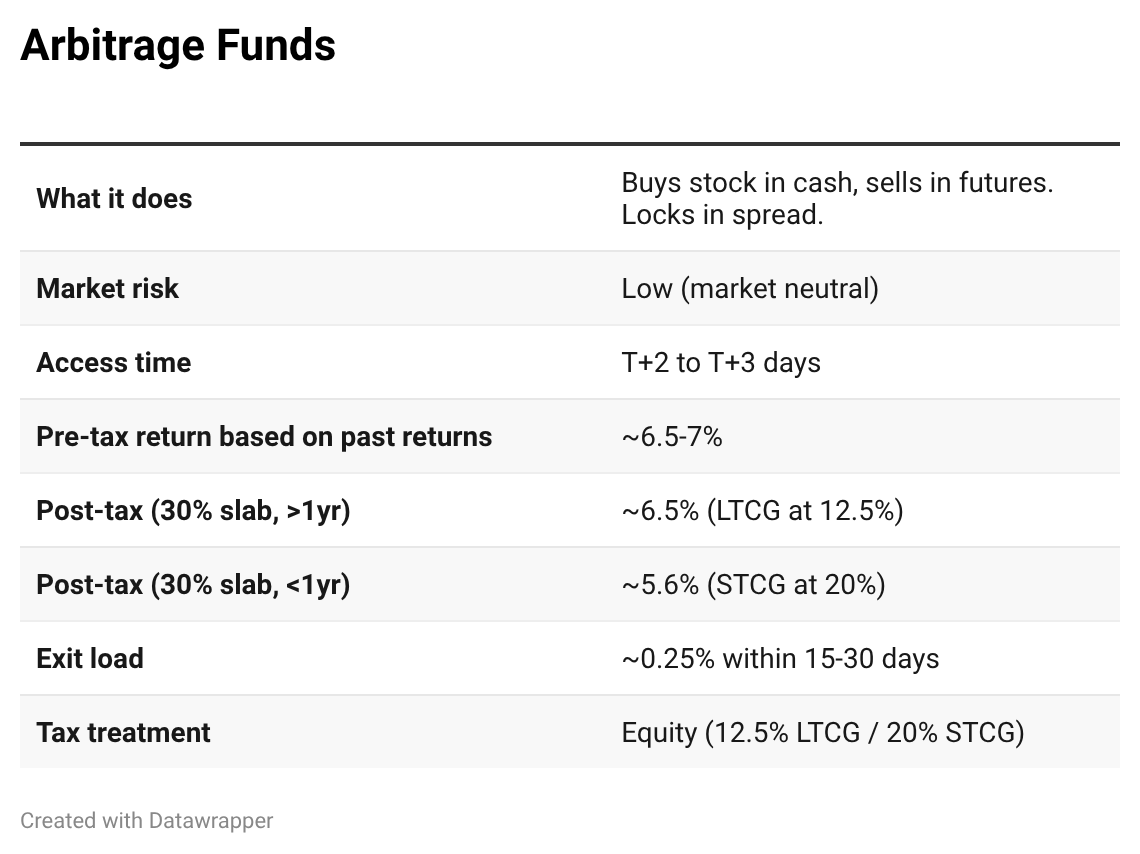
Liquidity: T+2 to T+3 days
Safety: Low risk
Post-tax return: ~6.5% (last 3-year average return at LTCG at 12.5%)
Here is how an arbitrage fund works. Say Reliance Industries is trading at ₹1,300 in the cash market and its one-month futures contract is at ₹1,308. The fund buys the stock at ₹1,300 and simultaneously sells the future at ₹1,308, locking in ₹8 per share. It does this across dozens of stocks. Because both trades happen together, the fund doesn’t care whether markets go up or crash.
The one big advantage of arbitrage funds for parking emergency funds is tax efficiency.
Because most of the fund amount is invested in stocks and futures, they get equity taxation. Hold for more than 12 months: 12.5% LTCG (with ₹1.25 lakh annual exemption). Hold for less than 12 months: 20% STCG.
Compare that to 30% slab rate on debt funds and FDs. A 7% return on an arbitrage fund gives you roughly 6.5% post-tax (held over a year) versus 4.9% on an FD. Even if the sale happens under a year, 20% tax rate beats 30%.
The trade-off here is liquidity. Redemptions usually take T+2 days. Most funds also charge ~0.25% exit load within 15-30 days.
Emergencies come in two flavours. I like how Vanguard, one of the world’s largest investment firms, calls them ‘spending shocks’ and ‘income shocks’.
Spending shocks are sudden costs: a medical bill, a car breakdown or an urgent home repair. You need the money now. Income shocks are the loss of income itself: a layoff or a long illness. Here, you need the corpus to sustain you over several months, not within the next few hours.
So, for spending shocks, keeping a portion of your emergency fund in an FD makes sense. You can usually break it online and access the money almost immediately. Some liquid funds offer instant redemption, but this is generally capped at ₹50,000 or 90% of the folio value, whichever is lower.
For an income shock, you are unlikely to need the entire corpus immediately. So, you can keep this portion somewhere that offers better return potential, even if redemption takes a couple of working days.
See, an FD tells you upfront how much it will pay if you hold it until maturity. A liquid, money-market or arbitrage fund cannot offer the same certainty. Standing today, we cannot say which of them will deliver the highest return over the next year.
But historically, arbitrage funds have often stood out on a post-tax basis, especially for investors in higher tax brackets.
So, I would split the emergency fund. Keep around 30% in FDs for spending shocks and immediate access, and the remaining 70% in arbitrage funds for income shocks and better post-tax return potential.
You can adjust the ratio to your situation. If you need more immediate liquidity, you could go 40–60. If not, you could go 20–80.
It depends on your personal situation. If you don’t know where to start, six months of your monthly expenses is a reasonable anchor. Not salary, expenses. If you earn ₹1 lakh but spend ₹60,000, your target is ₹3.6 lakhs. Single-income or unstable job? Stretch to nine or twelve months.
Ideally, yes. The emergency fund prevents you from panic-selling your investments when life throws a curveball. But telling yourself “I won’t invest until I save six months” can mean doing nothing for a long time. A better approach: start an SIP and split it — say 70% towards building the emergency fund and 30% into your regular equity investments. Once the buffer is built, flip the ratio.
An auto-sweep FD is a fixed deposit linked to your savings account. When you withdraw, the bank automatically breaks the FD in the background. You get instant access without manually processing a premature withdrawal. This is what makes FDs work as an emergency fund — you can get your money at midnight from an ATM without planning ahead.
They offer 1-1.5% higher rates, and DICGC covers them up to ₹5 lakhs just like any bank. But don’t park your entire emergency fund in one. Keep it diversified — a portion in a small finance bank, the rest in a large bank or other products.
Look at the Macaulay Duration in the factsheet. Higher duration means more sensitivity to rate changes. For emergency funds: overnight funds have a one-day duration, liquid funds 30-60 days, money market funds up to 6-8 months.
Check the portfolio composition. You want 90%+ in sovereign or A1+/AAA rated paper. If the fund holds AA or below, there is meaningful risk.
Short-duration funds hold 1-3 year instruments. There’s some interest rate and credit risk. In 2022, they underperformed FDs. Equity savings funds take 20-30% unhedged equity exposure. If markets crash the week you need the money, that works against you.
A liquid fund holds paper maturing up to 91 days. A 1D ETF holds only overnight paper, resetting daily. So liquid funds earn more (~6.6% vs ~5.3-5.8%) but carry slightly more interest rate risk. A 1D ETF needs a demat account, trades on the exchange, and if trading volume is low, you may face a wider bid-ask spread. Liquid mutual funds don’t need a demat, redeem at NAV, and settle T+1.
Prioritize credit quality (90%+ in sovereign/A1+/AAA), low Macaulay Duration, larger fund size, and lower expense ratio (0.1-0.3%). Also, check exit loads — most liquid funds have a graded load for the first 7 days, money market funds usually have none.
Look for a 3+ year track record with consistent returns, shorter exit load windows, and low expense ratio on direct plans.
This newsletter is written by Satya Sontanam.
Do read, Why Options Get Expensive Before Earnings in our Delta newsletter.
For any feedback or topic suggestions, write to us at varsity@zerodha.com

No posts
Comments
Nothing yet. Say the first thing.
Sign in to join the conversation.