

The Ukrainian invasion of sovereign Russian territory that was launched on August 6 is as bold and risky as any in recent memory. Undoubtedly, it has dramatically changed the paradigm of the Russo-Ukrainian War. At a minimum, the offensive allowed Ukraine to seize the propaganda initiative. After all, for the first time ordinary Russians - some 180,000 civilian men, women, and children - had to flee their villages and towns because of an advance by a Ukrainian force of 10,000 men and 500 armored vehicles into Kursk oblast. [1] The last time that happened was when the Germans invaded Russian territory in World War II. In fact, this was the first time that a Ukrainian army invaded Russia since Cossack Hetman Dmytro Konoshevych Sahaidachny marched on Moscow in 1618. [2] As of the date of publication of this article, there are unconfirmed reports of the Ukrainian army following up on its incursion into Kursk oblast by attacking along two points of the Russian border in neighboring Belgorod oblast. Nevertheless, I reserve the right to address this new development later, since it may take days for this story to fully develop. In the meantime, the operational and strategic objectives of the Ukrainian invasion of Kursk oblast call for a closer look.
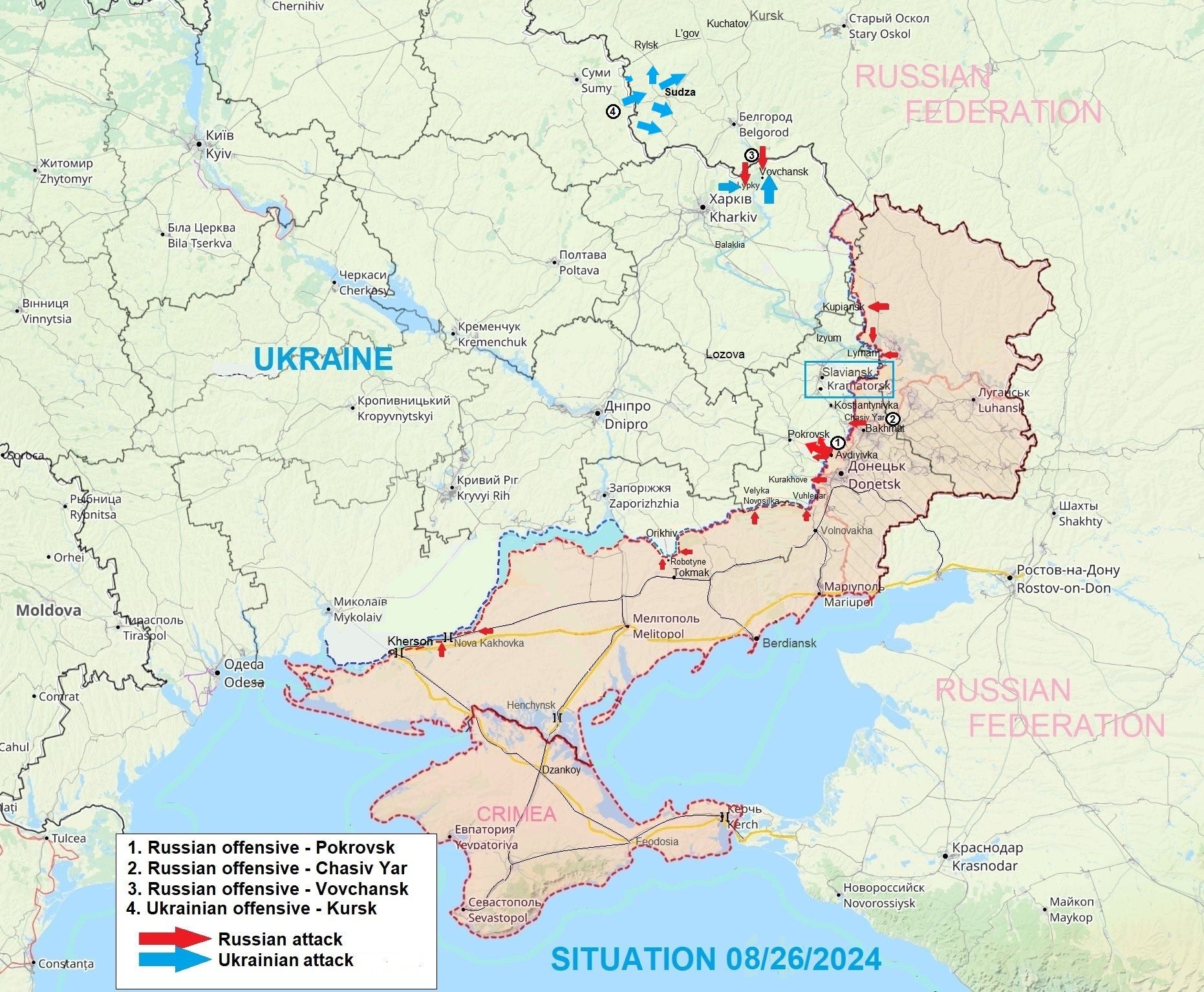
Map 1
The Ukrainians attacked with a corps-sized battle group of approximately five brigades that incorporated armor, artillery, electronic warfare assets, engineering, attack drones, tactical air support, and the robust use of special forces. In their breach of the Russian border on August 6, the Ukrainians achieved total operational surprise by maintaining tight operational security and by attacking where the Russians least expected. (The nearest large-scale fighting is located 140 kilometers south near Kharkiv). (See Map 1) The border at the breaching site, although protected by two lines of prepared defenses, was manned by border guards and inexperienced conscripts, who quickly gave way to the veteran soldiers from some of Ukraine’s elite units, like the 80th, 82nd, and 95th Air Assault brigades. [3] The elite Ukrainian formations exhibited proficiency in combined arms maneuver - something that newly raised brigades were unable to do during last summer’s Ukrainian counteroffensive in Zaporizhzhia. There are reports of hundreds, even thousands, of Russian prisoners taken during the first days.
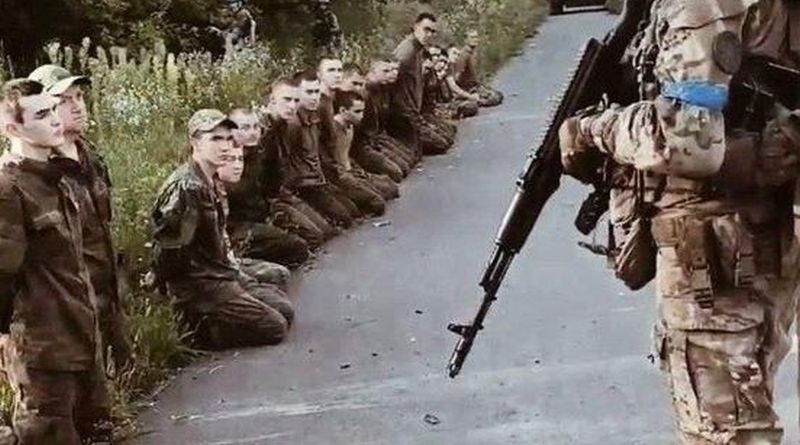
Young Russian conscripts taken prisoner near Sudza, Kursk oblast
Ukrainian forces seized the important transportation hub and natural gas transit site at the town of Sudzha, which is 25 kilometers from the city of Kursk – the focal point of an iconic Soviet victory in World War II. In all, the Ukrainians seized 1,250 square kilometers of sovereign Russian territory – more than Russian forces have been able to seize during the last six months of fighting in Ukraine. Two weeks into the offensive, the Russians were finally able to bring up some 15,000 reserves from inside Russia and East and South Ukraine to try to contain the offensive. Nonetheless, the Ukrainians are continuing to expand the flanks of their breach and started to fortify key defensive points along their front. Up to 3,000 Russian troops are trapped south of the Seym River after the Ukrainian air force destroyed three key bridges over its span, cutting off their avenue of retreat. Ubiquitous Russian pontoon bridges are constructed every day to maintain logistics, only to be destroyed by Ukrainian aviation and tactical missiles. Pushing the Ukrainians back over the border will be a major task, especially if the Russians persist in pressing their offensives in the Donbas and Kharkiv regions of Ukraine without relocating veteran forces back north to Russia. [4]
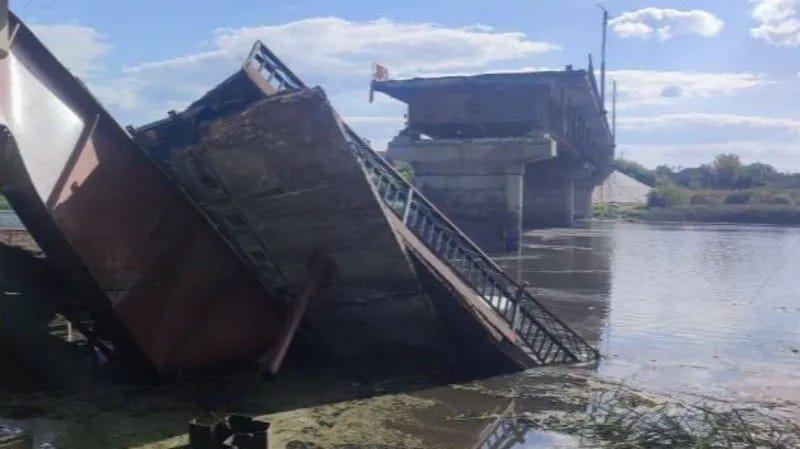
Dropped bridge over River Seym near Glushkov
Regarding stated war aims, the Ukrainians are pushing the narrative that they are creating a “buffer zone” to make it more difficult for the Russians to invade Ukraine’s Sumy region from Kursk oblast. However, anyone can see that the plan is more ambitious than that. The operational design of this offensive is as impressive in its propaganda effect as it is in its operational objectives. The psychological impact of the operation in Western capitals has already succeeded in pushing back on the prevailing Russian narrative that Ukraine is on the back foot and that Russian victory is inevitable. [5] No less a connoisseur of political nuance than Senator Lindsey Graham of South Carolina, was barely able to contain his alliteration when he described the Kursk offensive as “brilliant,” “bold” and “beautiful,” when learning of it during a visit to Kyiv on August 14. British Kremlin expert Mark Galeotti wrote that “…the Kursk offensive has sent a powerful message to Russia, the United States, and its Western partners that the beleaguered Ukrainian military can still fight, that Ukraine has the capacity to bring the war onto Russian soil, and that the Kremlin’s “red lines” can be crossed without triggering nuclear catastrophe.” [6] Furthermore, by holding Russian territory hostage the Zelensky administration blocked Putin’s stated objective to begin peace talks on the basis of “realities on the ground” – meaning cementing Russian territorial gains in place as a starting point of negotiations. [7] By holding Russian territory, Ukrainian President Zelensky is also set to push back against any new American president who tries to strong-arm Ukraine into unacceptable territorial concessions.
Meanwhile, the operational objectives of the offensive contemplate the (1) diversion of Russian reserves from hard-pressed sectors of the front in Ukraine and (2) the interdiction of the railroad connection between the town of L’gov and Belgorod, the key logistics hub for Russian operations in Kharkiv and Kupiansk. In large measure, the operational success of the Kursk operation will depend on the extent the Russians are forced to divert reserves from Pokrovsk and Chasiv Yar, their focus of main effort in the Donbas region of Ukraine. (See numbers 1 and 2 on Map 1) So far, they have refused to take the bait and persist in pushing their operational main effort in the Donbas, irrespective of the bad news emanating from Kursk. Granted, there are reports that Russian reserves have been pulled back from Zaporizhzhia oblast in the south, the Kupiansk sector in the east, and the Kharkiv front in the northeast. Thus, Ukrainian intentions to pull Russian forces from Ukraine to Russia have had some success on secondary vectors of advance. [8]
Despite Russian propaganda attempts to spin the Kursk operation as an insignificant distraction, the Ukrainian invasion shocked at least that part of the Russian populace that gets its news from social media and embarrassed Vladimir Putin like never before. Particularly, news of the hundreds of fresh-faced teenage conscripts who surrendered to the Ukrainian army did not go down very well with their parents. After all, Putin promised that the conscripts performing their one year of obligatory service shall not be used in combat. Evidently, this was an empty promise. Finally, the Ukrainian public received a much-needed dose of good news, after months of hearing about steady retreat.
Where all of this goes, nobody knows. Nuclear escalation may be in the offing if the Ukrainians continue towards Kursk unabated and Putin’s hold on power is somehow threatened. After all, for the Ukrainians to succeed where the Nazis failed in 1943 is unthinkable for Putin’s regime. Some Russian war bloggers caution that the other shoe is about to drop in another sector, meaning that the Ukrainians have used the Kursk offensive as a diversionary attack before striking somewhere else. Is Belgorod oblast that “somewhere else?” It is unlikely that the Ukrainians have the reserves and resources to be that ambitious. They are more likely to dig in and hold what they have captured so far. In any case, the ongoing invasion of Russia calls for a recalibration of Ukrainian strategy, providing me with a transition to a discussion of attrition, exhaustion, grand strategy, and centers of gravity – those vulnerabilities that provide openings for the crafting of successful military strategy.
I. ATTRITION, EXHAUSTION, AND THE POLITICAL WILL TO FIGHT
The Russo-Ukrainian War has been ongoing for thirty months. This is a conventional conflict between the Russian Federation, a nuclear regional power, and neighboring Ukraine, a non-nuclear proxy of the United States and its European allies. It is a limited war in that Russia has not used nuclear weapons and the fighting has been restricted to the border between Russia and Ukraine. The primary reason the proxy war has not turned nuclear is because Ukraine is not a member of NATO and therefore, not protected by the Article 5 trigger of the NATO Treaty. Article 5, after all, requires all NATO members to come to the aid of a member who is attacked. However, the direct involvement of U.S. combat forces in a war against Russia would quickly escalate to the nuclear level. Thus, Ukraine must fight alone, albeit with enough Western arms and support to sustain its defense, yet without escalation. This dynamic is being put to the test by Ukraine’s recent invasion of Russian territory, which was launched two weeks ago without the knowledge of Western partners. It goes without saying that the Biden administration is unhappy with the unilateral Ukrainian decision to escalate the war by invading Russian territory. It is true that Putin lashed out by launching over 200 strategic drones and ballistic missiles at Ukrainian cities and infrastructure on August 26. Nonetheless, it does not appear that he will respond with tactical nuclear weapons. However, if Ukraine makes significant inroads to the point of threatening to capture the city of Kursk, or the nuclear reactor in Kurchatov, west of the city, Putin may consider a more extreme response. There is speculation that the United States may try to curb its proxy by interrupting the flow of ammunition if the Ukrainians go too far. Time will tell whether this Ukrainian invasion of Russia escalates the war to dangerous levels or whether Ukraine has successfully crossed heretofore “untouchable red lines,” which will increase its freedom of action and that of its Western partners, who may allow the use of longer ranged strategic missiles that can reach targets deep within Russia. So far, Ukraine has attacked targets inside of Russia with its native strategic missiles and drones, which it is able to manufacture in only small batches.
Regardless, this has been the most intense conventional war on the European continent since World War II. In geographic scope the line of confrontation between both sides covers the 1,900-kilometer border between Ukraine and Russia - comparable to that of the Eastern Front between Germany and the Soviet Union in World War II. Granted, the number of combatants in this current war does not approach the millions that were involved in the fighting in 1941-1945, but only because of the increased range and destructiveness of modern weapons and the improvement in modern communications, targeting, and surveillance, which enable less troops to cover more space with firepower. Nevertheless, the number of front-line personnel involved in the ground war is substantial. Currently, approximately 580,000 Russians are squaring off against about 450,000 Ukrainians. [9] Thus, this has been a highly destructive war by any standard. Russian battlefield losses, according to French intelligence, exceed 150,000 killed – ten times the Soviet dead suffered in the ten years of fighting in the Soviet-Afghan War of 1979-1989. [10] British and American intelligence agree that so far Russia has suffered 500,000 irreplaceable casualties, including dead, seriously wounded, prisoners, and missing. [11][12] If current casualty rates continue Russian dead will exceed 200,000 by the end of 2024.
Although Ukrainian casualties are a well-guarded secret, estimates of 300,000 killed, wounded, prisoners-of-war, and missing-in-action are within the realm of probability. Ukrainian battlefield deaths will likely reach 100,000 sometime early next year. According to official UN statistics, 11,520 civilians have died and 23,640 have been injured because of Russian hostile action. [13] Furthermore, some 20,000 Ukrainian children have been deported to Russia and put up for adoption in a macabre initiative to eradicate their native identity and to redress Russian demographic shortages. [14] Finally, eight million Ukrainians have either emigrated to the West or have been internally displaced by the fighting in East Ukraine.
To put these statistics into the perspective of recent American experience, there were 2,459 American combat-related deaths in the War in Afghanistan, which lasted from October 2001 to August 2021. Total American combat deaths in the Iraq War so far, which began in 2003, amount to 3,481. Regarding the Vietnam War, which lasted roughly over twenty years but with peak US combat activity occurring between 1965 to 1973, resulted in 47,434 combat-related deaths. [15]
What the high casualty rates in the Russo-Ukrainian War suggest is that the conflict is currently at a tactical impasse with both sides resigned to a strategy of attrition, hoping that the other will be the first to fold due to exhaustion. Put differently, each side is targeting the psychological endurance and moral cohesion of the opponent’s population. In other words, each adversary is hoping that the other loses the political will to fight. Regardless, neither side is exhibiting any significant weakening of resolve. Therefore, both sides are hedging their bets by trying to strengthen their bargaining position at any future cease-fire negotiations by capturing additional territory. The Russians are pursuing the conquest of the remainder of Donetsk oblast in Ukraine, while the Ukrainians are trying to seize a sizeable chunk of Kursk oblast in Russia.
In the meantime, the war is prosecuted in accordance with military strategies that each side hopes will lead to the exhaustion of the other. The military strategies are a by-product of decisions made by the civilian political leadership of both governments at the level of national policy, where national interests are translated into foreign policy objectives after factoring the relative strengths and weaknesses of not only foreign adversaries but also allies. In furtherance of these foreign policy objectives, both combatants in this war have identified new vulnerabilities in their adversary, that may not have been apparent during the first two years of the war. These vulnerabilities, also referred to as centers of gravity, are one of the main themes of this article.
Before we discuss centers of gravity, we need to address grand strategy. Grand strategy is a sub-category of national policy that contemplates the application or threat of military force. Grand strategy is conceptually at a more abstract level than military strategy and considers a broader range of foreign policy consequences, rather than the narrower scope of purely military objectives. [16]
II. GRAND STRATEGY
Grand strategy is formulated at the highest levels of government based on intelligence assessments of the relative strengths and weaknesses of hostile adversaries, their international influence (alliances), military power, internal cohesion, and economic capacity. If the decision is made to use military force in furtherance of a foreign policy objective, the military establishment, usually the general staff (in the United States, the Joint Chiefs of Staff), is tasked with crafting a war-winning military strategy. A war-winning military strategy requires the accurate identification of the adversary’s centers of gravity, the vulnerabilities that, if sufficiently attacked, trigger the collapse of the enemy’s political will to fight. Before discussing the respective centers of gravity of the adversaries in the Russo-Ukrainian War, we need to consider the grand strategy of the actors who have a stake in this war.
a. Russia
For Russia, or more precisely its autocratic president and his narrow circle of security and defense managers, this is a war of imperial restoration as well as regime survival. Putin and his closest lieutenants aspire to roll back the humiliation that followed the dissolution of the Soviet Union by restoring Russia to its proper place as a continental power in Eastern and Central Europe. This is the historical legacy that Putin hopes to leave behind for posterity. The first prerequisite to imperial restoration is the return of Ukraine back under Russian control. After all, Ukraine had been a Russian colony from 1654 until the dissolution of the Soviet Union in 1991. While the Russian elite cannot imagine Russian greatness without a subservient Ukraine, it concurrently shudders at the prospect of an independent and economically thriving next-door neighbor that is democratic and tied to the West. Otherwise, the Russian public may begin to question its loyalty to a unidimensional economy and politically corrupt regime.
Thus, for Putin, this is both an offensive and a defensive war. It is offensive not only because he intends to reassert control over Ukraine but also because he aspires to shatter what he believes is the façade of NATO unity over support for Ukraine. In other words, he wants to force individual European states to choose between following the United States in supporting Ukraine or avoiding the wrath of Russian power in its many kinetic, non-kinetic, and hybrid forms, particularly its capacity for political subversion. Indirectly, Putin wants to remind NATO members of the potential dilemma they face if they must choose between defending the Baltics and Poland because of Article 5 of the NATO Treaty or avoiding nuclear annihilation by turning a blind eye to Russia’s mischief in Eastern Europe.
The war is defensive for Putin in that an economically viable Ukraine tied to the West presents a grave threat to the Russian elite’s domestic control. So, when Putin states that this is an existential war for the preservation of the ruskii mir (Russian world), he means it. After all, how can the Russian double-headed eagle soar if its imperial wings are clipped? Or to put it another way, how can Russia maintain domestic equilibrium without catering to the Great Russian chauvinism of its populace, which prefers Ukrainians inferior, subservient, and humiliated? It is for the above reasons that Putin decided to take advantage of Russia’s primary sources of power and influence, namely its military might, espionage and security services, and oil and gas reserves, to (1) conquer Ukraine and (2) to intimidate NATO into fracturing over the question of continued support for its former colony.
Obviously, Putin’s aspirations have fallen far short of initial expectations, which anticipated a quick decapitating strike of Ukraine’s leadership and victory on the cheap. The Russian leadership is now stuck pursuing victory through a long war of attrition more to survive politically at home than to chase geopolitical gains against NATO. Paradoxically, the Russian invasion strengthened NATO, expanded it to Finland and Sweden, and spurred the resurrection of Europe’s dormant military-industrial capacity. Lest anyone think that I agree with the position of the realists that NATO expansion caused a Russian backlash for fear of foreign invasion, it is the fear of implosion from within that keeps the Russian plutocrats up at night, not a NATO attack from the West. Russia invaded precisely because NATO was perceived as weak and would have invaded even if there was no NATO expansion or supposed CIA intermeddling in the “color” revolutions in Georgia in 2002 and Ukraine in 2004. So long as the Ukrainians obstinately continued to pursue their Western orientation after the Euro-Maidan protests in 2014, he had no choice but to accelerate his imperial project through the overt use of military force.
b. United States

Meanwhile, for the United States this is a defensive proxy war over the control of Europe without the dilemma of invoking Article 5 of the NATO Treaty. The Russo-Ukrainian War is a gift that provides the US with the opportunity to prosecute a hot war against Russia without the involvement of U.S. boots on the ground, which if properly managed, limits the risk of nuclear escalation to acceptable levels and herds the recalcitrant Europeans back under American skirts. Please recall that US influence in Europe waned after the dissolution of the Soviet Union, since the threat of Soviet invasion was no longer there. Thus, although the US has less at stake, its foreign policy elite views war in Ukraine as an opportunity to reassert US influence over a key strategic region and global market - on par with North America and the Pacific Rim in importance. As an indirect benefit, support for Ukraine also reinvigorates U.S. alliances that push back on Chinese military pressure on Taiwan and further economic expansion into global markets.
c. Europe
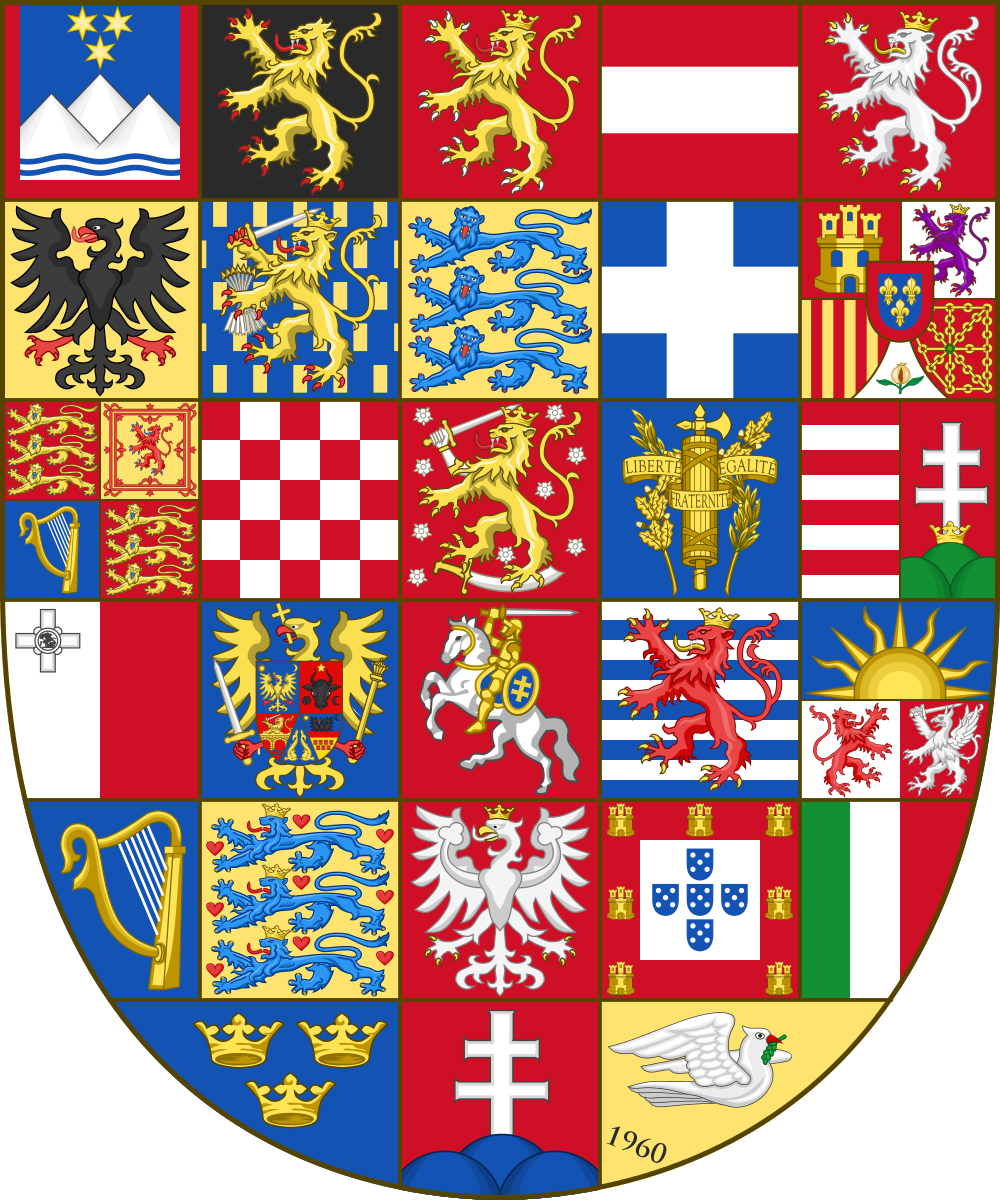
The Europeans also have a vital interest in supporting Ukraine in this war. Had Ukraine not withstood Russian aggression in February 2022, the burden of military mobilization of heretofore pacifist and recalcitrant consumer societies would have fallen on the Europeans. Apart from the Balts and Poles, enthusiasm for military service in Europe is low. Although ethnically and religiously diverse, the Ukrainians have managed to raise an effective army of 500,000 personnel. They proved that they have an officer corps that is capable of commanding large bodies of troops in modern combat operations against the powerful Russian army. Ukraine acts like a huge combat outpost for Europe that absorbs Russian military power, while the European governments buy time to decide what to do if Ukraine falls to the Russians. No less a concern for the Europeans is the prospect of yet another wave of ten million Ukrainian refugees, who would have to be absorbed by European societies, in the event of an occupation of Ukraine by Russia. When weighing the alternatives of (1) following Washington’s lead in supporting Ukraine, (2) capitulating to Russian demands for a free reign in Europe, or (3) submitting to Chinese political and economic influence in exchange for President Xi’s restraint of his junior ally, Vladimir Putin, the Europeans have so far chosen the first option. European financial and military aid to Ukraine has been substantial, collectively outstripping the totality of the aid provided by the United States, albeit the United States has been the largest single donor, when compared to the individual European states. [17] The Europeans will have to decide whether they continue with their solidarity against Russia if and when the next American president decides to defund NATO and seeks and independent accommodation with Putin.
D. Ukraine
Conversely, for Ukraine this is an existential war over the preservation of Ukrainian sovereignty and the survival of its elite, language, and culture. Therefore, this is not a limited war for Ukraine. It is in its interest to prosecute the war by any means possible, even if it requires an attack onto Russian soil. However, Ukraine has been restrained by its US benefactor and Western allies because of the threat of nuclear escalation. What this means is that it is unlikely that Ukraine can win dramatically and decisively in one fell swoop – only incrementally – lest Russia retaliate through a nuclear strike. In a scenario where Russia is on the verge of a major embarrassment, like the loss of Crimea for example, the Western Ukrainian city of Lviv becomes the most tempting nuclear target in the world. Thus, a spectacular offensive to seize Melitopil and the approaches to Crimea will probably not end the war. It will only force Putin to double down as an act of political survival and desperation. That is why the recent Ukrainian invasion of Russian territory in Kursk oblast raises the temperature in many Western capitals because it pushes the war up the escalatory ladder. If the Ukrainian offensive is too successful, resulting in a major domestic embarrassment for Putin, he may lash out in a rash manner? Or, have the Ukrainians pushed past another red line, which increases their freedom of action?
Judging by his previous reaction to the Ukrainian success in Kharkiv oblast in September 2022, Putin may be forced by the right-wing of the Russian political spectrum to order another mobilization, with all its political, economic, and social disruption. Will the Russian people blame Putin for the debacle along the border near Kursk or merely channel their anger at the Ukrainians and the West? So far, the Ukrainian strategy of denying Russia control over prestige objectives like the city of Kharkiv or the twin cities of Sloviansk and Kramatorsk in the northern Donbas ratchets up the frustration of ordinary Russians with Putin’s war. The recent involvement of teenage conscripts in the fighting in the Kursk region, hundreds of whom have been captured, is sure to make the fighting even more personal, at least for their parents. That way the war is touching the Russian people like never before. Thus, Ukrainian victory rests on the exhaustion of the Russian will to fight through the political and economic frustration of ordinary Russians. That means many more years of fighting. The ability of Ukraine to sustain its war effort depends on the continued support of the Europeans. Long-term support from the United States remains an uncertain proposition because of the volatility of its populist politics. There is no guarantee that the Ukrainian people have the stamina for such a long struggle. However, Russian ruthlessness and cruelty in the form of the unabated strategic missile bombing campaign of Ukrainian cities and power grid, atrocities by occupying Russian troops in occupied territories, and Putin’s maximalist war aims, leave the Ukrainians little choice but to soldier on. Even after two and one-half years of attritional war, Putin still seeks the capitulation of Ukraine’s government and the surrender of its military.
III. THE ELUSIVE CENTER(S) OF GRAVITY
The crafting of a decisive war-winning strategy depends on the prudent and accurate identification of an adversary’s strategic center(s) of gravity, because there may be more than one. A strategic center of gravity is a focal vulnerability, akin to the hub of a spoked wheel, or a computer motherboard, that, if sufficiently disturbed, disrupts the enemy’s physical capabilities, organizational cohesion, and moral unity of purpose to achieve the political objective of the war. A center of gravity may be tangible, like the enemy’s army or territory, or it may be intangible, like the moral support of a key sector of the population for the war. The thinking goes that if this strategic center of gravity is subjected to a shock that is sufficient to disrupt the orbit of the material, intellectual, and moral components of the war-fighting enterprise, the enemy’s will to fight will collapse. The trick is in accurately determining the enemy’s center(s) of gravity. That is easier said than done. Like many seminal ideas about the nature of war, the concept of the strategic center of gravity originates with the 19th century Prussian theorist Carl von Clausewitz in his seminal German-language treatise, On War. [18] For von Clausewitz, the starting point in a search for a center of gravity is the enemy’s army, capital or key province. Von Clausewitz borrowed the concept of the center of gravity from the Newtonian physics of his day, particularly the law of universal gravitational pull. [19] It is an abstract idea that is difficult to translate into tangible events. Thus, von Clausewitz has been often misunderstood and criticized for allegedly focusing on the opponent’s army as the strategic center of gravity at the exclusion of moral and psychological factors. This criticism was pervasive following the First World War, where endless slaughter during the first three years of the conflict failed to achieve victory. Likewise, American theorists chastised von Clausewitz for his apparent singular focus on the destruction of the enemy’s army, when looking for an explanation for American defeat in the Vietnam War, where a strategy of attrition of the Vietcong and North Vietnamese forces failed to lead to victory. [20][21] However, a closer reading of von Clausewitz indicates that this is not necessarily so. Apparently, his most nuanced ideas have been lost in translation. His musings on the subject are best encapsulated in the following phrase:
“It is possible to increase the likelihood of success without defeating the enemy’s forces. I refer to operations that have direct political repercussions.” [22]
Therefore, the collapse of the enemy’s will to fight does not necessarily occur within a fighting army itself. It may develop within the political leadership of a government, the general population of the state engaged in war, or within an alliance that supports one of the combatants with arms and funding. With both sides in the Russo-Ukrainian War pursuing strategies of attrition, we need to discuss their respective vulnerabilities, or centers of gravity, that motivate the pursuit of these strategies. In Part II of this article, I discuss the respective Russian and Ukrainian centers of gravity.
______________________________________________________________________
[1] Oblast is a Soviet-era term for a larger political territorial subdivision of a nation-state, formerly known in the Russian Empire as a gubernia. It is akin to an American state.
[2] Ukrainian leader who led an army of 18,000 Cossacks in support of Polish Crown Prince Wladyslaw IV’s pretensions to the Russian throne during the Polish-Muscovite War (1605–1618). The Cossacks besieged Moscow in 1618 but ultimately retreated, resulting in the signing of the Treaty of Duelino between the Polish-Lithuanian Commonwealth and Muscovy, which enabled the ascendancy of the Romanoff lineage to the Russian throne. Hrushevsky, Mykhailo. “History of Ukraine-Rus', Vol. 7: The Cossack Age to 1625.” Canadian Institute of Ukrainian Studies (CIUS), 1999.
[3] Isabel Coles. Ukrainian Soldiers Describe Rapid Offensive Across Border as Russians Fled. WSJ. August 13, 2024.
[4] Michael Koffman, Ryan Evans. How Ukraine re-introduced dynamism into the war. Russian Contingency. August 21, 2024. http://warontherocks.com
[5] Sveta Yafimenko. Kyiv’s Kursk Offensive and the Symbolic Theater of War. Foreign Policy in Focus (FPIF), August 13, 2024.
[6] Mark Galeotti. Will Ukraine’s Kursk Offensive Pay Off? The Spectator. August 8, 2024.
[7] Oxana Shevel. In Brief: The Ukrainian Operation Into Kursk. WOTR, August 21, 2024.
[8] Jack Watling. Ukraine’s extraordinary incursion into Kursk has changed the narrative of the war – but is a high-risk strategy. The Guardian. August 17, 2024.
[9] Jack Watling. Russian Military Objectives and Capacity in Ukraine Through 2024. RUSI, February 13, 2024.
[10] France estimates that 150,000 Russian soldiers have been killed in the Ukraine war. France24. March 5, 2024.
[11] George Allison. UK Estimates Half Million Casualties in Ukraine. UKDJ. June 2, 2024.
[12] Chris York. As Russian losses in Ukraine hit 500,000, Putin buries future demographic risks at home. Kyiv Independent. May 25, 2024.
[13] Ukraine civilian war casualties 2024 | Statista, July 31, 2024.
[14] Ukrainian children, abducted by Russia and then returned, are speaking out: NPR, February 5, 2024.
[15] Defense Casualty Analysis System (osd.mil)
[16] Edward N. Luttwak. Strategy. The Logic of War and Peace. (The Belknap Press at Harvard Press: Cambridge, Mass., and London, England, 1987), 177-189.
[17] Christopher Wolf, Elliott Davis, Jr. Countries that have committed the most aid to Ukraine. US News and World Report, February 23, 2024.
[18] Clausewitz, Carl Von. On War. Translated by Peter Paret and Michael Howard. (Princeton, NJ: Princeton University Press, 1976), 485.
[19] Friedman, B. A. On Tactics. (Naval Institute Press: Annapolis, 2017), 168.
[20] Harry G. Summers, Jr. On Strategy: A Critical Analysis of the Vietnam War. (Random House: New York, 1995).
[21] John R. Boyd. “Discourse on Winning and Losing.” Lecture at USMC Command and Staff College. Marine Corps University, Quantico, VA. April 25, May 2, May 3, 1989. Based on John R. Boyd’s outline “Patterns of Conflict,” 1982.
[22] Clausewitz, supra.
No posts
Comments
Nothing yet. Say the first thing.
Sign in to join the conversation.