

Mount Korachun behind slag heaps between Sloviansk and Kramatorsk
Recent reporting in mainstream media regarding the progress of the Russo-Ukrainian War fluctuates between despair and euphoria. Through May of 2024 Russia was reportedly advancing everywhere and there was no way for Ukraine to win, particularly if the US House of Representatives continued to block further military aid to the beleaguered Ukrainians. The Russian capture of Avdiyivka on February 24, 2024, represented the nadir of gloomy assessments, as the fall of the heavily fortified town opened the path for Russian forces to the strategic logistics hub at Pokrovsk to the northwest or towards Kostiantynivka, a steppingstone to the politically strategic city of Kramatorsk to the northeast. (See Russian offensive #1 on Map 1) However, on April 24, 2024, when Republican Speaker of the House Mark Johnson relented and allowed a vote on the aid package to proceed, opinions about Ukrainian prospects temporarily brightened, although not for long. When Russian forces opened a new offensive towards Kharkiv on May 10, 2024, doubt began to set in regarding the ability of Ukraine to hold on. (See Russian offensive #3 on Map 1) By June 1, 2024, however, the headlines began reporting that the Kharkiv offensive had stalled. News services focused on the exorbitant losses suffered by the Russians. Reportedly, on June 9, 2024, the Russians lost 1,270 people, the highest daily loss of the war. [1] Moreover, during May alone, nearly 40,000 Russian personnel were killed, wounded, taken prisoner and missing in action, the highest monthly rate of the war. [2] Some articles mentioned that such losses were unsustainable and perhaps Vladimir Putin’s hold on power was somehow in the balance. [3][4] Finally, as of the posting of this article, it is apparent that the Kharkiv offensive is but a diversion, albeit large in scope, intended to deflect Ukrainian reserves away from a powerful Russian offensive that simultaneously threatens Pokrovsk and Kostiantynivka. (See offensive #1 on Map 1) Combat operations continue while Ukrainian president Volodymyr Zelensky attends the G7 Conference in Italy and then presides over a unilateral international peace summit on 15-16 June 2024 in Bürgenstock, Switzerland. This article attempts to place recent developments into their operational and tactical context.
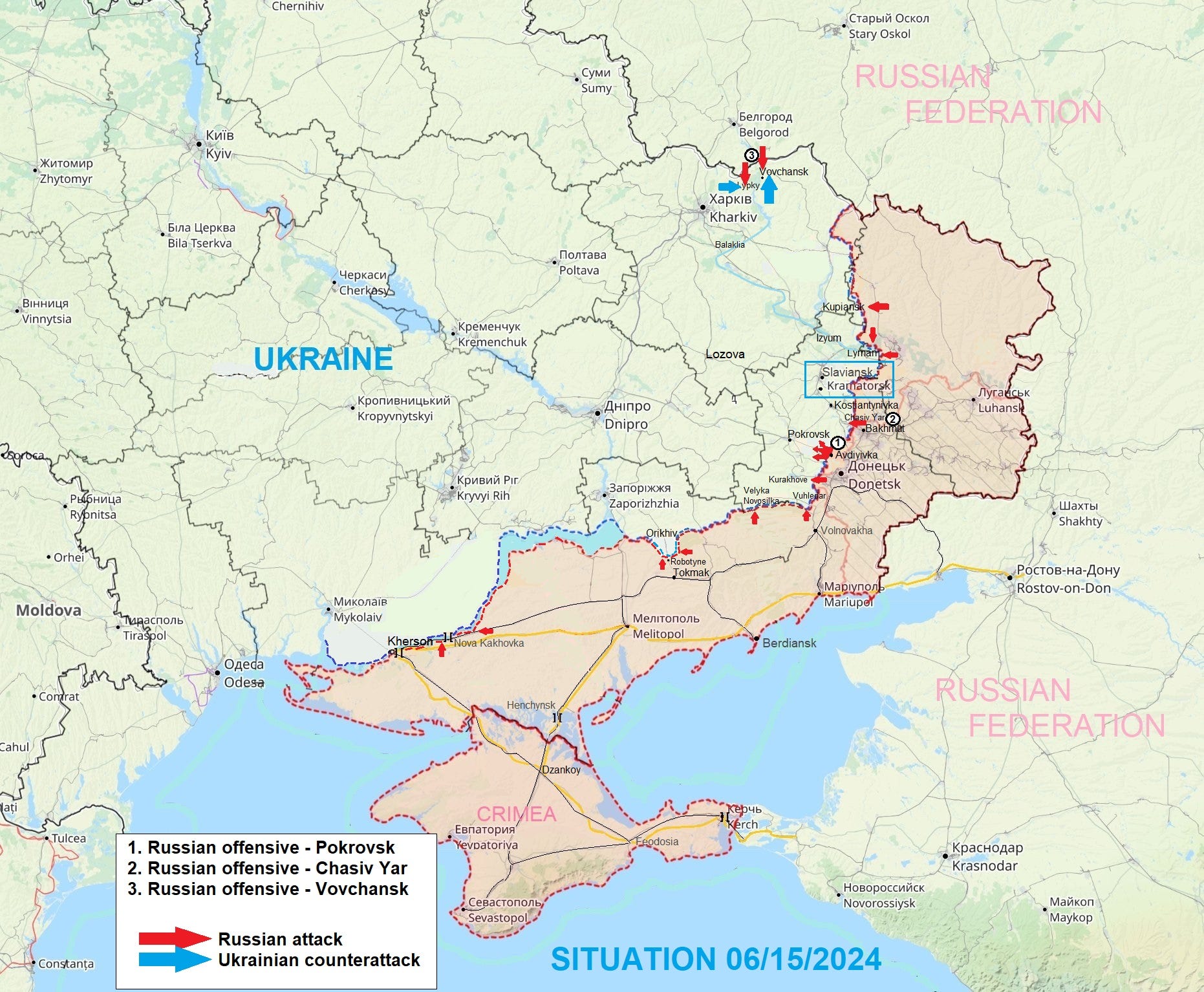
Map 1
Before I discuss the causal factors that influence this current phase of the war, I must stress that the conflicting headlines follow the propaganda messaging that is pushed relentlessly by both sides. It appears that tactical results on the ground have value only if they can be spun into propaganda that targets an intended audience, both foreign and domestic. In other words, tactical events have substance only if they lay an ostensible foundation for the propaganda narrative to follow. In that regard, Vladimir Putin’s propaganda offensive to convince voters in Western democracies that Russian victory is inevitable has been his greatest success, even if facts on the ground are nowhere as bleak for Ukraine as Putin would have you believe. The messaging questions continuing Western support for Ukraine, if the outcome is already predetermined. No less important is his separate messaging to the Russian people regarding progress in this war. The Russians have sacrificed over 150,000 souls for the as-of-yet unrealized satisfaction of bringing the “disloyal” Ukrainians to heel. Russian domestic support is sustained by a concerted distortion of military successes, which upon close examination, have not been very impressive. Since the capture of the port of Mariupol in May 2022, the Russian army has yet to capture a major Ukrainian city. Moreover, Crimea is rendered indefensible, effectively shut off from major resupply by Ukrainian missiles and drones. The Ukrainians, who have no navy, succeeded in chasing the Russian Black Sea Fleet out of the great naval base at Sevastopol and sent it packing to Novorossiya in the Eastern Black Sea. The Russian navy no longer interdicts Ukrainian shipping in the Western Black Sea littoral, enabling Ukraine to resume its export of grain to the Global South. Nevertheless, since Fall 2023 Russia has placed the Ukrainian ground forces under substantial stress on multiple fronts and continues to enjoy the strategic initiative. What contributes to this Russian advantage?
The causal factors that contributed to the current operational-tactical situation are (1) Russian manpower superiority, (2) shortage of Ukrainian artillery ammunition, (3) shortage of Ukrainian anti-air missiles, (4) interruption of US aid in the House of Representatives, and (5) the inadequate Ukrainian mobilization of replacements. After discussing each factor separately, I close my article with a discussion of the operational and tactical objectives that both sides will likely pursue during the remainder of 2024. The twin cities of Sloviansk and Kramatorsk figure prominently as prestige objectives in Putin’s War.
a. Manpower Levels
Ukraine’s Summer counteroffensive culminated in October 2023 - ten kilometers short of its minimal operational objective of Tokmak. [5] Russia immediately went on the offensive on multiple fronts and by December of 2023 recaptured the strategic initiative. [6] The Russian General Staff timed its offensive, or rather multiple offensives, to take advantage of an accumulated stock of 70 newly raised regiments (140,000 men), some of which were used to replace losses at the front, but some of which were set aside for new offensives. [7] (See red attack arrows on Map 1) For the first time in the war, the Russian army was able to exceed Ukrainian manpower levels in the theater of operations. Please recall that Ukrainian victories in 2022 coincided with a clear Ukrainian manpower advantage, which was not addressed by Russia until September 21, 2022, when Putin ordered a partial mobilization of 300,000 new inductees. Concurrently, the Russian army began a recruitment campaign that offered Russian volunteers financial inducements far in excess of the average blue-collar salary. This recruitment campaign proved popular in the rural and peripheral regions of Russia, both among poor ethnic Russians and the even more destitute non-Russian ethnic minorities. An altogether separate source of manpower was tapped by Evgeny Prigozhin, Putin’s former chef, who impressed 40,000 convicts from Russian penal colonies into his Wagner Group, a private army of mercenaries. However, after Prigozhin’s aborted mutiny over a pay dispute in June 2023, Putin lost his appetite for mercenary condottieri [8] and looked for alternate sources of cannon fodder. These were found outside of Russia through recruitment drives of foreign mercenaries from countries as far off as Serbia and Nepal. According to the latest reports from British Military Intelligence, Russia is recruiting mercenaries from central African countries like Rwanda, Burundi, Congo, and Uganda. [9] Reportedly, during the second half of 2023 the Russian military was able to sustain a recruitment rate of up to 30,000 new volunteers per month. Western intelligence assessments posit that currently, the Russians have 470,000 troops in theater. [10] The Ukrainians count only 466,000. [11]
Concurrently, Ukraine persists in defending with the remnants of its initial force of pre-2022 professionals and post-invasion volunteers, replacing losses with a tepid mobilization effort from mostly rural and poorer areas. Moreover, the better Ukrainian assault brigades, like the 3d Assault and the 47th Mechanized Brigades, recruit privately on social media outside the aegis of the military or government, looking for younger and better-motivated volunteers. However, these efforts are unable to fully replace Ukrainian losses, especially in quality. Thus, the ranks of the frontline Ukrainian brigades continue to shrink through attrition. Losses of experienced company and battalion commanders are acutely magnified since these are impossible to replace. Open sources do not reveal much about Ukrainian manpower levels, but an educated estimate places the number of available ground combat forces at about 400,000. Let us explore this estimate below.
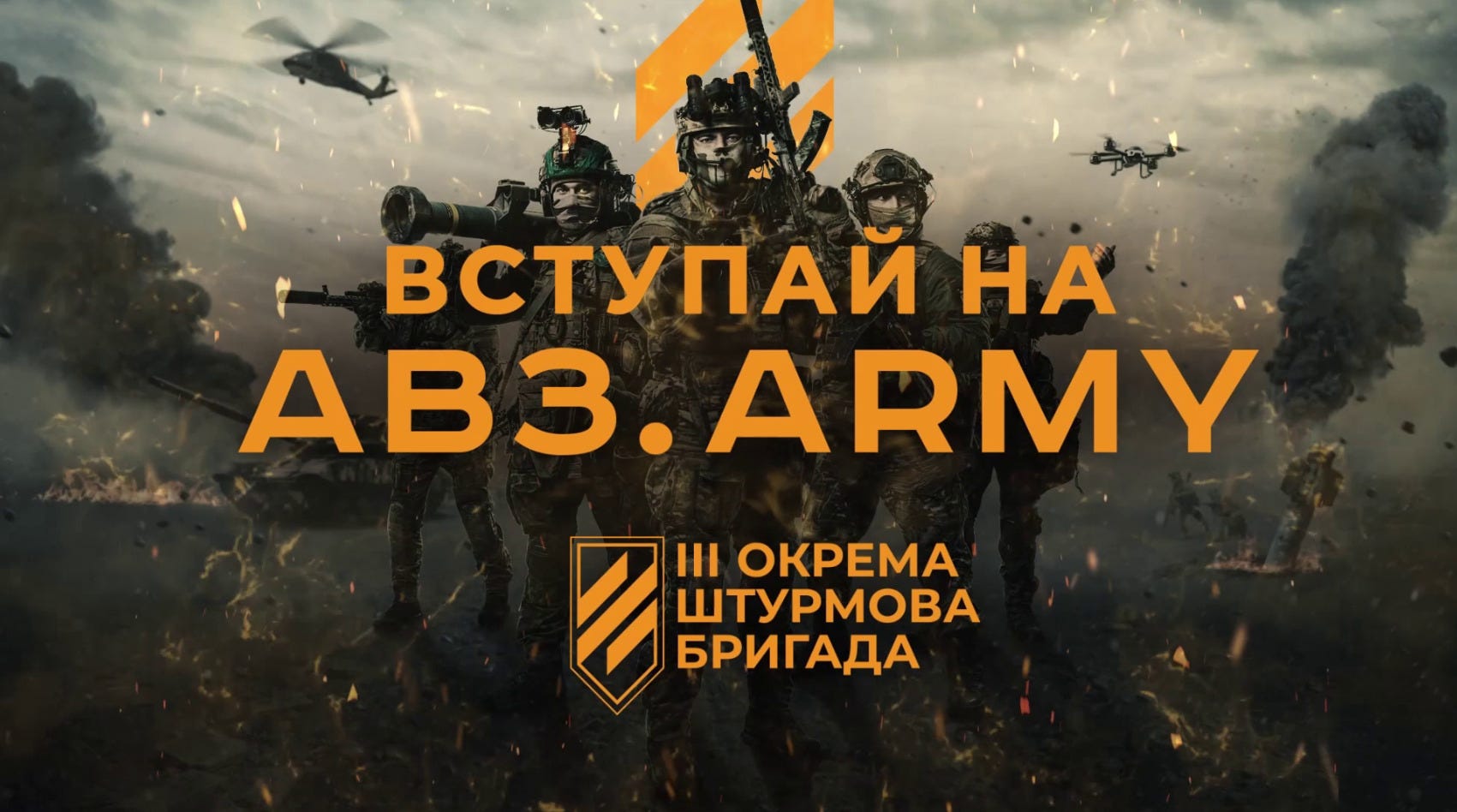
Recruiting poster of 3d Assault Brigade
Open sources indicate that Ukraine’s ground forces include 42 mechanized brigades, four motorized brigades, six foot-infantry brigades, two mountain brigades, three assault brigades, 12 airborne/air assault brigades, three Jager (light infantry) brigades, and four marine brigades – 76 maneuver brigades in all. [12] Given the attrition rate at the front and the inadequate mobilization of replacements, these are staffed at below their 4,000-4,500 optimum levels. The better brigades contain 2-3 mechanized battalions with tracked or wheeled armored vehicles and an additional two motorized infantry battalions in wheeled transport, together with a tank battalion (31 tanks) and an artillery battalion (12 guns and six MLRS rocket systems). However, some of the motorized and/or recently raised foot-infantry brigades tend to be smaller and have no more than three infantry battalions mounted in American HUMVEES, or similar light vehicles of Ukrainian manufacture. Thus, if we use an average of 3,000 fighters for each maneuver brigade, the Ukrainian ground forces can field approximately 228,000 front-line fighters. If one adds the 15 artillery and three rocket/missile brigades (1,000 each) and five tank brigades (2,000 each), the number of combatants increases to 256,000. Concurrently, the National Guard fields nine operational brigades, which at an average rate of 3,000 personnel, contribute 27,000 combat personnel to the tally. Additionally, the local reserves of the Territorial Defense Force (TDF) contain 30 brigades of what is in effect militia, which supplement the regular forces with another 100,000 men and women. However, most of these have marginal value on the offensive and are useful only as secondary defensive formations. Some of the TDF subunits are also a refuge for potential recruits who are shirking mobilization into the regular army by relying on the protection of local politicians to serve in rear area billets away from the front lines. In any case, no more than ten TDF brigades are performing front-line service along the active front at any given time. Most remain in their local garrisons as a last-ditch reserve or have occupied fortifications on the relatively quiet northern and northeastern sectors of the border with Russia near Chernihiv or Sumy, and near Transnistria in the southwest. Finally, Ukraine has a multitude of special forces units in the Army, the National Guard, military intelligence (HUR), and national intelligence services (SBU) that number approximately 10,000 operatives. Therefore, Ukraine has a total of approximately 393,000 fighters available for frontline service or in training. However, this is an older force with an average age of 42 years, resulting in an acute shortage of assault infantrymen – those who have the young legs and lungs to run around the battlefield and jump into and out of trenches. With the exception of the special forces, assault, and airborne, most Ukrainian brigades can barely muster one company (120 fighters) of assault infantrymen.
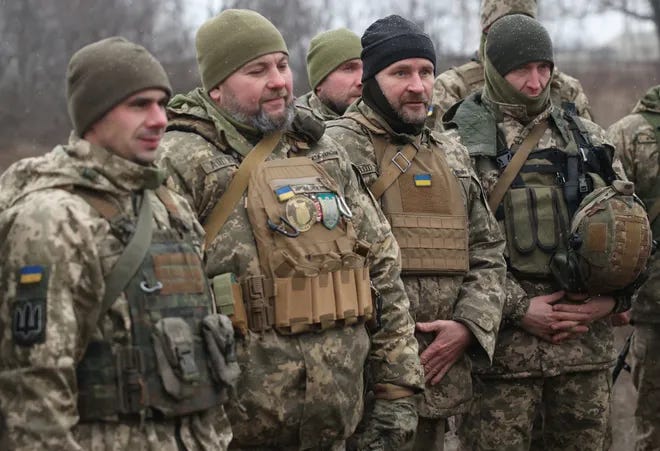
Not-so-twenty-something Ukrainian infantrymen
b. Artillery Ammunition Shortage
Beginning on October 25, 2023, Republican Congressman Mike Johnson of Mississippi, the newly minted Speaker of the US House of Representatives, began using parliamentary procedure to block a vote on further US military aid to Ukraine. Thus, after Ukrainian stocks of artillery ammunition were depleted by the fighting in the Fall of 2023, Russia began to attain a superiority in artillery fire. By December 2023 the Russians were firing five artillery shells for every Ukrainian shell. [13] Meanwhile, the West Europeans were still in the early stages of re-establishing their military-industrial output and could not fill the void. Fortunately, Czechia came through with funding to buy up some of the residual stocks of Soviet-era 152 mm artillery ammunition in the Global South, but this supply is just beginning to arrive at the front. [14] (The Czechs were competing with Russian brokers, who were also buying up Soviet-era ammo to replenish their own stocks.) Therefore, the Ukrainian command was forced to ration artillery ammunition for use in dire straits only, usually during local counterattacks. This enabled the Russians to mass larger formations in their assembly areas without the fear of large-scale bombardment, increasing the punch of their attacks. Ukraine attempted to compensate for the artillery shortfall by utilizing thousands of first-person-view (FPV), so-called “racing drones,” which Ukrainian cottage industry produces at a monthly rate of up to 150,000. [15] However, the reality is that up to 80% of active drones are blinded before they hit their targets through electronic jamming of their video feed or disabled because of an interruption of their radio control signals to the operator in the rear. Moreover, the widely used cheap Chinese Mavic quad drones are limited in effective range by the extent of their radio signal, usually five kilometers. In comparison, conventional artillery fire is not dependent on electronic signals but on accurate coordinates that calibrate standardized artillery barrel gauges and powder charges to enable the guns to accurately hit targets up to 30 kilometers away. Unquestionably, artillery is dependent on the correction of its fire by aerial observation drones but otherwise is much more reliable. Thus, attack drones are only a partial offset of Ukraine’s diminished artillery firepower. Furthermore, the Russians have used the compulsive power and purse of the central state to mass produce drones in larger quantities than the Ukrainians, albeit of lower quality. Therefore, Ukrainian front-line troops are tormented by Russian drones at no less a scale than the Russians are by Ukrainian drones.
c. Anti-Air Missile Shortage
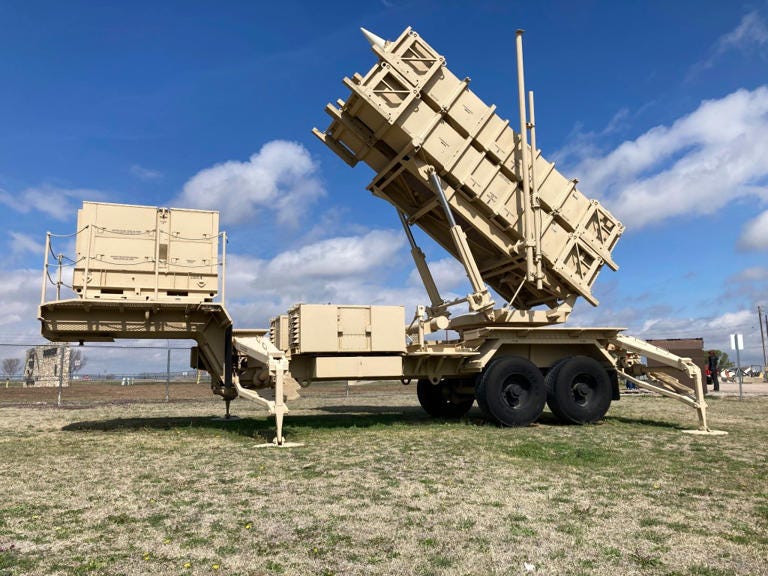
Similarly, the procedural block on a vote on US aid to Ukraine in the US House of Representatives stopped the resupply of vital S-300 and Patriot long-range anti-air missiles. Concurrently, the Russian strategic missile and drone bombing campaign directed at the Ukrainian power grid, large urban centers, and air bases diminished the supply of available anti-air missiles, leaving few available for use in protecting Ukrainian troops at the front. Ukraine is a democracy subject to the whims of voters. Thus, civilians in the major urban centers get the priority when defending against air attack. That leaves few long-range anti-air missiles available for use against Russian fixed-wing tactical aircraft, which can now safely approach within 45 kilometers of the line of contact to launch glide munitions from high altitude without fear of interdiction. As a result, the Russian army can concentrate larger mechanized formations closer to the front without fear of large-scale artillery bombardment and with improved tactical air support, now that the Russian fixed-wing aircraft are able to launch munitions from closer in. The cheap but plentiful 500-kilogram FAB glide bombs (KAB in Ukrainian) became a particular threat to Ukrainian defenses in built-up areas, since the closer launch point increased their accuracy and destructive power. [16]
d. Russian Capture of Avdiyivka
By taking advantage of their superiority in fires and air support, the Russians were able to launch sequential frontal attacks at a higher tempo than was the previous norm, particularly at Avdiyivka and west of Bakhmut at Chasiv Yar. [17] Reportedly, some Ukrainian positions were attacked ten times daily, which even if beaten back without Ukrainian casualties, exhausted the defenders physically and depleted their ammunition. Consequently, the Russians were able to make slow but steady gains against shattered defenses and exhausted Ukrainian defenders, albeit at a horrible cost in Russian lives lost and equipment destroyed. Reportedly, the Ukrainians still enjoy a favorable casualty exchange rate vis-à-vis the Russians, sometimes reaching one-to-eight but rarely lower than one-to-four. [11][13] This is accomplished by utilizing an elastic defense, with lightly manned advance outposts and larger reserves sheltered well to the rear. But when Russian fires destroy built-up urban areas or fortifications, the Ukrainians must pull back to new positions to deny Russian artillery and airpower targets in the open, which otherwise have nowhere to shelter or hide. Trading space for time, the Ukrainians have managed to prevent any major ruptures of their front. Nevertheless, there have been several reported near-disasters during tactical withdrawals, such as at Avdiyivka and Ocheretyne, where because of an interruption in Ukrainian command-and-control at brigade level and above, companies or even entire battalions were mauled, and scores of Ukrainians taken prisoner. Potent Russian electronic warfare intermittently jams Ukrainian radio communications, which in moments of crisis at the front, is exacerbated when command vehicles are forced to move to the rear.
Reportedly, by Spring 2024 Russian overall casualties in the Russo-Ukrainian War in killed, wounded, and missing reached 500,000. [4] Regardless, on February 17, 2024, the Russians were able to push the Ukrainians out of the heavily fortified salient at Avdiyivka and then to seize the village of Ocheretyne, a mere eight kilometers from the main highway linking the logistics hub at Pokrovsk with the strategic city of Kramatorsk. The capture of Avdiyivka was the most significant Russian victory since May 23, 2023, when Evgeny Prigozhin’s Wagner mercenaries and convicts captured Bakhmut. Although, like Bakhmut, Avdiyivka qualifies as no more than a tactical success, not an operational one. Its capture opens easier access to the main supply lines from Pokrovsk to Kramatorsk and threatens Ukrainian forces at Toretsk, to the southeast. At the same time, another Russian offensive further east towards Chasiv Yar enables the Russians to advance on the equally politically significant city of Sloviansk. (See Russian offensive #2 on Map 1)
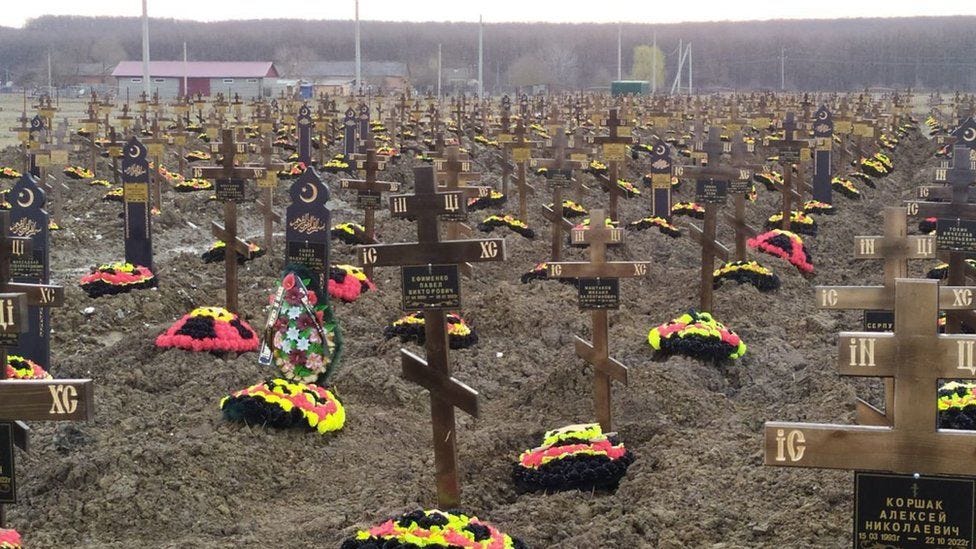
Cemetery of Wagner dead.
The twin cities of Sloviansk and Kramatorsk are located a mere five kilometers from each other in North Donetsk oblast. (See blue box on Map 1) Sloviansk and Kramatorsk are of major symbolic significance to Putin, since their capture will formally complete Russian control over the entire Donbas. Russian voters remember Sloviansk and Kramatorsk from the fighting in May-June 2014, when GRU (Russian military intelligence) colonel Igor Girkin’s Russian proxies seized Sloviansk in May 2014 but had to later abandon it in the face of a Ukrainian counteroffensive. Control of Sloviansk and Kramatorsk will be substantive proof to the Russian public that the cost and sacrifice of Putin’s special military operation is bearing fruit and will ease potential domestic pressures against the war. Like Stalingrad during World War II, Sloviansk and Kramatorsk are a symbolic center of gravity, which will determine the immediate psychological trajectory of this conflict, for both sides.
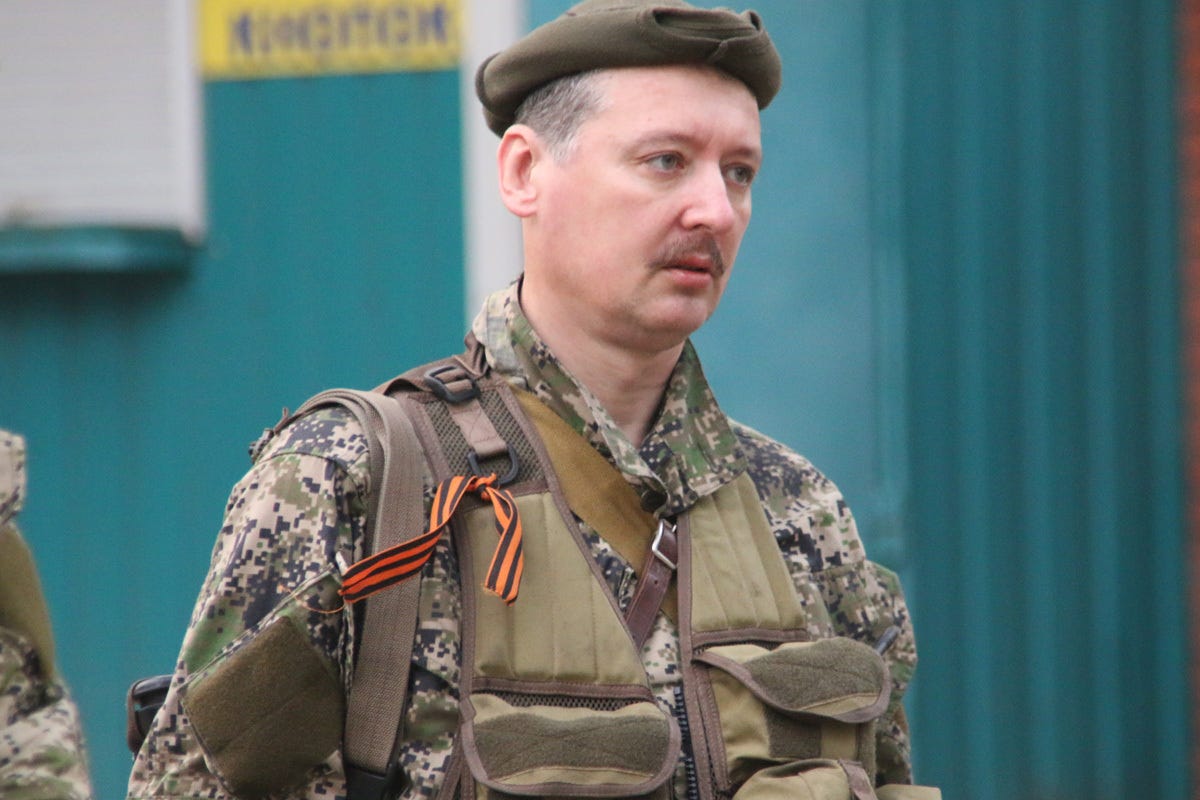
GRU Colonel Igor Girkin a/r/a Strelkov in Sloviansk in May 2014
e. Ukrainian Mobilization Deficits
The fighting for Avdiyivka exposed a shortage of competently trained Ukrainian infantry replacements, especially younger men who are physically qualified for assault detachments. Some of the recently mobilized Ukrainian conscripts revealed a lack of training and motivation that was no better than that of their Russian counterparts. Only the tactical acumen of Ukrainian company commanders and swarms of Ukrainian drones kept the front lines from collapsing. This was a symptom of Ukraine’s ineffective mobilization policy, which lacks the requisite compulsory mechanisms to induct new recruits or to punish draft evaders. Catering to political pressures, the Zelensky administration does not wish to alienate the more affluent urban middle class, which takes advantage of loopholes to enable their sons to avoid service and/or to escape to the West, while the poor rural areas are targeted for induction. I remind readers that like Russia, Ukraine has a serious demographic problem, in that sharply lower birth rates after the dissolution of the Soviet Union resulted in a much smaller pool of young men in their twenties, when compared to the available pool of older men in their thirties or forties. [18] Therefore, during the first two years of the war, Ukraine mobilized only those men over 27 years of age, to preserve its potential for siring future generations. However, by the Spring of 2024, insufficient and inferior manpower become a Ukrainian weakness on a par with the dearth of artillery ammunition and anti-air assets. If not addressed, it will affect Ukrainian prospects to sustain this long war. On May 18, 2024, after months of haggling in the Ukrainian Parliament and more than 4,500 proposed amendments, a series of new mobilization laws were finally signed by President Volodymyr Zelensky. The laws (1) lowered the minimum age for military service from 27 to 25, (2) established an online national data bank for the registration of eligible draftees, (3) defined the applicable exclusions from service, and (4) increased punitive measures for non-compliance or evasion. For instance, violators are prohibited from operating a motor vehicle, opening a bank and/or credit card account, or receiving social benefits. Its effectiveness, however, has yet to be tested. [19]
e. Russian Kharkiv Offensive
On May 10, 2024, Ukraine’s defensive woes increased when the Russian army opened a new front northeast of Kharkiv, Ukraine’s second-largest city (population 1.3 million). Russian forces attacked on two separate vectors, one aimed towards Lypky; the other against Vovchansk (See Russian offensive #3 on Map 1). According to Ukrainian military analyst Konstantyn Mashovets, 35,000 Russian soldiers, 1,500 armored vehicles, and 30 battalions of artillery (360 guns) were committed to the attack. These consisted of subunits of the 11th Corps: (18th Motor Rifle Division, reinforced by the 7th Motor Rifle Regiment); 1st Tank Army: (2nd Motor Rifle Division, 47th Tank Division, and the 138th and 27th Independent Motorized Brigades); the 44th Corps: (72nd Motor Rifle division reinforced by the 128th Independent Motorized Brigade); and the 6th Army: (138th and 25th Independent Motorized Brigades). [20] The attack on Kharkiv is likely the opening act of Russia’s new Summer offensive. Nonetheless, it is unlikely that the Russians are ready to expend the 100,000 or more souls that are necessary to capture this major urban center, which has the potential to develop into a bloody butcher’s mill. More likely, they are treating this as a diversionary attack. By attacking the town of Vovchansk to the northeast of Kharkiv the Russians are hoping to (1) threaten Ukrainian troops to the southeast at Kupiansk, along the Oskil River, and (2) to pull operational reserves away from Chasiv Yar and Pokrovsk in the South Donbas. The loss of Kupiansk would open the way for Russian forces to advance on Balaklia and Izyum, which the Ukrainians recaptured following their successful counteroffensive in September 2022. Meanwhile, the capture of the high ground near Chasiv Yar will enable the Russian army to direct fires at Ukrainian defenses on lower terrain to the northwest as it advances toward the politically significant city of Sloviansk. (See Russian offensive #2 on Map 1) As explained earlier, the capture of the road network at Pokrovsk will threaten supply lines to the equally politically significant Kramatorsk. (See Russian offensive #1 on Map 1)
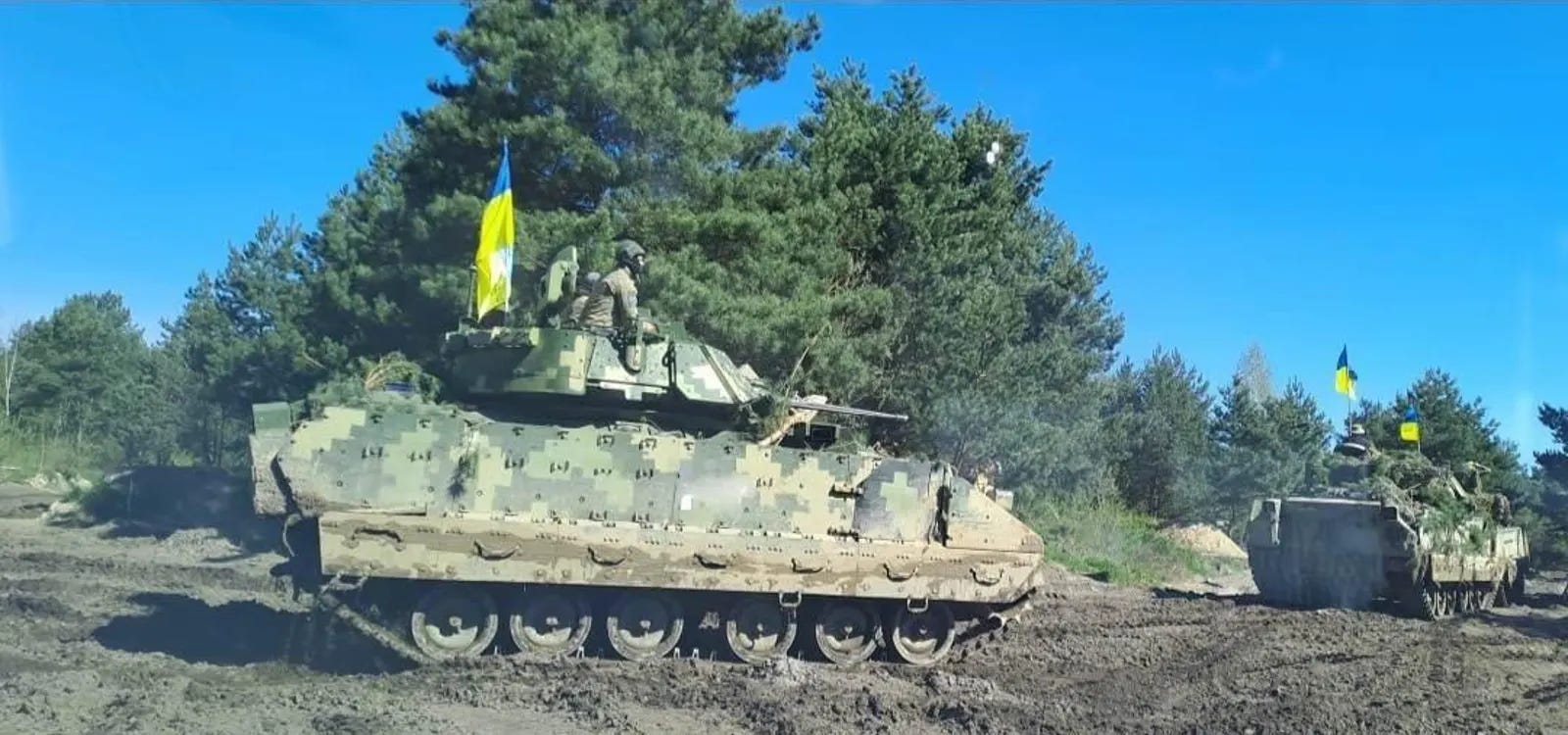
Counterattacking Bradley Infantry Fighting Vehicles of 47th Mechanized Brigade
f. Resumption of US aid
In any case, fortune smiled upon the Ukrainians when on April 24, 2024, after six months of procedural delay by right-wing Republicans, Speaker of the House Mike Johnson changed his mind and allowed a vote on over 60 billion dollars in military aid to Ukraine. The vote passed the appropriation in the US House and was followed by quick approval in the US Senate. It goes without saying that American ammunition and weapons did not begin arriving immediately and are not expected to substantively influence the fighting until late Summer. However, some benefits of the appropriation were immediate. Firstly, the new aid package emboldened the Ukrainian General Staff to release emergency reserves of artillery ammunition, which began making its precarious railway journey to the east, where the shells could be used to break up Russian attacking formations before they reach exhausted and hard-pressed Ukrainian defenders. Second, the congressional appropriation of aid to Ukraine forced the Russian General Staff to launch its Kharkiv offensive prematurely, as the Russian high command apparently decided to attack before American aid reached Ukrainian front-line units. Consequently, despite early Russian successes in the so-called “security zone” along the border in advance of Ukrainian prepared defense lines east of Kharkiv, the Ukrainians were able to contain both attacks. First, the Ukrainian security-service (SBU) and the equally competent military intelligence branch (HUR) had been warning of the offensive near Kharkiv for months. Thus, Ukrainian commanding general Oleksander Syrsky was able to prepare reserves and artillery ammunition for a counterattack against the Russian attacking columns at Lypky and Vovchansk. Elements of the 42nd mechanized, 92nd mechanized, 82nd airborne, 68th Jager, and 36th Marine brigades, together with artillery assets, began arriving at the Kharkiv front by May 15 and inflicted catastrophic losses on the Russians. [12] Reportedly, in May 2024 the Russian monthly losses were some of the highest of the entire war. By the end of May 2024, the consensus was that the Russian offensive at Kharkiv had stalled, for now. [21] Nevertheless, Russian attacks not only resumed but intensified in the Southern Donbas at Ocheratyne, Chasiv Yar, Krasnohorivka, and near Kurakhove, confirming that the Kharkiv offensive was a diversionary attack. As of June 12, 2024, the brigades of Russian army group “Center” have gained momentum in pushing north of Avdiyivka, concurrently threatening Pokrovsk to the northwest and Kostiantynivka to the northeast. This places the Ukrainian General Staff on the horns of a dilemma regarding where to send their strategic reserves, or whether to dilute their effort by reinforcing both at the same time. (See Map 2)
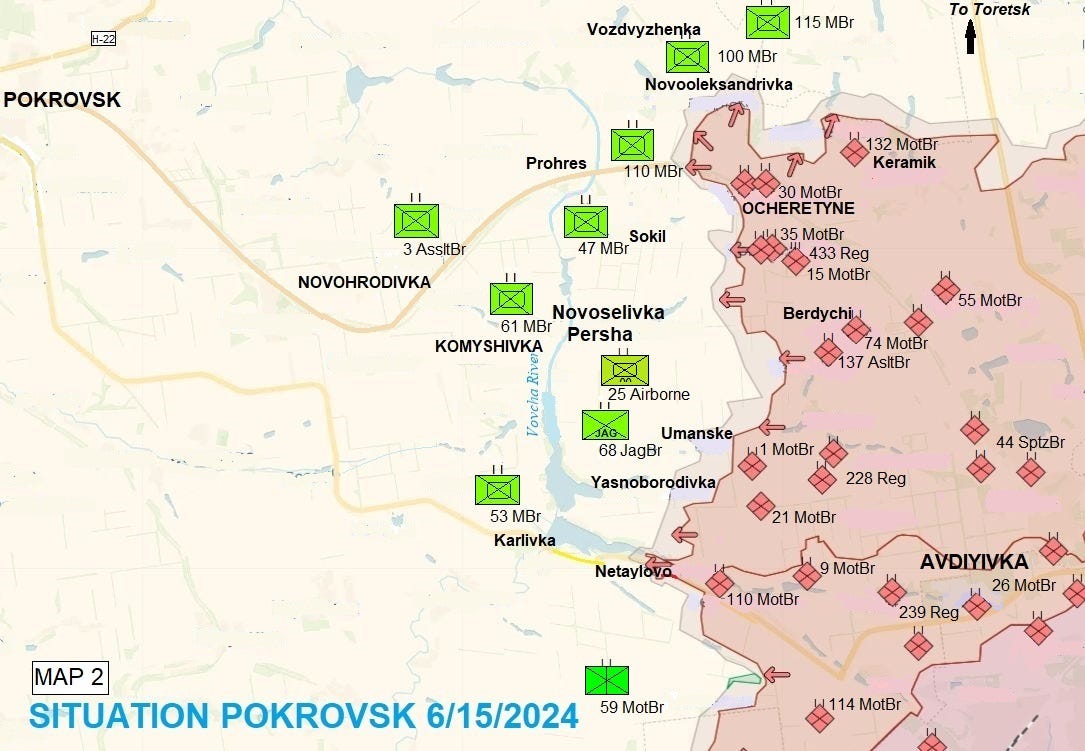
Pokrovsk appears to be the immediate Russian operational objective since it functions as a logistical hinge between Ukrainian defenses in the Southern Donbas at Vuhledar and the Northern Donbas at Sloviansk and Kramatorsk. Control of Pokrovsk would increase the pressure on Ukrainian ability to resupply and reinforce Sloviansk and Kramatorsk. According to Ukrainian military analyst Konstantyn Mashovets, a powerful concentration of 86,000 Russian soldiers, 280 tanks, 760 armored vehicles, and 1,100 guns and rocket systems from Russian army group “Center” are committed to the attack on the Pokrovsk vector. These consist of subunits of the 30th and 35th Independent Motorized Brigades, the 433d Motor Rifle Regiment, the 228th Motorized and 239th Tank Regiments from the 90th Tank Division, the 15th, 26th, 55th, 74th, and 114th Independent Motorized Brigades and the 1st Brigade of the Donetsk People’s Republic. [22] (See Map 2) On the other hand, if the current Russian thrust north of Avdiyivka turns to the northeast towards Kostiantynivka, Ukrainian forces in the Toretsk pocket to the southeast are threatened with encirclement. The Ukrainian 24th Mechanized Brigade occupies the Toretsk sector with forward combat outposts at the town of New York. (That’s right! There is a Ukrainian town named after the Big Apple)
Time will tell whether the Ukrainian army has sufficient reserves to simultaneously contain Russia’s multiple offensives in the Donbas and at Kharkiv. Furthermore, we shall see whether more Russian reserves are available to reinforce one of these efforts or to attack somewhere else. If the Ukrainians continue to hold their current positions while waiting for reinforcements and American munitions to make it to the front, they risk envelopment from both flanks at Toretsk and the harrowing prospect of executing yet another large-scale fighting withdrawal at multi-brigade level. Although they have been able to pull off similar escapes previously without major losses, the weight of Russian manpower and artillery fire may eventually cause one of these risky maneuvers to careen out of control.
Nevertheless, Russian manpower reserves are not limitless, particularly if the Russians lose men at the rate they did in May. Putin will likely go all out to take Pokrovsk or Kostiantynivka, sacrificing men with reckless abandon, while he attempts to derail President Zelensky’s peace initiative. In which case the Russians would need to recruit 40,000 volunteers monthly to cover their losses. Meanwhile, indications are that they are now struggling to match their previous monthly highs of 30,000. Reportedly, Russian recruitment rates for the first half of 2024 have dropped to a monthly average of 27,000. [23] It is an inevitable law of war that at some point the Russian offensives will culminate. Ukraine has a realistic chance to stall the Russian Summer offensive in 2024 and perhaps regain the operational initiative in 2025. Everything depends on the residual Ukrainian combat power while the country rearms with the newly released Western aid and mobilizes new troops. Watch for a Ukrainian counterattack against the flanks of the Russian penetration in the Pokrovsk area once Russian troops reach the limit of their offensive momentum since their penetration here is deep but on a relatively narrow front. For now, the Ukrainians are content with attritting Russian forces with newly resupplied artillery ammunition. Much will depend on the battlefield instinct of Ukrainian commanding general Oleksandr Syrsky to time a Ukrainian withdrawal from the Toretsk pocket or to launch a strong counteroffensive against the Russian vector towards Pokrovsk, perhaps in August 2024.
g. Sloviansk and Kramatorsk are the Center of Gravity in 2024
In conclusion, the main operational question in the Russo-Ukrainian War for the remainder of 2024 is whether Ukraine has enough combat power to keep the Russian army from capturing Sloviansk and Kramatorsk. (See blue outlined box on Map 1) The twin cities are the center of gravity for both sides at this stage of the war. A full discussion of the concept of the center of gravity will be undertaken in my next post. Suffice it to say, that a center of gravity holds together an adversary’s material capacities and political will to fight. [24] Its collapse throws the components of the entire collective effort out of orbit. It is highly unlikely that the Russian army has the manpower and resources to launch a concurrent offensive to seize Kharkiv or any other major city while it presses ahead with its current efforts to capture Chasiv Yar and to sever the lines of communications emanating from Pokrovsk. The capture of these operational objectives will enable the Russians to continue their advance towards Sloviansk and Kramatorsk. If Sloviansk and Kramatorsk fall, Putin attains a psychological reprieve in the minds of the Russian public regarding the trajectory of the war that will buy time to pursue his propaganda offensive against the Western democracies to dissuade voters from voting for politicians who support Ukraine. Although the election of Donald Trump does not guarantee outright American support for Putin’s Russia, further US aid to Ukraine in 2025 would be unlikely. It remains to be seen whether the Western Europeans will develop their military-industrial capacity to fill the void. But if the Ukrainians maintain their grip on Sloviansk and Kramatorsk without having their logistics severed to these twin cities from the west, the pressure inside the boiling tea kettle that is Putin’s hold on power will increase. The economic imbalances of an overheated war economy, caused by Russian pay bonuses and government spending on war-related manufacturing, when combined with increased foreign sanctions, are fueling an approaching political reaction. One does not know whether this will come from members of the Russian elite, the Russian general population in general, or both. After all, the common people will be the first to pay the price for the fiscal mismanagement through rampant inflation. Although, Russian domestic propaganda trumpets the capture of Bakhmut and Avdiyivka as equivalents of legendary Soviet victories of World War II, most of the Russian people can read a map. There have been merely incremental changes in the front lines since February 2022 and no loss of a major Ukrainian city since the capture of the port of Mariupil on May 20, 2022. Furthermore, the Ukrainians recaptured much of Kharkiv oblast and the west bank of the Dnieper River together with the city of Kherson in the Fall of 2022. Continuing monthly losses of 40,000, such as suffered during May 2024, without something major to show for it, endanger Putin’s regime, especially if he must order another mobilization.
Tactically, maintaining supply lines to Sloviansk and Kramatorsk from the west through the logistics hub at Pokrovsk is the more immediate challenge for the Ukrainian army. Conversely, for the Russians, the best way of leveraging the Ukrainians out of Sloviansk and Kramatorsk without a bloody siege is to sever supply lines leading from Pokrovsk. Therefore, battles in the Southern Donbas will continue with great intensity during the remainder of 2024. Whether Vladimir Putin has the manpower to achieve these tactical objectives remains to be seen. Current Russian reserves are estimated at 50-60,000. [25] Even if he succeeds, it is questionable whether the Russian army will be able to launch another major offensive in 2025. However, the psychological boost for Putin would be significant, at home and abroad, if Sloviansk and Kramatorsk should fall into Russian hands. To recapitulate, the propaganda narrative that Russian victory is inevitable has been Putin’s greatest operational success in 2024, even if reality on the ground does not measure up to the claims. Denying him a substantive factual foundation for such a narrative while destroying Russian manpower and weaponry creates cognitive disconnects between myth and reality that will be difficult to sustain.
In my next post I intend to discuss the current grand strategic implications of the Russo-Ukrainian War at the level of national policy and how these are affected by the duration of the war. I will then attempt to define victory for both Russia and Ukraine. Central to the discussion are the respective centers of gravity, which determine the strategies upon which victory hinges in this long war. These have shifted since the war began.
[1] Russia loses 1,270 more soldiers, 60 artillery systems and 26 tanks over past 24 hours. Ukrayinska Pravda, June 9, 2024.
[2] Stavros Atlamazogolou. Russia Lost 40,000 Soldiers in Ukraine War Last Month. National Interest, June 8, 2024.
[3] Alexander Smith. The ‘stunning’ scale of Russian deaths in Ukraine signals trouble ahead for Putin. Newsweek. May 2, 2024.
[4] Chris York. As Russian losses in Ukraine hit 500,000, Putin buries future demographic risks at home. Kyiv Independent. May 25, 2024.
[5] Culmination is a temporal phenomenon, which occurs when a military offensive slackens because of a lack of manpower, resources and/or will. It cannot be pre-determined or predicted with accuracy. Culmination becomes evident only after the fact.
[6] The strategic initiative is held by the combatant who has freedom of action to decide when and where to act next instead of reacting to the adversary’s previous move.
[7] Meduza, 5 October 2023, https:// meduza.io/feature/2023/10/05/v-ramkah-mobilizatsii-v-rossii-sozdali-bolee-120-novyh-voinskih-chastey-tret-prizvannyh-otpravili-v-kadrovye-chasti-vospolnyat-boevye-p
[8] Italian term for captains of mercenary companies during the wars of the Renaissance.
[9] Stavros Atlamazogolou. The Russian Military is Running Short of Recruits to Fight in Ukraine. National Interest, June 10, 2024.
[10] Watling, Jack; Reynolds, Nick. Russian Military Objectives and Capacity in Ukraine Through 2024. RUSI. 13 February 2024.
[11] Chris York. Zelensky: Russian losses during Kharkiv offensive 8 times higher than Ukraine's. Kyiv Independent. May 25, 2024.
[12] Ground Forces of Ukraine |MilitaryLand.net. https:// militaryland.net/ukraine/armed-forces/ground forces; https://www.zsu.gov/ua/
[13] Gady, Franz-Stefan; Koffman, Michael. Making Attrition Work. A Viable Theory of Victory for Ukraine. Survival. Global Politics and Strategy. IISS. Volume 66, 2024 – Issue 1., p. 10.
[14] Vladyslava Kovalenko. First batches of shells arrive in Ukraine under Czech initiative. RBC, June 16, 2024.
[15] Ukraine Poised to Produce 2 Million Drones in 2024. Kyiv Post, March 6, 2024.
[16] David Axe. As the Glide Bomb War Intensifies Over Ukraine. Forbes, June 3, 2024.
[17] Max Hunder, Ukraine outnumbered, outgunned, ground down by relentless Russia. Reuters, February 21, 2024.
[18] Andrew E. Kramer, Josh Holder, Lauren Leatherby. Can Ukraine Find New Soldiers Without Decimating a Whole Generation? NYT, April 11, 2024.
[19] Elena Davlikanova, Kateryna Odarchenko. Ukraine’s new mobilization law leaves demobilization issue unresolved. Atlantic Council, May 2, 2024.
[20] Kostantyn Mashovets. Visti z frontu. Tverezyi Pohliad, May 27, 2024.
[21] Michael Koffman, Ryan Evans. Is Russia’s Window of Gains this Summer Narrowing? Russian Contingency. June 14, 2024. http://warontherocks.com
[22] Kostantyn Mashovets. Visti z frontu. Tverezyi Pohliad, June 11, 2024.
[23] Putin: No need for mobilization as more than 460,000 volunteers have signed up. NHK News, June 8, 2024.
[24] Friedman, B. A. On Tactics. (Naval Institute Press: Annapolis, 2017), p. 168.
[25] Kostantyn Mashovets. Chyselnist reservu okupantiv ne perevyshchuye 50-60,000 osib. Tverezyi Pohliad, June 8, 2024.
No posts
Comments
Nothing yet. Say the first thing.
Sign in to join the conversation.