
Hi there,
I sat down with Anil Punyapu. Biochemistry degree, law degree with honors, co-founded a hedge fund, then spent 20 years as SVP at Cvent scaling $200M+ in enterprise sales through an IPO, a take-private, a second IPO, and a Blackstone acquisition. At 50, he walked away from all of it to study neuroscience, understand stress at the root, and build an AI wellness startup from scratch.
I’m not here to chronicle his expertise. The point is, that going from law → tech → SaaS → neuroscience → AI wellness, Anil Punyapu’s trajectory is ultimately the perfect example of the adaptability mentality I teach on stage with my keynote on technostress, because the future doesn’t belong to the most fluent anymore, in the era of AI it belongs to the most adaptable. And this is exactly why I started this newsletter and I write these field notes. To showcase what becomes possible when a cross-industry builder follows the energy instead of the title.
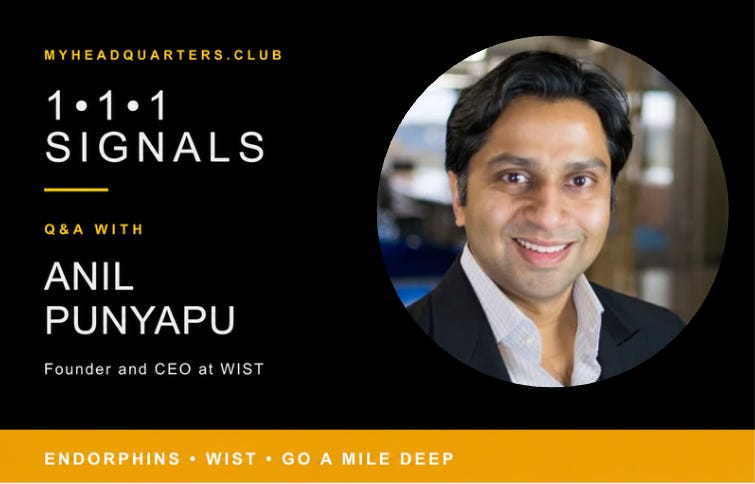
This issue is lean and specific: what your brain actually needs to perform (not what marketplaces sell you), the startup Anil is building to deliver it, and his invitation to go deeper than anyone else is willing to go.
I recorded the full conversation with Anil. You are in for a treat!
Below the extracted signals.
MENTAL INFRASTRUCTURE: Tips for better human performance. When your body runs well, your mind thinks sharper.
There are three neurotransmitters that drive your energy, resilience, and cognitive sharpness: endorphins, oxytocin, and serotonin. You cannot buy any of them. No injection, no supplement, no app delivers the real thing. Dopamine gets all the marketing. These three do the actual work.
Here’s what Anil’s research, grounded in Paul Zak’s Immersion Theory and Positive Psychology, says you can do today, at your desk, in under five minutes (actually in just three min).
When your cognitive function drops because you’re exhausted
You need a positive emotion hit. That’s endorphins.
Pick a multisensory activity you actually enjoy and immerse yourself in it for three to five minutes. Put on your favorite song. Step into the sun and feel the heat on your skin while you listen. The key is multisensory immersion, not meditation (which your mind will sabotage in the first five seconds). The research says three minutes of high-quality immersion deflects everything else. It’s a flow state in miniature.
Extra tip: shared with someone else, it’s even more potent.
When your cognitive function drops because someone rattled you
You need mood regulation. That’s serotonin.
This is biochemistry, resetting the stage so your brain can re-engage. You need regulation before reasoning. Move. Breathe. Step into light. Reduce mental load. Eat a comfort meal, ideally one that supports tryptophan production: turkey, chicken, eggs, Greek yogurt, salmon, pumpkin seeds, sesame, oats, bananas, or a handful of nuts. This isn't about eating more. It's about giving your brain the biochemical ingredients to re-engage.
When you feel disconnected or isolated
You need meaningful connection. That’s oxytocin.
And it does not require physical touch. It requires openness. The Dalai Lama told a conference audience that Western intimacy is projected too narrowly. You can generate oxytocin by talking honestly with someone, venting to a colleague, calling a friend for five minutes with no agenda. The research says the happiest people maintain five core relationships: a mentor or mentee, close family (not your spouse), childhood friends, a significant other, and a work friend. If you’re missing one of those five, that gap is measurable.
Anil shares that the company Applied Wonder built a multisensory recovery room at Mount Sinai Hospital during the pandemic for physicians who needed to reset between shifts. Five to ten minutes of calibrated calm: visuals, sound, temperature, breeze. It worked so well they’re now piloting it inside a major corporation for executives before high-stakes meetings, and inside a school district for high schoolers who need emotional regulation before they spiral.
Three hormones.
Three to five minutes.
No purchase required.
MINDS ON A MISSION: Startups and bold ideas I follow closely, that make me optimistic about the future we are building.
Anil looked at the data on stress management solutions and found the best-in-class tools were under 10% effectiveness. Meanwhile, 80% of primary care doctor visits are stress-related. Chronic stress triggers autoimmune disorders, inflammation, hypertension, depression, anxiety. Companies will pay almost anything for a solution that works. Nothing was working.
So he went back to school. Studied neuroscience. Talked to therapists. Dug into the research. Then he built Wist.
Wist is an AI-powered daily health assistant.
Here’s how it works:
MORNING CHECK-IN Wist texts you and asks how you’re feeling. Energy levels, mood, perceived stress. It pulls your calendar, identifies stressful events, grabs your heart rate variability data, and generates a stress score.
THREE PERSONALIZED ACTIVITIES Based on your profile, it drops three micro-activities into open slots in your calendar (yes it connects to your calendar!). One for endorphins, one for oxytocin, one for serotonin. You can swap any of them. For oxytocin, it might suggest sending a five-minute call request to one of your five core people. It drafts the message. You hit send.
EVENING REFLECTION Wist summarizes your day from your calendar data. Auto-journals for you. Then it asks one reflective question to help you release what’s lingering and drive serotonin through structured reflection. No blank-page journaling required.
What’s next: Wist is building toward personalization by geography, environment, and demographics. Predictive stress modeling that gets sharper over time.
Most apps wait until you’re in crisis. Wist doesn’t.
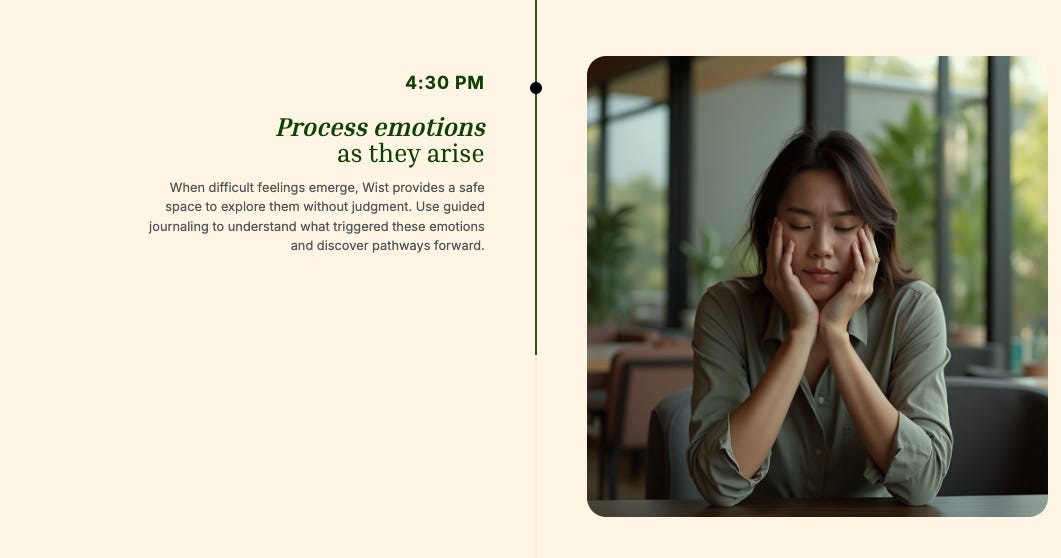
They’re currently looking for corporate partners to test the app, give feedback, and help shape the product before market launch.
If your organization is spending on wellness and not getting results, this is worth a conversation.
→ wist.health
→ Connect with Anil Punyapu on LinkedIn
INVITATION TO BUILD: Tools and perspectives to stay resilient as the pace of change accelerates.
I asked Anil what his invitation to build is. He referenced Cassie Holmes’ book Happier Hour, on positive psychology, and a finding that surprised him: workaholics are sometimes the least stressed people. Not because they grind. Because they love what they do. The work itself produces endorphins, purpose, connection.
He told me a story about someone close to him who dove into one of the heaviest, most emotionally devastating subjects you can imagine, and came out sharper, not broken. I won’t spoil it here. Please watch the full interview 👆🏻 above to hear why depth protects the people who go all the way in.
Anil’s invitation is direct: go a mile deep into one area.
Learn it from the ground up. Don’t just build something quickly and iterate.
Understand the science, the psychology, the mechanics. Then build.
He says this especially to younger people worried about AI replacing them: AI learned language. It didn’t learn depth. If you go a mile deep into something real, you’ll have what the machines don’t.
That’s also how he built Wist. He didn’t outsource neuroscience.
He went back to class.
As Anil puts it:
AI learned language.
Depth is still yours to own.
Thank you for reading and thank you, Anil, for such an inspiring interview.
Until the next 1•1•1 SIGNALS,
Yrmis
These Signals are for you, not your job title. Subscribe with your personal email to keep them when everything else changes.
If this sparked a question, reply!
Human replies are still underrated, and as rare as it is these days, I actually do respond.
The keynote is the argument. This podcast? It’s how I actually think. Messier, funnier, more human. Listen to Breakfast with Benefits and hear what the stage version leaves out. Entrepreneurial Trajectory | Work with me.
Comments
Nothing yet. Say the first thing.
Sign in to join the conversation.