
Hi there!
I don’t own a single wearable. With my background, that always comes as a surprise.
No Apple Watch. No WHOOP. No OURA. And yet I’m probably one of the people most obsessed with my own wellness and cognitive performance.
I get asked why a lot.
My answer: data without proper interpretation is just cognitive overload. That’s the opposite of human performance.
This edition goes from your kitchen (the glass of milk you’re not thinking about) to the future of building a company (what happens when execution becomes free) to the org chart I never expected to build (staffed by agents, managed by one human).
If you make decisions for a living, what you put in your body is a strategic choice.
Let’s get into it.
Mental Infrastructure: Tips for better human performance. When your body runs well, your mind thinks sharper. Build habits that strengthen both performance and decision-making.
Learning how to feed my body as the biological machine that it is has given me peace of mind, and tangible results.
Take milk, for example.
Most people think milk is milk. It isn’t.
The cow breed, the feed, the processing, and even the bottle all change what ends up in your bloodstream. And, as the most recent clinical trials show, what ends up in your brain.
We’ve been having the wrong conversation about milk for decades. The debate was lactose yes or lactose no. Turns out the real variable is a protein, not a sugar.
Most commercial dairy comes from cows that produce A1 beta-casein.
When you digest it, your body releases a peptide that behaves like an opioid.
It binds to receptors in your gut and brain, drains one of the most important antioxidants your brain uses to stay sharp, and in a randomized clinical trial, it measurably slowed people’s thinking.
Slower gut. Foggier brain. Worse decisions. From a glass of milk.
A quick note before we go further. I’m not here to tell you to stop drinking milk. I’m here to help you find the right milk for you. That’s a very different conversation.
I’m also not talking about oat, almond, rice, or any of the other plant “milks.” Those belong in a separate signal. The short version: most are ultra-processed, nutritionally empty, and their carbs break down into fast sugars during manufacturing. Oat milk has a glycemic index close to white bread. They’re not the upgrade most people think they are. I don’t drink them.
We’re talking about dairy. Real milk, from real animals.
If you’re serious about thinking clearly, the dairy question isn’t about calcium.
It’s about signal integrity.
I wrote a guide about milk a while back as a consumer cheat sheet. At the time, I said the A1 vs A2 debate was “ongoing” and mostly anecdotal. It isn’t anymore. Science has caught up, and I’ve updated the guide for you.
Inside: what to look for, what to skip, why your morning latte might be quietly taxing your mental edge, and what to do about it.
If you make decisions for a living, this matters.
This one is... on the house.

Minds on a Mission: Showcasing inspiring startups, smart inventions, and bold ideas I follow closely, that add optimism, possibility, and momentum to the way we see the future.
You know that feeling.
You open your inbox Monday morning and there are four new AI tools you’re supposed to care about. Someone on LinkedIn is calling one of them “a game-changer.” Someone else already posted a tutorial. By 4 PM there’s a newer one. By Wednesday your cortisol is so loud you want to throw your laptop in the pool.
You’re not alone. BCG just published a study in Harvard Business Review on what they call “AI brain fry.” Yes, Technostress!
They surveyed nearly 1,500 workers and found that once people start juggling four or more AI tools, self-reported productivity actually drops. Not flatlines. Drops. Workers described mental fog, a buzzing feeling, and slower decision-making from the sheer cognitive load of overseeing so many AI outputs.
While most of us are trying to stay in the marathon race to learn all the AI tools, a guy named Ben Cera in San Francisco built something that skips the tool conversation entirely. He built an AI that is the company.
His product is called Polsia
It is listed at $49 a month. Plus 20% of whatever it earns.
Human employees on payroll: zero.
You give it an idea or ask for one.
It builds the product, ships the code, creates the landing page, runs the ads, handles customer support, and sends you a morning CEO briefing. Like a full team working overnight, every night, while you sleep.
I took the free trial.
I let it scrape data about me and it came up with the one idea my cousin has been telling me to build for years. While she named it “Yrmis Approved”, Polsia named it “Puresift” but pretty much same thing. That to say Polsia got to know me pretty well, pretty quick.
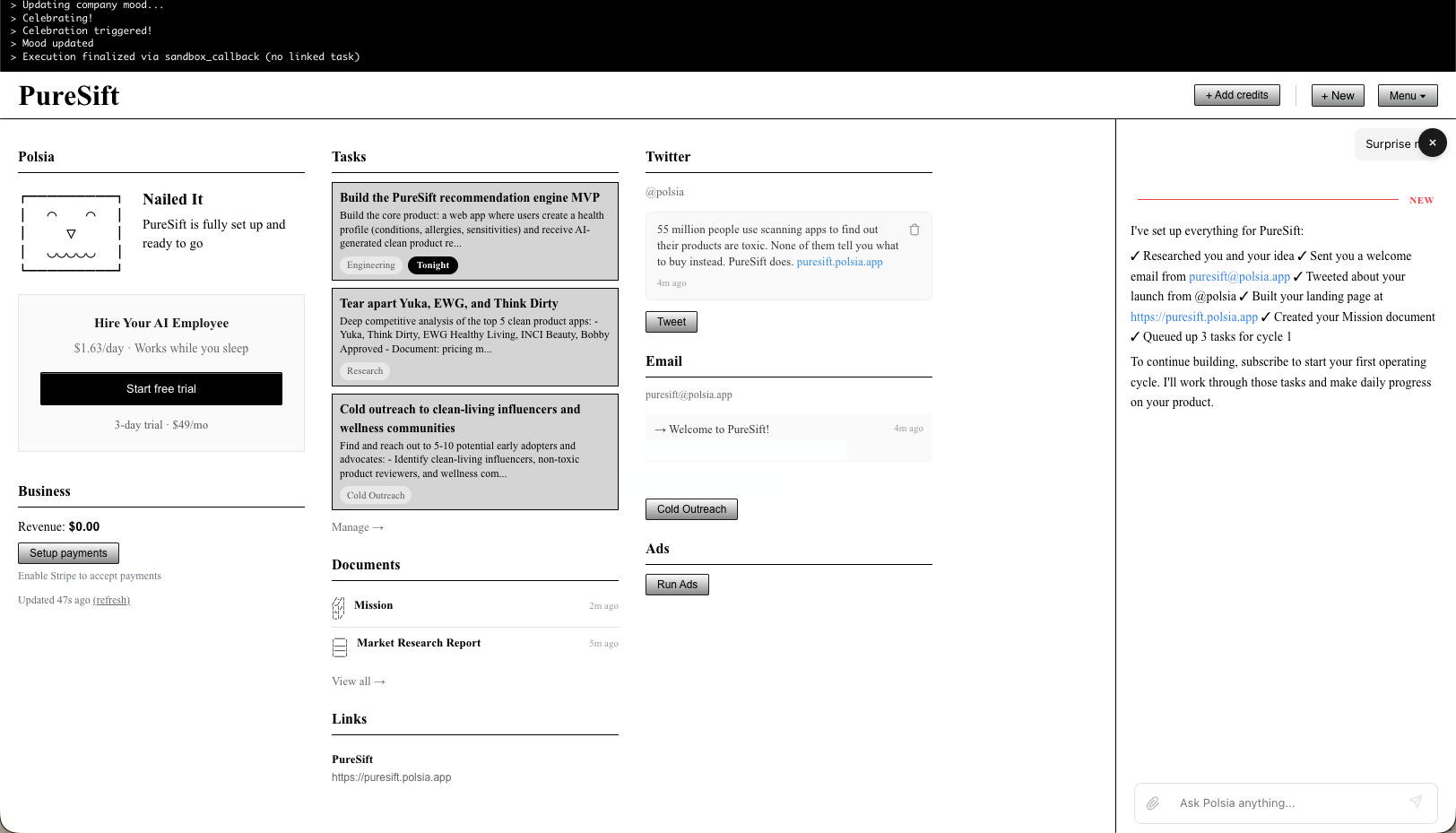
Now. I’ve built a few companies. I know the difference between a headline and a business.
His reported run rate recently hit $1.5M ARR with over 1,500 companies on the platform. These numbers are self-reported.
The platform is young. I’m not telling you to go sign up tomorrow.
I’m telling you to pay attention to what it implies.
“If you have a new company and you don’t make it 80% autonomous, you will be cooked.”
BEN CERA, FOUNDER, POLSIA
80% AI. 20% human taste. We all love Pareto, right?
For decades, we built entire organizations around execution. We hired for it. We raised money for it. We measured ourselves by how much of it we could manage.
What happens when execution is essentially free?
What’s left is taste. Judgment. Point of view.
The ability to ask a question nobody else thought to ask.
Marc Andreessen dropped 105 minutes on Lenny Rachitsky’s Podcast a few weeks ago and called AI “the philosopher’s stone.” Isaac Newton spent decades trying to turn lead into gold and failed. AI turns sand into thought. Silicon into ideas. The most common material on earth producing the rarest output.
You don’t have a job loss problem. You have a philosopher’s stone sitting on your desk that you’re not using enough.
US productivity growth has been running at half the rate of the postwar boom for fifty years. Most people don’t even know we’ve been in a drought. AI didn’t show up early. It showed up right on time.
Here’s the part I keep coming back to. Polsia is $49. I mention the cost, because that’s less than pizza for two.
If your teenager has a business idea they won’t shut up about, or your friend keeps talking about “someday,” or your partner has been sketching something on the back of a napkin for two years... this is the easiest way to back them. Not “learn to code.” Not “write a business plan.”
Just: go. Test it. See what happens.
And look, it doesn’t have to be Polsia. Lovable, Base44, Bolt, Replit... there are plenty of plain-English build tools out there now. The only problem with these tools is that they are so simple they sound like pure social media hype. They’re not. They are real, they work, and they are waiting for someone with a good idea to press go.
The tools aren’t the signal. The shift is the signal.
Execution is collapsing toward free.
The people who win from here are the ones with the sharpest taste and the clearest point of view.
I teach that. I’ve lived it. And I’ve never seen it move this fast
An Invitation to Build: Tools and perspectives to stay resilient as the pace of change accelerates.
I’m about to tell you something I never even imagined would be true for me.
I have been head down decoding AI agents (I am a non-coder so pun intended.)
Four weeks into the rabbit hole I have four agents working for me across my company. These are not interns. These are like PhD-level operators. And I say this with full responsibility for what it implies.
One looking for grants that fit my business impact and purpose. One looking for stages that would benefit from my technostress framework keynote. The third one managing a stealth project. All managed by a rockstar chief of staff I could have never afforded. She rules.
The decision about what makes it in and what gets cut? Mine. That’s the 20% Ben Cera (The founder of Polsia) was talking about in Signal 02.
I stopped thinking about AI as a tool
and started thinking about it as a team.
Not metaphorically. Literally.
I asked: if I were redrawing the org chart for where this company needs to go, what roles would exist, and what would each one be responsible for?
Then I built agents for everything that didn’t require my judgment, my taste.
That’s when everything changed.
What surprised me is how much simpler this turned out to be than most people make it look on social media. It needs more than a few iterations. It also breaks. A lot. So we are at the very beginning. But that should not stop us from starting and reaping the endless benefits. If not done well, it can also turn out to be more expensive than it should be.
McKinsey just published a piece about this. They call it “the agentic organization.” Their finding: over 80% of companies investing in AI are not seeing results on the bottom line. The reason? Companies keep bolting AI onto old workflows instead of redesigning the work itself.
I read it and thought: yeah, I know. Because I made that mistake first.
The gap between “good with AI” and “elite with AI” is getting wider, not narrower.
That’s not a technology gap. That’s a willingness gap.
A willingness to let go of how you’ve always done it, even when how you’ve always done it used to work.
I know because letting go was the hardest part for me. Every instinct said: review every output. Add a checkpoint. Keep control. And some of those instincts were right. But most of them were just habit wearing a quality-control costume.
I talk to executives every week who are stuck in the same loop. They’ve bought the tools. They’ve run the pilots. They’ve sat through the vendor demos. And nothing has fundamentally changed because they haven’t changed the shape of the work. They’ve added AI to the org chart without redrawing the org chart.
Pick one workflow your team runs every week. Something unglamorous. Something that eats time and produces predictable output. Now redesign it from scratch. Not “add AI.” Redesign. Put AI at the center and ask: what does this look like if a human only touches the 20% that requires judgment?
You will learn more from that than from any pilot, any vendor deck, or any report.
YOU ALREADY KNOW WHICH WORKFLOW TO PICK
Take the invisible work.
Summaries. Follow-ups. Status emails. Meeting notes.
No one tracks the hours. Everyone feels them dragging.
Now redesign it.
Every conversation becomes structured output automatically.
Every thread becomes a decision log.
Every update writes itself.
Hours don’t come back because people worked faster.
They come back because the work stopped existing.
And if you want the version that makes your CFO pay attention: do the same thing with your pipeline review. AI reads every call. Scores every deal. The meeting stops being about updates and becomes about one thing only: where do we intervene?
Same principle. Bigger number.
That’s the 20%. Not doing the work. Deciding what the work means.
I always assume you’re deeply technical. But for those who are building their first agents or haven’t started yet: would you want me to make you a guide on how I built mine? To save you the trial and error and make it simple?
If that’s something you’d want from me, please let me know by leaving me a yes right here in the yellow button below.
YES, BUILD ME THAT GUIDE 👇🏻👇🏻👇🏻👇🏻👇🏻👇🏻
Until the next signal,
Yrmis
These Signals are for you, not your job title. Subscribe here with your personal email to keep them when everything else changes.
Human replies and comments are underrated, and as rare as it is these days, I actually do respond.
Comments
Nothing yet. Say the first thing.
Sign in to join the conversation.