
The debate over whether we’re in an AI bubble has become dominated by big-picture metrics, viral graphics and memes showing circular financing deals.
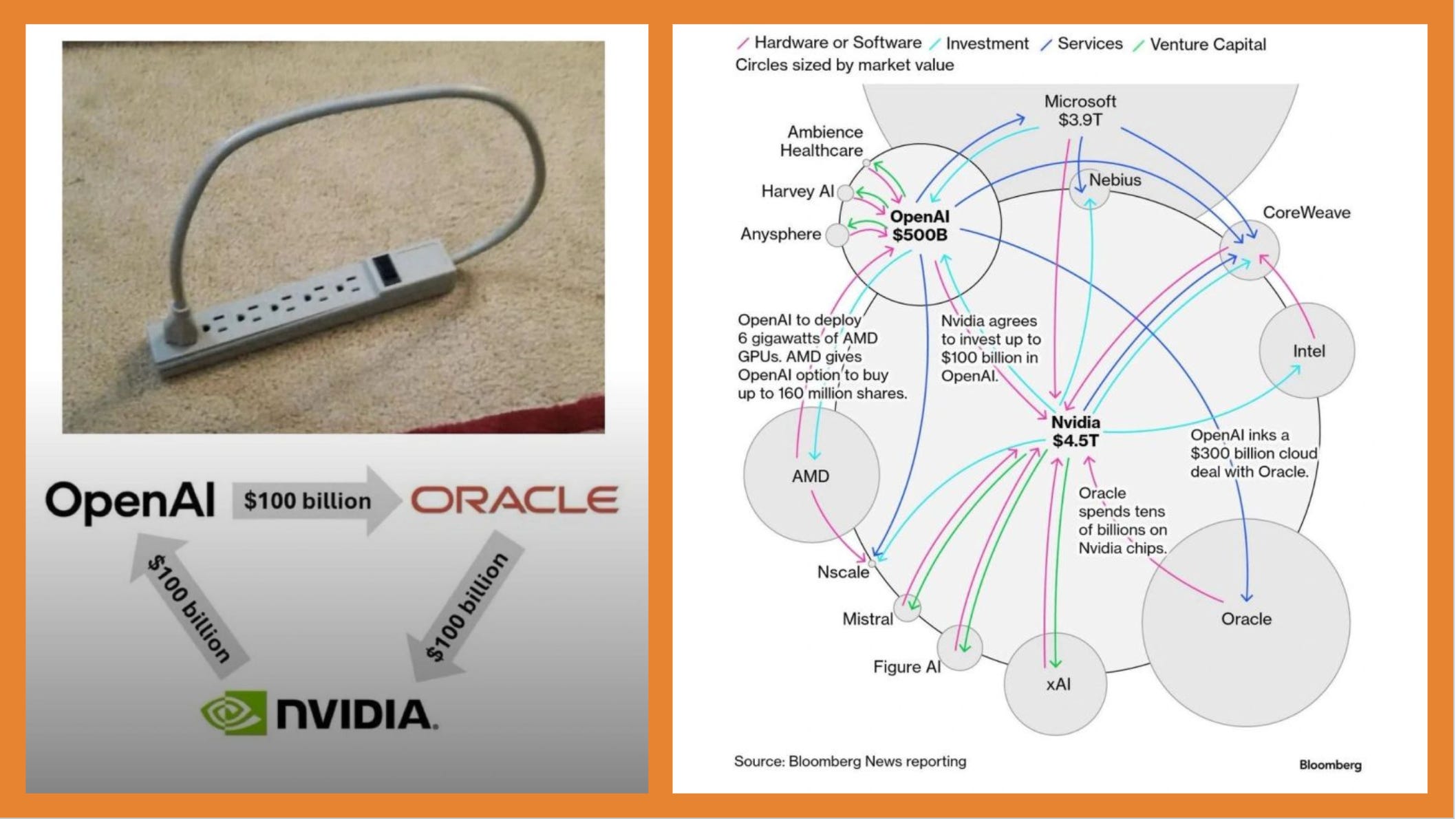
While these are catchy and easy to share on social media they miss a crucial accounting detail that should alarm anyone trying to value AI companies: GPU depreciation. (I know, sexy).
Let’s quickly recap what everyone is discussing and why this omits an important part of the picture.
Capex-to-revenue imbalance: Setting aside NVIDIA, companies ranging from OpenAI to Anthropic to Big Tech are generating approximately $60 billion in AI revenue while investing $400 billion in GPUs and data centres. That equates to $6.7 of capital expenditure for every dollar of revenue (6.7:1). Historical precedents that ended in a bursting bubble were much lower: the 1990s telecoms boom had a 4:1 ratio, and the 1870s railway boom 2:1.
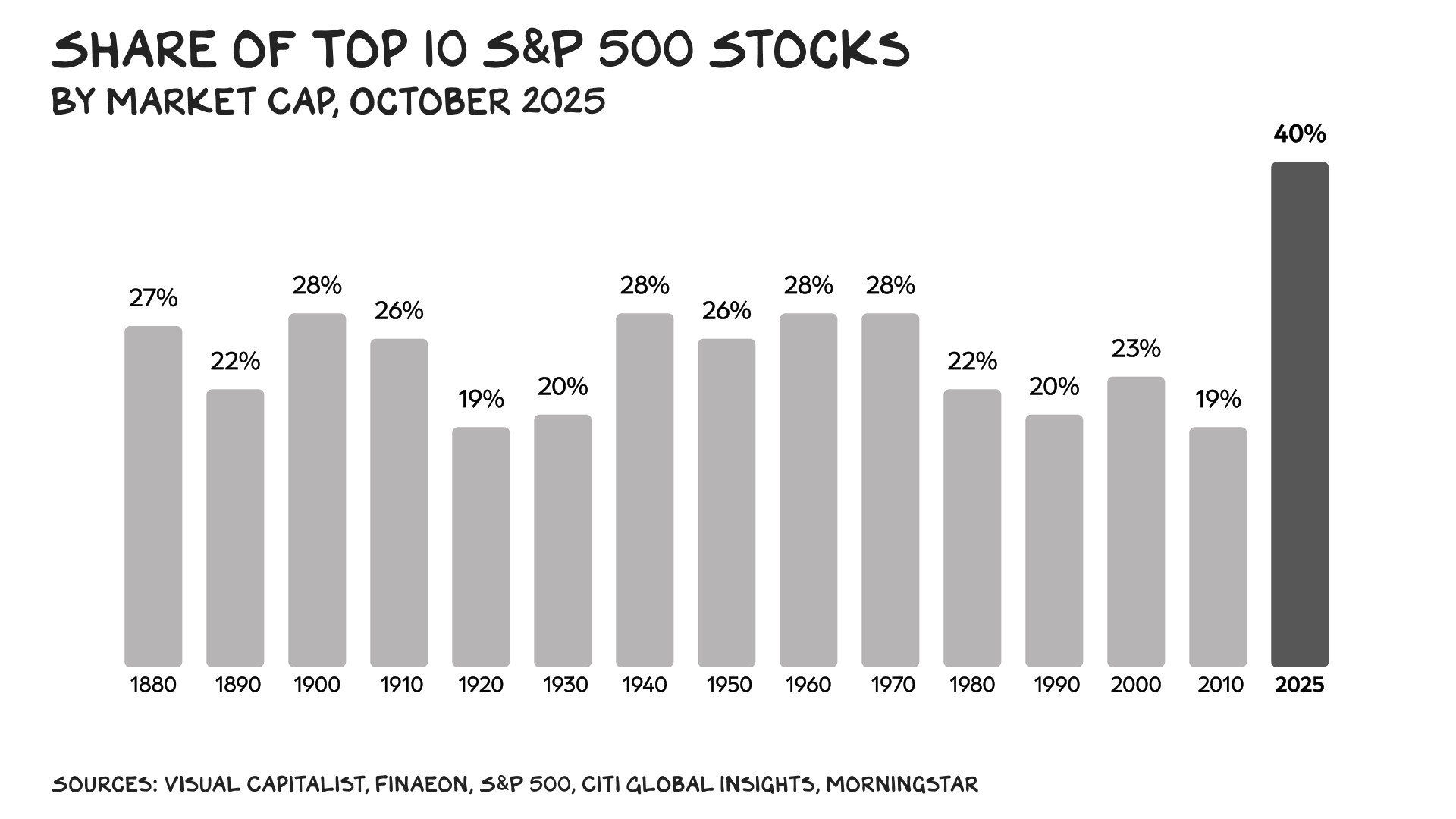
Valuation extremes: The Shiller P/E ratio - a widely-followed measure of how expensive the US stock market is - now sits at 40x earnings, more than two standard deviations above its long-term average. As my former colleague and friend Simon French, now chief economist at Panmure Liberum, an investment bank notes:
“The last time valuations were that rich was in 1999,” during the dot-com bubble, “so this trend represents the loudest echo from history”.
Concentration risk: Despite IT processing equipment and software representing just 4% of US GDP in the first half of 2025, this sector accounted for 92% of GDP growth over that period, according to Harvard economist Jason Furman. His calculations also suggest that if we strip out the astronomical growth in AI company valuations the real economy grew by an anemic 0.1%. Ergo, the US economy is now just a big bet on AI, that’s obviously hyperbole but there are lots of investors with a lot to lose. By some estimates, $35 trillion of wealth could be torched if there was a significant correction.
Here’s the detail that matters: American tech companies are depreciating GPUs over six years, despite their effective economic and operational lifetime being closer to three years before they’re replaced by newer, more powerful and more efficient chips.
This isn’t a minor technical issue— the widely cited $400 billion capex figure obscures the true financial burden which is that GPUs represent approximately 40% of that spending—roughly $160 billion—while the remaining $240 billion goes to infrastructure like cooling, power systems, and construction that can be reused across GPU generations.
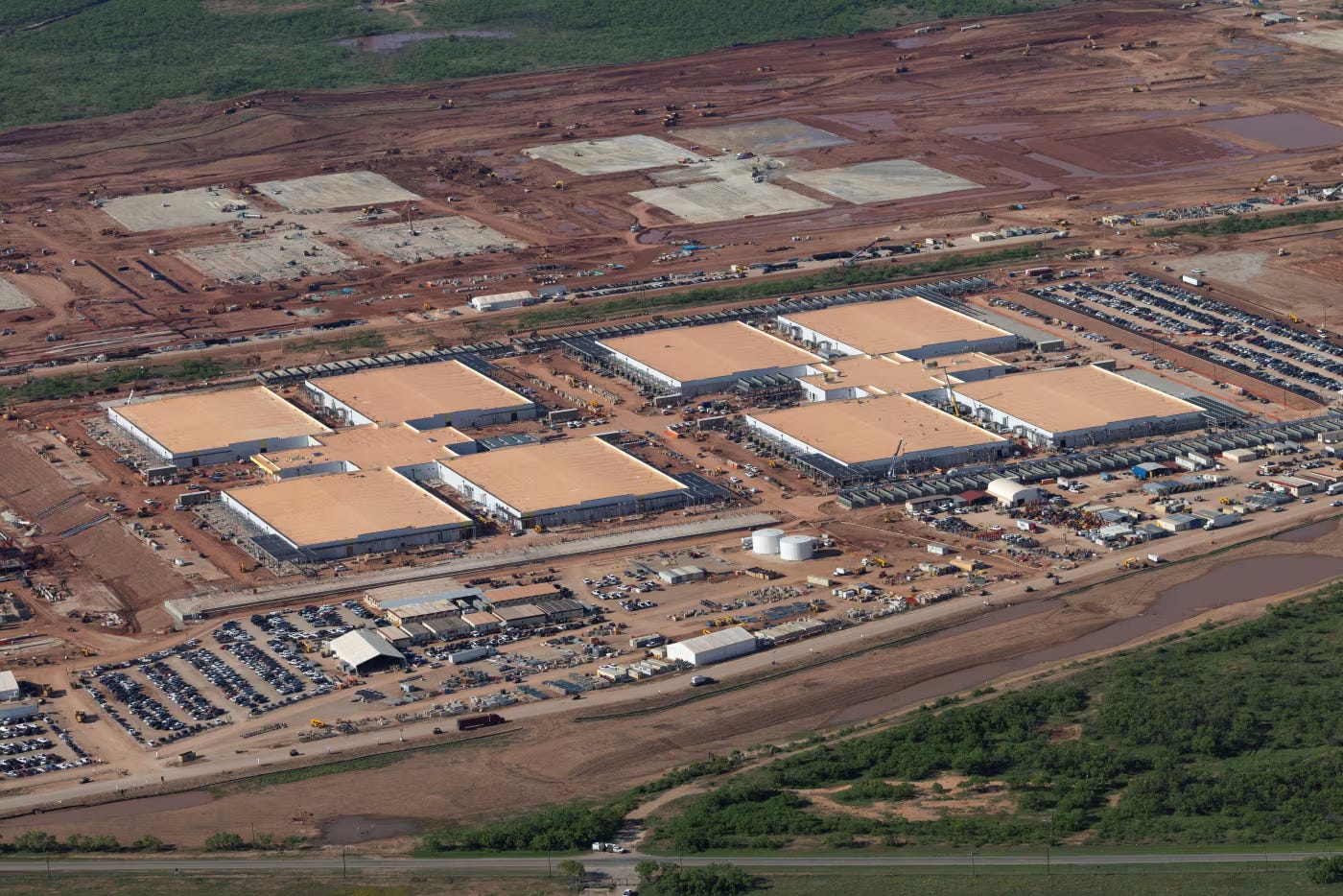
By depreciating GPUs over six years instead of three (their actual lifetime), hyperscalers are recognising $26.7 billion in annual depreciation vs an actual of $53.3 billion.
This sums to a $160 billion capital shortfall every six years.
The crunch comes in years three and four, when companies face a double burden: needing to spend on replacement GPUs whilst still depreciating the existing installed base.
It also needs to be said that this creative accounting will have a knock on impact on earnings, free cash flow, return on capital and leverage ratios.
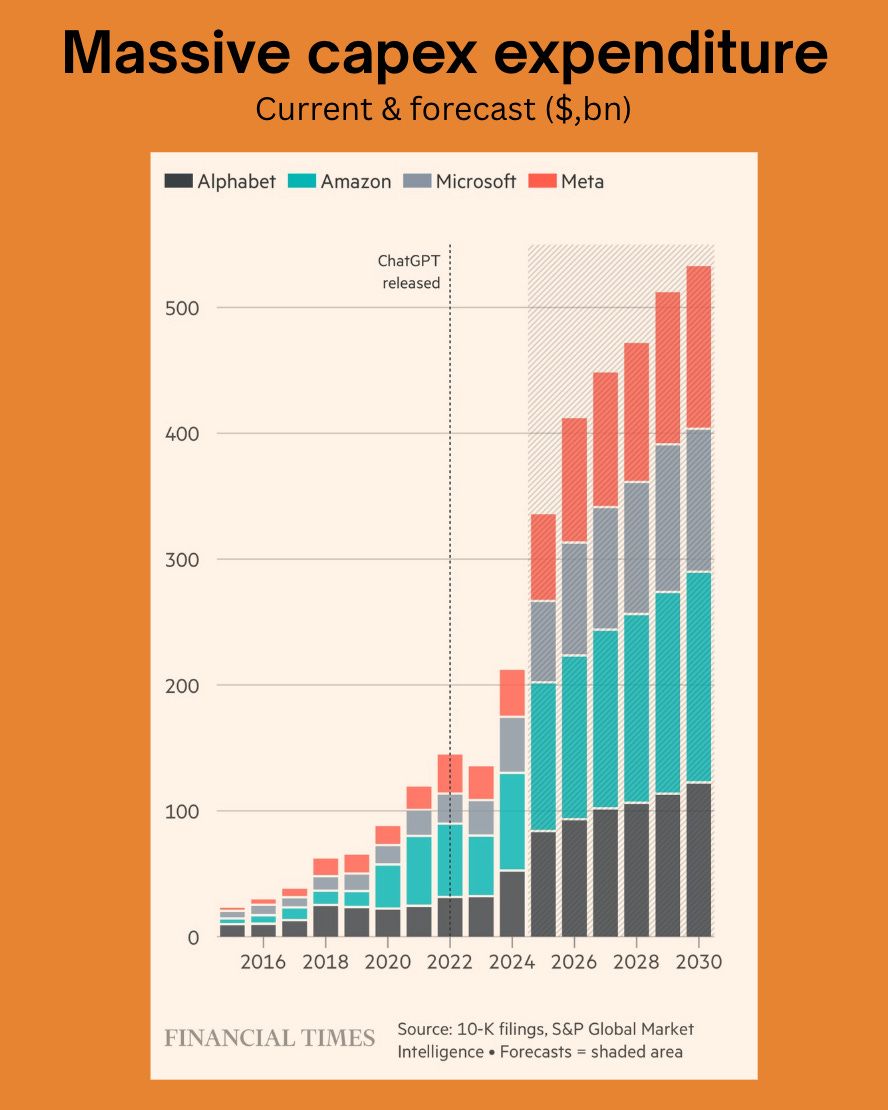
This means the already massive capex expenditures through to 2030 are understated, and given we’re already at a 6.7 to 1 capex-to-revenue ratio, discovering that your actual replacement costs are double what’s on the books should change how you think about sustainability and profitability timelines.
So far, global capital expenditure on AI infrastructure has been funded largely by hyperscalers’ vast internal cash reserves. But as the FT notes, the scale of projected computing needs is now driving
a shift towards more leveraged, opaque and circular financing structures.
An analysis of future AI infrastructure spend shows that more than 50% of $2.9tn is coming from off balance sheet lending, and a large chunk from private credit ($800bn), corporate debt ($200bn) and securitised credit ($150bn).
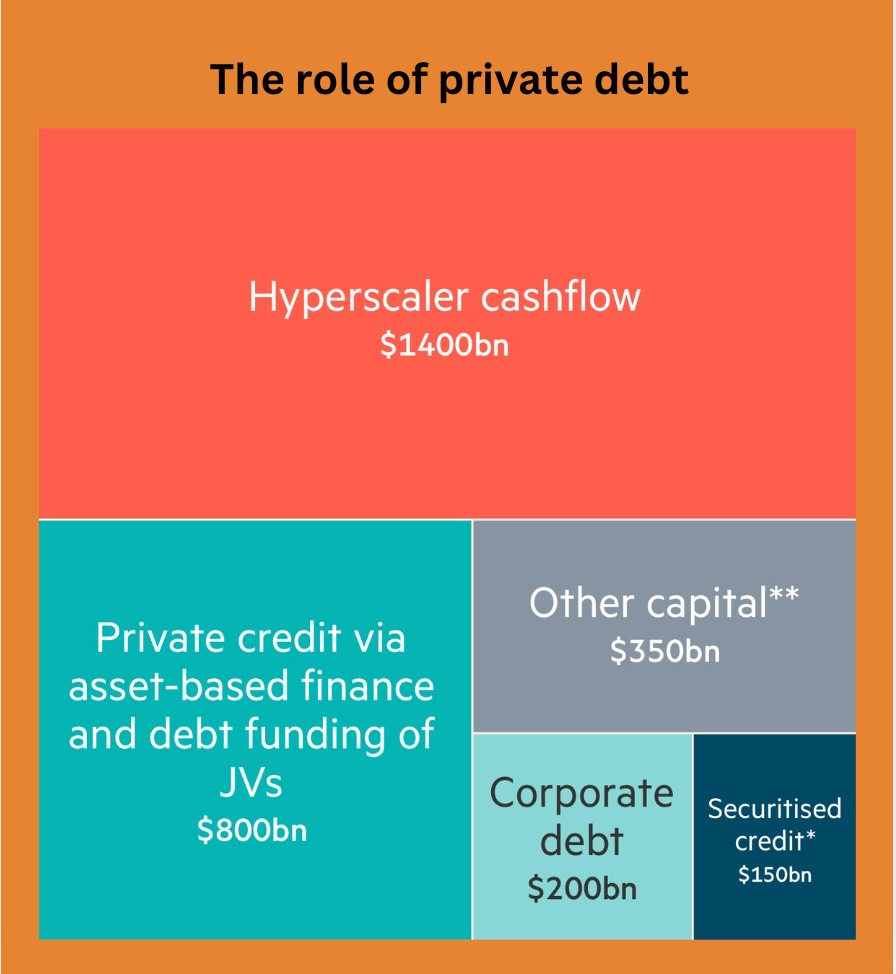
These financing options create potential transmission mechanisms for systemic risk, a fancy way of saying that dominoes could fall.
Here’s a more than plausible scenario: massive, expensive data centers which take around three years to build, in the best case scenario, are commissioned and constructed with borrowed money, but generative AI demand doesn’t materialise at the anticipated scale, or—more likely given the GPU depreciation issue—these centres become obsolete faster than their debt schedules assume. Companies like OpenAI and CoreWeave, who themselves are massively leveraged, struggle to pay data centre builders, who in turn can’t pay contractors...dominoes fall, loudly. No AI prompt is gonna be able to solve that situation.
AI optimists would counter that:
Revenue growth could accelerate dramatically in 12-24 months, narrowing the capex-to-revenue gap
The productivity gains from AI could justify current valuations even if near-term returns disappoint
Inference costs are dropping rapidly, which could unlock massive new demand
Unlike dot-com companies, today’s AI leaders have genuine products with real revenue. $60 billion should not be sniffed at and we are just at the beginning of the adoption curve, even though 800m consumers and most businesses now use ChatGPT
And even if the bubble bursts we will have built useful structure for the future (the Telecoms argument).
Now I’ve seen it, I can’t unsee the fact that six-year GPU depreciation is a fundamental misstatement of capital requirements. When AI companies are already spending $6.67 for every dollar of revenue, discovering their actual replacement costs are double what appears on their books is…alarming.
Combined with frothy valuations, extreme market concentration, and increasing leverage through opaque private credit structures, it looks like we are living on borrowed time. In addition to this, we have begun to see the first casualties in the private credit sector (First Brands and Tricolor), and they may well turn out to be the subprime canaries in the coal mine.
I have come to the conclusion that it’s not a matter of if I should rebalance my portfolio and get out of certain equities and ETFs, but when. Timing is the greatest art of all. For now, I will continue to hold my NVIDIA stock, nervously. To borrow a phrase from Sir Alex Ferguson, we are definitely entering ‘squeaky bum time’. Time to clench.

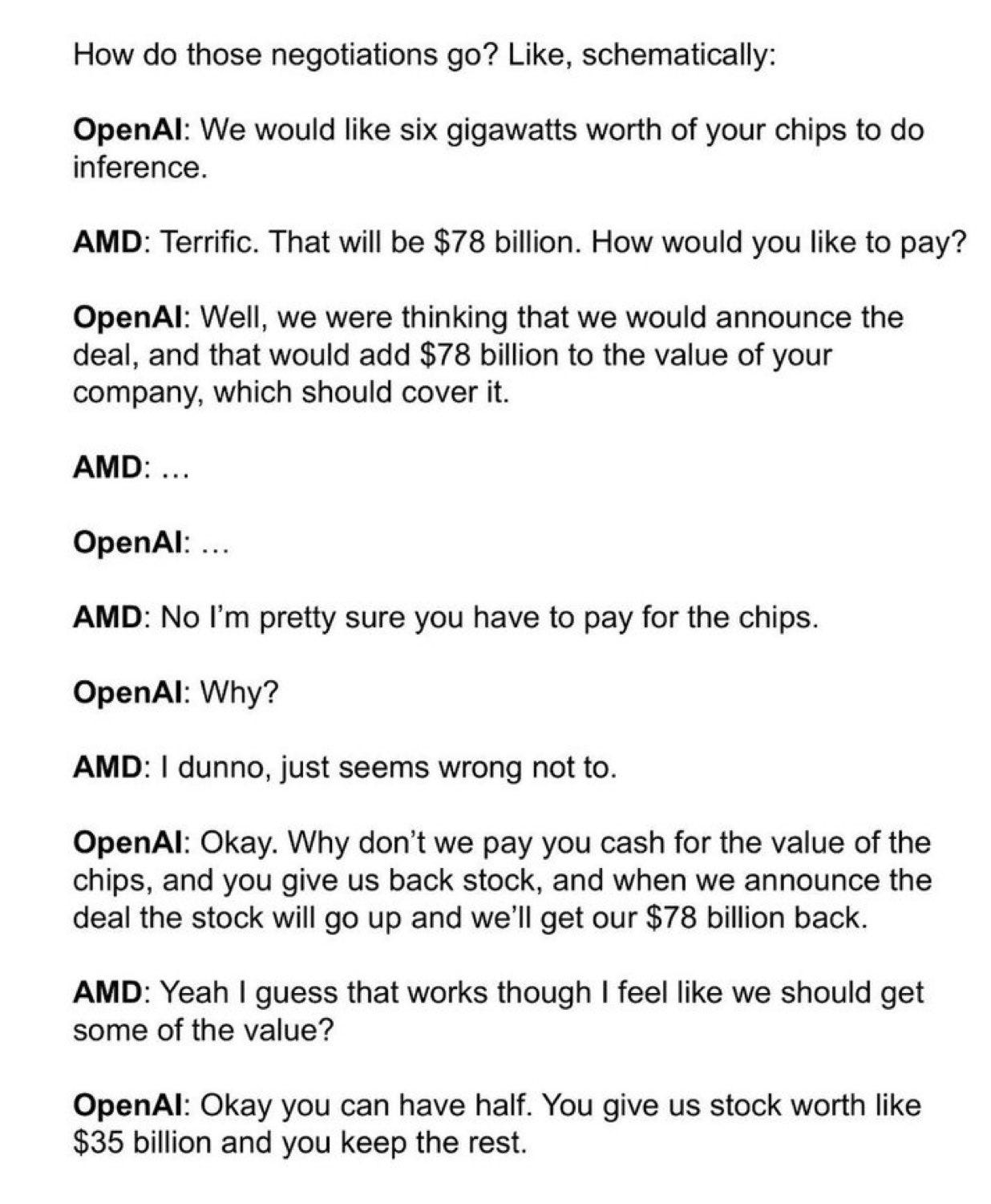
P.S. An insight into the “Anatomy of an AI deal” as imagined by Bloomberg’s inimitable Matt Levine. (Another reason to be cautious).
No posts
Comments
Nothing yet. Say the first thing.
Sign in to join the conversation.