
Earlier this week, I witnessed a mother being told by her four-year-old daughter that she was a “stupid cow” in front of a full music lesson. The child was asked in a gentle, pleading voice, to “please not say that”, but like a poker player sensing that her opponent was bluffing, she doubled down.
“You shitty, stupid old cow” she shouted, emboldened by the absence of any firm boundaries.
Although the little girl didn’t learn much about music that day, she did learn that those around her would accommodate her feelings, no matter how disharmoniously they were expressed.
No one said a word, although I’m sure a number of the other parents were thinking :
This was not the first time I had seen a parent’s authority completely undermined that week. Just a few days earlier, I had witnessed a tantrum at a playdate which predictably resulted in the child getting exactly what they wanted. I then had to sit and watch the same child pile food onto their plate, leaving little for anyone else. The hoarded, uneaten leftovers were later thrown into the bin. Again, omerta.
These moments have crystallised a peculiar modern dilemma for me: we’ve become so accepting of different parenting styles that we’ve lost the ability to recognise when tolerance tips into abdicating authority.
The crazy thing about all these situations is that these children and parents hold everyone around them hostage to their whims. No one will say anything because saying anything about someone else’s approach to parenting is about as taboo a topic as there is nowadays.
As Marilyn Simon explains :
Gentle parenting professes to foster compassion and emotional self-understanding in a child. It’s about respecting the emotions of a child and the motivations behind those emotions. If a child has a tantrum, hits, or generally misbehaves, it is because she is frustrated — and a parent’s job is to address the root cause of the child’s frustrations. A child should be understood, never punished.
It is important to distinguish between gentle parenting with clear boundaries, where there are consequences for overstepping them, and permissive parenting, which has no boundaries and essentially allows children to do whatever they want, short of burning down the house, with no real consequences.
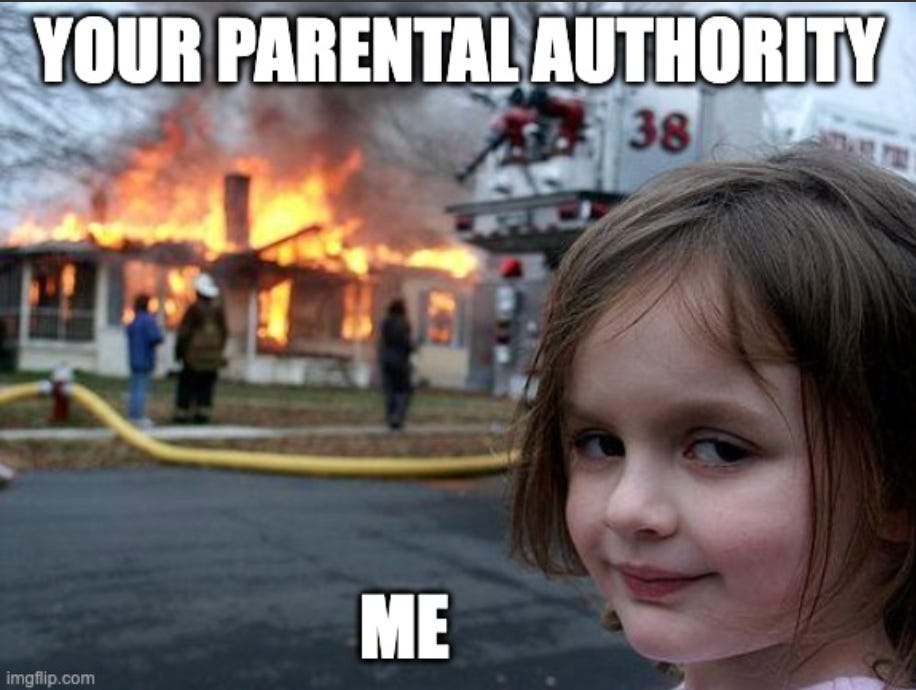
From what I have observed, permissive parents incorporate other avowed beliefs into their parenting approach like “he knows when he wants to sleep“, or “she lets me know what she wants to eat and when she wants to eat”. Both of which are clearly bullshit.
Let a kid decide when they feel like falling asleep and they’ll stay awake as long as they can, until they get overtired, cranky and make bedtime into an ordeal for everyone.
On the rare occasions when I am asked how our daughter sleeps, I report that sleep training is a wonderful invention and offer to share a PDF containing peer-reviewed research showing that learning to self-regulate sleep does not damage a child’s long-term development. Oddly enough very few sleep deprived, sex starved parents have yet to take me up on the offer.

Because the research shows that children raised permissively with few boundaries struggle with impulse control, self-regulation, and often become demanding and selfish - which doesn’t do these kids any favours in the long term, and means we have to put up with them as children, adolescents and adults.
To quote a line which stayed with me from Jonathan Haidt and Greg Lukianoff’s bestseller, The Coddling of the American Mind : How Good Intentions and Bad Ideas Are Setting Up a Generation for Failure, permissive parents :
prepare the road for the child instead of preparing the child for the road.
In other words, the hidden assumption is that children are fragile and that their spirit could be crushed by a two minute “time out” on the naughty step and result in lifelong trauma.
The truth is that children are in fact anti-fragile. They need challenges and stressors, as well as boundaries, to grow stronger and become well-adapted individuals.
The bottom line is that the taboo against commenting on other people’s parenting isn’t protecting children—it’s protecting parents from confronting the consequences of their choices.
By recognising that raising children is not a completely private activity, even if we have made it seem that way. When a four-year-old yells obscenities during a music lesson, it affects everyone in the room. If children learn that they can monopolise communal resources without facing any consequences, we are all complicit in their miseducation about how society should function.
Perhaps the answer lies in reclaiming the idea that raising children who can behave in public spaces is everyone’s responsibility, rather than an attack on parental autonomy. This could involve discreetly addressing a friend whose child is misbehaving, with genuine concern, even if it feels awkward. It could mean saying firmly, but without judgement to a misbehaving play date, that we don’t accept this type of behaviour in our home.
If we really care about raising resilient, conscientious children, we need to be resilient and conscientious enough to have these difficult conversations ourselves. Staying silent is neither progressive nor enlightened; it’s just cowardice dressed up as tolerance.
No posts
Comments
Nothing yet. Say the first thing.
Sign in to join the conversation.