
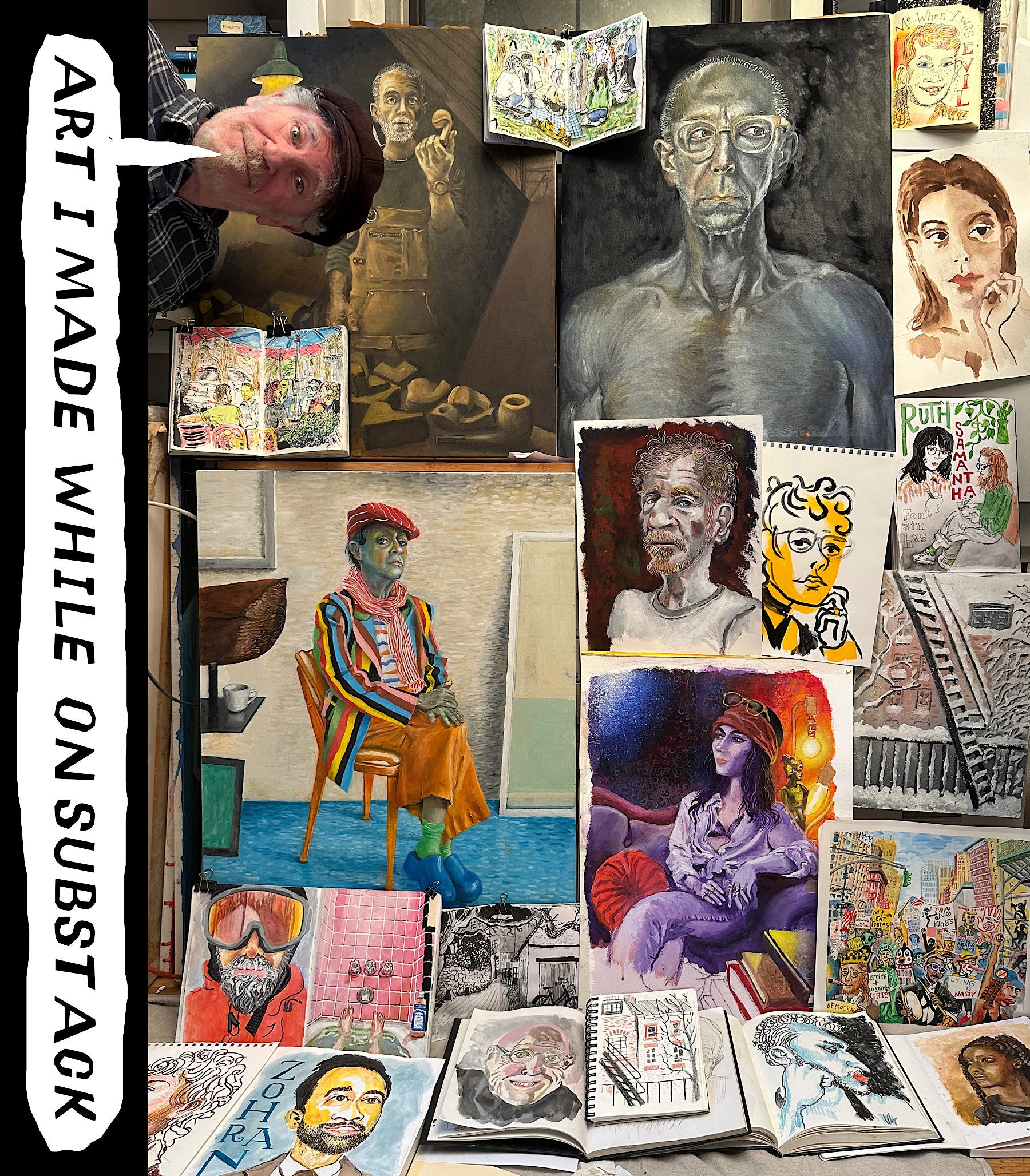
If you’re like me and you enjoy posting your art and writing about your art on Substack and you enjoy connecting with others and would like to expand those connections and make your experience more productive and fun, maybe some of the lessons I learned might apply to you.
Having said that, I am ME and you are YOU … so you might have a very different vision about what will make your Substack worthwhile, so feel free to ignore me.
I’m going to front load this post with the 2 big lessons I learned in my first year about making my Substack experience so freaking productive and fun … and then down below I’ll give you a time-lapse replay of how my first year on Substack taught me these lessons.
Substack is like a bustling metropolitan city with all these different neighborhoods — politics, tech, wellness, writing, art and so on. You probably don’t even go into many of those neighborhoods most of the time.
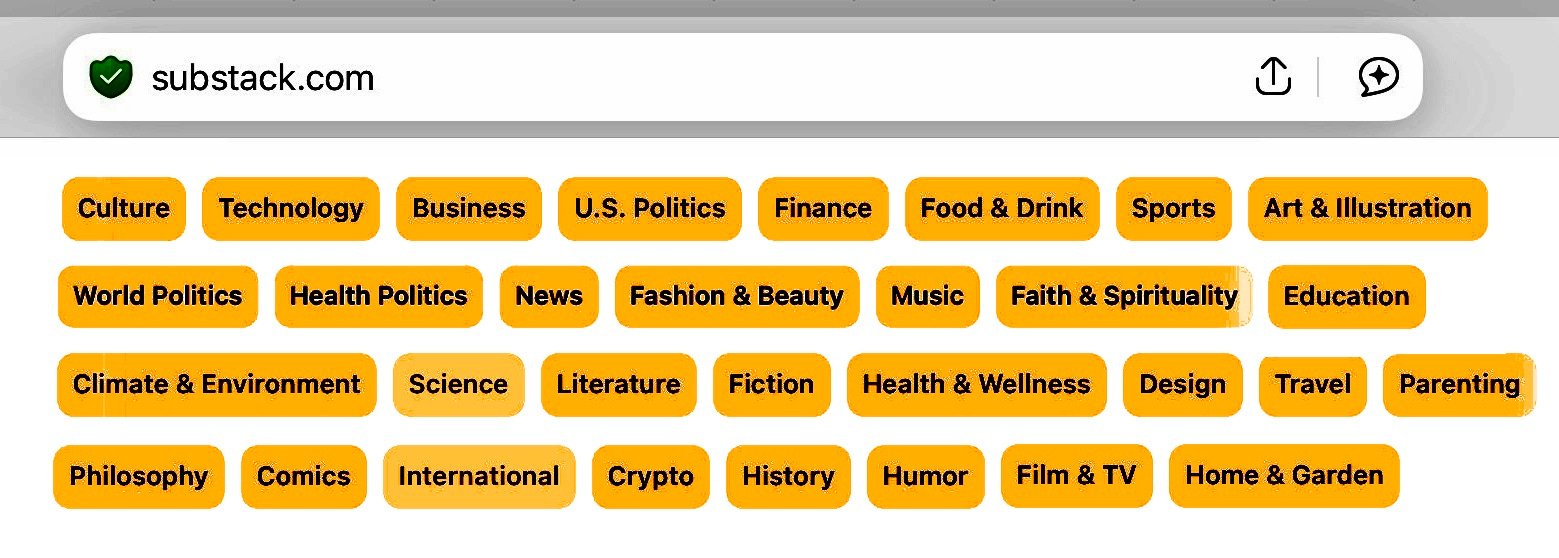
The funny thing is that there are even subdivisions within those neighborhoods. Take ART. There’s cartooning, graphic novels, sketching, landscapes, portraits, politics, print-making, fine art, watercolors, weaving and even art history where someone writes about art rather than making it.
If you’re an artist on Substack you’re probably mostly hanging out in a neighborhood with like minded artists who make work that’s kinda like yours. Like how the East Village whacksters who gather in Tompkins Square Park are a whole different tribe than the cultured folks who visit the Cloisters.
Which explains why I consider my fellow like-minded artists (and even some of you artists who are a little different than me because you draw graphic novels or paint landscapes) as my Substack friends and neighbors.
But what does it mean to be a good Substack neighbor?
First of all when I pop onto Substack, I might see a note of yours or post of yours and in a nice neighborly fashion, I might pop over and say “hello,” or write a comment. I sure know when one of you — my dear Substack friends and neighbors — reaches out to me it gives a little lift to my day.
What’s more if I see a piece of art or a post that really hits me, instead of just liking it, I’ll take a minute to gather my thoughts and tell my neighbor why I like their art or their post. Maybe even restack it with my comments. I know my neighbor will probably appreciate some thoughtful words about their work. Or even just a friendly joke 😂.
And lastly, when someone comments on one of my posts, I think of that as a really cool and nice thing to do, so I try to be cool and nice in return. Your neighbors like to be seen and heard.
In fact some of the very best conversations I have on any given day are those I have with my Substack friends and neighbors.
Thank you Substack friends for chatting with me across the digital picket fence. You are the main reason Substack is so freaking fun for me.
Give a man a fish and you feed him for a day; teach a man to fish and you feed him for a lifetime. It’s one of those great quotes from the Bible that you can live by even when you strip out the religion.
The biggest misconception I had about Substack was that people would be interested in my IDEAS. Hahahahahaha — Oh, Josh, you foolish fellow! So I wrote all kinds of posts based on clever ideas. They were fun and a certain number of people liked them and maybe they even stuck with people a little bit, but in the end to be honest who really cares? They were just clever ideas that made me think I was smart, but didn’t really do much for anyone else.
As it turns out artists are like everyone else and what they most want to know is how to fish … uh … I mean .. they want to know how to make art.
In other words, my posts where I showed an artist how to actually do something like “How to draw a Scene like a Folk Artist” or “How to make Art while Traveling,” were the posts that connected the most with readers.
Are you ready for a Substackian narrative twist?
This teaching-an-artist-to-fish thing didn’t begin with me teaching others but from others teaching me. I found so many “teachers” on Substack who I could study and learn from and ask questions of and then in my posts I reported back on what I’d learned, writing about my artistic struggles and triumphs to draw, to paint, to use new tools and and develop systems to try to become a better artist as I tried to incorporate those art-making-lessons into my own practice.
As it turns out the secret of whatever humble success I’ve found on Substack is that I’ve let other artists on Substack change me as an artist by learning from them and then I explained what I learned to you.
It’s not that I didn’t make art before I was on Substack, but I used the artists on here as a way to push my art above and beyond where it was before.
To my dear Substack ‘teachers’ I say, “Thank you from the bottom of my art.”
Know someone trying to figure out Substack? This post is public so feel free to share it.
I know you’re probably busy which is why I gave you my two big lessons first. But if you have a couple more minutes I invite you to travel along with me to experience the entertaining story of how it all came to be in this quicky-time-lapse-replay of my first year on Substack
It was just about a year ago when I published my first Substack post. Back in those innocent days I had no idea of the dead ends, trap doors and cul-de-sacs I’d wander down before I (kind of) figured it out.
Truthfully, being on Substack wasn’t some dream of mine. I got on here because I was pitching a book called YOU and ART and an agent told me, “It’s a great book, I love it but you should build up a Substack following before we try sell it to publishers.”
I was like. “OK, I’ll try that,” ‘cause I’ll do anything on a dare.
I jumped right in and wrote posts on such subjects as Artists are (a lot like) Hobos and Move your ASS and your ART will follow and Dear Art
Those kinds of Substack posts I was writing were based upon two hilarious misconceptions. First of all I thought, “I’m a smart guy and people will love all my super clever ideas about art,” and what’s more “‘my posts will be sooooo good they’ll appeal not just to artists but to every kind of creative, you know writers and filmmakers and chefs.”
Both those ideas were stupid with a capital ‘S’.
Sure, the posts were fun and maybe clever, but they were not particularly useful to artists or anyone else. Those posts were more about me, Josh than they were about an artist and his or her work.
- - - -
The first piece I wrote that got an extra bit of interest was this:
This is the first piece in which I wrote about how Substack had changed me. I did this by reporting on how some artists on Substack had inspired me to not just draw in my studio but to start drawing out in the real world and writing about what that felt like and how I did it and of course respectfully crediting the Substack artists who I had learned all this from.
The fact that this story struck a chord with many readers got me thinking I should write less about my oh-so-clever ideas and more about … y’know … making art.
- - - -
This is the next post I wrote that seemed to reach a lot of new people.
A short course in LETTERING
·
December 4, 2025
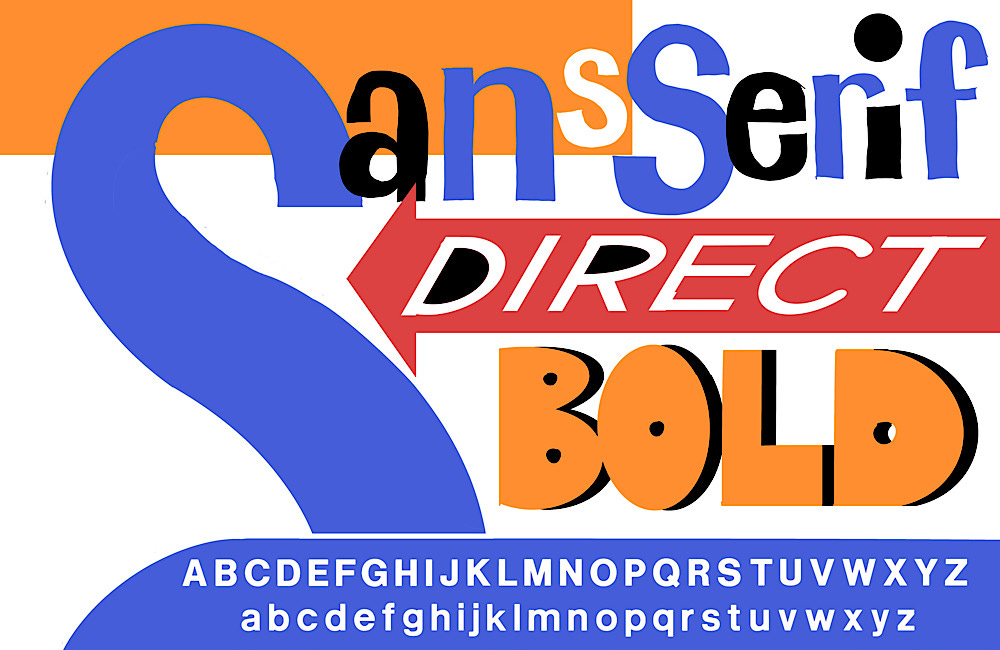
To letter better in your art is to know the letters so well that they become your friends. So let’s meet them and learn about them…
Having been an art director at New York Magazine for 10 years and having been an artist who always loved using type, hand-lettering just happens to be something that I know a lot about. Yet, it took me a long time to realize that artists who like to hand-letter might find a straightforward manual on how to combine lettering with art a useful thing. I’m slow I guess. 🙈
And here’s another funny thing: Most of what I knew about lettering I couldn’t really articulate. Which is why to write this piece, I basically had to go into my own mind and go rooting around to understand what the basic principles were and how I could summarize them to make them understandable and useful.
This has become my method since then — study myself to learn what I’m doing so that I can explain the process to other artists — which you can see in the next post I wrote, which also got a lot of interest
How to draw a SCENE (like a folk artist)
·
Feb 9
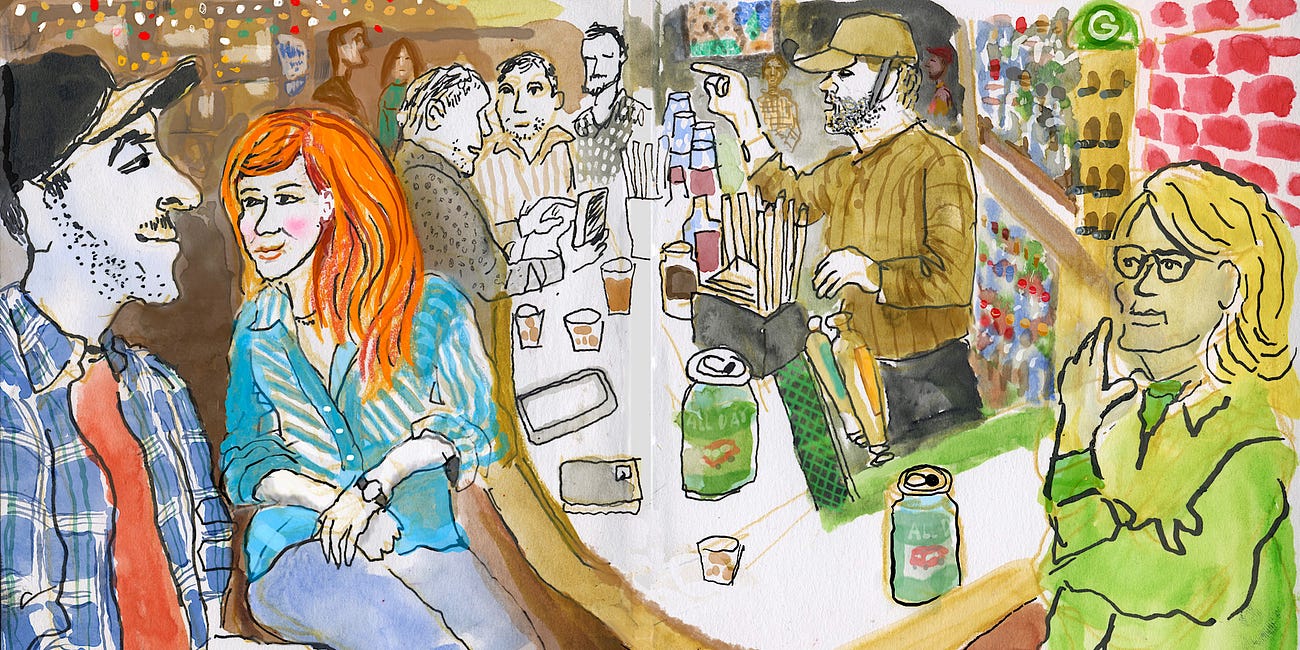
There is a classic technique for drawing scenes. By a “scene” I mean a group of people in a specific location that might be anything from a bar to a cafe to a li…
This was a fun post to write. Having been inspired by Substack artists to draw scenes out in the real world, over time I developed my own unique technique. I draw scenes not by blocking them out but by just starting on one side of the page and drawing the first person or thing and then the next, one after another and so on till the whole page is filled.
To write the post I went out to my local pub at 1 in the morning. I parked myself at a corner of the bar and drew the scene from left to right, one person or thing at a time, photographing the drawing in stages and then I put it all together to explain how to draw a scene like a folk artist.
It was beginning to get through my thick skull that folks appreciated how I challenged myself to do new things, the honest way I reported on it and my devotion to explaining things in ways that people can understand.
So I kept challenging myself by trying new things I’d never done before and writing about the results in posts such as How to be an ARTIST when you’re taking a TRIP, How to start a DRAWING CLUB, How to design your very own portable ART KIT, and How to throw a DRAWING PARTY.
All this new learning inspired me to go back to my past as a painter and start a new series of oil paintings — Portraits of my Friends. In these posts I wrote about the making of these portraits of my friends Laurie and Ian for instance, describing the process of painting a portrait from the original idea, through the sketching and ideating to the painting itself and all the ups and down and decisions I make along the way.
And that my friends is the story of how I made my Substack experience productive, art-filled and so freaking fun.
Thank you Substack friends 🙏🏼 for being such good and true, entertaining and supportive neighbors.
Since I believe every artist is a unique soul with a unique voice and unique things to say in their art and that sometimes all an artist needs is a just a little nudge or a new technique or just the idea of making it fun to get closer to the place where they want to be, I’m going to spend the next year developing “Josh’s DIY art school.”
I’m still figuring out how to make it useful for artists … what subjects or techniques to focus on and how to use chats, videos, zooms or prompts. And I’d sure love to know what you’d like to practice or learn about on Substack.
See ya soon
Your fellow Substacker,
Josh
Comments
Nothing yet. Say the first thing.
Sign in to join the conversation.