
In many Black communities, the word corporate doesn’t usually bring warm feelings. It can remind us of workplaces where we had to code-switch to be accepted. Companies that profited from our culture but overlooked our contributions. Institutions that demanded excellence from us while extending grace to everyone else. Systems that too often felt like they were built without us—or worse, against us.
Because of that history, it’s understandable that many of us instinctively push back against anything that sounds overly structured, administrative, or “corporate.” But perhaps we’ve been rejecting two different things as though they were the same. Corruption is one thing. Order is another.
When we slow down and study Scripture—including the Torah, the Prophets, the Wisdom books, the Renewed Covenant writings, and the Apocrypha—we discover something unexpected. The Kingdom of Yahuah is profoundly organized. The Bible presents order not as man’s invention but as a reflection of the Creator Himself.
The issue has never been organization. The issue has always been whether that organization serves righteousness or exploitation.
For a people seeking to rebuild families, businesses, ministries, schools, media platforms, neighborhoods, and generational wealth, that distinction matters.
One of the most fascinating observations comes from the Book of Enoch. As Enoch describes the heavens, he repeatedly points to something every successful organization desires: consistent execution.
The stars keep their appointed courses. The sun and moon never miss their assignments. The seasons arrive exactly when they should. Every part of creation performs the function it was designed to perform. Creation does not improvise its responsibilities. It operates according to divine order.
Enoch contrasts this with humanity. While creation faithfully carries out its assignments, mankind repeatedly departs from the order established by Yahuah.
Think about that for a moment.
The trees don’t decide they’re too tired to produce fruit this year.
The seasons don’t say they’ll get around to changing next month.
The heavens don’t operate on excuses.
Everything honors its assignment.
That same principle echoes throughout Scripture. Ecclesiastes speaks of appointed times for every purpose under heaven. Paul later reminds believers that “all things should be done decently and in order.” The consistency of creation reflects the consistency of its Creator.
Sometimes we read Scripture looking only for spiritual inspiration while missing how remarkably organized it actually is.
The Bible is filled with systems that would feel familiar to any operations manager, logistics coordinator, project leader, entrepreneur, or community organizer.
When Yithro observed Mosheh trying to solve every problem himself, he recognized a leadership bottleneck. His solution wasn’t to work harder. It was to build a system. Leaders would oversee thousands, hundreds, fifties, and tens, creating clear lines of responsibility and accountability. That’s scalable leadership.
The Levites were organized into specialized responsibilities. Some served as gatekeepers. Others managed treasuries. Others transported sacred furnishings. Others oversaw music, worship, maintenance, logistics, and administration. Everybody didn’t do everything. Everybody had an assignment.
Even the construction of the Tabernacle demonstrates astonishing project management. Every measurement, every material, every responsibility was documented with precision. Again and again Scripture repeats, “according to the pattern shown.”
Excellence wasn’t accidental. It was organized.
For many of us in the Black diaspora, we’ve been taught to celebrate gifted people. Scripture certainly celebrates gifted people. But it also celebrates organized people. Talent starts movements. Systems preserve them.
Documentation may not seem exciting, but Scripture treats it as sacred.
Enoch was instructed to write what he saw and preserve it. Habakkuk was told, “Write the vision and make it plain.” Malachi speaks of a Book of Remembrance. Revelation describes books being opened. Genealogies, censuses, covenants, temple inventories, boundaries, and laws were carefully recorded.
The Kingdom keeps records.
Documentation protects truth. It preserves accountability. It allows knowledge to outlive the individual who first received it. That’s especially important for us.
Too much Black history has been erased, rewritten, or never documented at all. Too many family stories disappeared because nobody wrote them down. Too many businesses closed without systems that could be passed to the next generation. Too many ministries depended on one gifted leader instead of documented processes that others could continue. If we want legacy, we must value documentation as much as inspiration.
Long before modern business law, Scripture established covenant. Biblical covenants included defined responsibilities, witnesses, memorials, blessings, consequences, and public acknowledgment. Agreements were expected to be clear, understandable, and honored.
Clear communication is treated the same way.
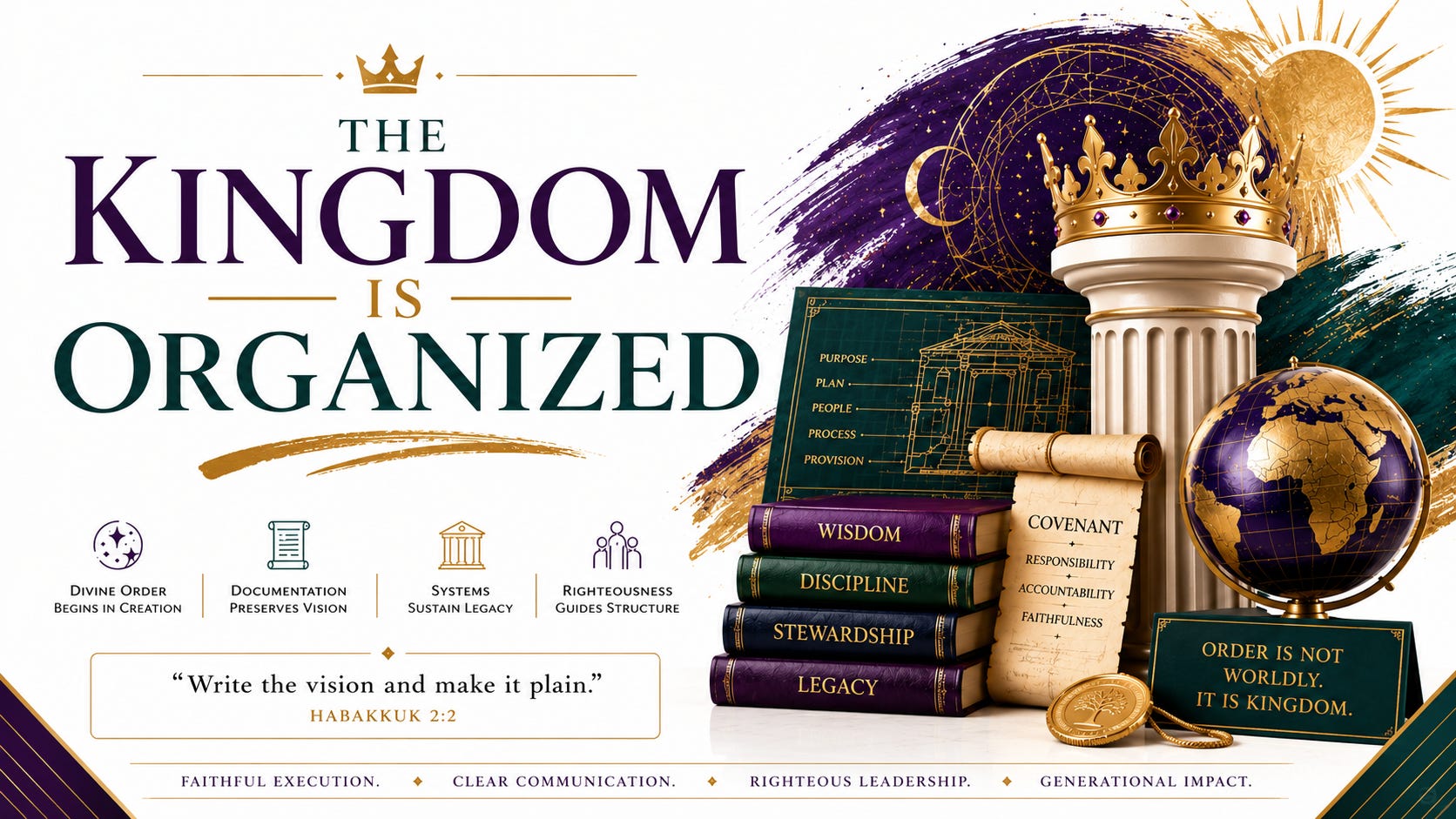
“Write the vision and make it plain.”
Imagine how many misunderstandings in our families, ministries, businesses, and organizations could be prevented if expectations were communicated plainly instead of assumed.
The righteous person is described as someone who keeps his word even when it costs him. Trust isn’t built through charisma. It’s built through consistency.
The Bible never glorifies confusion. Bezalel was chosen because he possessed extraordinary craftsmanship and technical skill. Yoseph developed long-term food storage systems before famine arrived. Nehemiah inspected damage, developed a rebuilding strategy, assigned responsibilities, monitored progress, corrected problems, and completed the work despite intense opposition. These are stories of faith. They are also stories of competence.
In many of our neighborhoods, we’ve been told we have to work twice as hard just to receive half the recognition. Whether that has been your experience or not, Scripture encourages us to pursue excellence because it honors Yahuah—not because we are chasing someone’s approval.
Proverbs consistently praises diligence, preparation, discipline, foresight, and consistency while warning against laziness, negligence, impulsiveness, and disorder. Wisdom is organized.
Some believers speak as though business itself is worldly. Scripture doesn’t. It condemns dishonest business.
The Torah forbids false weights and dishonest measurements. Workers are to receive fair wages. The poor are not to be exploited.
The prophets go even further. Amos condemns economic systems that manipulate prices and prey on vulnerable people. Ezekiel rebukes leaders who enrich themselves while neglecting those they serve. Nehemiah confronts officials who profit from the suffering of their own people.
The Apocrypha reinforces these themes. Sirach warns merchants about greed and dishonesty. Wisdom of Solomon exposes those who use power to oppress the righteous. Maccabees shows how bribery and compromise can corrupt entire societies.
Many in our community have witnessed systems that seemed designed to benefit everyone except us. Those experiences are real.
But Scripture doesn’t call us to reject organization. It calls us to build righteous organizations. Babylon represents organized corruption. The Kingdom represents organized righteousness. Those are not the same thing.
Throughout Scripture we encounter calendars, appointed times, priestly rotations, census records, genealogies, feast schedules, treasury management, judicial systems, scribes, stewards, gatekeepers, musicians, artisans, administrators, and messengers. The Kingdom is highly organized.
Even Yahusha’s teachings assume structured communities. He speaks about managers, laborers, vineyard owners, stewards, wages, investments, and faithful administration because His listeners understood responsibility. Leadership was never about controlling people. It was about serving them faithfully.
This is where the conversation becomes personal. Let’s reject the lie that Black people struggle with organization because we are somehow less capable. History completely disproves that.
Ancient African civilizations built sophisticated governments, trade routes, engineering projects, educational systems, legal frameworks, and thriving economies.
Across the diaspora we’ve built churches, schools, businesses, newspapers, mutual aid societies, neighborhoods, music industries, civil rights organizations, and global cultural movements that changed the world. We know how to organize.
The deeper question is whether centuries of instability changed how many of us relate to structure itself.
When institutions repeatedly become places of discrimination, unequal justice, surveillance, broken promises, and exclusion, it’s understandable that trust in systems weakens.
Sometimes survival requires flexibility instead of predictability. Improvisation becomes a strength. Relationships become more valuable than procedures.
Those adaptations helped many of our families survive difficult seasons. But survival habits do not always produce generational institutions.
One familiar example is the phrase “CPT”—Colored People Time. Most of us have laughed about it. Yet underneath the humor is an opportunity for honest reflection. Punctuality isn’t about impressing other people. It’s about honoring our own commitments.
Scripture points us toward appointed times because reliability builds trust. Another remarkable strength within Black culture is improvisational brilliance.
From jazz to hip-hop, from entrepreneurship to neighborhood problem-solving, we’ve repeatedly shown an extraordinary ability to create something powerful from very limited resources. That creativity is a gift. But legacy usually requires systems.
Yoseph didn’t save Egypt through creativity alone. He saved it through planning, forecasting, documentation, storage, and disciplined administration.
We can also acknowledge that some of us have become more comfortable with verbal agreements than written documentation. Given our history with discriminatory contracts and unjust legal systems, that hesitation is understandable.
Yet Scripture repeatedly emphasizes written covenants, documented instruction, witnesses, and preserved records because documentation protects communities.
Communication deserves equal attention. Many gifted people never reach their full impact—not because they lack talent—but because expectations remain unclear, responsibilities undefined, and follow-through inconsistent.
“Write the vision and make it plain.” That instruction still speaks. Imagine what could happen if the creativity, resilience, spiritual depth, innovation, and influence already present throughout the Black diaspora were consistently paired with documentation, operational clarity, stewardship, and long-term planning. That combination builds institutions. Not just moments.
This isn’t about becoming robotic. It isn’t about abandoning our culture. It isn’t about sounding, dressing, or behaving like somebody else.
Some of the greatest strengths in Black culture—creativity, hospitality, rhythm, resilience, storytelling, communal care, and innovation—should never be lost.
The invitation is not assimilation. The invitation is stewardship.
Observe:
The heavens keep their schedule.
The seasons honor their appointments.
Creation fulfills its assignment.
Scripture preserves its records.
Leaders delegate.
Craftsmen specialize.
Stewards manage resources.
Prophets document revelation.
The Kingdom functions through faithful order.
Structure is not the opposite of spirituality.
When governed by righteousness, structure becomes one of its greatest expressions.
Communities aren’t transformed overnight. They’re transformed through thousands of small decisions repeated consistently.
Try this:
Arrive ten minutes early.
Write things down.
Finish what you start.
Replace vague promises with clear commitments.
Use a calendar instead of hoping you’ll remember.
Organize one drawer, one folder, or one workspace.
Keep your word.
Teach children responsibility with patience and consistency.
Build simple systems that make faithfulness easier tomorrow than it was today.
None of these habits require wealth. None require a college degree. None require permission. But together, they cultivate trust, stewardship, and stability.
As Black people across America and throughout the diaspora, we’ve already demonstrated remarkable creativity, endurance, faith, and influence. Now imagine coupling those gifts with disciplined stewardship, organized excellence, documentation, consistency, and long-term vision.
That isn’t becoming more corporate. That’s becoming more Kingdom.Everything in heaven still performs its appointed work.The question isn’t whether order is biblical. The question is whether we’re ready to build with it.
The Kingdom doesn’t need more talented people. It needs more faithful stewards.
If creation can honor its assignment every single day, then perhaps it’s time for us to honor ours—with greater consistency, clearer communication, stronger systems, and righteous order. The goal isn’t to become more corporate. The goal is to become more Kingdom.
Our communities already possess extraordinary creativity, resilience, and influence. Imagine what Yahuah could do through a people who paired those gifts with disciplined stewardship and organized excellence.
The work starts today.
You’re out of the trance now—keep walking in truth.
No posts
Comments
Nothing yet. Say the first thing.
Sign in to join the conversation.