
0:00
-4:30
Some of us were taught to think repentance was a sentence.
“Sorry, Yah, for being a sinner.”
Sometimes we said it because someone led us in a prayer. Sometimes we said it because we knew we were supposed to. Sometimes we said it because we wanted relief, blessings, protection, or another chance. And if we are honest, some of us treated repentance like a spiritual transaction: say the words, feel slightly better, then move on to ask Yahuah for what we wanted.
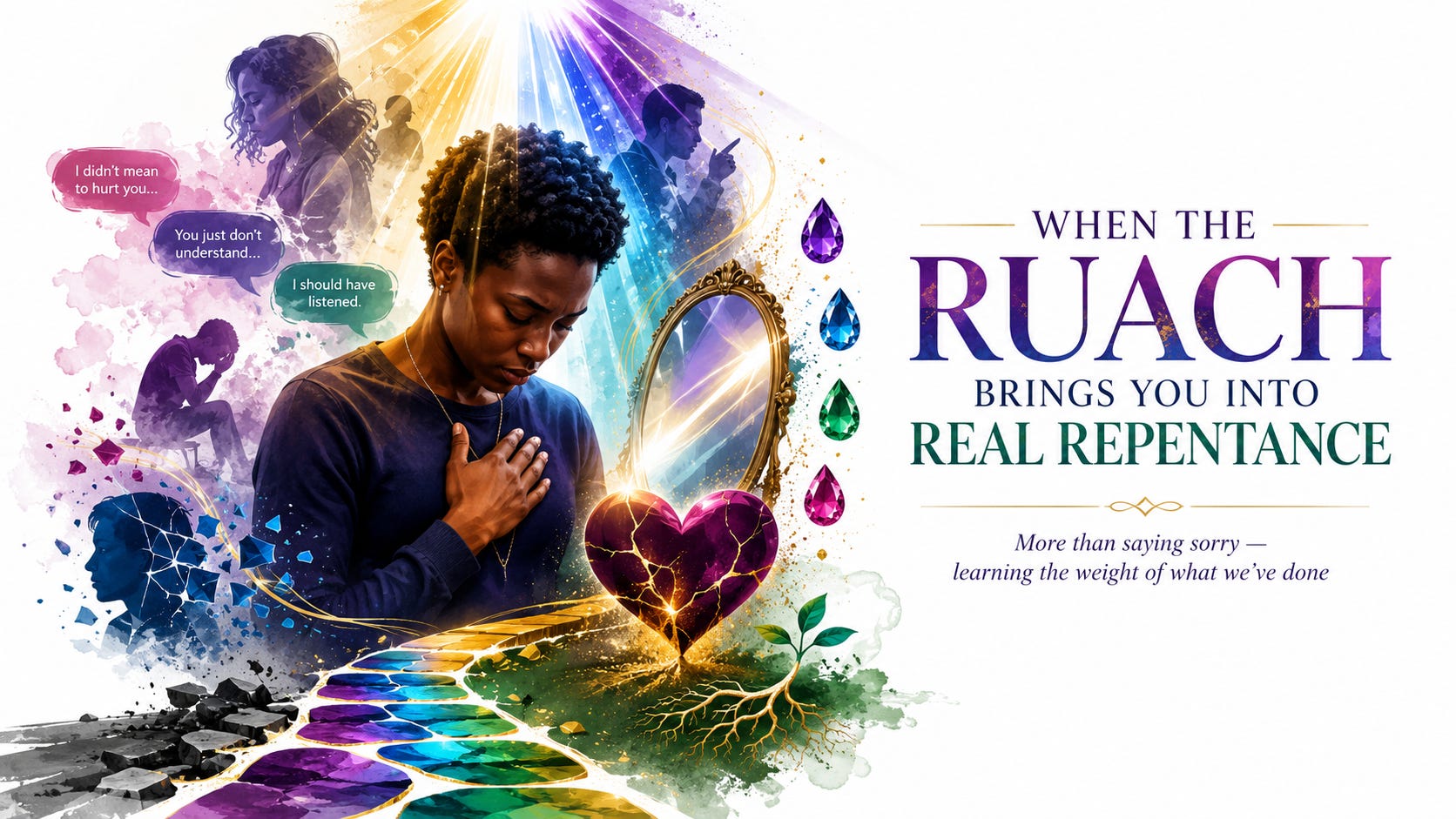
But real repentance is not casual. It is not shallow. It is not a religious checkpoint we hurry past on the way to the next request. Real repentance begins when the Ruach starts making sin personal.
Not just, “I did something wrong.”
But, “I wounded someone.”
Not just, “I fell short.”
But, “My actions carried weight.”
Not just, “Forgive me so I can feel clean.”
But, “Yahuah, show me what I have done, who I have harmed, what I have ignored, and what needs to be changed in me.” That is a different kind of prayer.
I have been there. I know what it is to offer casual apologies to The Most High, thinking it was just part of the process. I knew the rhythm: confess, ask forgiveness, ask for mercy, then continue with my requests. But when the Ruach began to convict me for real, repentance stopped being language and started becoming sight.
In prayer, situations came back to me. Conversations replayed in my mind. Moments I had minimized became heavy. I started realizing, “I was the bad guy in that situation.” I started feeling the pain I had caused others. That is sobering. That will humble you in a way religious language never could.
Then came the dreams. The memories. The scenes in prayer. Sometimes I would remember being done wrong, and before I could sit too comfortably in my own pain, the Ruach would point to a time when I had made someone else feel the same way.
That is when repentance becomes real. Because real repentance does not only reveal what was done to you. It reveals what has come through you.
▌Repentance is not just feeling bad because consequences showed up. Repentance is grief over the damage sin caused, agreement with Yahuah about what was wrong, and a willingness to turn from it.
One of the signs that Yahuah’s Spirit is bringing you into repentance is that your excuses start losing power. Before conviction, we explain everything.
“I was tired.”
“They pushed me.”
“I was hurt first.”
“That is just how I am.”
“They misunderstood me.”
“I did not mean it like that.”
But when the Ruach starts working on you, explanations no longer cover the wound. You may still understand the context, but you stop using context as a hiding place. You stop treating your pain like a permission slip to damage other people.
David understood this after his sin with Bathsheba and his murder-by-proxy of Uriah. For a season, David moved like a man who thought he had managed the situation. He covered. He arranged. He controlled the narrative. But Yahuah sent Nathan the prophet to confront him through a story. Nathan told him about a rich man who took a poor man’s only lamb, and David became angry at the injustice. Then Nathan said, “Thou art the man.” In that moment, the story turned into a mirror.
That is what real conviction does. It lets you feel righteous anger at wrong, then shows you where that wrong has lived in you.
David’s response was not a long defense. He did not say, “You do not understand the pressure of being king.” He did not say, “Bathsheba should have known better.” He did not say, “Uriah was just one man.” David said, “I have sinned against Yahuah.” That moment matters because repentance begins when we stop managing perception and start agreeing with Yahuah’s judgment.
Psalm 51 shows us the inside of David’s repentance. He says, “Against thee, thee only, have I sinned, and done this evil in thy sight.” He asks Yahuah to create in him a clean heart and renew a right spirit within him. He does not merely ask to escape consequences. He asks to be changed.
That is the difference between fear and repentance. Fear says, “Do not let me get caught.” Repentance says, “Do not let me stay this way.”
Many of us were taught sin mainly as rule-breaking. And yes, sin is rebellion against Yahuah’s instruction. But sin also spills onto people. It bruises trust. It causes confusion. It teaches others to protect themselves from us. It makes people question their worth, their discernment, their safety, and sometimes even their relationship with Yahuah.
If we only think about sin as a broken rule, we may apologize quickly and move on. But when we understand sin as damage, our repentance deepens.
We begin to ask:
Who had to recover from my words?
Who had to heal from my pride?
Who did I dismiss when I should have listened?
Who did I manipulate while calling it love?
Who did I shame because I did not want to be corrected?
Who did I abandon because their pain interrupted my comfort?
Who did I use, ignore, embarrass, silence, or mislead?
This is part of the weight. It is not condemnation for the sake of destruction. It is conviction for the sake of repair.
2 Corinthians 7:10 says that sorrow according to Aluah works repentance unto deliverance, but the sorrow of the world works death. Worldly sorrow is often self-centered. It grieves embarrassment, exposure, consequences, or lost access. But sorrow according to Aluah grieves the offense itself. It cares about Yahuah. It cares about truth. It cares about the people affected. Worldly sorrow says, “I hate that this happened to me.” Repentant sorrow says, “I hate that this came out of me.”
The Ruach may bring repentance through memory. You may be praying, and suddenly a conversation comes back. Not the version where you were the hero. Not the version where you edited out your tone. Not the version where you only remembered what they did. The full version comes back. The interruption. The sarcasm. The withdrawal. The threat. The manipulation. The indifference. The moment you knew better and still chose yourself.
That kind of remembering is mercy. It may hurt, but it is mercy because Yahuah is showing you what needs healing while you still have time to turn. Scripture says in Proverbs 28:13, “He that covereth his sins shall not prosper: but whoso confesseth and forsaketh them shall have mercy.” Covering keeps us stuck. Confession opens the wound to the light. Forsaking begins the change.
Sometimes repentance also sounds like finally hearing the other person’s pain without rushing to defend yourself. You may remember someone saying, “You hurt me,” and at the time you argued. You corrected their wording. You challenged their memory. You made yourself the victim of their reaction. But later, when the Ruach softens your heart, you realize they were trying to tell you something you were not humble enough to hear. That realization is a gift, but it is also a responsibility. Once Yahuah shows you, you cannot unknow it.
David’s repentance is important because David was not a man without failure. He was a man who knew how to return. He sinned terribly. He abused power. He took what was not his. He tried to cover it. He arranged death. He continued his life until Yahuah interrupted him. Yet when confronted, David broke. Not perfectly, not without consequences, but sincerely. Psalm 51 is not casual. It is not polished religious language. It is the cry of a man who sees the filth of his own heart and knows only Yahuah can cleanse him.
David asks for mercy. He acknowledges transgression. He admits that his sin is ever before him. He asks to be washed. He asks for truth in the inward parts. He asks for a clean heart. He asks not to be cast away from Yahuah’s presence. He asks for the joy of deliverance to be restored. Then he says he will teach transgressors the ways of Yahuah, and sinners shall be converted. That part is powerful.
David did not want forgiveness just so he could feel better privately. He wanted restoration that would turn into instruction. He wanted his failure to become warning, wisdom, and ministry. Real repentance does not make us pretend we never fell. It makes us walk differently because we know what falling cost.
John the Immerser told the people to “bring forth therefore fruits meet for repentance” in Matthew 3:8. That means repentance has evidence. It produces something visible. Not performance. Not religious acting. Fruit.
Fruit may look like humility where pride used to rule.
It may look like patience where anger used to explode.
It may look like restitution where selfishness used to take.
It may look like accountability where secrecy used to hide.
It may look like changed speech where cruelty used to live.
It may look like silence where you used to defend yourself too quickly.
It may look like going back and apologizing without adding, “but you also…”
It may look like accepting that forgiveness does not always mean immediate access.
It may look like no longer demanding people heal on your timeline.
This is where repentance becomes mature. Many people want to be forgiven, but they do not want to become safe. They want the relationship restored, but they do not want the habits corrected. They want mercy, but not transformation.
But Yahusha said in Luke 3:8 that true repentance has fruit. And Acts 26:20 speaks of turning to Aluah and doing works worthy of repentance. Not works to buy forgiveness, but works that prove the turning is real.
▌Repentance does not only change what you say to Yahuah. It changes how people experience you afterward.
There are times when repentance must move beyond private prayer.
Sometimes you need to apologize.
Sometimes you need to return what you took.
Sometimes you need to clarify what you misrepresented.
Sometimes you need to stop telling a one-sided story.
Sometimes you need to admit, “I was wrong,” without making the other person comfort you.
Zacchaeus gives us a strong picture of this in Luke 19. When deliverance came to his house, he did not merely cry. He made repair. He committed to giving to the poor and restoring fourfold to anyone he had wrongfully taken from. Yahusha then said deliverance had come to that house.
That shows us something: repentance can touch your money, your reputation, your habits, and your relationships. It may cost you something. But if it is real, you will not only want to be cleansed internally; you will want your external life to stop carrying the same harm.
The danger of shallow repentance is that it teaches us to apologize without changing. We can become fluent in confession but strangers to transformation. We can cry at the altar and still be reckless at home. We can post Scripture but refuse correction. We can say “Yahuah knows my heart” while ignoring the people our heart keeps damaging.
Jeremiah 3:10 speaks of returning “not with her whole heart, but feignedly.” That is frightening because it means a person can look like they are returning while still holding something back.
Yahuah is not fooled by religious theater.
He knows when repentance is sincere. He knows when we are grieving the sin or merely grieving the consequence. He knows when we want cleansing or simply want the pressure removed. He knows when we are ready to turn or only ready to pause until the heat dies down. This is why repentance must become a way of walking, not just a moment of emotion.
Repentance begins with conviction, but it matures through obedience. Here are practical ways to walk it out:
Ask Yahuah to show you the truth without letting pride edit the evidence.
Pray honestly. Ask Him to reveal what you have minimized, excused, or hidden from yourself. Psalm 139:23-24 gives us the posture: search me, try me, know my thoughts, and lead me in the everlasting way.Stop rushing past the weight.
Do not hurry into “I am forgiven” so quickly that you never sit with what needed forgiveness. Mercy is real, but maturity requires understanding. Let conviction do its work.Name the sin plainly.
Do not call cruelty “honesty.” Do not call pride “discernment.” Do not call manipulation “concern.” Do not call rebellion “being misunderstood.” Say what it was.Consider who was affected.
Ask, “Who carried pain because of my actions?” This does not mean drowning in shame. It means becoming sober, responsible, and aware.Make repair where possible.
An apology may be needed. Restitution may be needed. A correction may be needed. A changed boundary may be needed. Do what righteousness requires, without using repair as a way to force access.Accept consequences without calling them persecution.
Sometimes the consequence is part of the lesson. David was forgiven, but consequences still followed. Forgiveness does not always erase the earthly impact of what we did.Build new fruit through repeated obedience.
Repentance is not proven by one emotional moment. It is proven by a new pattern. Walk differently. Speak differently. Choose differently. Let people see consistency over time.Stay correctable.
A repentant person does not become offended every time correction comes. Correction may sting, but Proverbs repeatedly shows that wisdom receives instruction.Forgive others with the same seriousness you want Yahuah to forgive you.
When you understand your own need for mercy, it should soften your posture toward others. This does not mean tolerating wickedness, but it does mean refusing hypocrisy.Keep returning quickly.
The goal is not to pretend you will never stumble again. The goal is to stop making peace with sin. When the Ruach convicts, respond quickly. Do not harden. Do not delay. Return.
Repentance is not optional. It is not a side topic. Yahusha preached repentance. The prophets cried for repentance. The apostles called people to repentance. Acts 17:30 says the times of ignorance Yahuah winked at, but now commands all men everywhere to repent. That means repentance is not merely for the openly wicked. It is for all of us.
It is for the one who knows better but delays obedience.
It is for the one who teaches truth but refuses humility.
It is for the one who has Scripture in the mouth but bitterness in the heart.
It is for the one who has been wounded and now uses that wound as permission to wound others.
It is for the one who has mistaken knowledge for transformation.
And it is for the one who has been saying “sorry” for years but has never asked, “Yahuah, what did my sin do?”
Real repentance brings us low, but it does not leave us hopeless. It humbles us so we can be healed. It exposes us so we can be cleansed. It interrupts us so we do not keep walking toward destruction while calling it normal.
Yahuah’s mercy is not weak. His mercy is powerful enough to forgive and correct. His compassion does not excuse our sin; it gives us time and strength to turn from it. So the question is not simply, “Have I apologized?”
The deeper question is:
Have I turned?
Have I listened?
Have I made repair where I can?
Have I become safer, humbler, softer, cleaner, and more obedient?
Have I allowed the Ruach to show me the weight?
Because when Yahuah’s Spirit brings you into real repentance, you stop treating sin like a small thing. You stop hiding behind religious language. You stop making apologies that cost you nothing. You begin to grieve what grieves Him. You begin to care about the people your actions touched. You begin to walk differently. And that is where healing begins.
▌Repentance is not Yahuah trying to shame you into despair. Repentance is Yahuah inviting you out of blindness, out of pride, out of destruction, and back into truth.
You’re out of the trance now—keep walking in truth.
No posts
Comments
Nothing yet. Say the first thing.
Sign in to join the conversation.