
Song: Evidence by ESR Music Group
0:00
-4:08
A detective steps beneath yellow tape. The room is silent. No fingerprints. No confession. No eyewitness. At first glance… There is nothing. Yet he doesn’t pack up his equipment and leave. Why? Because someone he trusts has already told him there is truth to be found. So he begins searching. One clue leads to another. Tiny details begin connecting. A footprint. A receipt. A phone record. A conversation. Hours later, what was once invisible becomes undeniable. The evidence didn’t create the truth. It revealed the truth that was already there.
Most of us have been taught that faith works the opposite way. We think we need evidence before we can believe. Scripture invites us into something much deeper.
“Now faith is the substance of things hoped for, the evidence of things not seen.”
— Hebrews 11:1
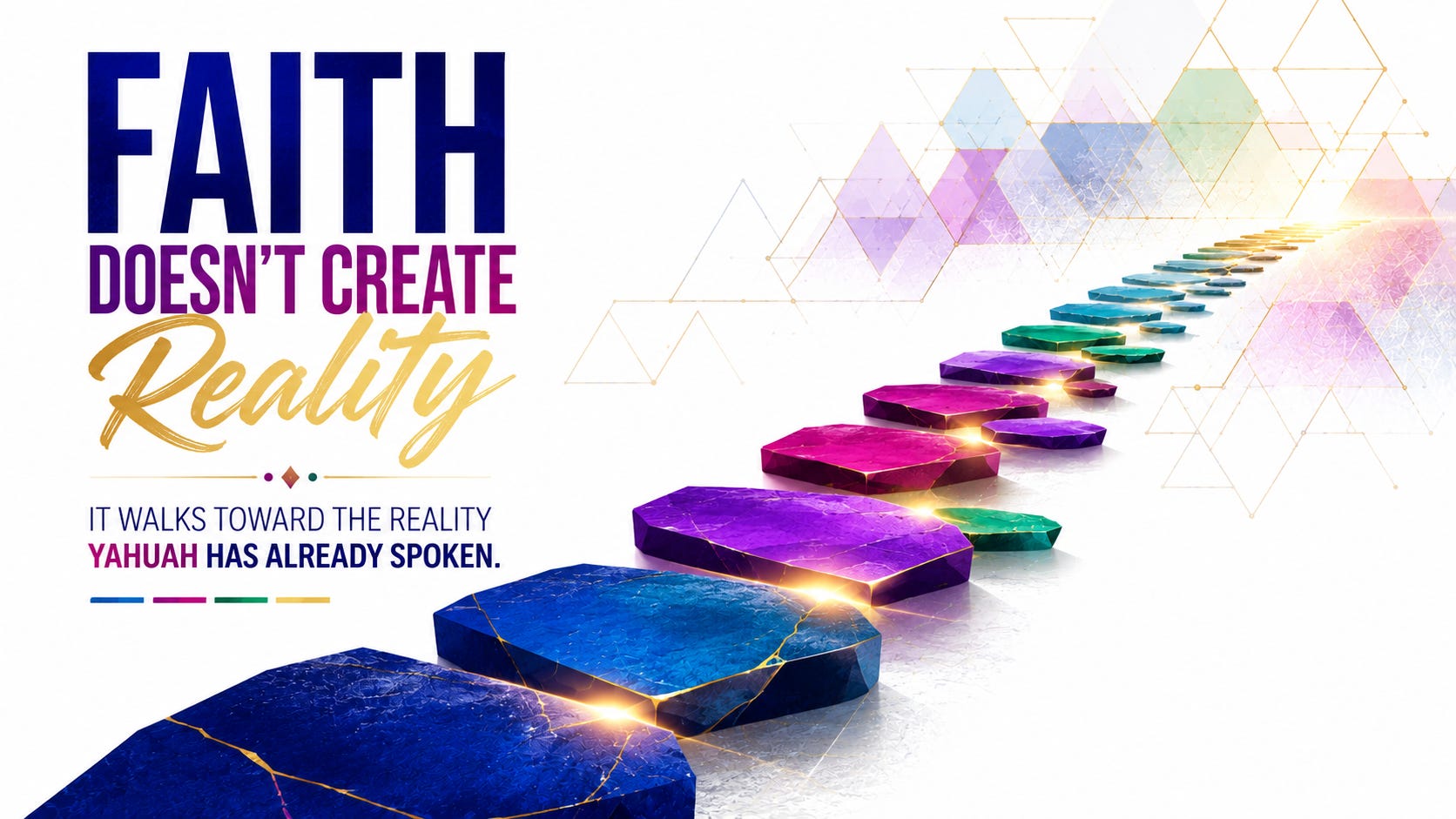
This may be one of the most quoted—and one of the most misunderstood—verses in the Bible. Many of us have come to think of faith as a spiritual force that creates reality. Believe hard enough. Speak confidently enough. Refuse enough doubt. Eventually, reality will bend to your conviction. But Hebrews tells a different story. Faith doesn’t create reality. Faith walks toward the reality Yahuah has already spoken. That distinction changes everything.
Look closely at every person mentioned in Hebrews 11. Noah. Abraham. Sarah. Moses. Joshua. None of them began with imagination. None of them began with positive thinking. None of them began with a vision board. They all began the same way. Yahuah spoke first.
Noah built because Yahuah warned him. Abraham left because Yahuah called him. Sarah believed because Yahuah promised. Joshua marched because Yahuah instructed. Faith was never their attempt to convince Yahuah. Faith was their response to what Yahuah had already said. That pattern hasn’t changed.
The Hebrew word often associated with faith is Amunah (אֱמוּנָה), rooted in Aman (אָמַן). It speaks of firmness. Stability. Reliability. Faithfulness. It is also the root of a word we say almost every week. Amen. Not merely, “The prayer is over.” Rather… “It is established.” “It is trustworthy.” “It is firm.”
Ancient Hebrew wasn’t only heard. It was seen. Every letter carried a picture. Aleph (א) points to strength, leadership, and the Father. Mem (מ) represents water—life that flows and sustains. Nun (ן) pictures seed, continuation, and enduring life. Together they paint a remarkable image. The strength of the Father producing enduring life.
Suddenly faith looks very different. Faith isn’t emotional excitement. Faith is becoming steady because you’ve discovered that Yahuah has never failed.
We often use the word hope to mean uncertainty. “I hope it doesn’t rain.” “I hope everything works out.” Biblical hope carries far more weight. The Hebrew word is Tiqvah (תִּקְוָה). Quite literally… It means a cord. A rope. Something that ties one point to another. It is the very word used for the scarlet cord Rahab hung from her window. Hope is not crossing your fingers. Hope is fastening yourself to a promise.
Its ancient letters tell another beautiful story. Tav speaks of covenant. Qoph points beyond the horizon. Vav connects. Hey reveals. Together they form a picture of a covenant connecting you to what will one day be revealed. Hope reaches into tomorrow before tomorrow arrives.
Our English ears hear substance and think of physical matter. The original audience would have heard something closer to foundation. That which stands underneath. That which supports everything resting upon it.
Think about constructing a building. No one admires the concrete foundation. Visitors compliment the windows. The architecture. The view. Yet without the unseen foundation… Nothing above it survives. Faith is like that. It quietly carries the weight of obedience long before anyone notices the finished structure.
Here’s where many of us unintentionally stop. We have hope. We say we have faith. Then… We wait.
Hebrews doesn’t describe passive faith. Every person in Hebrews 11 moved. Noah cut wood. Abraham packed his belongings. Sarah prepared for a child. Moses returned to Egypt. Joshua marched. Faith wasn’t merely agreement. Faith became obedience. Perhaps that’s why so many of us feel stuck. We’re waiting for evidence before taking the step Yahuah already asked us to take.
Imagine receiving a case file. You don’t yet have fingerprints. No DNA. No surveillance footage. No confession. Only one thing. A trusted source tells you, “The truth is there.”
So you begin. You investigate. You ask questions. You gather clues. Slowly… Evidence begins to appear. That’s remarkably close to the life of faith. Hope receives the assignment. Faith trusts the One who gave it. Obedience begins the investigation. Evidence follows. The evidence never created the truth. It simply uncovered what had always been true.
Faith doesn’t demand visible proof. It trusts the One who has already seen the end.
A husband chooses forgiveness before hearing an apology. A wife keeps praying for her family even when nothing appears to be changing. An entrepreneur refuses dishonest profit while competitors seem to get ahead.
A young couple sits at their kitchen table. Bills cover every inch of the table. One dishonest decision could solve everything. Nobody would ever know. Instead… They choose integrity. Not because it makes financial sense. Because Yahuah has already spoken. Months later, a door opens that no amount of manipulation could have forced.
An adult child faithfully cares for an aging parent who no longer remembers their name. Not because the parent can repay the love. Because honoring father and mother doesn’t depend on recognition. These moments rarely trend online. They seldom receive applause. Yet heaven recognizes every one of them.
What if Noah had waited for rain? What if Abraham refused to leave until he saw the Promised Land? What if Joshua demanded proof before marching? What if Esther waited until she felt completely fearless? Scripture would read very differently.
Instead… Yahuah spoke. Hope held tightly to the promise. Faith responded with obedience. Evidence arrived in His time. The pattern has never changed.
Maybe the greatest obstacle to faith isn’t doubt. Maybe it’s our insistence on seeing before obeying. We tell ourselves, “Once I understand everything…” “Once I feel ready…” “Once I have enough confirmation…” Then I’ll move.
But faith has always walked in the opposite direction. Hear. Trust. Obey. Watch. Faith doesn’t pretend something is true. Faith lives as though Yahuah tells the truth. Because He does. Every time.
Somewhere… Noah hammered another board onto an ark. Still no rain. Abraham walked another mile. Still no city. Joshua marched another lap. Still no fallen wall. Nothing visible had changed. Everything invisible already had.
Maybe today Yahuah isn’t asking you to see more. Maybe He’s asking you to trust more. One more prayer. One more conversation. One more act of forgiveness. One more honest decision. One more quiet act of obedience.
The evidence may not be visible today. But every faithful step declares something greater than your circumstances. It declares that Yahuah is faithful. And He always has been.
Take a sheet of paper and draw a line down the middle. On the left write: What Yahuah Has Already Said. Write down one promise from Scripture that speaks directly to your current season.
On the right write: What I Can See Right Now. Be honest about your circumstances.
Then ask yourself one question: “If I truly believed what Yahuah has said, what step of obedience would I take today?”
Take that step. Not because you’ve seen the outcome. Because you’ve learned to trust the One who already has.
You’re out of the trance now—keep walking in truth.
No posts
Comments
Nothing yet. Say the first thing.
Sign in to join the conversation.