
Gareth Evans is the Founder and CEO of VECKTA, a software platform and marketplace that helps commercial and industrial businesses deploy on-site energy systems. He is also the host of the Renewable Ride podcast, and recently closed a funding round with VoLo Earth, TechSquared Ventures, and Mobilize Climate Capital - a notable outcome in a year when most generalist investors put their pens down on climate and energy tech.
In this conversation, Gareth walks through what is actually happening in the US energy market - why the grid has earned a failing scorecard, why the real bottleneck is delivery rather than generation, and why every rooftop and car park in the country is a future power plant.
He also discusses his three rounds of fundraising as a climate tech founder, why one word in his pitch deck was quietly shrinking investors’ view of his market, and what changes when generalist VCs finally start paying attention to energy.
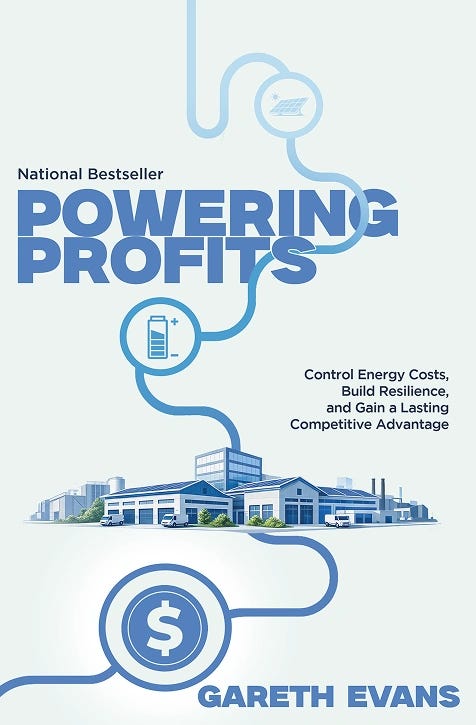
Also, check out his newly published book on energy, Powering Profits.
Topics include:
Why the US grid earned a D-plus rating and what that means for businesses building for the future
The $150 billion that US businesses lose to outages every year
Why power delivery, not generation, is the real bottleneck in the energy transition
The shift from passive consumer to active prosumer — and why every rooftop is a future power plant
Why generalist VCs are returning to climate and energy tech for the first time in years
The one word in a pitch deck that can shrink an investor’s view of your TAM
The K2 lesson: why culture and beliefs outperform tools and processes
Every four years, the American Society of Civil Engineers grades the country’s infrastructure. The US energy grid has dropped from a C-minus to a D-plus.
“If any of us had our kids come home with a D-plus scorecard, we’d be a little disappointed. And here we are today building the businesses of the future on a grid that is literally falling apart.”
Most of the grid is forty to fifty years old. Some of it is a hundred. The cost of relying on it is no longer abstract. US businesses now lose roughly $150 billion to power outages every year. Commercial energy costs are up 22 percent in the last four years. Industrial costs are up 30 percent. Europe is worse — UK, France, and Germany are up over 75 percent.
Meanwhile, US enterprises pay around 14 cents per kilowatt-hour. Germany pays 28. China pays 9 and is heading toward 7. The competitive picture is becoming hard to ignore.
The most common framing of the energy challenge - that we need more generation - is mostly wrong.
“One of the biggest misconceptions is that power generation is the challenge. Actually, it’s power delivery that is the challenge.”
The cost of generating energy has gone down. Solar, wind, and battery storage have been deployed at scale, and dispatchable renewable power is now cheaper than most of what the grid used to rely on. The cost of delivering that energy is what has gone up — because transmission and grid infrastructure require billions of dollars in upgrades.
Gareth is not a renewables-only advocate. He sees a role for nuclear, gas as a base load, and a phased exit from coal. But he is direct on small modular reactors: they have been ten years away his entire career, and they are still ten years away. The real opportunity is faster.
“We can build small, agile, flexible systems at the edge where they’re needed, super quickly and really cost-effectively.”
The shift Gareth describes is structural. Businesses are moving from being passive consumers of grid power to being active prosumers - generating, storing, consuming, and selling energy from their own facilities.
“Every rooftop you see could be a potential power plant. Every car park could be a power plant.”
The unlock is not just technology. It is the commercial model. On-site systems let businesses lower operating costs, improve margins, build resilience, and capture sustainability benefits in one motion. When excess energy is generated, it can be shared or sold to a neighbor. Emission reduction credits can be monetized. The role of the business shifts from cost center to revenue node.
“Profitability and sustainability go hand in hand. We need that sovereignty for our businesses and our communities, so we can thrive instead of just survive.”
The technology already exists. The barrier is awareness and the willingness to act before the cost of inaction compounds further.
Gareth has raised three rounds - pre-seed, seed, and a seed-plus - through the most volatile years in climate and energy tech investing. His read on where the market is now is direct.
The 2019 to 2024 period kept the generalists out. What remained was a small, technically gifted set of climate and energy specialists who built the backbone of the industry. That has changed.
“What’s recently changed this year is an acknowledgement by the more generalist firms that energy is now going to be firmly on the radar for the next twenty plus years.”
That returning interest creates opportunity, but also friction. Generalists don’t always understand how long energy deal cycles take, how capital-intensive the deployment phase is, or where SaaS economics apply and where they don’t. The first half of 2026 was particularly difficult - tariffs, regulatory uncertainty, and the new administration caused many investors to pause.
“It’s interesting seeing that short-termism when we’re talking about long-term problem statements, solutions, and macro trends.”
The most useful piece of fundraising feedback Gareth has gotten in the last two years had nothing to do with his business model.
“Several times I got the message that ‘your market is just too small.’ I didn’t understand it at all.”
After speaking to a few of his investor advisors, he traced it to a single word in his pitch deck: enterprise. Investors were reading “enterprise” as “Fortune 500” — a small buying universe. VECKTA actually sells to mid-market businesses as well. Every commercial and industrial site is a potential customer. One subtle word change reframed the entire TAM.
“Paying attention to those details really matters, especially if you’re just sending a deck and don’t get the chance to speak to them.”
The other lessons from three rounds: fundraising is a long-term relationship, not a transaction. Warm introductions short-circuit weeks of cold outreach. And in-person matters more than founders raised through COVID realized at the time.
Gareth closes with an idea from researcher Don Schmincke. Roughly 35,000 business books are published annually. Most of the management advice in them has high failure rates. The image that stuck with him:
“On K2, when they find the climbers’ bodies, they’re literally clinging to their ice axes — like their lives depended on it. And they literally did. But they perished.”
The point is not that tools are useless. It is that founders over-rely on tools and process when they should be building culture, beliefs, and behaviors. The story, the saga, and the mission give people the autonomy to act. The frameworks come second.
Comments
Nothing yet. Say the first thing.
Sign in to join the conversation.