

Seed isn't one market anymore. We call it by one name, read it off one set of benchmarks, price it against one mental model - three macarons, stacked, near-identical from across the room. Up close, they don't taste the same. They never did.
Thinking Machines raised $2B at a $12B valuation and called it Seed. Humans& closed $480M. Periodic Labs took $300M. Meanwhile, the median U.S. Seed round sits at $4.1M, almost exactly where it sat five years ago. Same stage by name. Not the same market.
Almost every venture argument from 2025 collapses the moment you stop treating Seed as one thing. Seed is too expensive. Seed is dying. Seed is back. EMs are being squeezed. LPs are over-allocated. Each of these is true of one slice and false of the others, and the people debating them are usually talking past each other without realizing it.
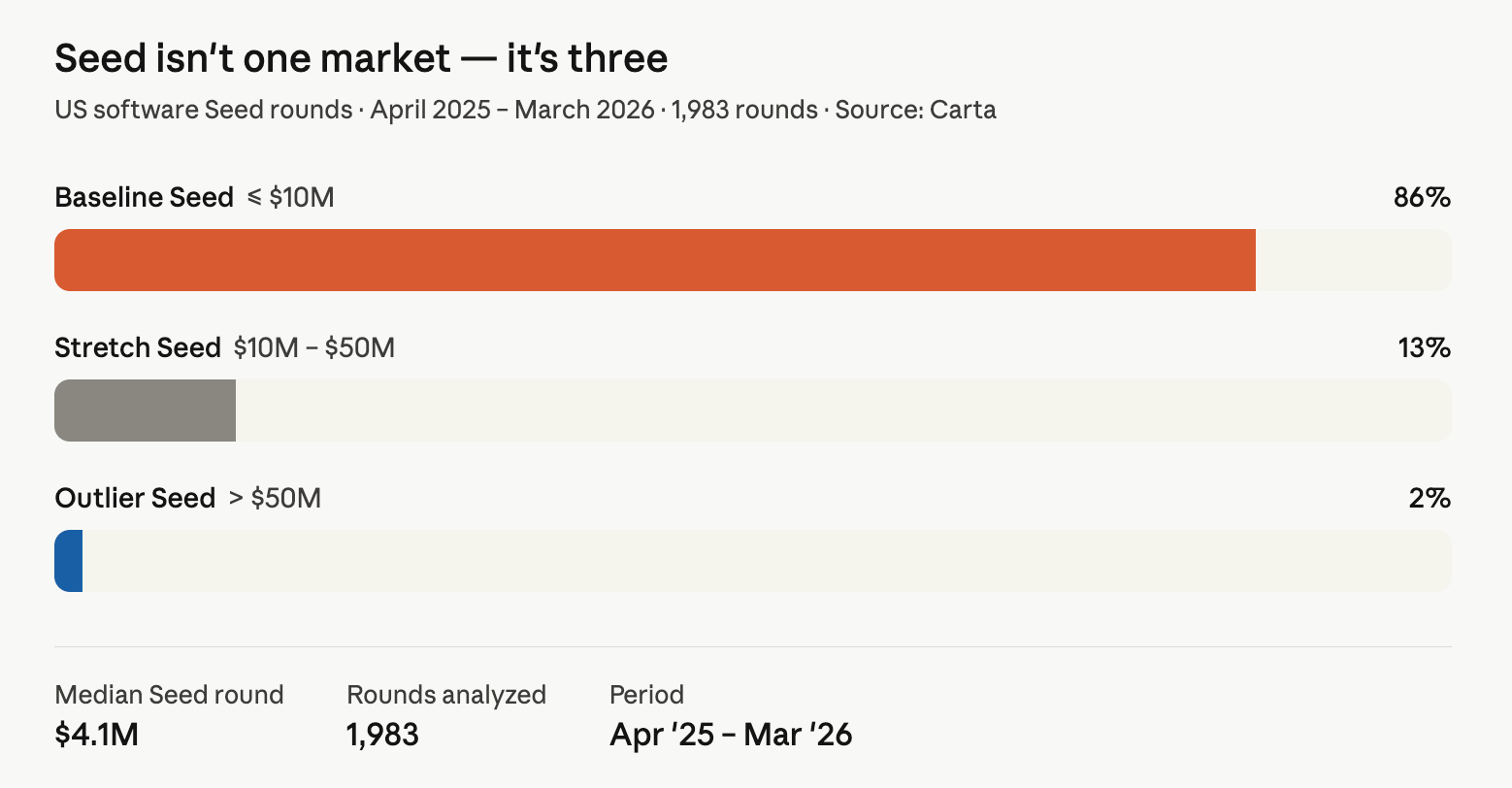
The split is this. A Baseline Seed: the $2M–$10M round most founders actually raise, barely moved in absolute terms over five years. A Stretch Seed: $10M–$50M - the one almost nobody is talking about. An Outlier Seed - nine and ten-figure rounds priced as Series As/Bs in disguise, going almost exclusively to teams attacking foundational AI, biology, or physical-world problems.
The label stayed. The market underneath split.
In the 2025 annual edition of the Big Book of VC, I flagged Redefining Seed as one of the biggest themes to watch for in 2026. Here is exactly what I wrote:
Seed investing is at an inflection point. Competition has intensified, the number of funds has grown, and megafunds have pushed aggressively into the stage. The market is increasingly bifurcated — AI-native startups attracting capital at scale, while non-AI companies lag. Traditional seed is being squeezed from both ends: pre-seed is encroaching upward, while “seed” rounds of $50M+ blur the definition of the stage entirely. Smaller funds are struggling to support follow-on rounds, larger seed funds are harder to raise, and LPs are actively reassessing seed exposure amid high valuations and lower deal volumes. These forces don’t neatly reconcile — creating exactly the conditions needed to redefine what seed investing actually means.
Within a single quarter, each of these observations has become more concrete.
Here’s what the data says, piece by piece.
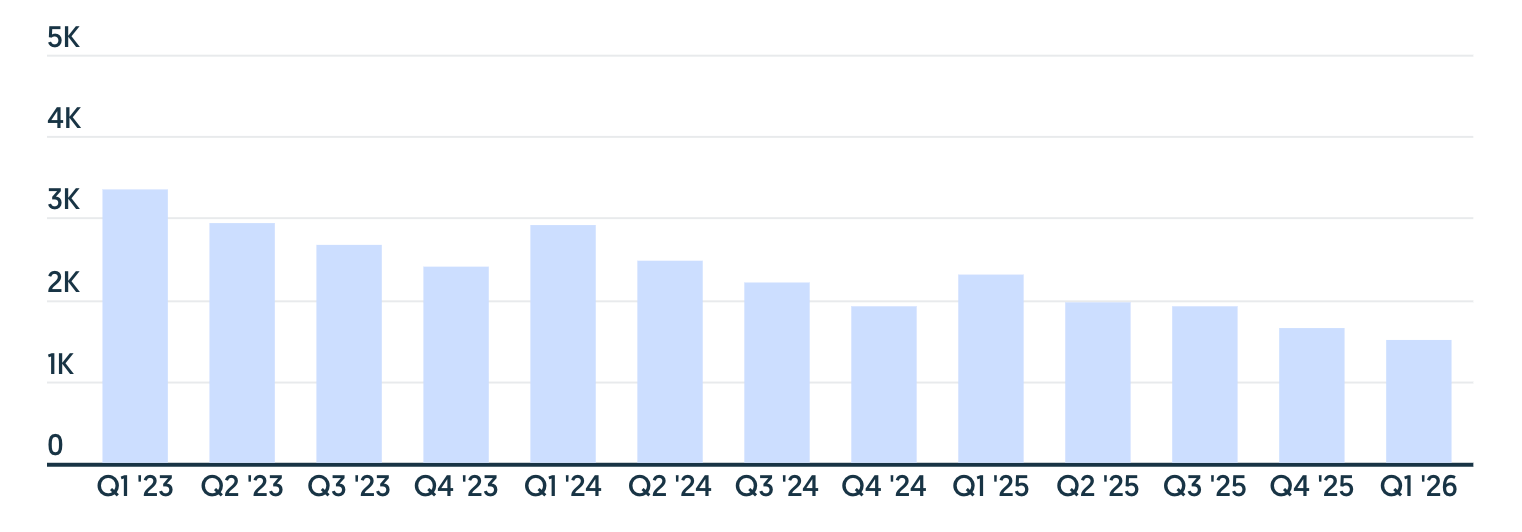
Start with a number most of the ecosystem finds inconvenient: the total number of North American Angel and Seed rounds has been shrinking almost every quarter since early 2023 (Chart 1).
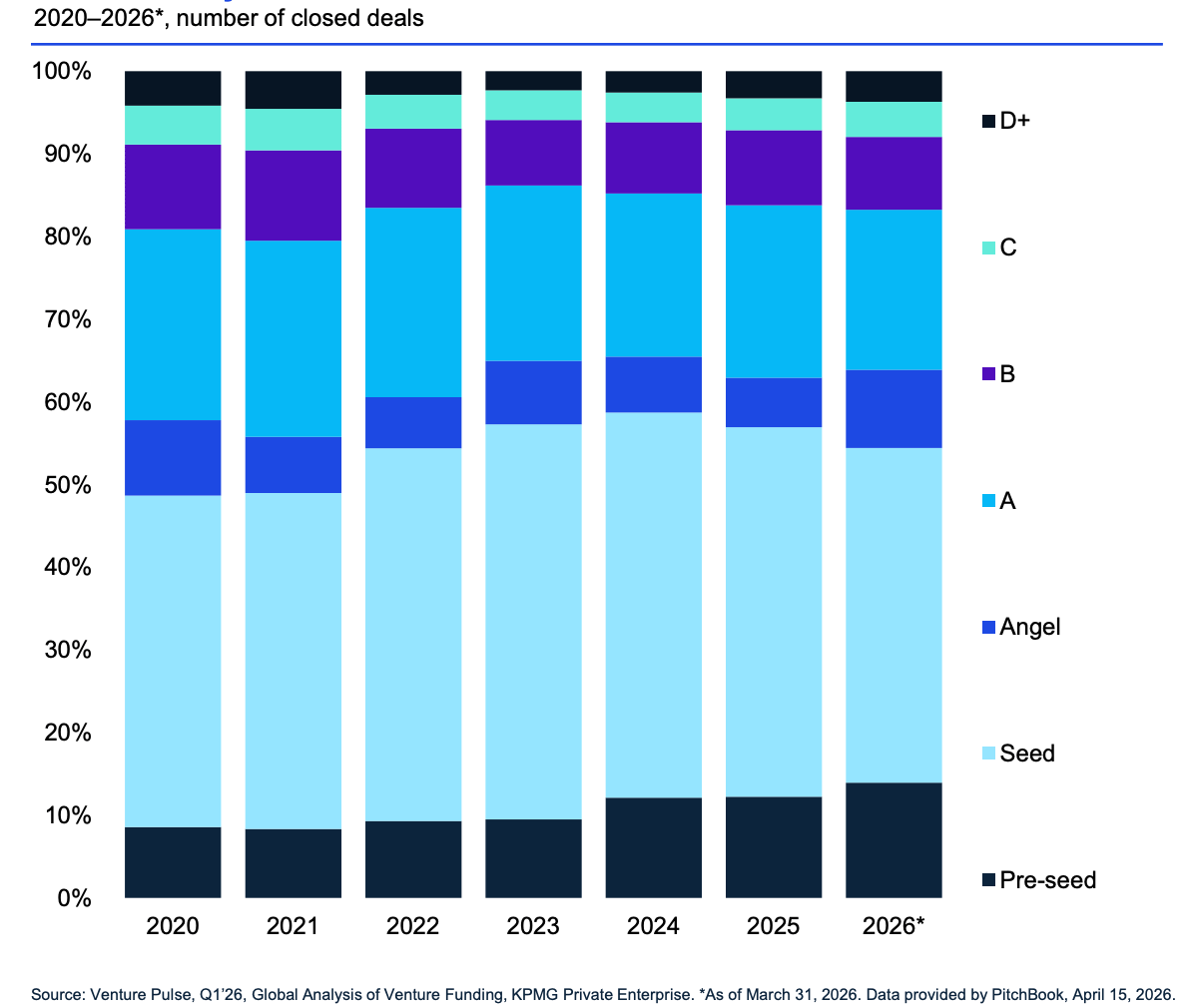
The deal-share data tells the same story from a different angle. Seed used to be the dominant share of all U.S. rounds. That share has been declining for several quarters running (Chart 2).
Seed is therefore declining both in absolute terms and as a proportion of the overall market.
So, just because things are tightening up, it doesn’t mean the next OpenAI won’t get funded. The best companies don’t vanish when the investment funnel shrinks; they settle into a more competitive, crowded group, with even more money fighting for fewer spots. That’s what actually changes - not a weaker pipeline, but a tighter one. This shift sets the stage for everything else: splits in the market, concentration at the top, wild differences in pricing. When there are fewer funding rounds but just as much (or more) capital chasing them, that’s the setup and everything else flows from there.
These statistics contrast sharply with the prominent headlines of 2025 and 2026, such as Thinking Machines Lab’s $2B Seed at a $12B valuation, Humans& at $480M, Unconventional AI at $475M, Periodic Labs at $300M, and MergeLabs at $252M.
These data points describe the same “stage.” They do not describe the same market.
Seed 1 = The Baseline Seed: the one 86% of founders actually raise, is still a $2M to $10M round at a $20M to $50M post-money. That has barely moved in absolute terms over five years. What’s new is a parallel market of nine and ten-figure “Seeds” priced at unicorn-level valuations, going almost exclusively to teams attacking foundational AI, biology, or physical-world problems that need serious capex on day one.
Seed 2 = The Stretch Seed: $10M to $50M. Roughly 14% of rounds by count. This is the most interesting and least discussed slice of the market. It’s where Seed extensions, “bridge-to-A” pile-ons, and multi-stage firms’ Seed checks all live. It’s also the bucket being squeezed hardest. The math is brutal: a pure Seed fund leading a $10M to $25M round at, say, 50% round ownership is writing a $5M to $12M check. To run a portfolio of 20 of those, the fund needs upwards of $100M. How many pure Seed funds at that size are actually being raised right now? Bare minimum.
The Stretch Seed gap isn’t a market signal. It’s a fund-construction artifact. Ho Nam has framed the underlying problem cleanly: “organize funds around companies, not the other way around.”
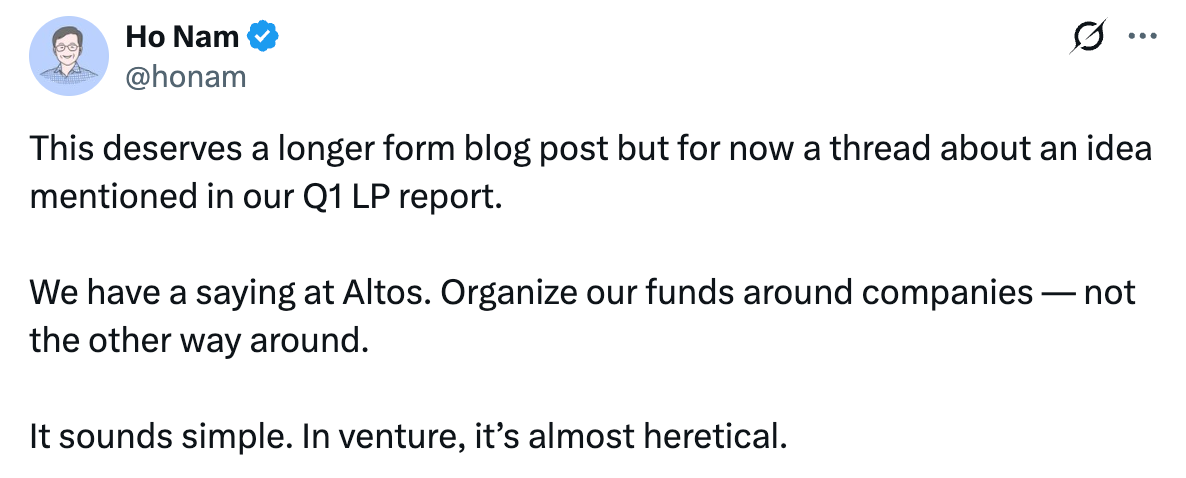
Most of the venture industry does the opposite. Fund size, reserve ratio, and ownership targets are decided up front, and startups get sorted into whether they fit. The Stretch Seed bucket is where that sorting fails hardest - companies that need $15M to clear an inflection point get force-fit into a $5M Seed or stretched into a Series A they’re not ready for, because nobody’s fund math is built for what they actually need.
Seed 3 = The Outlier Seed: It acts more like a Series A/B/C - just with a “Seed” label slapped on because it’s the company’s first raise. Pricing is all about pedigree, market size, dominance, and betting on hot sectors like AI. Investors don’t use old-school Seed math. Dilution, ownership, and reserves end up totally different from a standard Seed deal.
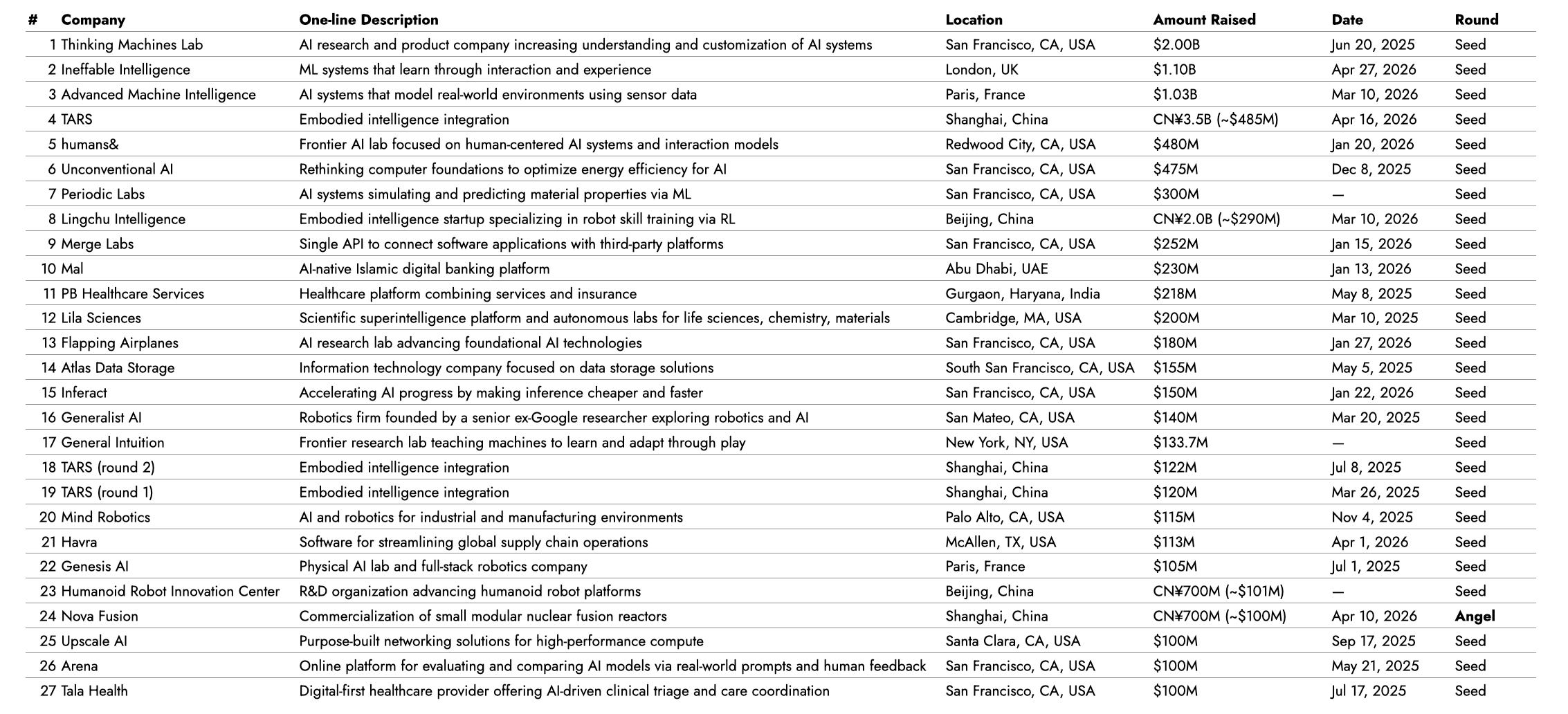
Some thoughts on the “Outlier Seeds >= $100M” chart 4 above:
Geographic concentration. The Bay Area is the gravitational center but no longer the whole map. Of 27 mega-seed rounds, 17 are US — and 14 of those sit within a 30-mile radius of San Francisco (SF proper, Redwood City, Palo Alto, San Mateo, South SF, Santa Clara, Cambridge MA being the lone East Coast outlier alongside NYC). What’s actually new is the second tier: China contributes six rounds across two clusters (Shanghai’s robotics axis, Beijing’s research axis), Europe shows three from two cities (Paris twice, London once), and the rest are one-offs in Abu Dhabi, Gurgaon, and McAllen. The pattern is barbell — capital pools either travel to the Bay or stay tightly local in domestic strategic clusters (Chinese state-adjacent capital, Gulf sovereign-adjacent capital, Indian healthcare-services capital). There is no European mega-seed cluster; Paris is doing the work of an entire continent.
Sector skew. AI is ~90% of the dollars, but the sub-segmentation matters more than the headline. Five distinct buckets are visible: (i) frontier model labs capture the top end — Thinking Machines, Ineffable, Advanced Machine Intelligence, humans&, Flapping Airplanes — and concentrate roughly $5B+ in five rounds; (ii) embodied AI / robotics is the largest by deal count, with Chinese players (TARS, Lingchu, Humanoid Robot Innovation Center) and Western counterparts (Genesis AI, Generalist AI, Mind Robotics) running parallel races; (iii) AI infrastructure — Unconventional AI, Inferact, Upscale AI, Atlas Data Storage — is the picks-and-shovels layer being capitalized at near-Series-B scale; (iv) scientific AI (Periodic Labs, Lila Sciences) is a small but well-defined wedge; (v) vertical applications — Mal, Tala Health, Merge Labs, Arena, PB Healthcare — round out the long tail. Only two non-AI rounds clear $100M at seed: Havra (supply chain SaaS) and Nova Fusion (fusion). The implicit message to LPs is that “seed” is now a stage of capital intensity, not maturity, and the bar for non-AI to qualify is very high.
So when the industry says “Seed rounds are bigger now,” they almost always mean the outlier. The Baseline Seed has barely moved. Read every headline about the stage with that split in mind.
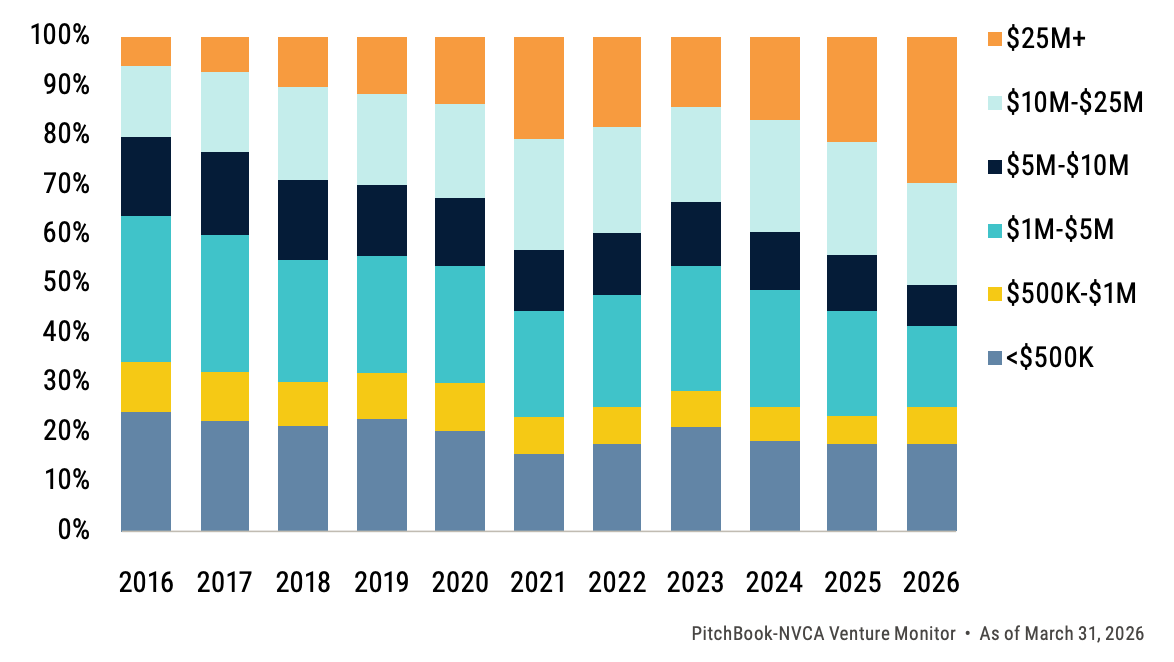
The structural shift in one chart, ten years end-to-end.
In 2016 (Chart 5), rounds of $25M+ accounted for 6% of the early-stage deal count. In 2026, they’re 30%. Five times bigger. The bucket that used to be the rare exception is now the largest single slice of the early-stage market.
Look at what got eaten to feed that growth.
The $1M to $5M bucket, what most of the industry would have called “Seed” a decade ago, has fallen from roughly 30% of deals to 16%. The $5M to $10M bucket has gone from 16% to 9%. The middle of the early-stage, between $1M and $10M, has lost roughly 20 points of market share over the past 10 years. That share moved up, not down.
The bottom didn’t move. Sub-$500K rounds were 22% in 2016 and 17% in 2026. Pre-seed held its ground. The squeeze isn’t happening at the floor. It’s happening in the middle.
This is the megafund aggression story told in deal counts instead of dollars. Multi-stage funds didn’t push into Seed by writing more $3M checks. They pushed in by writing $25M+ checks and labeling them Seed.
The implication for traditional Seed funds is uncomfortable. The bucket their portfolio model was built on, $1M to $10M, has lost a third of its share in a decade. If your fund construction still assumes 2016’s market shape, you’re underwriting against a market that no longer exists.
The middle of the early-stage didn’t shrink. It got moved upstairs.
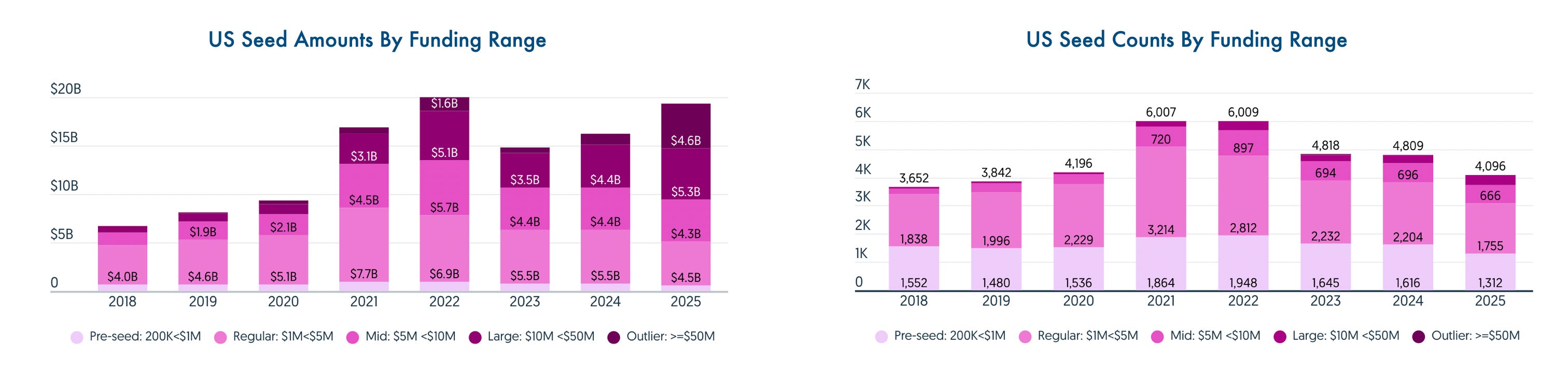
And it isn’t just PitchBook saying so. Run the same question through Crunchbase - different provider, different methodology, different bucket boundaries - and the curve bends the same way (Chart 6). Crunchbase’s “Regular” tier, $1M to $5M, is the closest analogue to what the industry has always meant by Seed. By deal count it peaks at 3,214 rounds in 2021 and falls to 1,755 by 2025, a 45% drop, while the $10M+ tiers expand to fill the space. The dollars panel shows the mechanism: Regular Seed is flat in nominal terms (~$4.0B in 2018, ~$4.5B in 2025 - a real-terms decline), while the Large and Outlier tiers go from a rounding error to roughly $10B combined.
Both databases, despite using different methods, point to the same conclusion. The early-stage middle didn’t shrink because startups stopped raising money. Instead, the definition of a Seed round expanded, and the deals that once defined this category were pushed aside by much larger checks. This shift is clear, no matter how you measure it.
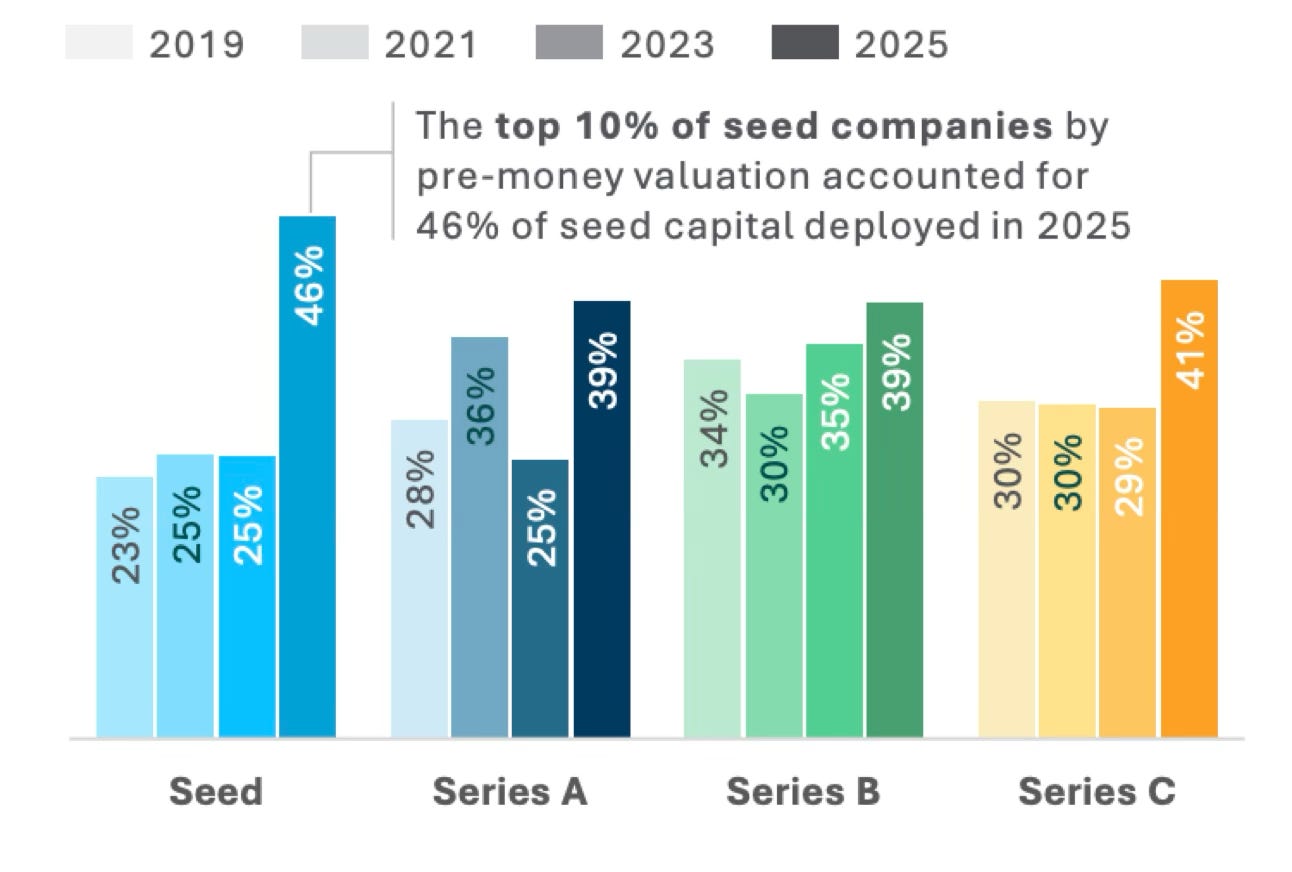
One. Concentration at Seed has roughly doubled. The top 10% of Seed companies by pre-money valuation captured 46% of all Seed capital deployed in 2025 (Chart 7). From 2019 through 2023, that figure ranged from 23% to 25%. Two vintages flipped it.
Two. This is not a Seed-only story. Series A jumped from 25% to 39%. Series B from 35% to 39%. Series C from 29% to 41%. Concentration has become the defining feature of venture at every stage simultaneously.
Three. Seed is the most extreme of the lot. That 46% figure is the highest concentration of any stage in the system. Seed, the place that used to feel like the broadest part of the funnel, is now the most top-heavy of all.
The three results look related on the surface, and they are. But they point in very different directions for how a fund actually gets built.
The broadest part of the funnel is now the narrowest top.
Concentration shows up on both sides of the market. The top 10% of companies are capturing 46% of Seed dollars. And according to Keith Teare’s post, the other side: the top 10 firms are capturing 19% of Seed dollars, up from 5% in 2020.
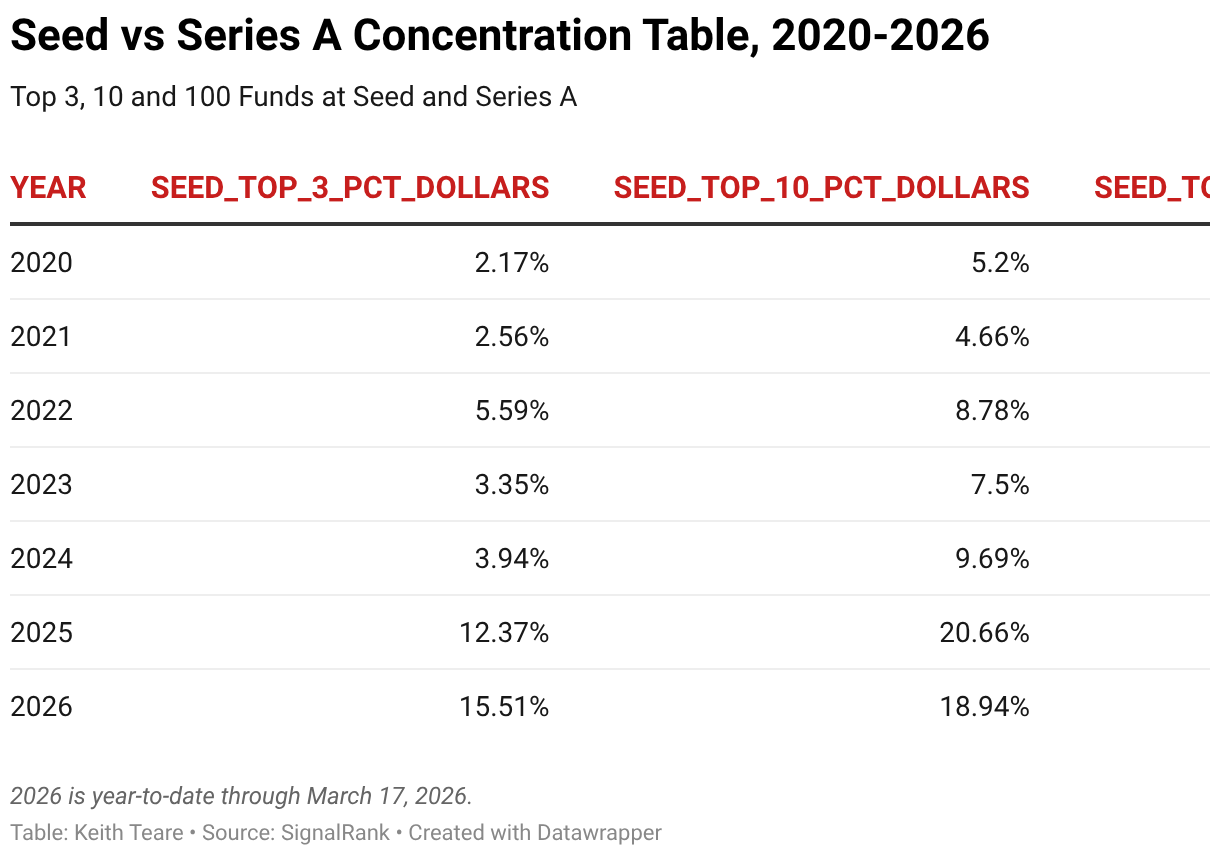
And, the part that chimes well with what I mentioned before - the top 5 aren’t writing more checks. They touched 1.01% of Seed rounds in 2020 and 1.73% in 2026. Same deal count, vastly bigger checks. That’s how a $5B fund leans into Seed without flooding the round count, by writing $40M checks into rounds that used to take maybe 1/5th, and calling the result “Seed.”
In 2019 (Chart 8), AI startups absorbed somewhere between 20% and 35% of U.S. software venture capital, depending on stage. By 2025, that range had moved to 60 to 72%. The shift held at every stage from Seed through Series E+.
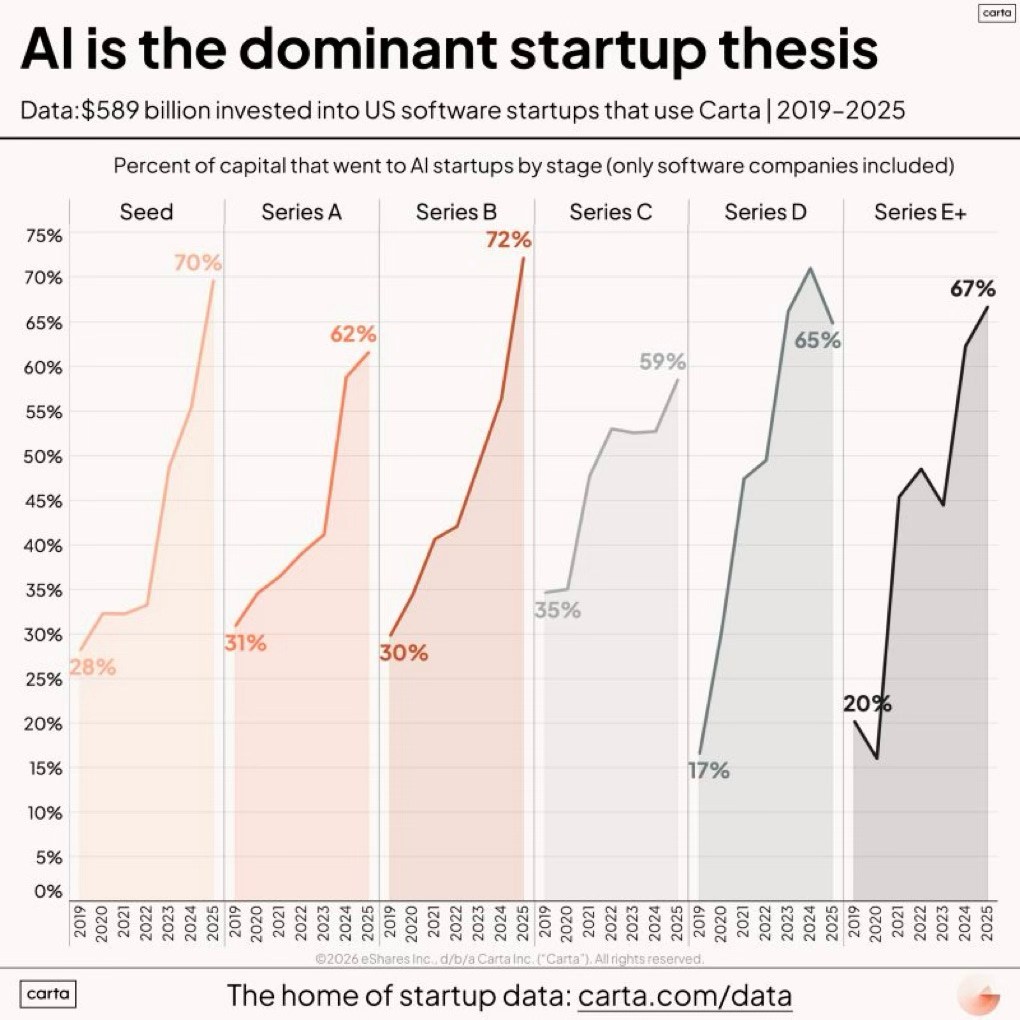
The cross-stage consistency is the part most people miss. If this were a hype cycle, you would expect the concentration to cluster at the late stage where the mega-rounds live. You don’t see that. You see Seed at 70%, which means the earliest underwriters in the system have already concluded non-AI software is a worse risk-adjusted bet. The filtering is happening at the top of the funnel, not the bottom.
The implication for “Seed” as a category is uncomfortable. “Software venture” and “AI venture” have effectively collapsed into one. Non-AI software is now a minority bet at every check size from Seed through Series E+.
The next vintage’s pipeline is already pre-filtered, and the filter has nothing to do with valuations and everything to do with whether the company is AI-native.
If anyone is still telling you the bifurcation is mostly a pricing story, this chart settles the argument.
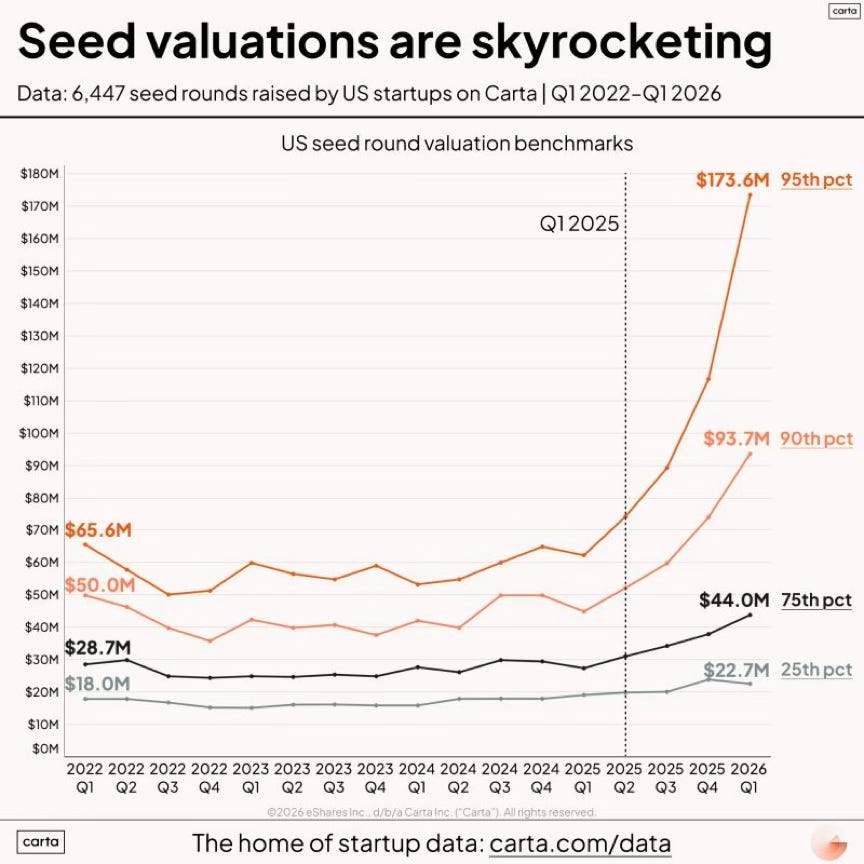
The common assertion that “Seed is getting expensive” is a misleading characterization.
The 95th percentile Seed valuation rose from roughly $65M in early 2022 to roughly $174M by Q1 2026 (Chart 9). The 90th percentile went from about $50M to $94M. Big moves, no argument.
But ask the obvious follow-up: expensive relative to what? If the benchmark is “Seed used to be $3M at $15M post,” that benchmark is historical, not financial. No law of finance says 2019 or any 20XX is the reversion point.
Compare it to public markets.
On 22 April 2022, the S&P 500 closed around 4,271. Today it’s around 7,100. Is the index “expensive”? Nobody seriously argues it has to revert to 4,271 just because that’s where it sat three years ago.
The deeper point is that price and valuation behave differently. Pricing is not range-bound. Valuation multiples loosely are. Forward P/E (Chart 10) expands during exuberance, compresses in downturns, and reverts to long-term averages over time. The ranges themselves drift with rates, inflation, and growth expectations, but the cyclical behavior is real.
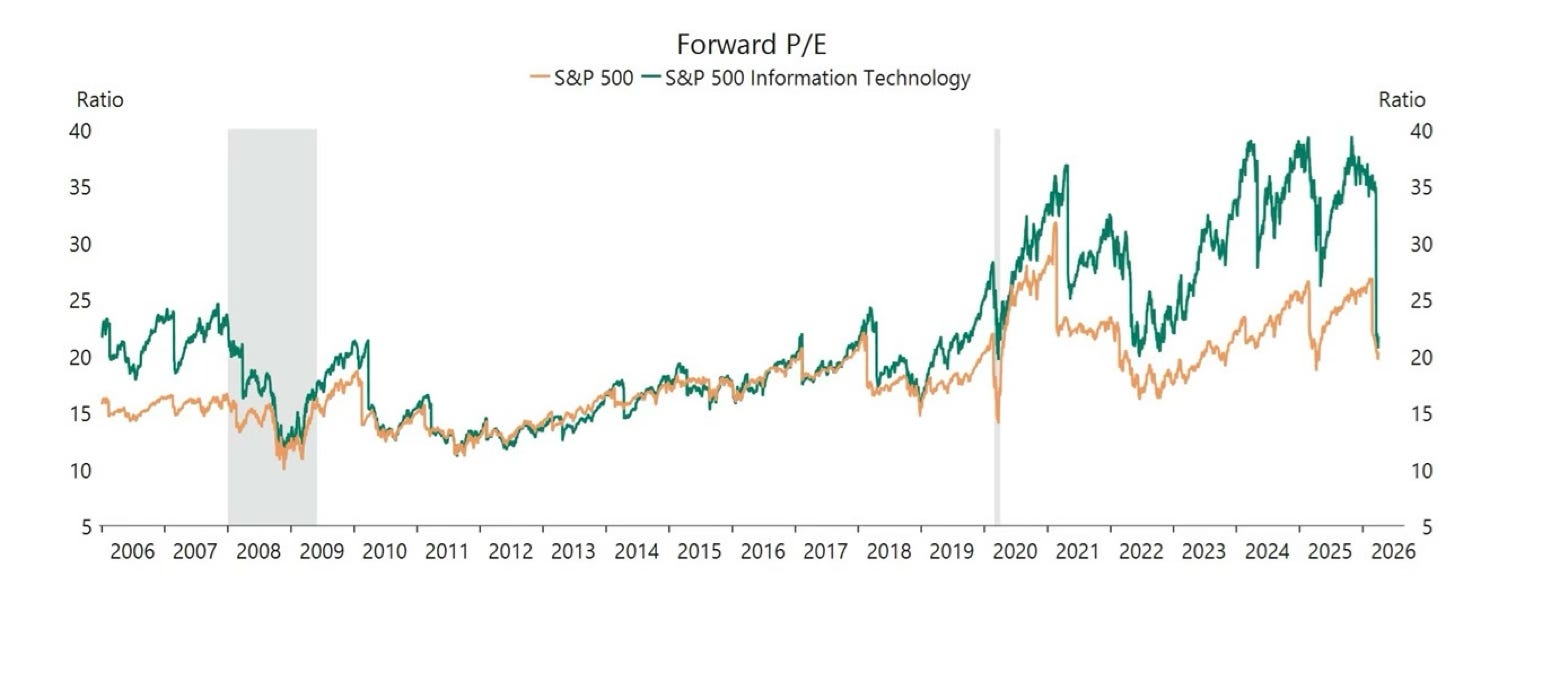
Seed values lack a comparable anchor. If founders demonstrate higher average quality, startups achieve revenue milestones more rapidly, and AI-enabled cost structures unlock small teams to deliver significantly greater output, then higher entry valuations may reflect a very genuine market dynamic. While this does not guarantee that higher valuations will persist, it does suggest that comparing 2026 Seed prices to those of 2019 is not a meaningful benchmark.
Pull from the top: As mentioned by Ashley Smith, “the Outlier Seed comps aren’t setting the ceiling, they’re setting the floor.”
Cursor, Lovable, ElevenLabs proved what AI-native velocity can look like, and the market is now pricing every Seed as if it’s one of them. The premium hasn’t fully crystallized at Seed yet, but the gravitational pull from the outliers above is exactly what’s pulling Baseline Seed valuations up at the 90th and 95th percentiles.
Now, most of the “expensive” debate is really an AI debate in disguise, so it’s worth pulling that apart. One striking detail in Charts 11 and 12 is that Seed is the only stage where the median AI vs. non-AI valuation premium is small.
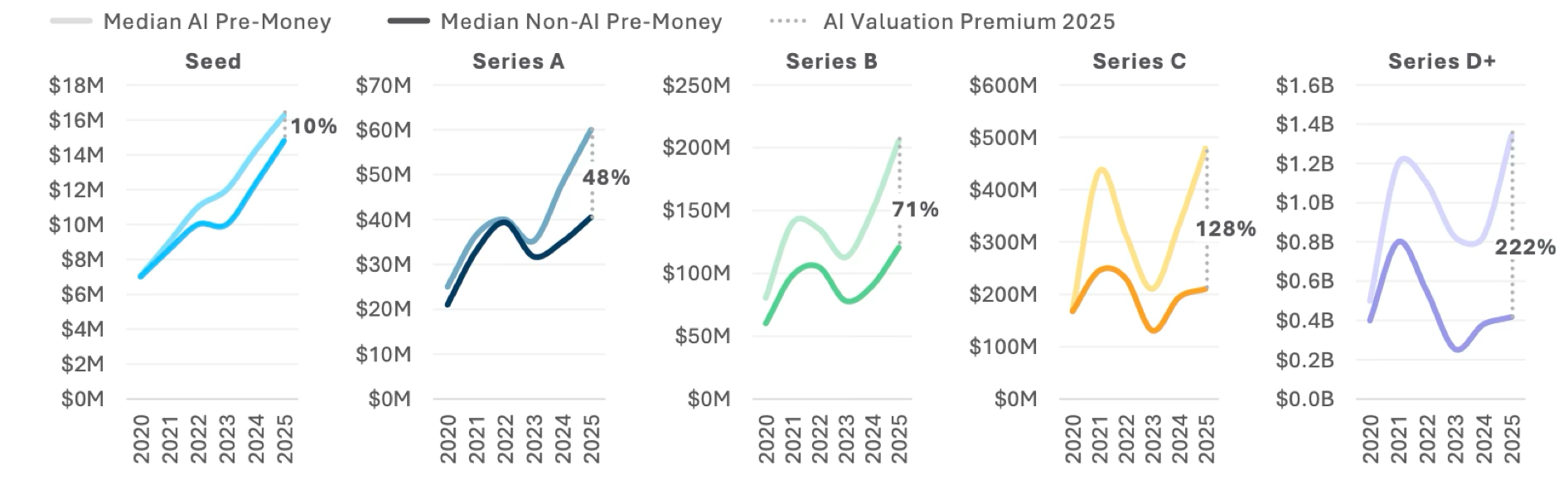
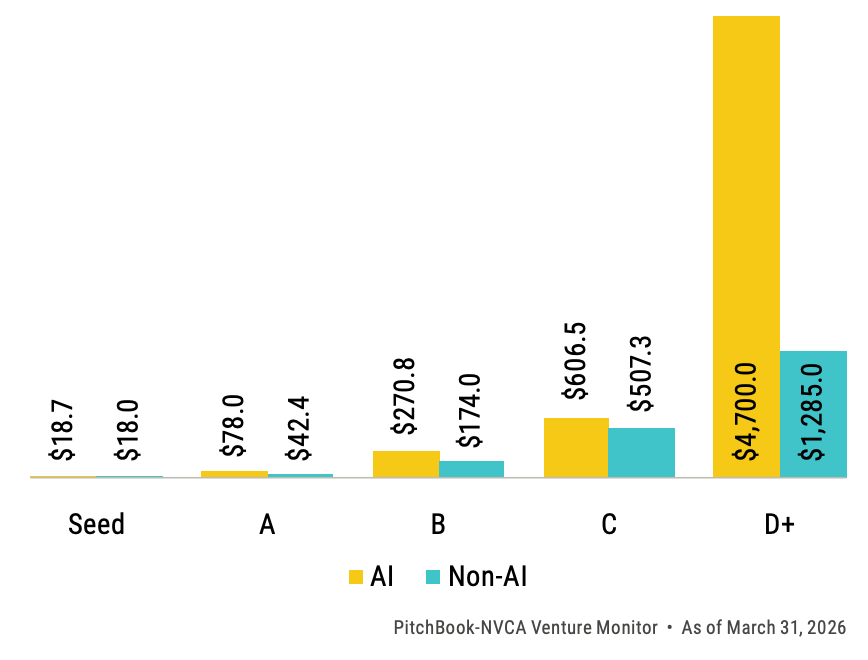
Hence, AI premium hasn’t fully crystallized at Seed yet. Either because the pool is still relatively diverse, or because very early-stage underwriting is closer to “founder quality” than “category bet.”
The 'expensive' label only makes sense if you're benchmarking 2026 against a 2019 that isn't coming back.
Consider a thought experiment: If managing a Seed fund, should one pursue higher-priced Seed rounds or focus on value opportunities? Which founders merit support?
One camp says hunt for the entry price. More ownership, less competition, diamonds in the rough. The other says today’s peak Seed rounds reflect today’s best founders and biggest ambitions, and only those bets can produce the outlier outcomes the venture math actually requires.
These two strategies yield distinct types of successful outcomes, and both have the potential to generate fund-level returns. Each is grounded in a fundamentally different theory of alpha - a distinction LPs need to internalize, and one that most “David vs. Goliath” debates on venture-focused social media miss entirely.
Megafunds deploying $50M Seed investments are making a deliberate strategic choice, as their model requires companies capable of scaling from $1B to $50B or more, where access is more critical than entry price. Conversely, EMs making $2M investments at lower entry prices are also pursuing a coherent strategy, as their model relies on a small number of investments achieving 50x returns, with ownership and entry price compounding differently in that segment.
Megafunds deploying $50M Seed checks are buying access to legibility - as mentioned by Adam Besvinick in his X-post.
Startups that are already visible as exceptional, founders already pedigreed, theses the market has begun to form a view on. Their model requires scaling from $1B to $50B+, and in that setup the bottleneck is not the high entry price. On the other side, managers writing $2M checks at lower entry prices are buying pre-consensus conviction, in many cases. Their model relies on a different number of 50x returns, where the bottleneck is whether you got there first.
Both camps are right about their strategy. Both are wrong to think the other is wrong. There are multiple ways to win.
The risk is very different, though, and it’s worth framing. A $1B outcome is ‘ok’ for a $3B fund, ‘decent’ for a $300M fund, and ‘awesome’ for a $30M fund. These are not the same game. They should not be evaluated by the same metrics.
On the high end, the question is whether the eventual exits for $100M+ Seeds are large enough to justify the entry. A $150M Seed round needs a roughly $XXB exit (the XX is on purpose) to deliver venture-grade returns with typical ownership and dilution. The number of $15B+ tech exits in any 5 to 10-year window has historically been in the single digits globally. Many of these giant Seeds will not get there. For the portfolio math to work, the hit rate on truly enormous outcomes has to be higher than anything we’ve seen historically.
On the low end, the question is whether there’s a healthy exit market for companies that top out around $XB or below. Strategic acquirers, PE roll-ups, secondary-driven liquidity. The classic “Seed, 50x on a $500M exit” path assumes a functioning M&A market by strategic players, PE firms, and larger startups. That market has been soft since 2022. If the bottom of the market stays frozen, small-check strategies get structurally harder regardless of how good the picks are.
In both scenarios, the primary constraint is not the chosen stage strategy but rather the effectiveness of founder selection.
Historical data consistently show that approximately 5% of Seed companies generate meaningful outcomes. Without identifying this subset, the specific investment approach offers little advantage. The critical skill lies in selection, not in the chosen segment.
The total count of active venture investors globally is down roughly 30% from the 2022 peak. In the most recent quarter alone, it fell another 10% QoQ. And the decline runs across every stage, not just Seed. (Chart 12).
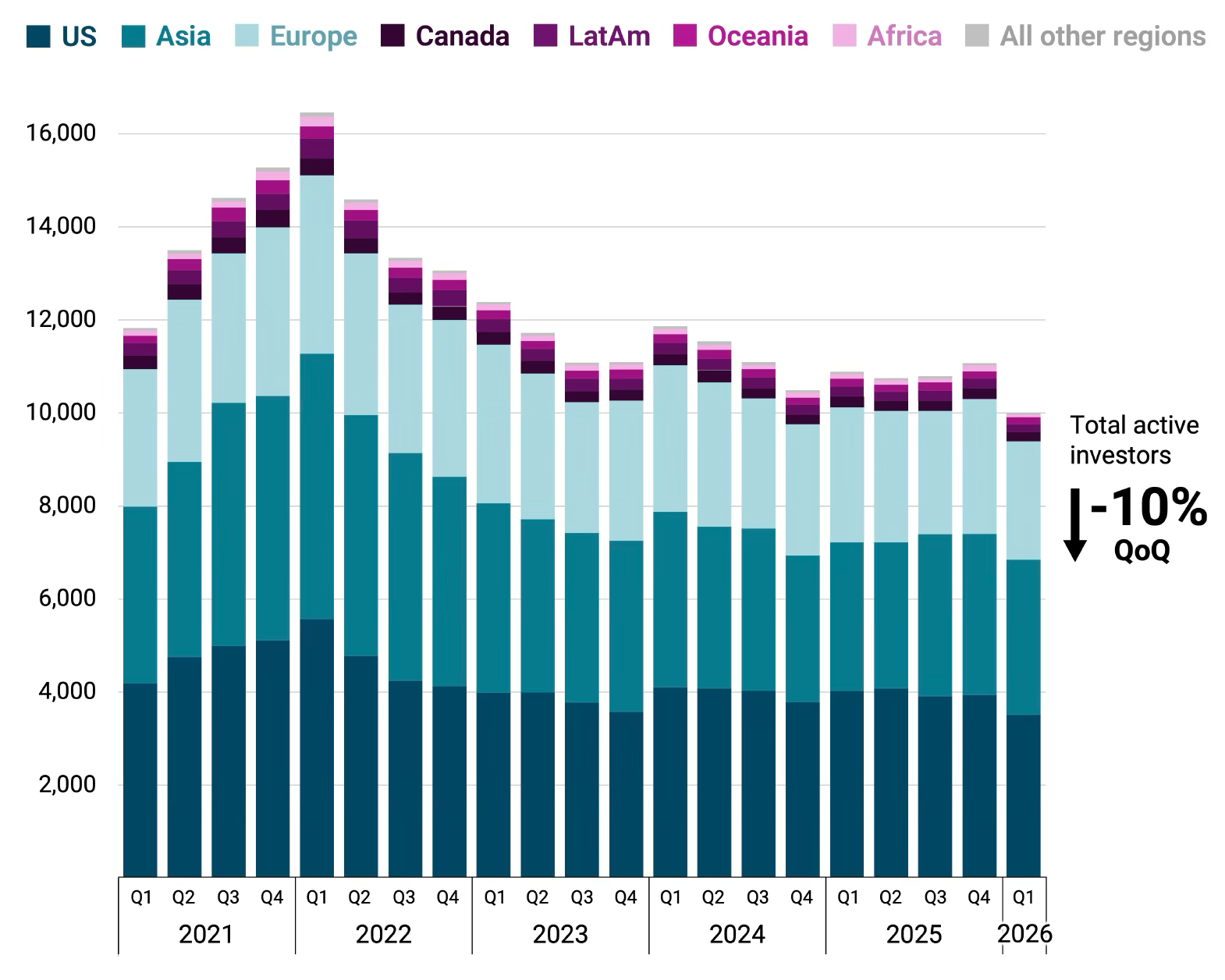
For those immersed in tech-social media, the perception may be quite different, as new Seed fund announcements appear frequently. Both perspectives are valid, and understanding their reconciliation is essential.
Both things are true simultaneously, and the reconciliation is important:
Active investor counts are falling (Chart 13). Older venture firms are quietly going zombie. LPs aren’t re-upping commitments because the funds aren’t meeting their KPIs. The websites stay live, but the check-writing slows down. Meanwhile, GPs from those firms (and from the megafunds) are spinning out and hanging their own shingles every quarter.
Newly raised firms are disproportionately Seed-focused and sub-$50M in AuM. The newcomers skew small (Chart 14). Most of the new wave is sub-$50M and Seed-focused. So the emerging manager story is real, but it doesn’t move the total fundraising number, because dozens of $30M funds don’t replace a single megafund raising twenty times as much.
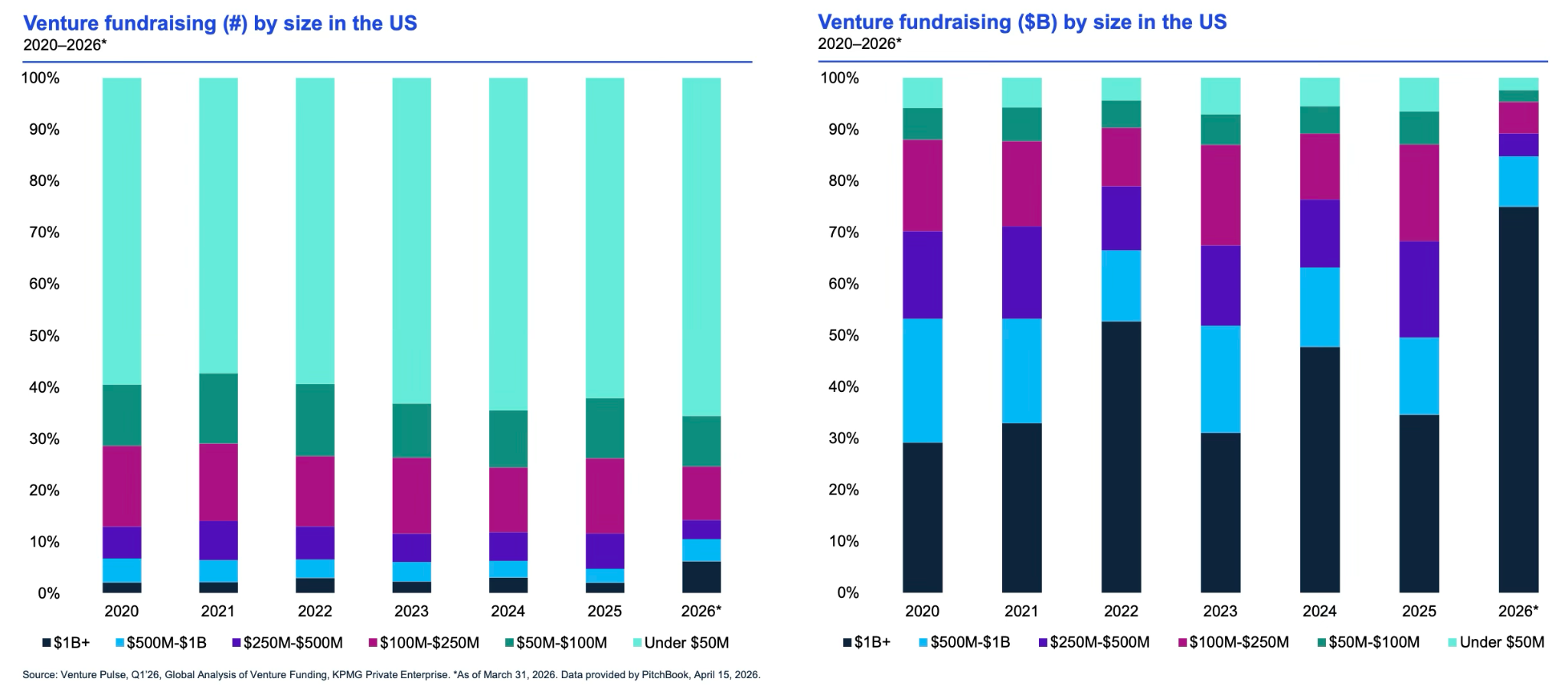
The practical effect: fewer investors are handing out checks, and when they do, they expect a lot more before they commit. You see more rounds these days with one main lead taking a big piece, then calling in other investors they already know to fill out the rest. That’s why the venture scene feels so all-or-nothing right now. If your Seed round is hot, it’s done in two days. If not, you’re stuck waiting half a year, hoping someone bites.
I talk to LPs every month who are asking the wrong questions about Seed. ‘Only the top Seeds win, so we need GPs with hot-round access.’ ‘Seed is too expensive.’ Both framings lead to bad allocation.
Here are the thoughts I think are actually worth contemplating.
1. Stop underwriting “Seed” as one stage.
‘Seed' is no longer one product - it’s three. Underwriting it as one is a portfolio error before the allocation check is cut.
Allocation decisions should begin with an understanding of the manager’s investment philosophy, target areas, and market dynamics.
Subsequently, it is essential to assess whether current conditions support that philosophy. If the thesis is to invest at lower valuations and achieve 50x outcomes, check that the underlyings of an exit market for such outcomes remain viable. If the thesis is to secure hot+unique access, ensure that this access is repeatable and that check sizes align with the intended ownership model.
2. Don’t invest in just one type of Seed.
Don't pick one type of Seed. Picking one is no longer a diversification move -it's another concentrated bet.
Historically, Seed provided broad-funnel access, while later-stage offerings offered exposure to concentrated winners. However, with over 40% of capital now concentrated in the top decile at every stage, Seed no longer serves as an effective diversification tool. Instead, it represents another concentrated bet with distinct risks.
3. Watch for Seed creep.
When you’ve got three markets, you get three temptations.
A Baseline Seed fund can jump into a Stretch round and say it’s “leaning in.” A Stretch fund can slide into an Outlier round and call it “access.” And an Outlier fund can swoop down into a Baseline round, chalking it up to a “founder relationship.” Each move sounds reasonable on its own, but put them all together, and it’s just strategy drift pretending to be conviction.
The clearest signal is the gap between the stated strategy and the actual portfolio. A $20M fund writing into a $100M Outlier Seed isn’t doing what they raised to do. They’re chasing the narrative, the founder pitch, or the deal that crossed their desk that week. Some adjustment is healthy - markets evolve, and rigid GPs underperform. Total drift is something else.
“Organize funds around companies, not the other way around.” - is good theoretically. Done badly, it looks like a fund that abandons its strategy and becomes whatever the latest deal demands. LPs should grant GPs leeway to flex within their stated Seed market. Drifting across Seed markets is a different question - and a worse one.
4. Valuation is a signal, not a verdict.
Valuation should be regarded as an indicator rather than a definitive judgment.
Data indicates that both high- and low-valuation investments can succeed if the GPs select the right companies. Overemphasizing entry price as a metric may exclude exposure to startups generating meaningful outcomes. Both strategies merit inclusion in an LP’s portfolio, as they yield different returns and entail distinct risks. However, it is critical to avoid supporting a VC whose stated strategy does not align with their actual investment behavior.
5. Think wider than valuations.
It is essential to consider factors beyond valuations.
Traditional Seed portfolio construction models - such as investing in 25 to 35 companies with the expectation of two or three significant outcomes and a 3x fund return - assumed certain portfolio economics. With 46% of capital now concentrated in 10% of companies, the remaining 90% face increased competition for funding. Graduation rates, rather than entry prices, have become the primary constraint. For example, a $20M post-money Seed investment that cannot secure a Series A round may yield a worse outcome than a $60M post-money Seed investment that successfully advances.
Seed investing is not fundamentally flawed; rather, it has been redefined. The challenge lies in the fact that the terminology has remained constant while the underlying reality has diversified significantly.
The intensity of industry discourse on this topic reflects the extent to which bifurcation challenges multiple established narratives. Large funds are attracting more capital, emerging ecosystems are consolidating, fund formation has become more difficult, and limited partners are increasingly skeptical. Each of these developments is occurring simultaneously.
However, the underlying market dynamics are more straightforward than the prevailing discourse implies. Seed has not constituted a single market for at least two years. Managers and limited partners who recognize this shift and adapt their underwriting to reflect the current market structure, rather than relying on historical labels, will be well-positioned.
Seed isn’t broken. It’s been redefined. The label stayed. The market underneath split. The managers and LPs who see that survive. The ones who don’t will keep getting surprised.
You are receiving this message because you subscribed to either the “All Things VC” newsletter, “TheOnePoint” podcast, or downloaded one of our “The Big Book of VC” ecosystem reports.
No posts
Comments
Nothing yet. Say the first thing.
Sign in to join the conversation.