
A year ago, we published Rethinking Venture Capital: A Strategic Lens. Three months of work, one outcome I didn’t expect: a reach and admiration beyond anything I had planned. Read by VCs of every size, by LPs across the spectrum (family offices, HNWIs, fund-of-funds, institutionals), and by ecosystem builders in more than 50 countries. Thousands of views later, it’s still being downloaded.
Venture is a long-term asset class. On that timescale, one year isn’t enough to fundamentally alter how the asset class works. Which is why the report still reads like a thought-leadership goldmine - the frameworks and models are exactly the same. What’s changed is the environment around them.
So today I’m relaunching the same report with a short follow-up that walks through some key shifts over the past 12 months.
Download the original 130+ page report
Special thanks to the 11 experts across the U.S., Europe, and India - your insights validated key shifts and grounded the report in a global context 🙏🏼
Aarti Gupta - CIO–Family Office DM Gupta & Anikarth Ventures LLP
Christoph Junge, CAIA - Former Head of Alternatives at Velliv
David Clark - Chief Investment Officer at VenCap International plc
Eric Woo, CFA - CEO at Revere
Frank Tanner - Director at Morgan Creek Capital Management, LLC
Jamie Rhode, CFA - Partner at Screendoor
Joel Sandhu - Managing Partner at Top Tier Access
Michael Motschmann - Managing Partner at MIG Capital
🌱🤝🌍 Nicolas Sauvage - President at TDK Ventures
Rando Rannus - General Partner at Siena Secondary Fund
15 Strategic Takeaways for LPs
14 Strategic Takeaways for GPs
The Four Lens Model of Venture
The Venture Value Chain
Venture’s Dissonance Era
All Things Macro
The Venture Spread Model
The Three Tenets of Venture Investing
All Things Exits
Secondaries
Venture Capital 3.0
Highlighted below are excerpts, developments, and facts from the past year that I still hold dear.
These are golden rules built to age well. The favorite I hold tight and recommend to every LP I meet is this:
Venture is fragmenting; rebuild the playbook with public-private insight.
Venture is no longer monolithic, which opens the door to championing selection opportunities. It also requires blending public and private market insights to form a more holistic view of sectors and trends, enabling integrated investment strategies in a complex landscape. If anything, the last year has only made this more urgent. The dispersion across sub-sectors, geographies, and tech types has widened. The LPs who still treat venture as a single bucket are making decisions at a layer too coarse for the market they operate in.
The fundraising-side GP takeaways still hold. What’s changed is on the operations side. AI is now reshaping the venture business itself - sourcing, diligence, portfolio management, reporting, LP communications. The GP takeaway that has aged best in this context:
No more hiding behind the power law - own every bet you make.
Top-performing GPs don’t just celebrate their winners; they take full accountability for the entire portfolio. LPs are increasingly demanding transparency, KPIs, and clear post-investment strategies for both stars and strugglers. The full-cycle mindset is no longer optional.
Of the four lenses - Innovation, Investment, Strategic, Emotional - the Strategic Angle has accelerated the most. Venture as a national and corporate imperative is no longer a thesis. It’s policy.
Two concrete proof points from the last several weeks alone:
The EU’s €5B Scaleup Europe Fund. Officially launching this June with EQT named as fund manager, this is Europe’s largest technology growth fund. It’s the latest instrument in the EU’s mission to help its companies grow from start-ups to tech leaders without jumping ship at the scale-up phase to move to the US. This is the usual pattern for European scale-ups, who struggle to find financing at home once their investment needs approach nine figures. To fill the gap, the Scaleup Europe Fund will directly invest in strategic technology companies from Series B onward, with cheques in the range of €100 million. The aim: catalyse Europe-led funding rounds in the range of several hundred million euros.
India’s RDI Fund. In mid-May, the Technology Development Board signed its first agreements and disbursed the first tranche under the ₹1 lakh crore Research, Development and Innovation Scheme -backing five deep tech startups working across space, robotics, batteries, drones, and advanced healthcare. This marks the first time central money has flowed under a scheme specifically designed to de-risk private innovation at the prototype-to-product stage - a gap Indian startups have long struggled to cross. Approved by the Union Cabinet in July 2025, the RDI Scheme aims to deploy ₹1 lakh crore over six years, including ₹20,000 crore in FY 2025-26, to back private sector enterprises working on sunrise and strategic technologies.
Two regions, same logic: governments are stepping into the late-stage capital gap to keep strategic technology -and strategic optionality- at home. The Strategic Lens isn’t a frame anymore. It’s the dominant frame.

The circular capital flow model still describes the asset class better than any single-axis lens. The 2024 numbers told the story painfully: ~$848B in available capital, only $377B invested, $323B returned. Twelve months on, with 2025 data, the structural imbalance appears to be resolving: ~$723B in available capital, $510B invested, $558B returned. But behind these improving numbers lies a hard truth of concentration. Big exits and big investments in startups are causing this massive jump in numbers.
On the exit side: Wiz acquired by Google for $32B, Scale AI’s strategic investment by Meta for $14.3B, and CoreWeave raising $1.5B in an IPO. On the startup fundraising side: OpenAI raised $40B from SoftBank/Microsoft, Anthropic raised $13B, and Databricks and xAI each raised more than $5B.
That said, the capital recycling engine of venture has yet to fully restart.
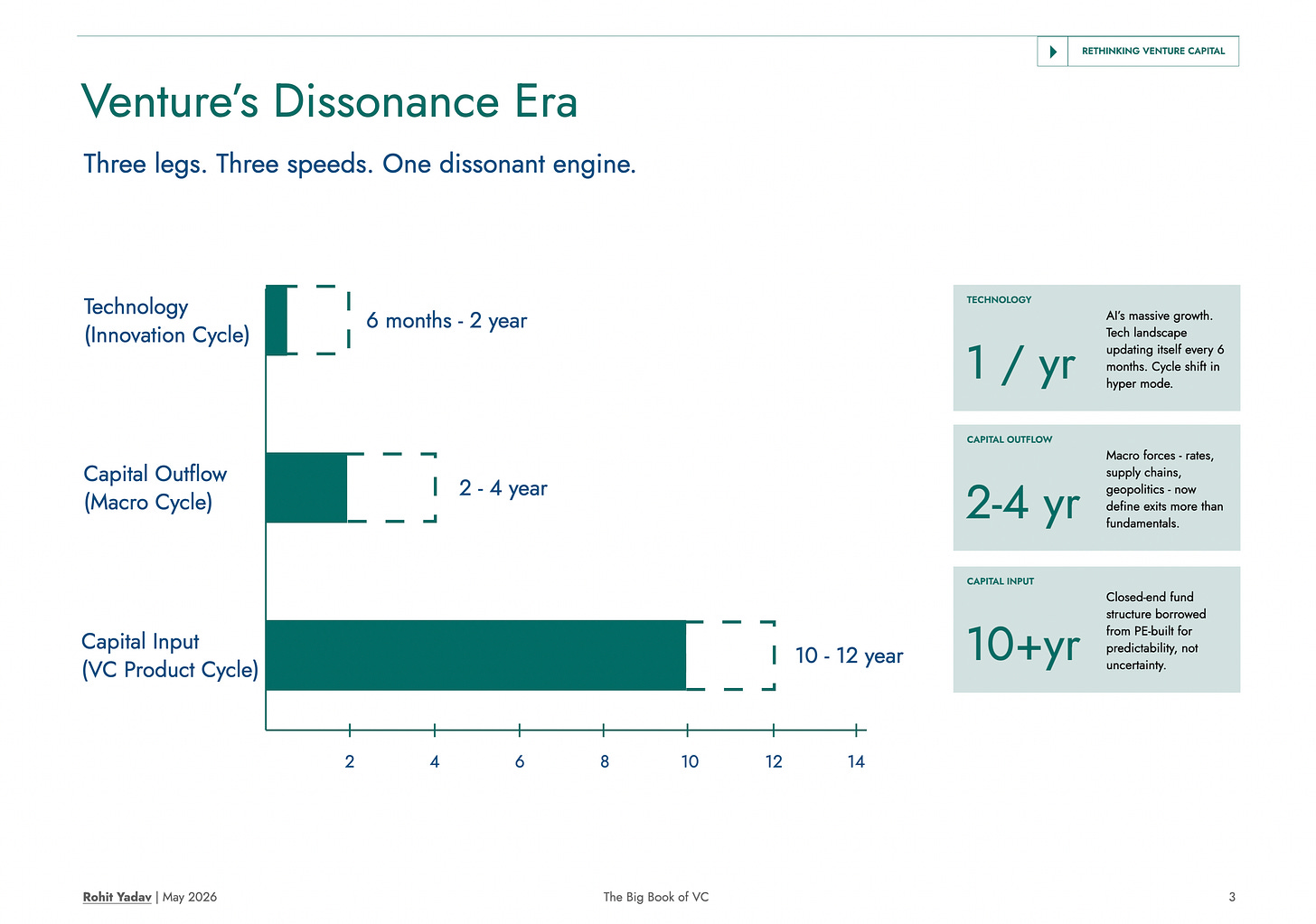
The three mismatched legs - fixed capital structures, accelerating technology, uneven exit regimes - are still pulling in different directions.
If anything, the technology leg (AI specifically) has accelerated this dissonance further,
While the capital inflow side remains anchored to 10+2 fund structures designed for a different era. The dissonance isn’t being resolved.
We are living and investing in a 3D world - a world underlined by Dissonance, Deviation, and Dispersion.
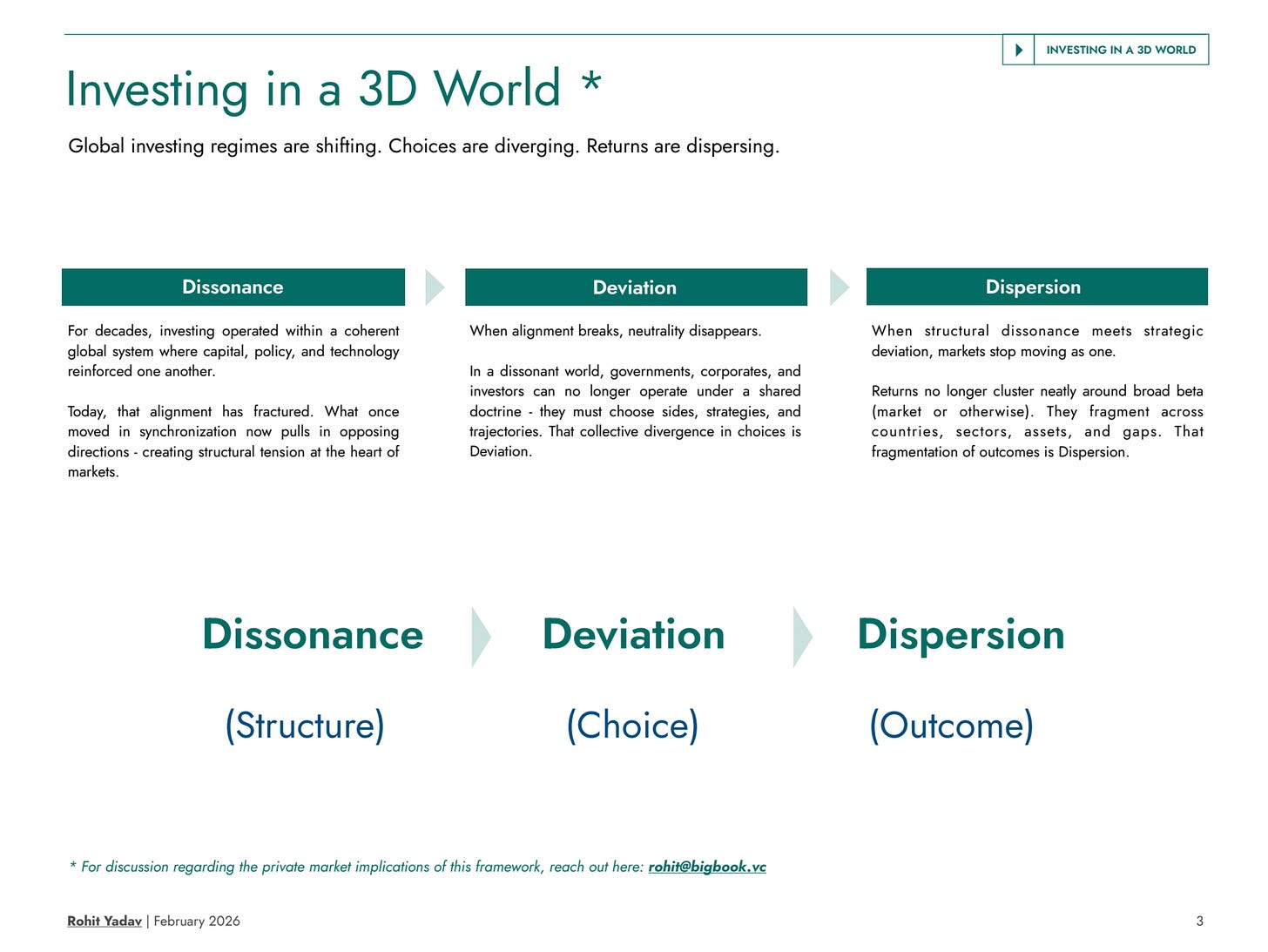
Macro hasn’t improved since 2025. It has reshaped into a different set of risks.
Earlier in 2025, the conflict in Europe was still the dominant lens. That has now expanded to include the Middle East, with repercussions felt around the world through the transfer of goods and oil via chokepoint trade routes. Rather than viewing Middle East conflicts as isolated shocks, they might be better contextualized as a continuation of trends investors have been monitoring since the COVID-19 pandemic. The world has become a more fragmented and potentially more volatile place, and dispersed reactions are driving markets and economies.
For venture LPs, this matters in two specific ways. First, sovereign capital is becoming more strategic and more home-biased -the EU and India examples above are early signals of a broader trend. Second, the cost of capital, supply chain resilience, and energy infrastructure are no longer macro footnotes. They’re investment theses.
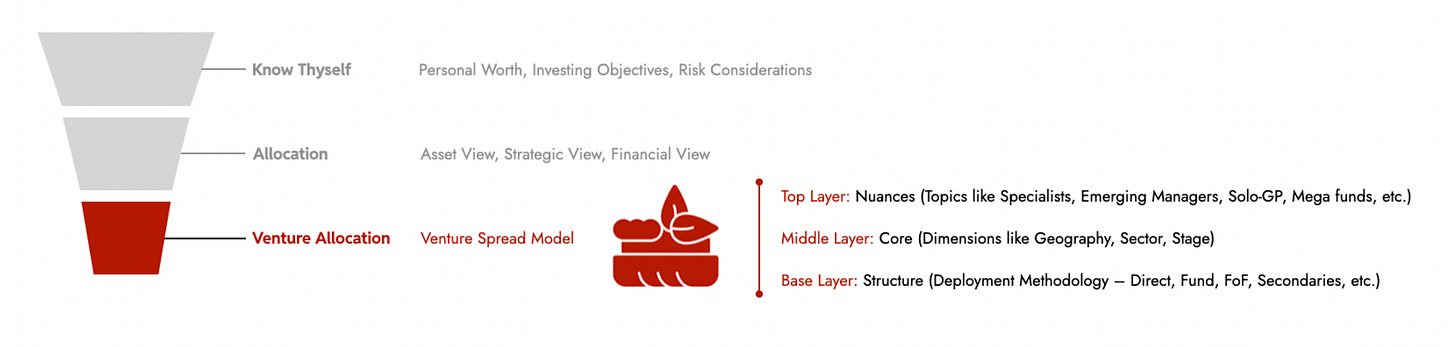
After the fundamental must-do analysis of “Know Thyself” and the institutional allocation framework, comes the Venture Spread model - base layer (structure), core (geography, sector, stage), nuances (specialists, emerging managers, solo-GPs, mega-funds).
This still holds as the cleanest way to build a venture program.
What I’m seeing in conversations with LPs over the past year is that this framing is being adopted more explicitly. People are asking the layered question - what’s our structural exposure, what’s our core exposure, what are the sprinkles? - rather than the flat one. That’s progress.
Three tenets, each about embracing the true nature of venture investing. Each timeless. If anything, the past year has made all three more rather than less true.
Long-termism. Venture capital is inherently a long-term risk asset class. Investors who fail to recognise this fundamental characteristic expose themselves to misunderstanding the asset class and diminishing their chances of success.
Power law. While periods of exuberance (such as 2020–21) may create the illusion that all managers are performing well, only a select few achieve outperformance over complete fund cycles. Manager selection remains the primary lever.
Illiquidity - a feature, not a bug. Venture’s illiquidity stems from both the nature of the underlying businesses and the mechanics of the market.
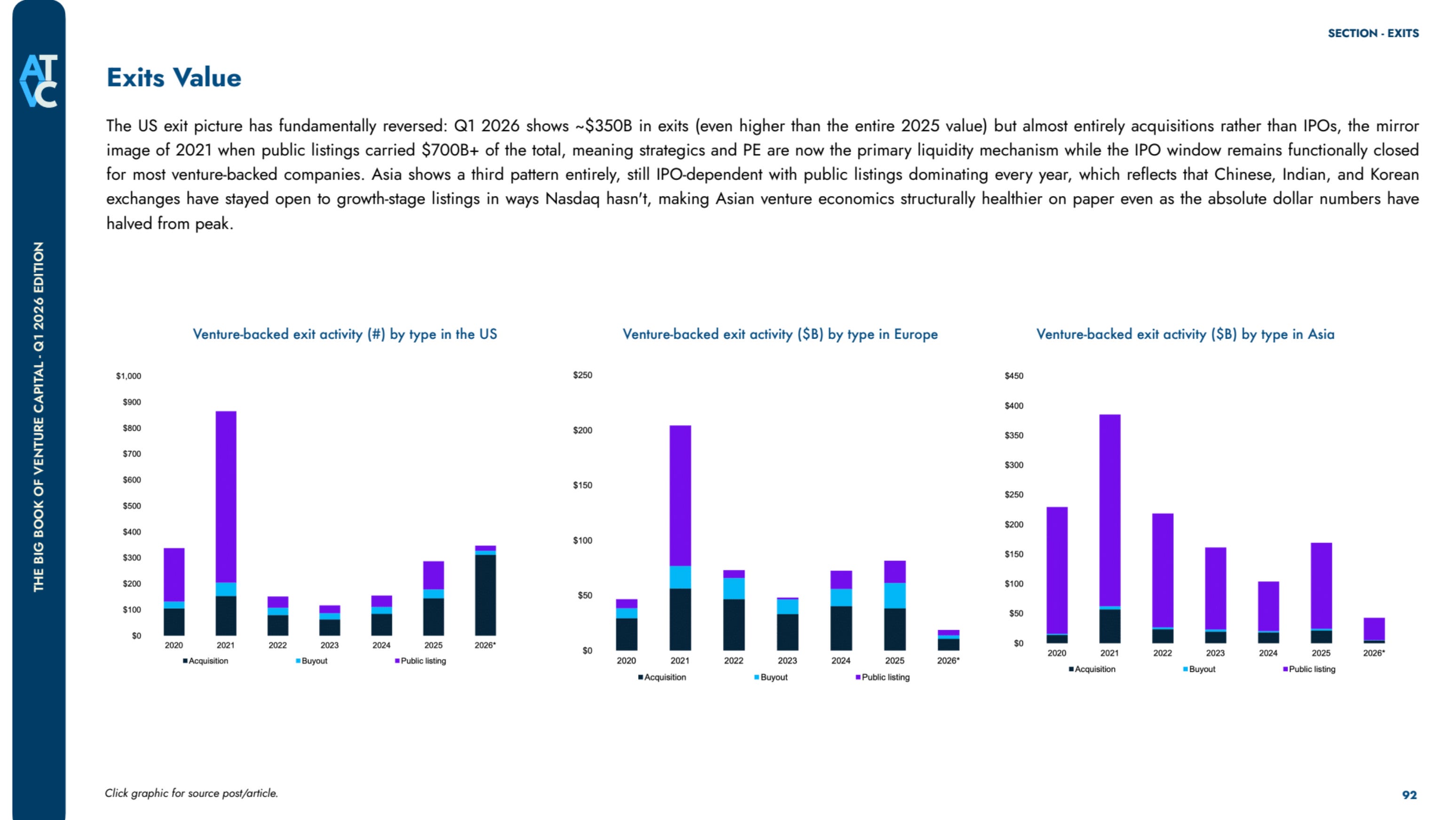
This was the biggest point of struggle until the end of 2024, according to the last report. The global exit value had touched a decade low, and LPs and GPs were becoming wary of distributions.
But in 2025, this reversed across all geographies, and if Q1 2026 is any indication, it could be a bumper year for exits, even though they would be concentrated in a handful of deals.
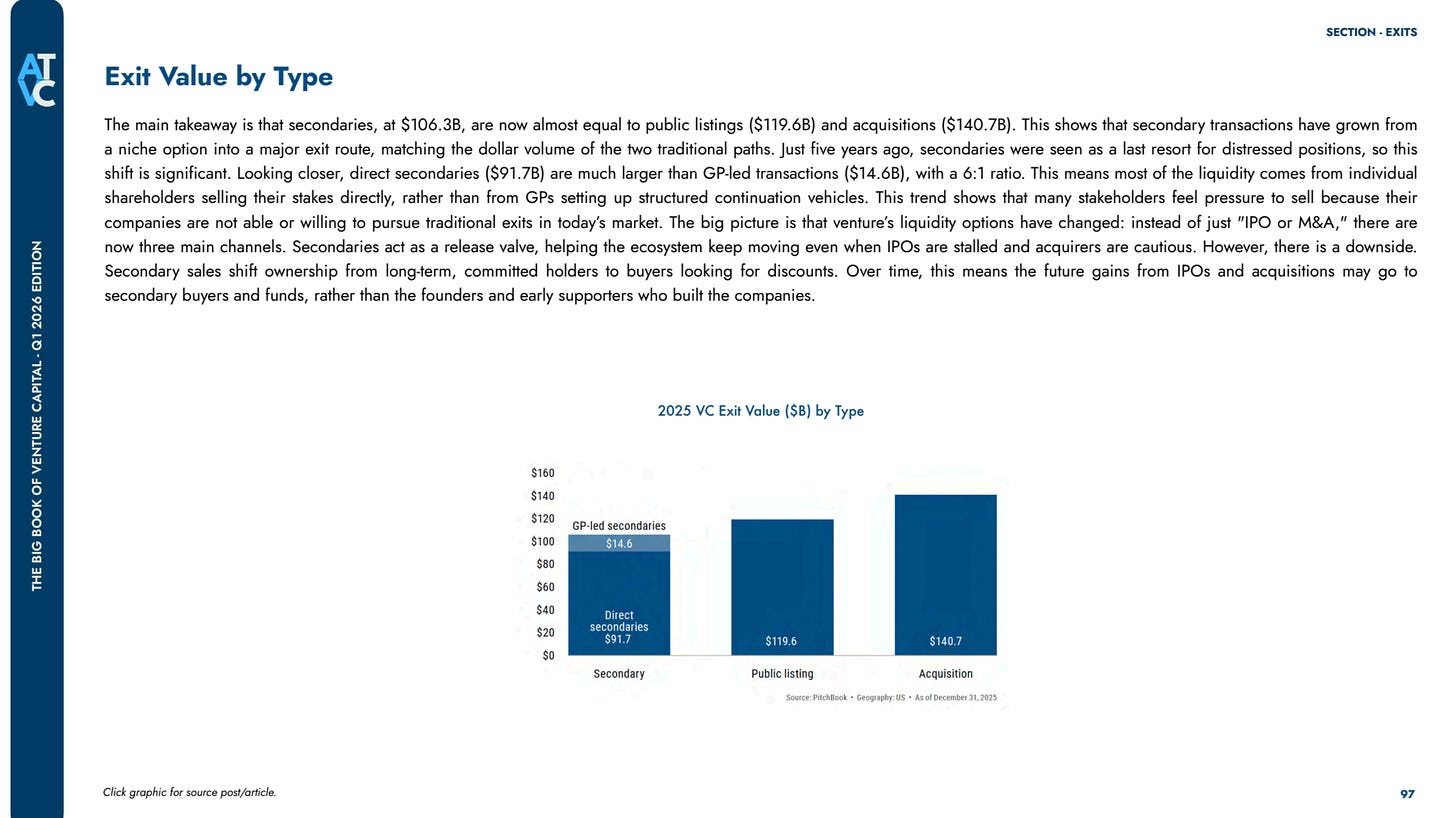
Another massive point of change was the method of exits. Secondaries have become a viable third alternative, and the segment is poised to grow in the year to come.
VC secondaries are rapidly transitioning from a niche, misunderstood corner of the market to a central pillar of the ecosystem.
Once viewed as reactive tools for distressed sellers, secondaries now serve strategic purposes - offering liquidity, enabling portfolio rebalancing, and unlocking capital velocity. With growing investor demand, new platforms, and the rise of GP-led transactions, the market is expanding and evolving.

Venture 3.0 marks a pivotal evolution in the industry. First, venture has moved beyond its roots as a niche or alternative play. Second, the landscape is transforming along two parallel paths: increasing institutional sophistication and broader accessibility.
The same arc of institutionalization that defined public equities in the 1980s, real estate in the 1990s, and private equity in the 2000s is now playing out in venture capital.
The institutionalization of venture capital is not just a trend - it’s a fundamental transformation, reshaping the asset class from the inside out. This shift is no longer a matter of if but how fast and how well. Institutional capital brings scale and demands rigor, accountability, repeatability, and governance.
Twelve months on, the original report’s thought models, frameworks, and forward-looking discussions remain firm. The environment around them has shifted a bit, but directionally we are still in a similar state - venture remains somewhat stressed, with signs of improvement across the board, though in varying degrees.
If you missed the report the first time, the full 130+ page version is still available - HERE. And if you read it then, this might be a good moment to read it again with what we now know.
Thank you to everyone who read, shared, downloaded, and commented back over the last year. The conversation is what makes this worth doing.
— Rohit
You are receiving this message because you subscribed to either the “All Things VC” newsletter, “TheOnePoint” podcast, or downloaded one of our “The Big Book of VC” ecosystem reports.
No posts
Comments
Nothing yet. Say the first thing.
Sign in to join the conversation.