
Since 2022 - but especially since summer of 2023 - and in an attempt prevent Ukrainian drones and missiles from crossing into its airspace, Russia established a massive line of air defenses in the occupied territories and along the border to Ukraine. For those that did, there were some air defenses protecting key regions, such as Moscow and Leningrad oblasts, and others that protected air bases, refineries or factories. The air defense systems in the occupied territories suffered losses that increased with time until, early this year, it was no longer possible to maintain a strong air defense wall around Ukraine. Ever since, Russia re-formed its air defenses, concentrating most of remaining systems around Moscow. Other locations have received varying mixes of systems, depending on their importance.
Deployment
The radar systems need to detect aerial threats, not engage them. Radars around Moscow should detect any incoming threats, especially since the air defense systems have their own radars in addition to these stand-alone radars. Novorossyisk and Kaliningrad have a high density of radars and Rostov has a fair amount. The rest of the stand-alone radars are scattered opposite the Ukrainian border and throughout the large nation to try and detect any penetrating threats.
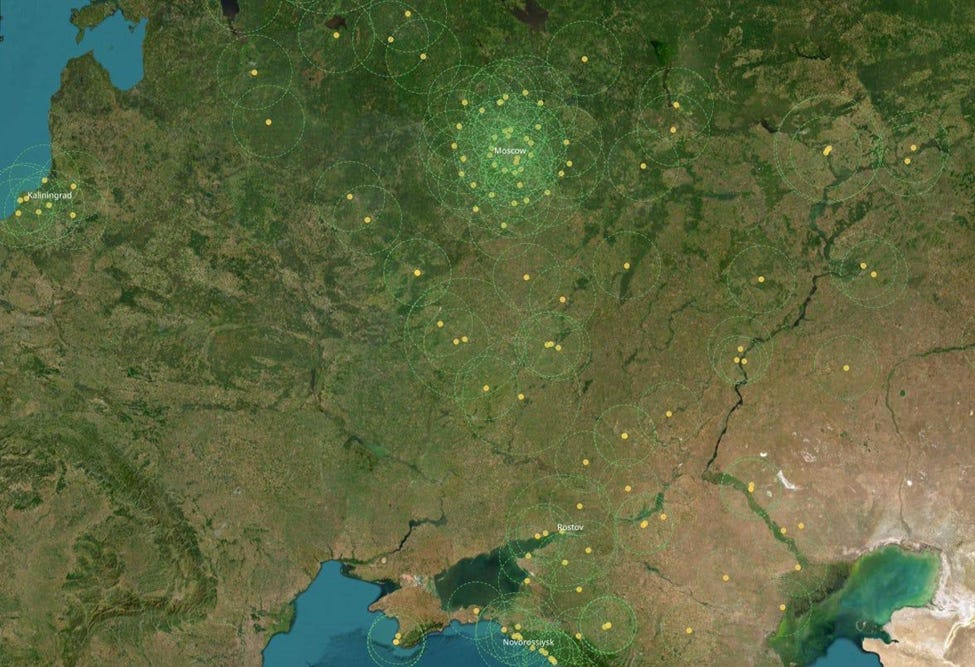
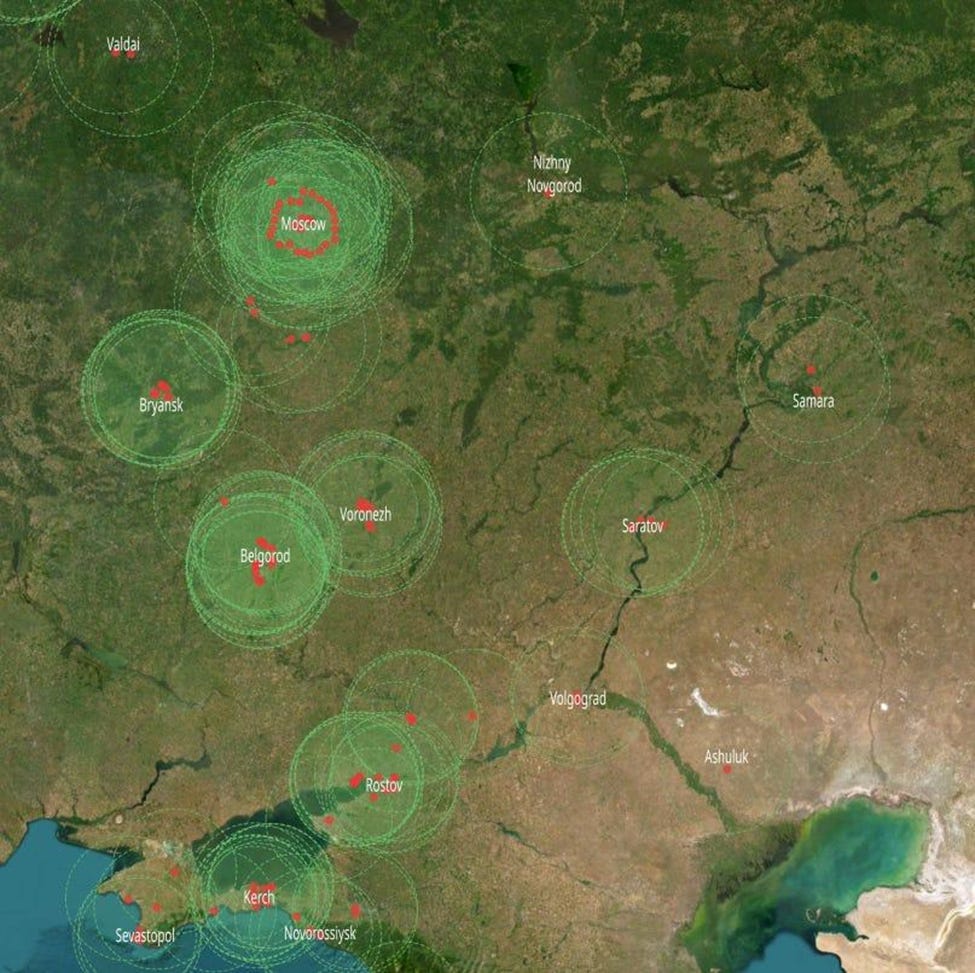
Primary means of the Russian ground-based air defences are S-300 and S-400 surface-to-air missile (SAM) systems. The mass of these is operated by the Russian Air-Space Force (VKS): S-300s are available in multiple variants, and covering medium- and long-ranges. The Russian army is primarily operating longer-ranged S-300-variants. The S-400s of the VKS can deploy a mix of own and S-300-fired SAMs.
The S-300/400 systems have to engage the threats. Since so many were knocked out over the years, the VKS as attrited to the degree where it lacks enough S-300/400s to establish and maintain a ‘wall’: an extended line dense enough for each other’s radars to be able to detect threats, or to provide mutual protection. This is why early this year they’ve pulled back and established circular point defense positions.
This way, both radars and SAMs - plus point-defence/short-range systems protecting each of S-300/400 SAM-divizions (battalions) can protect each other and crucial installations. Traditionally, Moscow is the best protected piece of real estate in Russia: therefore, it is defended by the biggest concentration of SAM-systems. A handful of other cities are also defended by S-300/400s, but nowhere else is their concentration as dense.
For example: the Kerch bridge and Crimea are still heavily defended. Sure, the 31st Air Defence Division VKS was mauled over the time, and had to be patched up by older S-300s instead of its S-400s, but this good for Ukraine because the Russian air defence on the peninsula have been proven as vulnerable and they continue to suffer losses.
Valdai is notable only because Putin has one of his favorite homes there. There is nothing else to defend at that location, but the VKS has to protect it because it would be a massive blow for the regime to get hit there. Finally, Ashuluk is Russia’s air defense testing and training center.
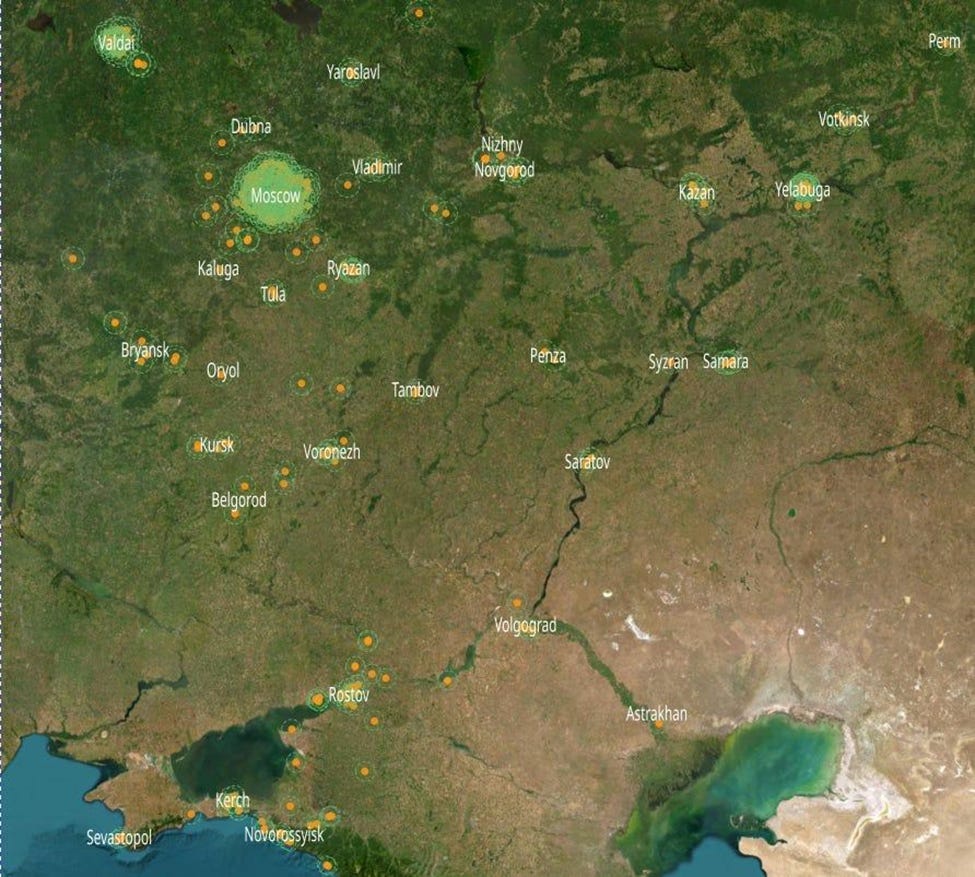
Exceüt for S-300/400s, Pantsyr systems are the most numerous operated by the VKS. They are point defense systems: short-range weapons combinging missiles and anti-aircraft guns. Their primary purpose nowadays is the defence of S-300/400 SAM-sites, but also different important objects. Therefore, they are available in huge numbers and can be found almost anywhere around Russia. For example, at least a battery each (usually: four Pantsyr vehicles, plus support equipment) is deployed for the defence of each refinery: those in Astrakhan, Perm, Syzran, Ryazan, Yaroslavl are often defended by two batteries.
Moscow is the most heavily defended location. The Pantsirs in the region are often located in specially built platforms or on top of buildings so their radars have a better chance of locating the aerial threats - and doing that from longer range - without being blocked by terrain. Putin’s home at Valdai is heavily protected, and there are a lot of Pantsirs at Yelabuga, also on platforms, because that is where the Shahed/Geran drones are built. Votkinsk has been attacked twice, once successfully, because that is where the Kinzhal, Iskander and Oreshnik missiles are built.
Effectiveness
As far as is known, most of Ukraine’s drones are shot down in Russia by surface-to-air missiles and cannon fire. Relatively few by man portable air defence systems (MANPADs) and air-to-air missiles fired by manned interceptors (MiG-31, Su-35, Su-30, Su-27 etc.) and attack helicopters (Mi-24, Mi-28, Mi-35, and Ka-52), machine gun fire and rifle fire.
It is hard to determine the exact numbers, but to get a rough estimate, take the reported number of drones launched into Russia one night, whether it is 300, 400 or 500, and then count how many hits on different installations have been reported - which is often somewhere in the 5-25 range: by deduction, you can establish a rough percentage of how many drones were shot down by the Russians.
One group was able to provide a more precise estimation of how many drones are successful in the heavily defended region of Moscow.
Deployment of Air Defense Systems.
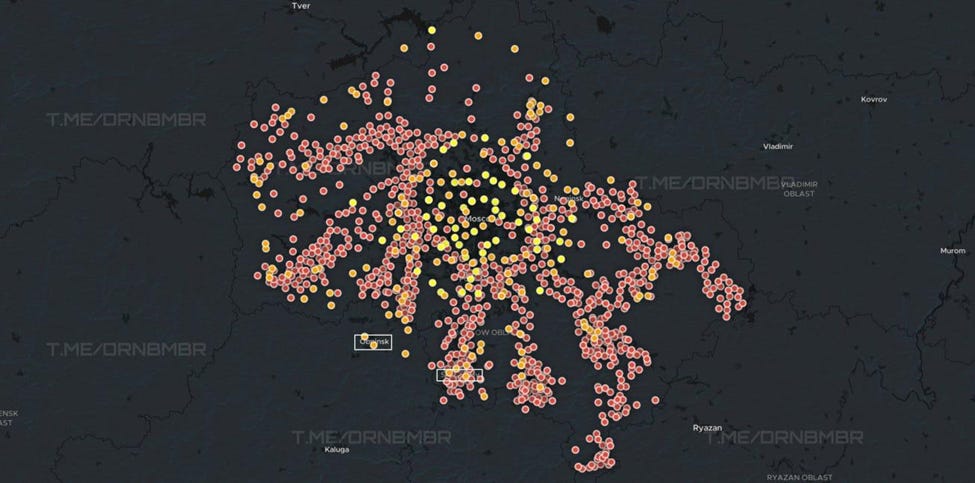
All good defensive positions on the ground or in the air have depth, and Moscow has, more or less, three rings of defenses. The first ring is fairly well defined, but the second and third rings are packed closer together. If the outer ring doesn’t destroy all the targets in front of them or that fly behind them, the next layer will have a chance for multiple shots and nearby units will also take shots. The first step in engagement is detecting the target, and there are stand-alone radars and radars organic to each air defense system.
Drone Interception Patterns
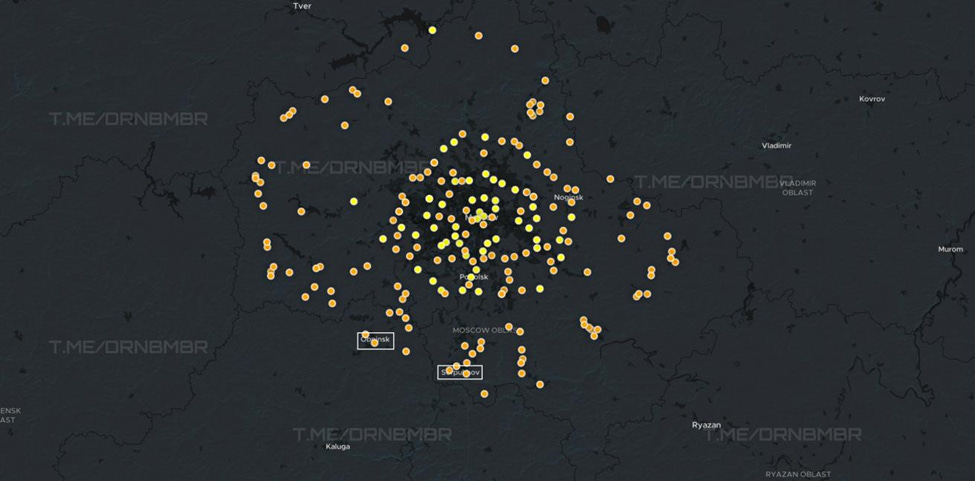
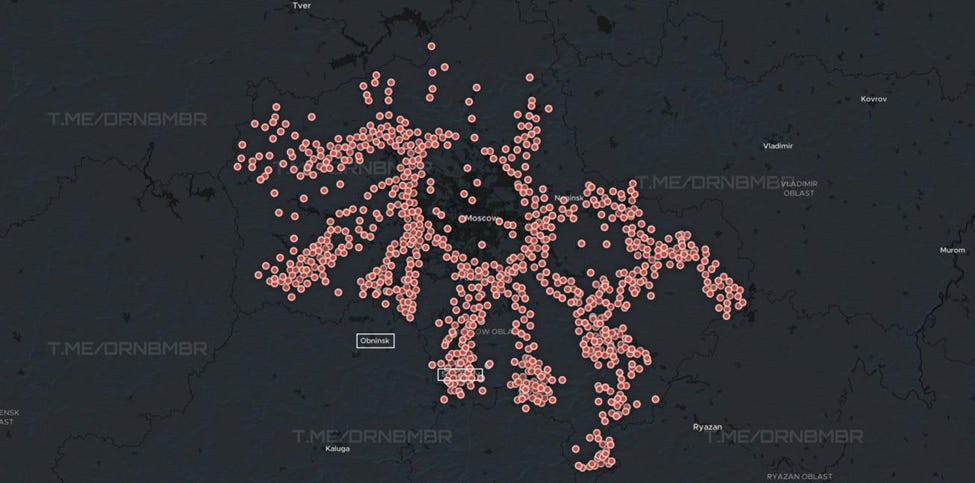
The group recorded about 1,500 reports of detections and interceptions. These reports were not from the same attack but were scattered reports from across the month of July.
This map shows where the drones were shot down. Videos show how the drones fly usually alone, sometimes with another drone nearby and rarely are there three drones in the same view. So the air defenses shoot at them one at a time. In this map, distinct linear patterns are formed as the drone streams arrive from particular directions and are shot down one at a time at varying distances.
Most of those drones are shot down not as they approach the outer first ring, but after they’ve gone by. With Obninsk and Serpukhov as references, some drones are shot down before Serpukhov and none are shot down in front of Obninsk. The areas in which the most drones were shot down in front of the outer first ring is west and north of Ryazan. Maybe a hundred drones are shot down outside the first ring Moscow defenses. The other 1400 were shot down inside them.
This is a good example of why depth in air defenses is important. The targets have to be detected and all the systems have to be alerted on where to look. The first ring provided that higher level of detection, and then the first, second, and eventually third ring would engage the drones. The drones flying west and north of Ryazan were detected much earlier than from other directions and were engaged much earlier.
In Crimea, the Russian air defenses have relatively little depth (indeed: in the Sevastopol area: next to none). Some drones and missiles were detected by Crimea’s air defenses as the approached but others were only detected at close range or when they went by. If Ukraine knew the location of a Russian air defense component and attacked it, then the air defense unit had a chance to defend itself but too often it was attacked before it recognized there was a threat. When Ukraine used naval drones to launch FPV drones on the coast line, Russian air defenses were helpless. This is why Crimea was a deathtrap for Russian air defenses, and this is why it’s so difficult for Ukraine to defend Odesa against drones and missiles.
It’s also a good example of how Ukraine was able to eat away at Russia’s air defenses behind the front line over the years. Russian systems in the front were the most vulnerable. Sometimes they would defend themselves, sometimes a neighboring system would defend them, but every once in a while a system would be destroyed. As more systems were destroyed, the density of the defenses eroded and there were fewer systems to detect and protect each other, and it became easier to attack the systems that remained.
Evaluating the Cost
Moscow’s air defenses are more dense than Russia’s air defenses near Ukraine everywhere. Because of that, they are very effective. There were reportedly 6,225 drones that headed to Moscow in July. Of those, 780 were supposedly intercepted before they reached Moscow’s defenses. There could be more that were intercepted before reaching Moscow that was not reported, but there were potentially 5,445 drones that reached Moscow.
Of those, 1,500 sightings and interceptions were reported. 1,400 were destroyed by the first and second rings. 100 drones reached the third ring of defenses, and of those, one drone hit a target.
There were about 3,945 drones that did not have reports of interception locations or hits on targets, but in the months of June and July (not July only), Ukraine managed to hit:
-The Kapotnya oil refinery several times to put it out of service until 2027, inside the third ring of defenses.
-The Medvezhi Ozera Space Communications center, adjacent to the second ring of defenses.
-Koledino logistical warehouse, adjacent to the second ring of defenses.
-The Chekov Wildberries 25 km north of Serpukhov, inside the first ring of defenses.
-The Elektrostal Wildberries, adjacent to the first ring of defenses.
-Chekhov Regenerative (rubber recycling) Plant, 25 km north of Serpukhov, inside the first ring of defenses.
-The Dubna Space Communications Center, adjacent to the first ring of defenses.
-The Beloomut Space Communications Center, 20 km in front of the first ring of defenses.
-The Meshcherino Space Communications Center, adjacent to the first ring of defenses.
-The Noginsk oil depot, adjacent to the first ring of defenses.
It’s difficult to say what Russian systems engaged the 1,500 Ukrainian drones, whether the Pantsir used its cannon or missiles, or both, or how many missiles were fired from Pantsir, Tor, Buk or S-300/400 systems, or what the operating costs for the helicopter and jet aircraft that also engaged the drones. One team estimated that it cost Russia $250-450 million in ammo to shoot the 1,500 drones down. Even a conservative $125 million figure is significant.
They also used a figure of $10-30,000 for Ukrainian drones but if the $55,000 cost of an FP-1 drone is used then Ukraine spent $82.5 million in drones for the two months of attacks on Moscow.
The cost to rebuild the Kapotnya refinery is estimated to be $1 billion, plus, it won’t be producing 1.5 million tons of gasoline or 1.5 million tons of diesel, either, in those six months. And there is the damage to all the other facilities.
Moscow is the most heavily defended airspace in the world. Ukraine’s success rate is very low, but the impact of those successes is a very good return on the costs of the attacks. Ukraine’s success rate in other regions is also low, but the impact on the refineries alone makes their campaign a success.
Cruise Missile Defenses
When Russia reorganized their air defenses after so many losses, the stand-alone radars that were spread across the country could not track all the Ukrainian threats. There were too many gaps. Sometimes a target would be tracked for a couple of hours and then it would travel out of coverage range and be lost. In addition, even if a target was being tracked, there might not be any ground systems in range to engage it.
The A-50U is a long-range airborne early warning and control aircraft that was used to detect Ukrainian radars in support of drone and missile attacks on Ukraine. After two of them were shot down, the remaining A50’s patrolled at a greater distance from Ukraine. There are seven A-50U planes, but only four are operational. One was down for maintenance or repairs, but between 4-22 June, an A-50U with the tail number “45 Red” was returned to duty.
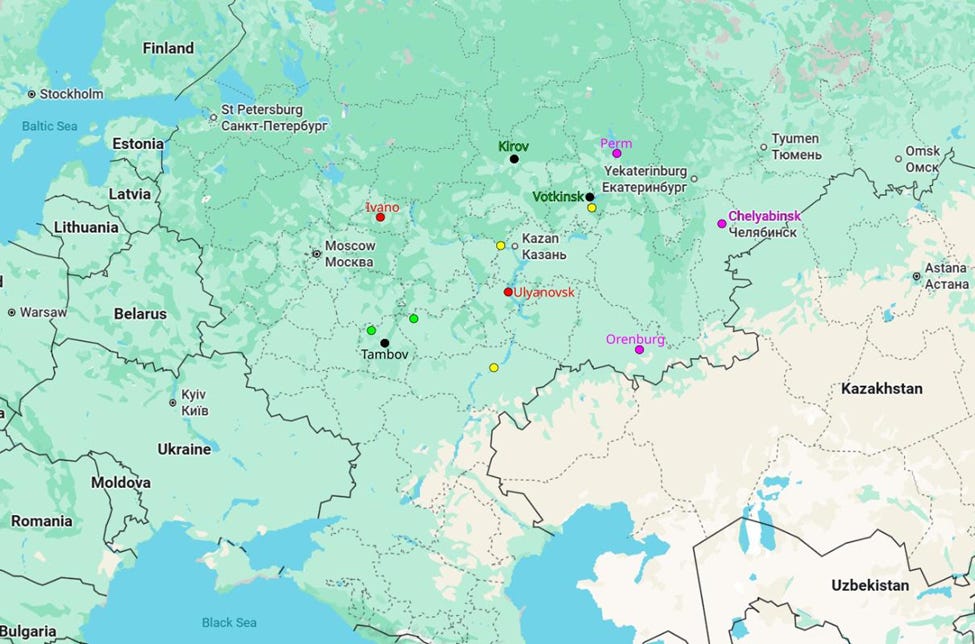
At some point, Russia decided that their air defenses needed more help than their air attacks. The A-50 was a mobile radar that could move towards the threat to keep tracking Ukraine’s drones and missiles. It could detect a Flamingo at 600 km and a long-range drone at 200 km. And if a ground air defense system was not in range, a helicopter or fighter aircraft could be directed to move towards the threat and engage it. And so, at some point no later than 4 June 2026, the A-50s were no longer patrolling Ukraine, but were providing radar coverage as part of Russia’s diminishing air defenses while based at Ivano and Ulyanovsk. They switched from offensive operations to defensive operations.
On 23 June, the pattern changed. One plane started flying around Ulyanovsk, mostly at night. They would rotate patrol duties and 60 separate missions were recorded in the next 11 days.
On 4 July, Ukraine launched five Flamingo missiles towards Votkinsk, a Iskander and Kinzhal ballistic missile factory that one Flamingo had hit back in February 2026. The Flamingo was a big missile, about 13 meters long, and can easily be detected and shot down if a radar has a line of sight to it. To avoid this, the Flamingos flew low over rivers so air defense radars on the ground would be blocked by intervening terrain. But the A-50 radar was flying between 5-10,000 meters in the air and wasn’t blocked by any terrain. All 5 missiles were shot down at three locations before they could reach the Votkinsk factory.
After the 4 July Flamingo attack the 4-5 A-50U’s were moved from Ivano and Ulyanovsk to Perm, Chelyabinsk and Orenburg to reduce the chances of them being attacked. On 6 July, it took FP-1 drones 12-15 hours to fly to Omsk. By the time they arrived, an A-50 was above the refinery to direct a Su-57 to intercept the drones, but it only downed one and at least two drones hit the refinery.
The next day, on 7 July, four A-50’s were in the air at the same time, a level of readiness that had not been seen before.
On 24 July, 5 Flamingo missiles were launched. Three were shot down somewhere, but two hit the Avitek plant in Kirov, which makes engines for the Kh-101 cruise missile, among other things.
On 7 August, 5 Flamingo missiles tried a new route to presumably reach Votkinsk and all were shot down.
The Effectiveness of the Flamingo
Increased Ukrainian attacks will likely result in a higher operational pace for the four A-50U planes, which could lead to maintenance and malfunction issues at some point. It is another source of stress for Russian air defenses, but the planes greatly increase Russia’s chances of detecting and engaging Ukrainian drones and missiles.
Ukrainian drones have been very effective against flammable targets, such as Wildberries warehouses, refineries and other energy targets. They also continue to be effective against Russian air defenses when targeting them. But the 60-120 kg warheads do a limited amount of damage to a larger facility that isn’t flammable.
The Flamingo has a 1,150 kg warhead that is very effective against any facility. If just 40% of them hit, a lot of Russian industries would be in ruin. The problem is that they are easy to detect if a radar has a line of sight to them and they are easy to shoot down if they are detected. The Flamingos had some success avoiding radars by flying above rivers, but the A-50s can see down into the rivers. Since A-50s started participating in air defense operations only two of 15 missiles made it to the target. At $600,000 each, a loss of five Flamingos costs $3 million.
Even when a Flamingo isn’t shot down, there are sometimes navigation issues and they land a short distance away. Once a missile had the misfortune of hitting a pole only a couple hundred meters from the target.
Ukraine has been launching Flamingos five at a time, either because that is all they are capable of launching or because they determined that is the most effective tactic. Either way, it doesn’t seem likely that 15 missiles will be launched at a target to overwhelm the defenses.
The 3,000 km range and 1,150 kg warhead are excellent attributes but the navigational issues and the ease with which they can be shot down when an A-50 detects them renders them ineffective. They likely have a much greater chance of hitting targets at 1,000 km or less, but would put many targets off limits, and targets like Votkinsk need to be destroyed.
They are largely ineffective as they are currently being used against Russia’s current air defenses. Ukraine needs to create conditions to make them effective.
The Future
Ukraine’s long-range drones are very effective, even against the toughest air defenses in the world. They have repeatedly attacked air defenses around Kerch, Krasnodar and Novorossiysk but there are very few reports of air defenses being attacked elsewhere deep in Russia. If they could find a way to do so, Russia’s ability to defend itself would be further reduced.
Key Russian facilities that produce missiles and drones need to be attacked. If Ukraine cannot reach them with Flamingos then massed drone attacks should be considered.
Destruction of the A-50s would be difficult but desirable.
The FP-9 is a ballistic missile with an 800 kg warhead and an 855 km range is supposed to become operational in the fall. Nothing counts until it happens, and accuracy would also need to be established, but ballistic missiles are harder to shoot down. Fire Point has a tendency to overpromise, but if the missile turns out to be effective with a decent production rate then it will be one more weapon to stress Russian air defences.
No posts
Comments
Nothing yet. Say the first thing.
Sign in to join the conversation.