
(…continued from Part 1…)
Kostiantynivka
A month ago, Syrsky’s… erm… Ukraine’s 425th Assault Regiment was clearing out the southwestern corner of Kostiantynikva. Last week, Russian forces were dropping anti-tank mines into buildings in that same section of time. No video activity was seen east of the river.
Druzhkivka continues to be pounded. Russian infiltrators reached Torske and Petrivka, up to 9 km from the front.
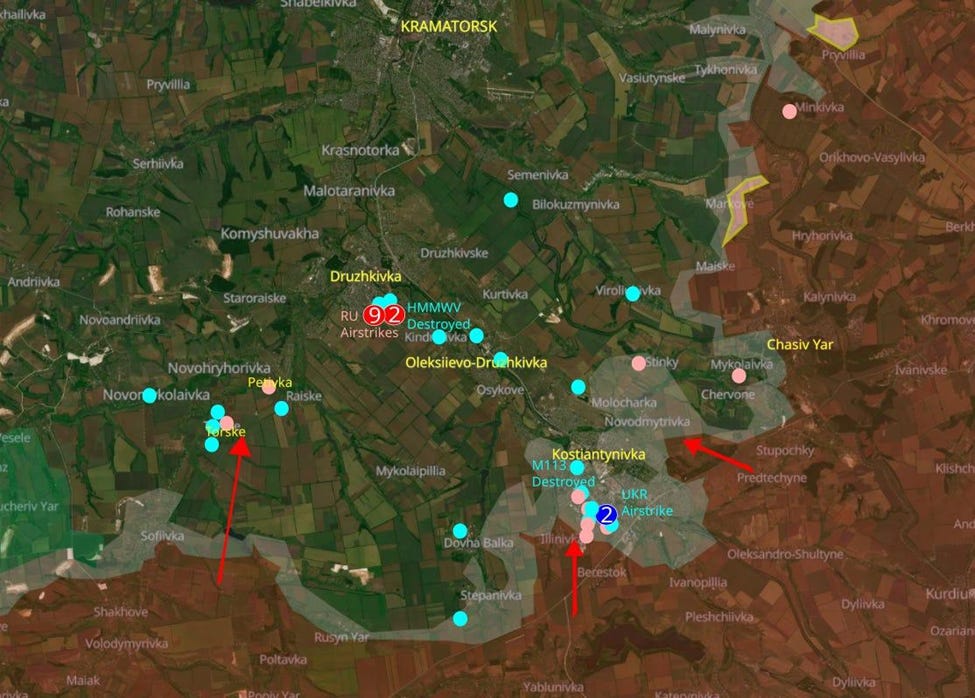
For some reason, Russians park a convoy of vehicles only 20 km from the front.
Dobropillia
Dobropillia continues to be pounded by airstrikes. Russian infiltrators continue to put pressure across the front.
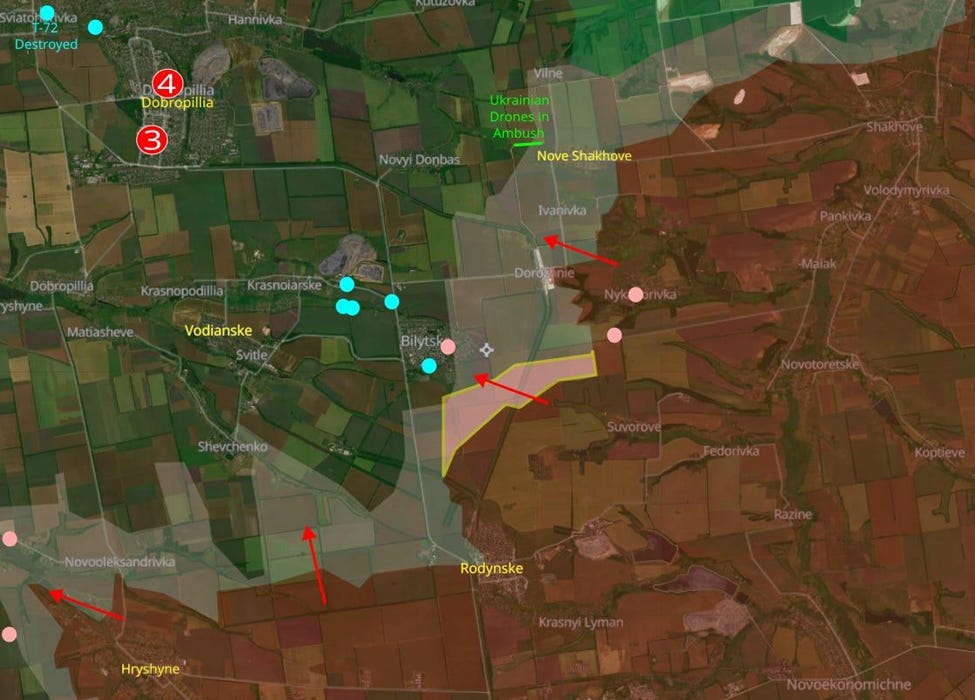
Both sides sometimes park a drone on a road and wait for a vehicle to arrive to take off and ambush it. For some reason, Ukraine had a hundred drones parked on a road west of Nove Shakhove. Drones have attacked enemy ambush drones before. Since most drones only have a forward-facing camera, infantry have approached ambush drones from behind to disable it. In this case, with so many Ukrainian drones, the Russians use dripping thermite to eliminate a few Ukrainian drones. (Indicated on the map)
Komar
Some history leading up to the current situation around Komar:
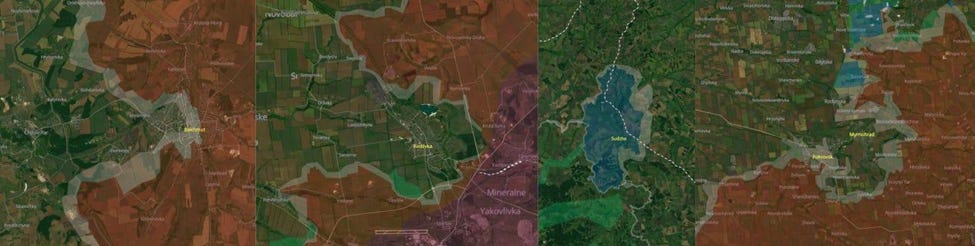
Avdiivka fell in February 2024 and the Russians broke through at Ocheretyne in April the same year, starting their long march to Pokrovsk. The rest of the front was stable as late as July 2024, but Russia was putting heavy pressure on Vuhledar. Instead of reinforcing Vuhledar or counterattacking the relatively small penetration at Ocheretyne, Syrsky - with Zele’s agreement, of course - invaded Kursk a month later. Russia kept advancing throughout 2025, but no front was more unstable than the line stretching from Komar to Ternuvate and Huliaipole.
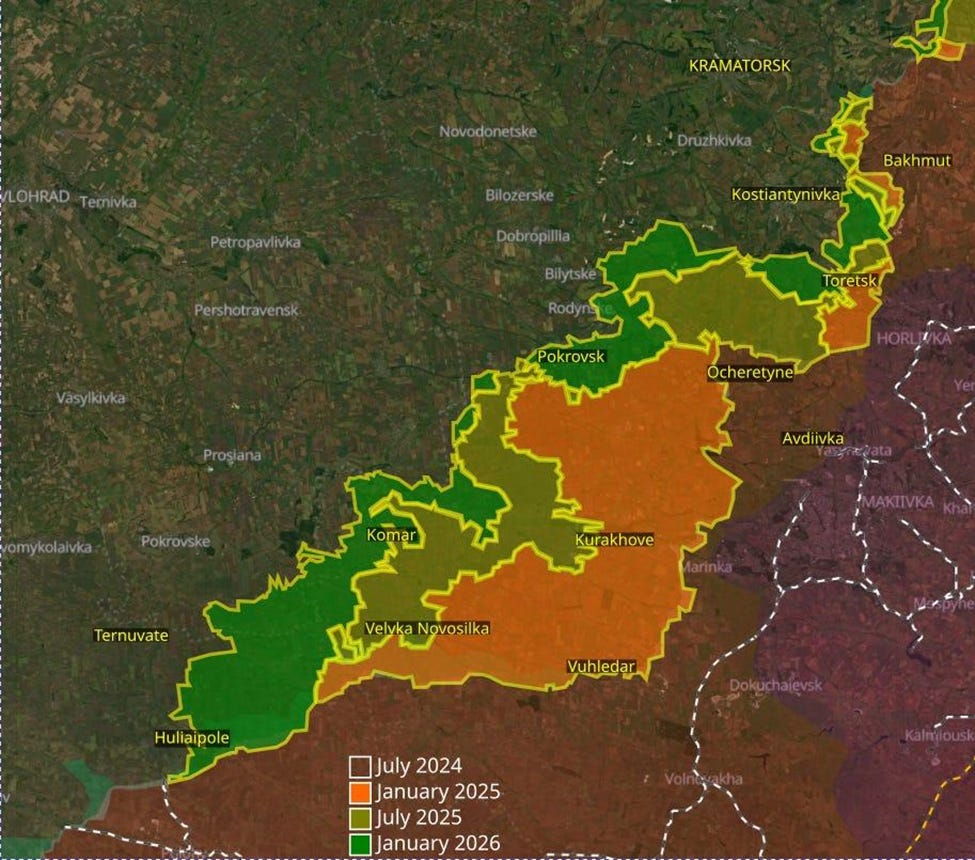
Ukrainian defenses around Oleksandrohrad began to stiffen in January but the units around Huliaipole were in shambles. Reinforcements were sent to the area in December to try and slow the Russians down but they still advanced. In February, 70% of the assault forces were used to counterattack the Russian positions in the north. Other strong Ukrainian brigades were sent to maintain a slow, methodical advance that was designed to maximize Russian casualties and minimize Ukrainian casualties. Throughout the war, these brigades released very few videos. This reduces benefits they may have received from public recognition but it also denies any details that could benefit Russian planning.
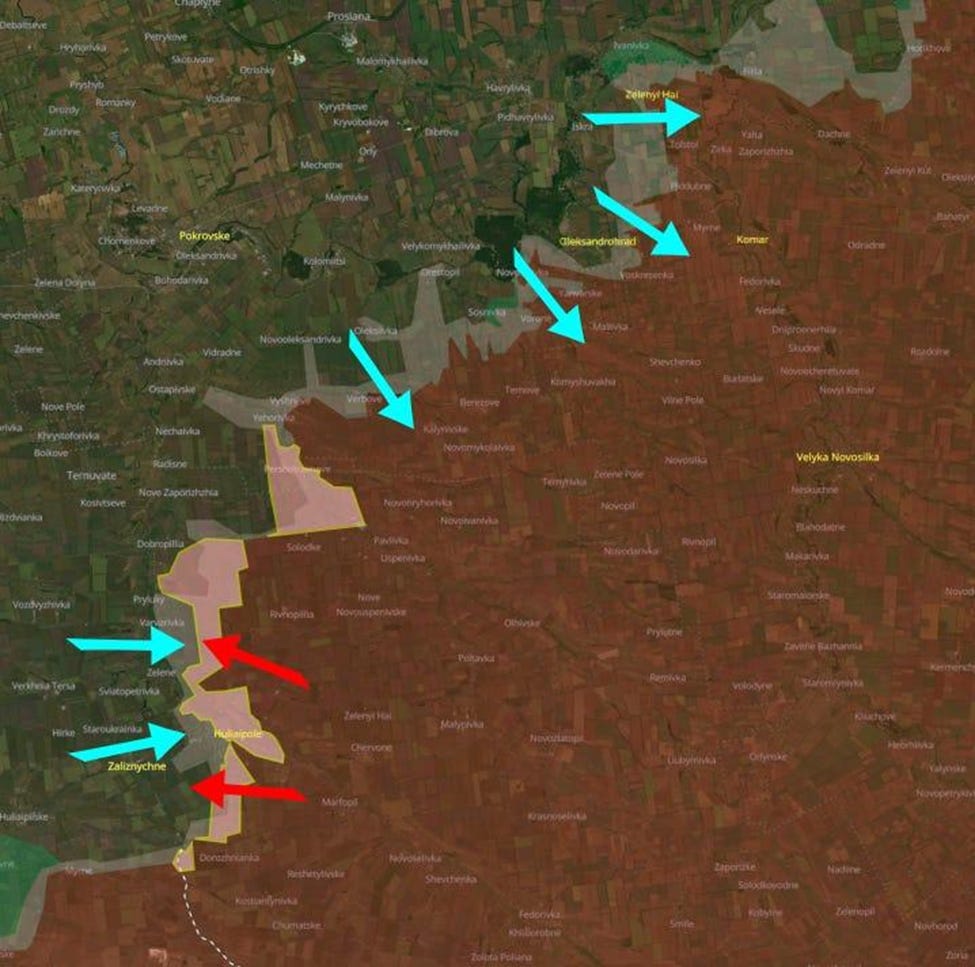
In offensive operations, it is best to isolate the battlefield as much as possible. Total encirclement would block any movement of supplies and replacements by ground, but the rate of advance has been slow enough that troops threatened with encirclement have been able to withdraw. Even so, supplies and replacements that pass through a shrinking corridor suffer increasingly higher loss rates as the gap closes. These losses, plus the threatened encirclement, compel the withdrawals, and any forces leaving through the narrow corridor also suffer heavy casualties. The Russians have often used partial encirclements to achieve their objectives.
It is also possible to partially isolate a battlefield without encirclement. In the Second World War, the western Allies would use airpower to restrict movement deep behind enemy lines. Closer to the lines, artillery fire would target enemy movements, and closer still, mortars would engage targets.
In this war, Ukraine uses mid-range drones to attack any traffic, warehouses, depots, headquarters or troop concentration points that are 50-200 km from the front lines. Mariupol is currently 120 km from the front. From the front lines to 50 km, FPV drones are used to attack any target they can find. Artillery, infantry, headquarters and depots are targeted. Russian drone teams are a high priority, and anything that moves is easier to spot.
Russia is trying to do the same with their FPVs. Both sides have positions behind each other in the gray zone, so FPVs from both sides operate there. Further behind Ukrainian lines, Russian drones attack any target they see and Russian bombs confirmed or suspected target with a high level of inaccuracy.
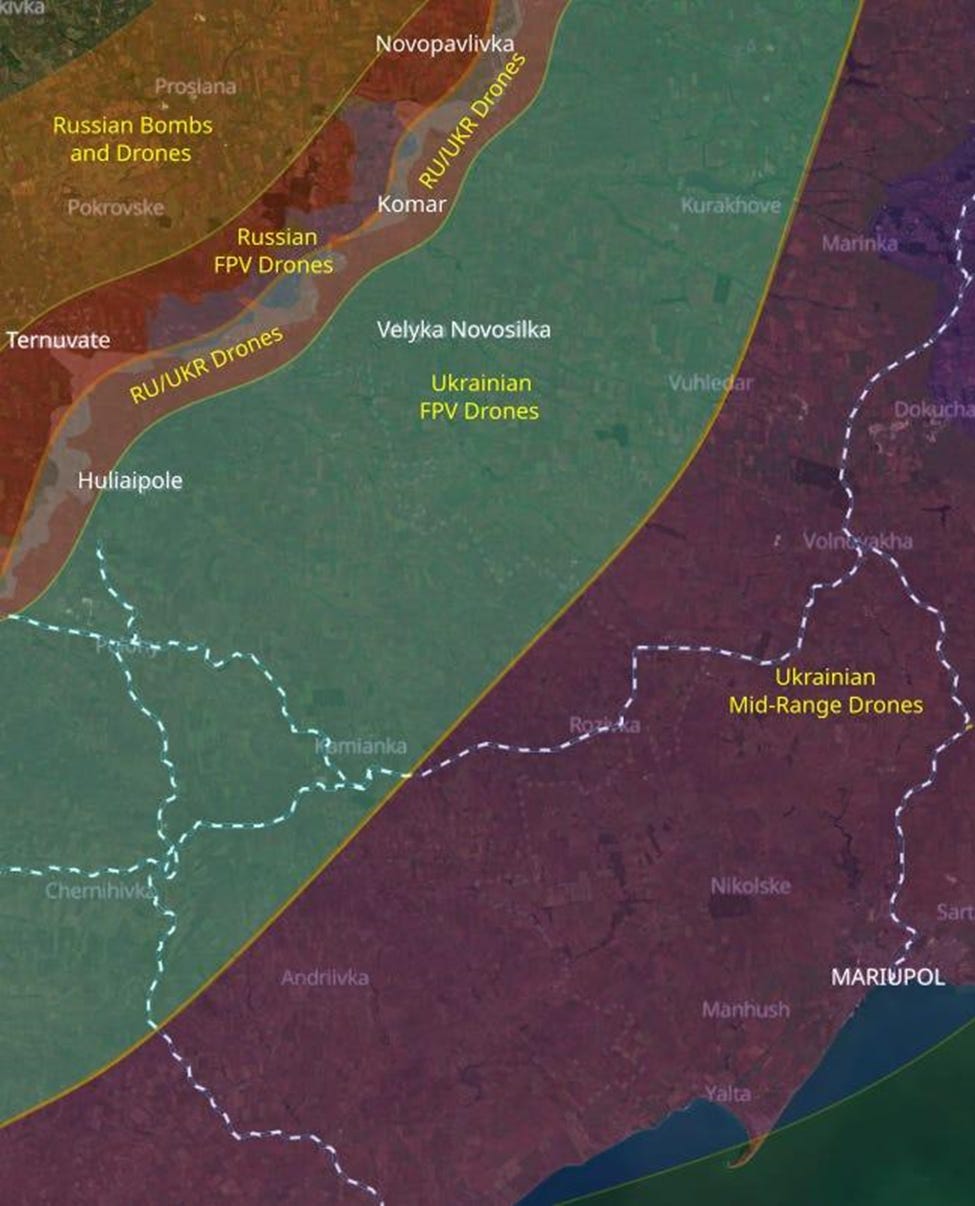
These aerial interdiction attacks do not eliminate the flow of supplies and replacements but it does reduce the rate in which they reach the front. If Ukraine can casualties at a higher rate than Russia can replace the casualties, the number of Russian troops on the front line will be reduced over time.
If there were a thousand people in a unit and they suffered 50 casualties a day and they received 50 replacements a day, they would maintain their strength. But if they suffered 50 casualties a day and only received 90% of their replacements, only 45 troops would refill the unit. 5 people does not make that much difference for just one day, but if that stayed consistent every day then at the end of the month the unit would only have 850 troops. In two months they would be down to 700 personnel, and in three months they would be at nearly half-strength with a roster of 550 people.
The same is true for supplies.

In addition to drones, artillery and bombs, infantry on the ground also reduces the rate of supply. Russia sends infantry in teams of one to four people 5-15 and sometimes 20 km behind Ukraine’s front positions. They wait in different villages and treelines until other infiltrators arrive. If enough accumulate, they move forward again or attack Ukrainian positions. They also observe Ukrainian positions and movements which are attacked by drones, artillery, bombs and infantry. If they reduce enough Ukrainians in forward positions and prevent replacements from arriving then eventually it will become Russian-controlled territory.
On the opening day of the Ukrainian counterattack, the assault regiments made several mechanized attacks with the associated loss of at least a dozen vehicles. Other brigades were more methodical, conducting their own infiltration behind Russian positions. They were supported by drones that kept the battlefield under constant observation and provided firepower. For Russian positions that required an infantry attack, heavy drones flew in machine guns and other equipment to support the attack, and then flew them out so the infantry could move and hide more easily.
Behind the Ukrainian infiltrators, other units were hunting and eliminating any pockets of Russians that moved behind them. This made it easier to supply the forward units and evacuate their casualties.
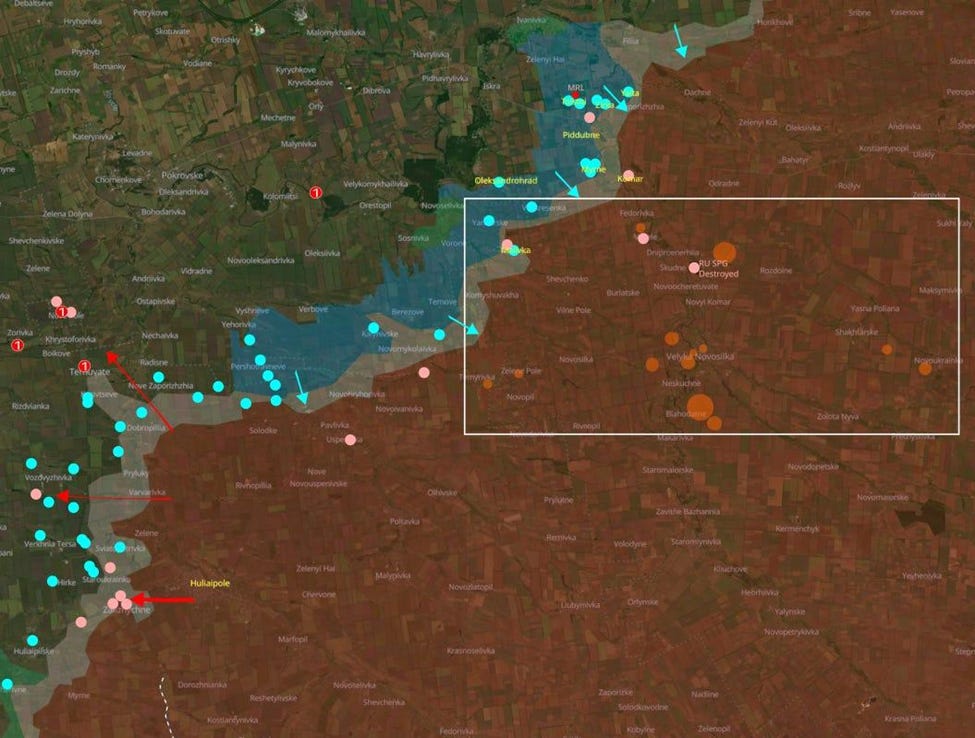
The primary objective was to preserve Ukrainian lives and destroy Russians, and Ukraine is achieving this objective. They’ve also advanced a kilometer a month over six months. They held onto that info until last week to prevent Russia from learning any info.
A journalist says that more area has been liberated than was shown but that Ukrainian casualties were very high. Other analysts also say that bombardments indicate Ukraine has advanced further than what the government acknowledges. Ukraine already crossed the Mokri Yaly river at Yalta and Zirka in the north.
The orange circles highlight fires in an outlined box representing a snapshot of the attacks on Russian logistics for less than one day. Several drone units stopped a small column of Russian vehicles.
Two soldiers of Ukraine’s 475th Assault Regiment (Code 9.2) eliminated a Russian position but were then attacked by Molniya drones. A ground drone was sent to evacuate them but it was attacked and knocked out. Their company commander raced out by himself in a truck, lifted them into the back and then sped away before another Russian drone arrived.
Zaporizhzhia
In April, Syrsky signed an order that limited the time a unit could be stationed on the front to two months. After that time, they must be rotated for rest within one month. Often, units have to wait until bad weather because drones make movement difficult. Some have lived in a dugout for more than a year.
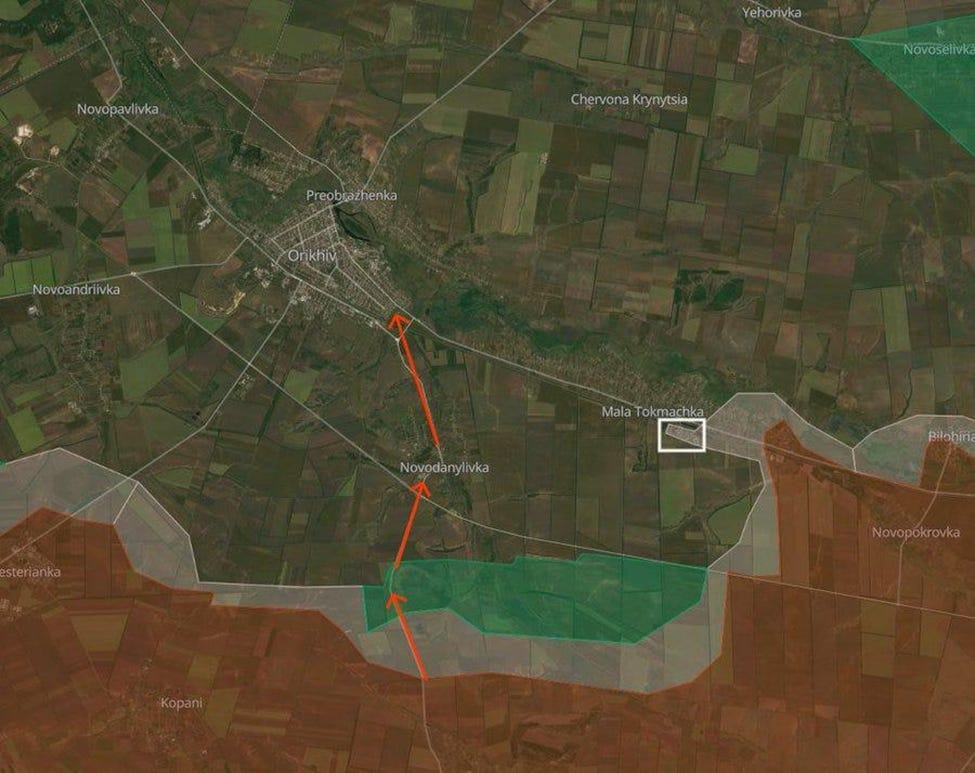
Platoon Commander Anatolii Syshchuk’s platoon arrived at the front line in April to relieve another unit that had been there for eight months. Syshchuk’s platoon was only supposed to be there for one month. Four months later, they are short of food, drinking water and medical supplies. Food is sometimes delayed 3-7 days and once they didn’t have food for 12 days.
The platoon belongs to the 121st Territorial Defense Brigade, which said they’ve delivered 27 nine kilogram packages over the course of a month. Then they said that weather conditions and Russian forces meant that supplies could not always be delivered on time or in full. The brigade said that the commander was personally communicating with that platoon and the platoon’s message “did not reflect all the circumstances.”
The 121st belongs to Operational Command South, which says the platoon will be rotated out once the security situation allows it, that the platoon is carrying out combat missions in a complex and dynamic sector of the front and the situation remains under the command’s control.
“At the same time, the information presented in the video message reflects only a small part of the complex operational situation and does not convey the full context of the measures being taken,” the Operational Command South statement said. “Over the past 30 days, approximately 240 kilograms of food supplies have been delivered to the positions of soldiers from the 121st Separate Territorial Defense Brigade. A series of measures is currently being implemented to rotate the unit as quickly as possible.”
One of the sisters of a platoon member said, “In our reality, it’s usually the ordinary soldier who is blamed — the one who keeps the front line holding. But if even once a commander had been punished and held accountable for the lives and health of the troops, there would be no need for such appeals.”
Platoon Commander Syshchuk said it’s been over four months now and he decided to lead his troops to the rear when favorable conditions presented themselves, and he would do it whether another unit was there to take their spot or not. Addressing the Commander-in-Chief, he said, “We are not refusing to serve, but we have no other choice. We are asking for safe passage out of the area and transportation for our evacuation. All the other authorities we have approached have failed to help us. You are our only hope.”
(…to be continued…)
No posts
Comments
Nothing yet. Say the first thing.
Sign in to join the conversation.