
What does Japan have in common with Uganda?
Japan has a population of around 123 million people. The median age is almost 50, with one of the oldest workforces in the world and relatively low unemployment.
Uganda has a population of around 52 million people. The median age is just 17. Its economy, labour market and education system face very different opportunities and challenges.
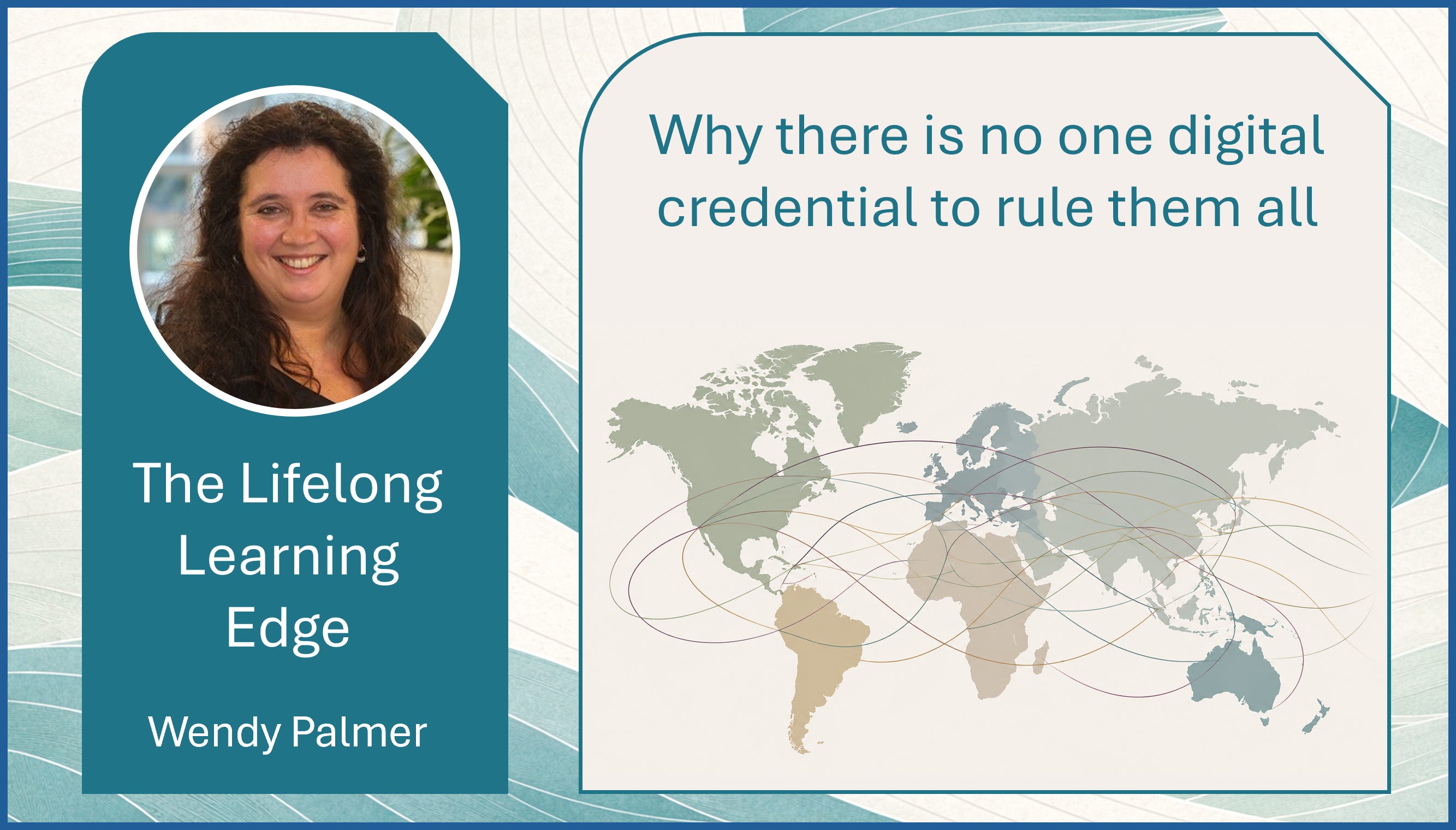
The short answer is very little in common, yet we still seem to search for universal education models, universal definitions of micro-credentials, and qualification systems that can be applied consistently across every context.
I think we’re asking the wrong question. Perhaps we don’t need one global model, but rather shared principles that allow many different models to emerge.
Most countries have their own currency. We haven’t solved international trade by insisting everyone uses the same dollar, yen or euro. Instead, we’ve built systems that allow different currencies to be exchanged, trusted and understood.
Rather than trying to make every qualification and credential look the same, perhaps our challenge is to build trusted ways for learning to be recognised, understood and valued across different systems.
One of the unexpected privileges of working internationally is seeing how different countries are responding to change. Over the past year I’ve been involved in conversations about digital badging strategies in Manila, stackability frameworks in Mauritius, recognition ecosystems in Colorado and across the US, and through my work with the World Alliance of Micro-credentials I’ve been following developments across Europe. Last year I had the opportunity to attend the Warsaw Micro-Credentials Summit, and the Canadian CredX, where many of these same themes were emerging in different ways.
At first glance, these conversations are different
Education systems – some are standardised nationally, others are state based
Policy settings – national, state based, regional or emerging.
Technologies – paper, excel spreadsheets, online registries or sophisticated badging platforms.
Priorities – equity, access, revenue, skills shortage, formal education, workforce planning.
Yet wherever I go, I keep hearing the same question.
How do we recognise what people know and can do in a world that is changing faster than our systems were designed for?
I don’t think that’s a coincidence, I think that regardless of our own context, we are all responding to a series of disruptions that are happening all at once.
Universities are asking whether qualifications designed for another era still serve learners who will need to reskill and upskill throughout their lives. We continue to debate the role of the degree, explore shorter and more flexible forms of learning, and rethink how learning can be recognised across a lifetime.
At the same time, employers are facing their own disruption. Skills are changing rapidly. New occupations are emerging while others evolve or disappear. Alongside technical expertise, employers increasingly talk about durable capabilities such as communication, critical thinking, creativity and problem solving. They want people who can adapt.
Yet these capabilities often remain invisible. Almost every university tells prospective students they will develop these skills. Very few transcripts actually show them.
Artificial intelligence can now write polished resumes and persuasive cover letters in seconds. Increasingly, AI is also screening those applications before a human ever sees them. The result is a strange cycle where technology is helping people present themselves while simultaneously making it harder to distinguish genuine capability from polished presentation.
Across education and employment, the questions are beginning to converge.
How do we know what someone can actually do?
How do we recognise it?
How do we trust it?
What fascinates me is that while the questions are becoming more aligned, the answers are becoming more diverse.
Some countries are investing in digital badges. Others are building system wide learner employment records, others are developing national registries or stackable learning pathways. Governance models differ. Technologies differ. Terminology differs.
The paths are diverging, yet the principles are converging.
That became particularly clear with some of the recent work I’ve been doing with the Commonwealth of Learning on national framewords. One of the strongest messages to emerge was that implementation should never be a blueprint that every country copies. Good frameworks create shared principles that can be adapted to local cultures, policy settings and education systems.
The more countries I work with, the less interested I become in finding best practice.
I’m much more interested in understanding why an approach works in its own context, and what principles it shares with others. Because wherever I go, those principles sound remarkably familiar.
Recognition should be trusted.
It should be portable.
It should support movement between learning and work.
It should make visible knowledge, skills and capabilities that traditional qualifications don’t always communicate.
Most importantly, it should create value for the person whose learning is being recognised.
That last point has become increasingly important to me.
We spend a great deal of time talking about metadata, interoperability, standards and technology. Those conversations matter because they make trusted recognition possible.
Verified digital credentials aren’t valuable because they’re digital. They’re valuable because they allow trusted information to travel. In a world where almost anyone can generate a convincing CV with AI, evidence that can be verified becomes increasingly important.
Yet even that isn’t enough. People also need the confidence to recognise their own capabilities.
I’ve written before about the importance of skills literacy, and I believe it is becoming as important as digital literacy and AI literacy (the term skills confidence is also starting to emerge). If someone has never been helped to recognise that they are an effective communicator, a creative problem solver or a collaborative leader, how can they confidently communicate those strengths to an employer?
Recognition isn’t only something our systems do, It’s something people learn.
Perhaps that’s why, despite the diversity of approaches, I leave these international conversations feeling optimistic.
We’re unlikely to arrive at one global model for recognition, nor should we. Context matters too much for that.
But if we continue to converge around shared principles while allowing countries and institutions to find their own paths, I think we’re building something much more valuable than a common framework.
We’re building a common purpose.
I’m looking forward to continuing these conversations through my FutureLearn courses:
I’m also speaking at MyeQuals Connect2026 in Brisbane on 25th August , and then joining colleagues from across the region at ePIC APAC in Melbourne on the 27-28th August as we explore how we can unlock human potential by recognising more of what people know and can do.
If these are questions you’re grappling with too, I’d love to continue the conversation and see you at one of the events.
Comments
Nothing yet. Say the first thing.
Sign in to join the conversation.