
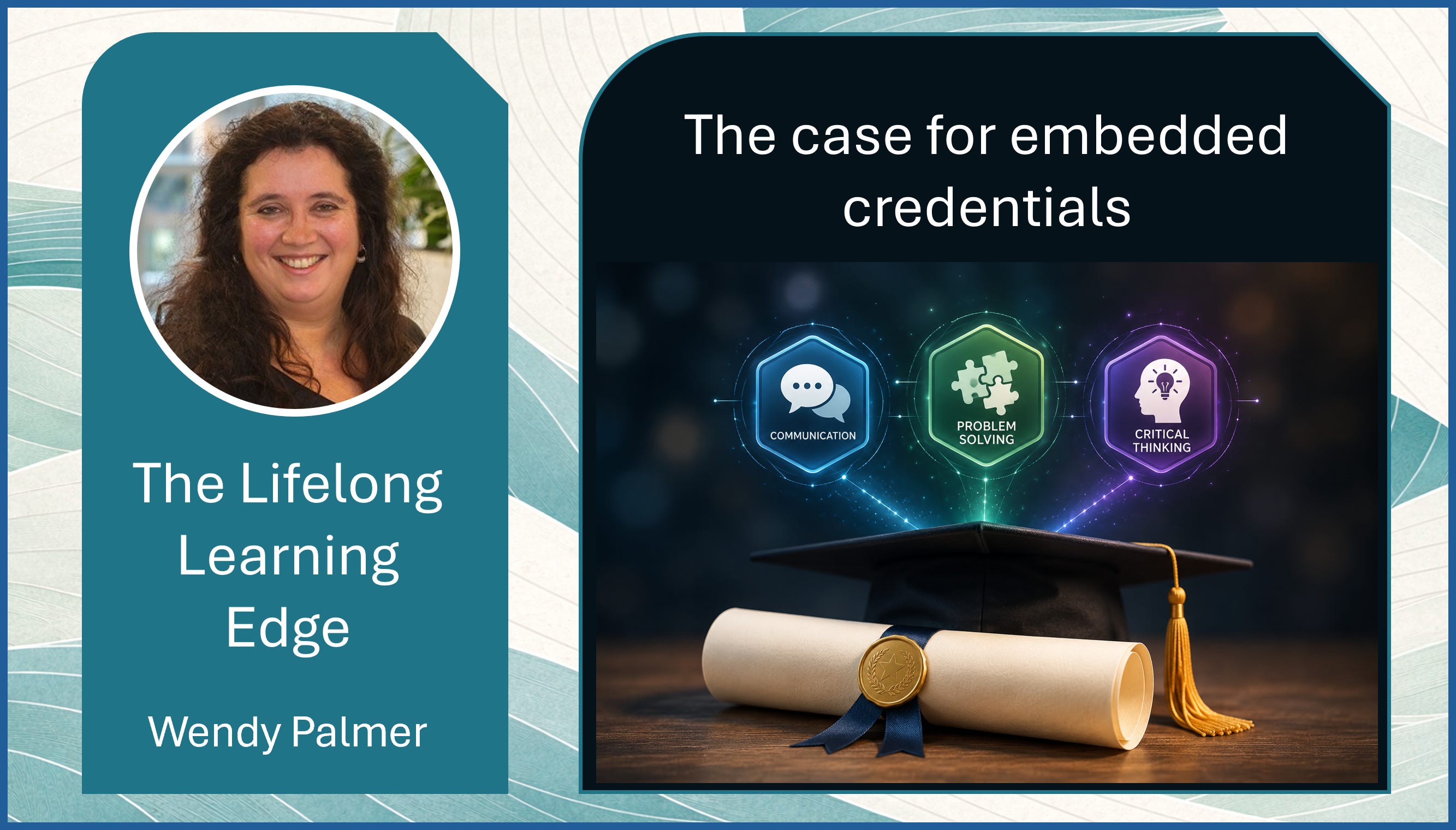
The global market for digital badges is booming.
According to market research by Fortune Business Insights, it was valued at more than USD 312 million in 2025 and is projected to grow to almost USD 1.2 billion by 2034. Organisations around the world are investing in platforms, technologies and digital credential ecosystems.
It would be easy to see this as another story about technology and infrastructure, platforms, standards and new ways of issuing, storing and sharing credentials. There is a rapidly growing market for digital credentials, but I think those conversation miss the purpose – recognition and evidence.
Years ago, before I found my way into the world of lifelong learning and digital credentials, I was studying a Bachelor of Science, but I wasn’t enjoying it and couldn’t see how it might connect to the rest of my life. I remember asking someone what the value was of a degree that didn’t lead directly to a profession like law leads to becoming a lawyer or accounting leads to becoming an accountant. Medicine has an obvious destination. But what about the degrees that don’t come with a clearly defined career path?
The answer that I got has shaped how I have approached education ever since.
“You learn to research. You learn to think. You learn to argue. Those are the skills you’ll use throughout your career.”
At the time, it seemed like a good reason to study something I was passionate about and I ended up completing a double major in Fine Art.
Even though, I’ve never worked in a job that asked for a Bachelor of Fine Arts, I still think it was one of the best decisions I ever made.
People sometimes assume studying fine art is just analysing paintings or sculptures. For me, it was something much broader. Art became a way of understanding people. It covered politics, religion, history, identity and culture. Art reflects society, and learning to interpret it meant learning to better understand the world around me.
But what I also realise now is that nobody ever explicitly pointed out the skills I was developing along the way.
Yes, I learnt a lot about art. But I was also learning to communicate ideas, to analyse, to question assumptions, to present an argument, to work with ambiguity, to accept critique and to think creatively. Those capabilities were embedded throughout my degree, developing alongside my disciplinary knowledge.
They were some of the most valuable things I learnt. Yet they remained largely invisible in the day to day learning experience.
That thought came back to me recently when I was reading a paper by Jobs and Skills Australia Deputy Commissioner, Megan Lilly, Skills, Mobility and Productivity: Why Australia needs a skills-frst tertiary education system. Rather than arguing that we should choose between qualifications and skills, the paper makes a much more interesting case. It suggests we need a tertiary education system that makes skills visible, portable and trusted while preserving the enduring value of qualifications.
For years we’ve tended to describe higher education in terms of subjects studied, credit points completed and qualifications awarded. Yet employers are often trying to understand something quite different. They want to know how someone solves problems, communicates, collaborates, adapts and exercises judgement.
The degree often contains those answers, we just don’t make them visible.
This is where I think embedded credentials have enormous potential. Not as another thing for students to complete and definitely not tokenistic digital stickers collected along the way.
But as meaningful recognition of capabilities that are already being developed through learning.
Imagine if, alongside studying engineering, nursing, history or fine art, students were supported to also intentionally develop an understanding of the durable skills they were building. Imagine if they regularly reflected on those skills and collected evidence of them. While talking about them with their teachers and peers, they learnt how to explain them to employers. And when they graduate not only do they have a qualification but also the confidence to clearly articulate what they can do and can contribute.
It is not simply knowing that communication or critical thinking are important. It is recognising those capabilities in yourself, understanding how you developed them, gathering evidence that demonstrates them and being able to describe them with confidence.
Perhaps even more importantly, it builds skills confidence. I’ve met countless graduates who are highly capable but struggle to answer one simple interview question.
“Tell me about yourself and what you are good at?.”
Not because they lack skills, but because nobody has ever helped them recognise them in a useful way. This is why I find the growing conversation around embedded micro-credentials so exciting.
Used thoughtfully, they don’t replace degrees, they enrich them. They shine a light on the learning that has always been there but has often remained hidden. They provide trusted evidence of capabilities that are developed across subjects, projects, placements and real-world experiences. They help learners make connections between what they are studying and who they are becoming.
As I think back to that conversation all those years ago, I realise the advice I was given was absolutely right. A university education wasn’t just teaching me science, or later art. It was teaching me how to research, question, communicate, analyse and see the world through different lenses and develop curiosity and a passion for learning. Those are the skills and capabilities I have carried into every role that followed.
The difference is that I had to discover them for myself. What if today’s students didn’t have to? What if, throughout their degree, they were encouraged to recognise those skills, gather evidence of them and build the confidence to talk about them long before they graduated?
The market for digital badges may well grow to more than a billion dollars over the next decade. Universities, employers and governments will continue to invest in platforms, standards and credentialing technologies, and they should. Those foundations matter.
But the greatest value won’t come from just issuing more badges.
It will come from doing the work to help more people recognise the skills they have developed, understand how those skills transfer into new contexts and have the confidence to tell that story. The badges need to be useful to the person who earned them .
If embedded credentials can help a graduate leave university knowing not only what they studied, but also what durable skills they have developed, then we’ve done much more than issue another digital badge. We’ve made learning visible.
If these ideas resonate with you, I’d love to continue the conversation.
At ePIC APAC: Unlocking Human Potential, educators, employers, policymakers and technology providers will come together to explore how we can build recognition ecosystems where all learning counts. We’ll be discussing the future of skills, qualifications, digital credentials and lifelong learning, with a strong focus on making learning more visible, portable and meaningful. Join us for this 1.5 day event at end of August in Melbourne. Find out more and register, tickets still available.
If you’re working in higher education, you might also enjoy my FutureLearn course, Lifelong Learning: Developing Transferable Skills in Higher Education. Together we’ll explore practical ways to help students recognise, articulate and evidence the capabilities they develop through their studies, building both skills literacy and skills confidence.
I’d love to see you in the course or at ePIC APAC, and to hear how you’re approaching these challenges in your own context.
Comments
Nothing yet. Say the first thing.
Sign in to join the conversation.