
On the eastern British and Canadian flanks, the tactical problem wasn’t cliffs—it was urban density, minefields, and heavy concrete obstacles. The British answered this with the 79th Armoured Division: Major General Percy Hobart’s “Funnies.”
These were specialised engineering vehicles designed to solve specific tactical puzzles at the water’s edge. The largest division of the war, they never fought together as a single tactical formation. Instead, they were “plug and play” with other frontline units.
Under the vast umbrella of Hobart’s specialised armour, the Churchill AVRE (Armoured Vehicle Royal Engineers) stood ready with its 290 mm petard mortar to fire forty-pound “flying dustbins” and shatter concrete fortifications. Beside it stood the Sherman Crab, utilising rotating chain flails to clear minefields on the fly. This was the bloodiest lesson from the failed 1942 raid at Dieppe—a lesson that the British, far more than the Americans, truly bought into: you need specialised armour to crack a fortified wall.
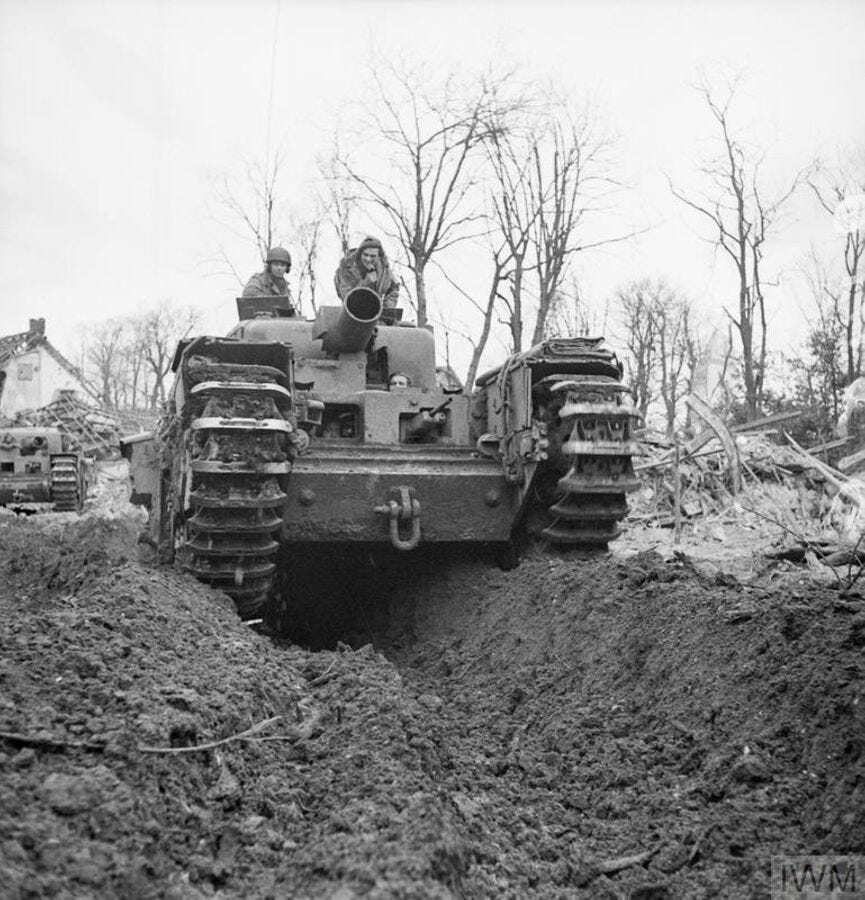
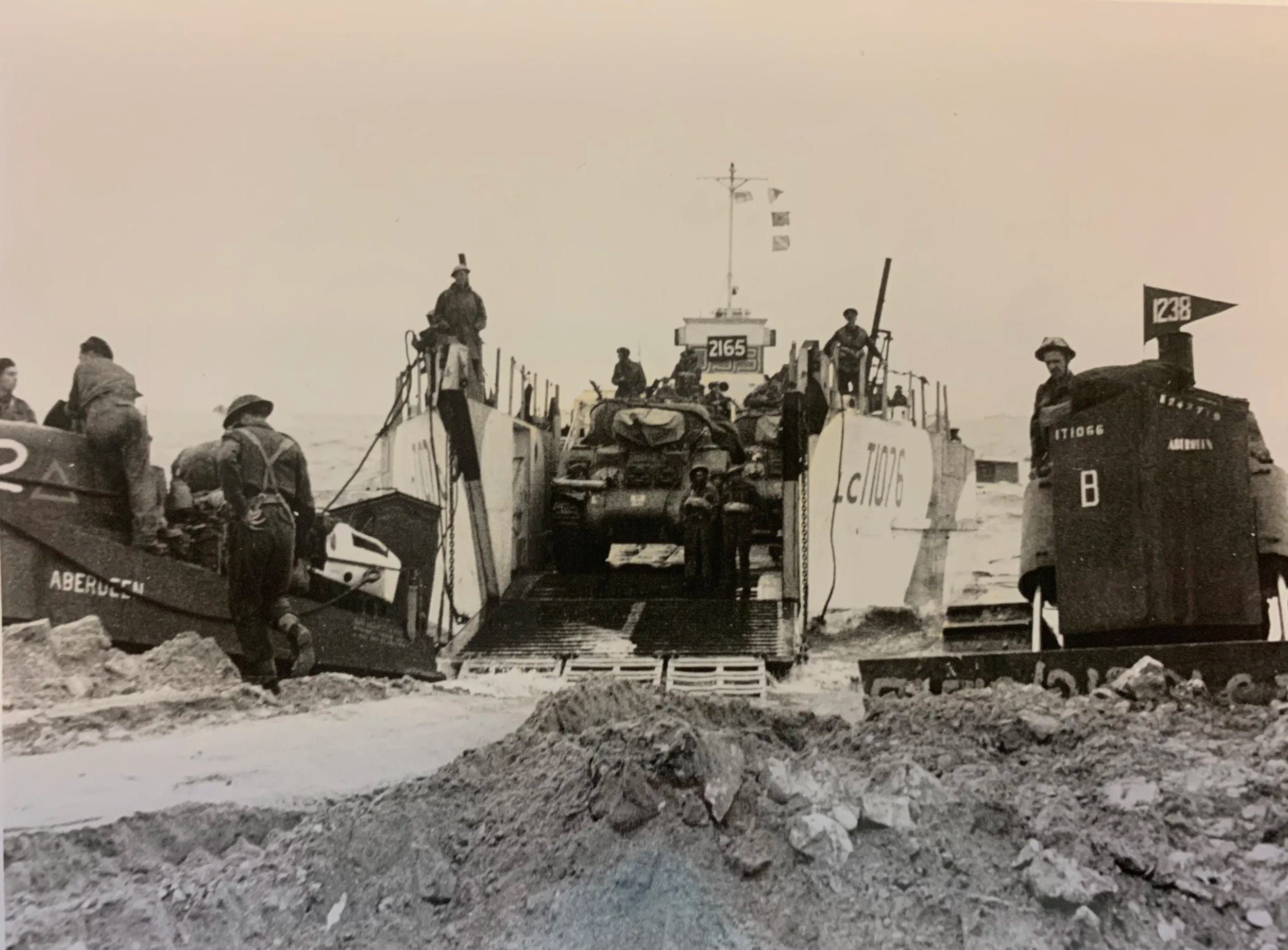
The British 231st Infantry Brigade—the Hampshires and Dorsets—was swept east into Jig Sector, landing at a 45-degree angle. They hit the beach completely separated from their armour. B Squadron of the Sherwood Rangers Yeomanry (SRY) landed exactly where it was supposed to, but found itself sitting without infantry support, a nightmare for the tankies.
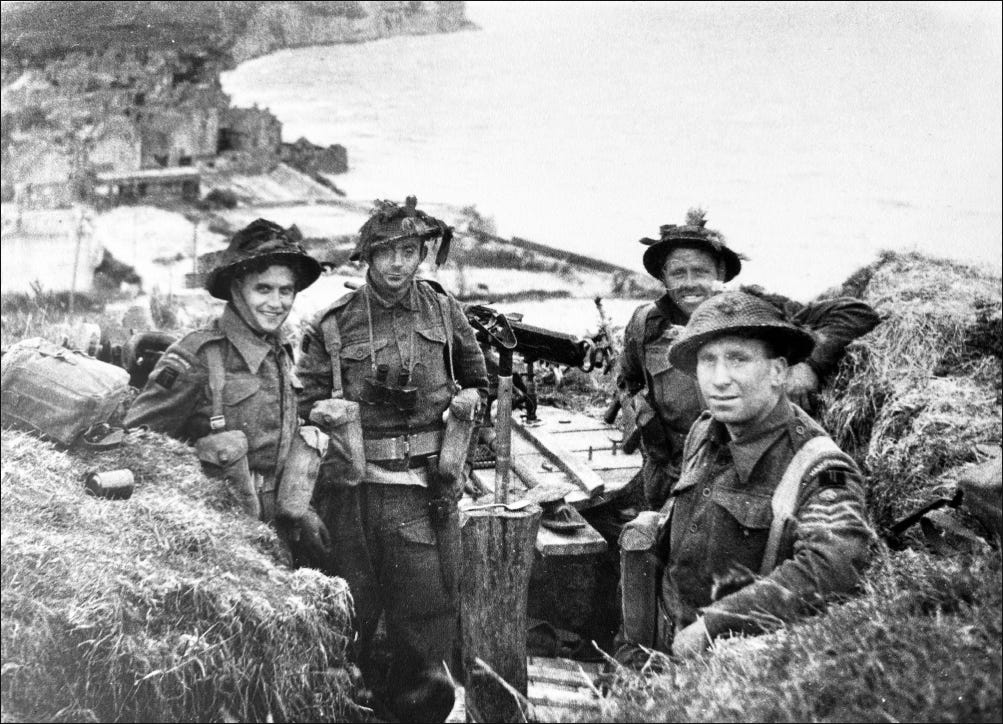
The primary obstacle was Widerstandsnest 37 at Asnelles—a heavily fortified sanatorium and bunker complex housing a French-made 75mm anti-tank gun that fired down the lateral beach road. Any DD tank that stopped to drop its canvas flotation skirt was caught broadside. A line of 6 Churchill AVREs and ammunition carriers was quickly reduced to burning scrap on the sand.
Sergeant Bob Palmer of the Essex Yeomanry broke the logjam. After a quick on-foot recce, he drove his Ordnance QF 25-pounder Sexton self-propelled gun at full speed, bypassed the burning vehicles, flew up the road, and turned to face the German bunker within 300 yards. Firing over open sights, his first round hit the lip of the concrete aperture; his second went straight through the teeth of the embrasure, vaporising the gun crew.
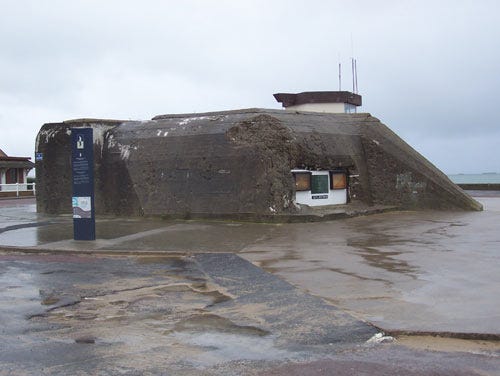
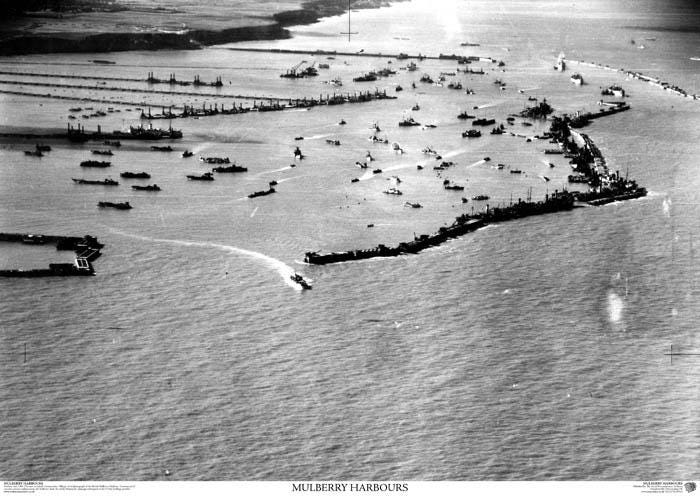
By 11:00, Gold Beach was an open highway into the Norman countryside. The rapid reduction of the beachhead allowed British engineers to begin surveying Arromanches immediately for the ultimate logistical feat of the campaign: Mulberry B.
An army crawls on its stomach, but an industrialised army runs on fuel and mechanical Stuff. To bypass the heavily defended or small French ports, the British engineered massive, artificial floating harbours. Mulberry B required towing 600,000 tons of concrete structures—including gigantic Phoenix caissons and Whale floating roadways—across the choppy Channel to form an improvised port capable of landing 7,000 tons of vehicles and stores daily.
Really, these were floating bits of concrete made in the UK, briefly tested, trained, and towed into position. This was obviously a world first and, as such, will encounter problems we will see later.
Coupled with this was Operation PLUTO (Pipe-Line Under The Ocean)—a series of flexible, high-pressure undersea oil pipelines laid across the bed of the English Channel from the Isle of Wight straight to the French coast. Without this continuous fuel artery pumping millions of gallons of aviation fuel and motor gasoline directly to the beachheads, the Allied spearheads would have run completely dry within a week of hitting the sand. That could not happen.
Before the first Canadian volunteer ever hit the Juno sand, the Royal Navy had already slipped a silent vanguard under the muzzle of the Atlantic Wall. This was Operation Gambit.
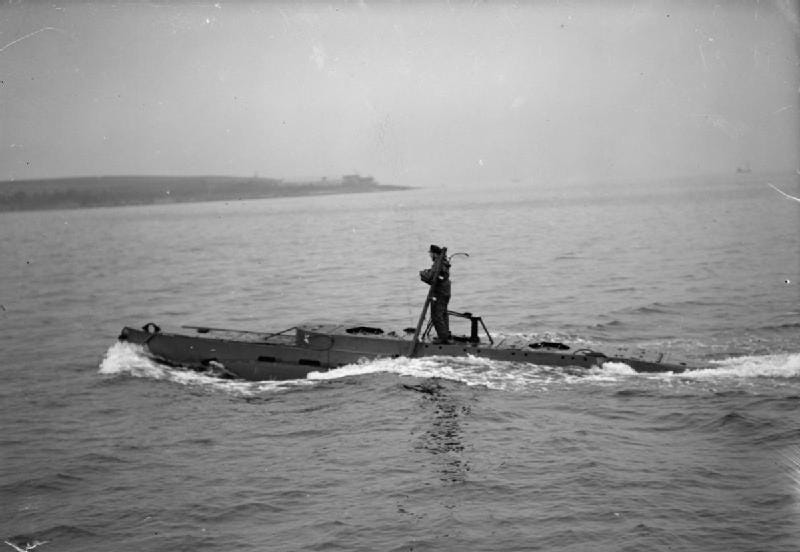
While the Americans rejected the concept for fear of premature discovery, the British embraced the audacity of it. On June 2, two five-man midget submarines—X-20 and X-23—slipped across the Channel. Their mission: act as invisible navigational markers to guide the Anglo-Canadian armada through the treacherous offshore shoals.
For two days, these cramped metal tubes sat on the seabed, just yards from the enemy shoreline. The crews endured foul air, freezing condensation, and absolute silence while German patrols rumbled overhead.
At 04:00 on June 6, the X-craft blew their tanks. Surfacing into the dark swell, they raised their masts and flashed green lights toward the horizon.
Lieutenant George Honour, commanding X-23, watched the dark silhouettes of the incoming flotilla emerge from the mist:
“They were steadily coming towards us... Although we knew they were on our side, it was a very frightening sight. One can only imagine that in the observation posts all along the coast, the Germans saw this. They must have been very surprised, and I should think very frightened.”
Guiding the ships was only half the battle. The Channel was a lethal maze of acoustic and magnetic mines. To carve a path, the Allies deployed 300 minesweepers—270 of them British or Canadian.
Working in the pitch black under the shadow of heavy coastal guns, the sweepers cut the cables and cleared a narrow highway through the waves. The transports got through. The logistical foundation was laid.
The swollen Canadian 3rd Infantry Division (18500 men strong), supported by the 2nd Canadian Armoured Brigade, hit Juno Beach at 07:45. In terms of raw firepower, the Germans had stacked more artillery here than at Omaha—including 50mm and 88mm guns covering a brutal 15-foot concrete seawall.
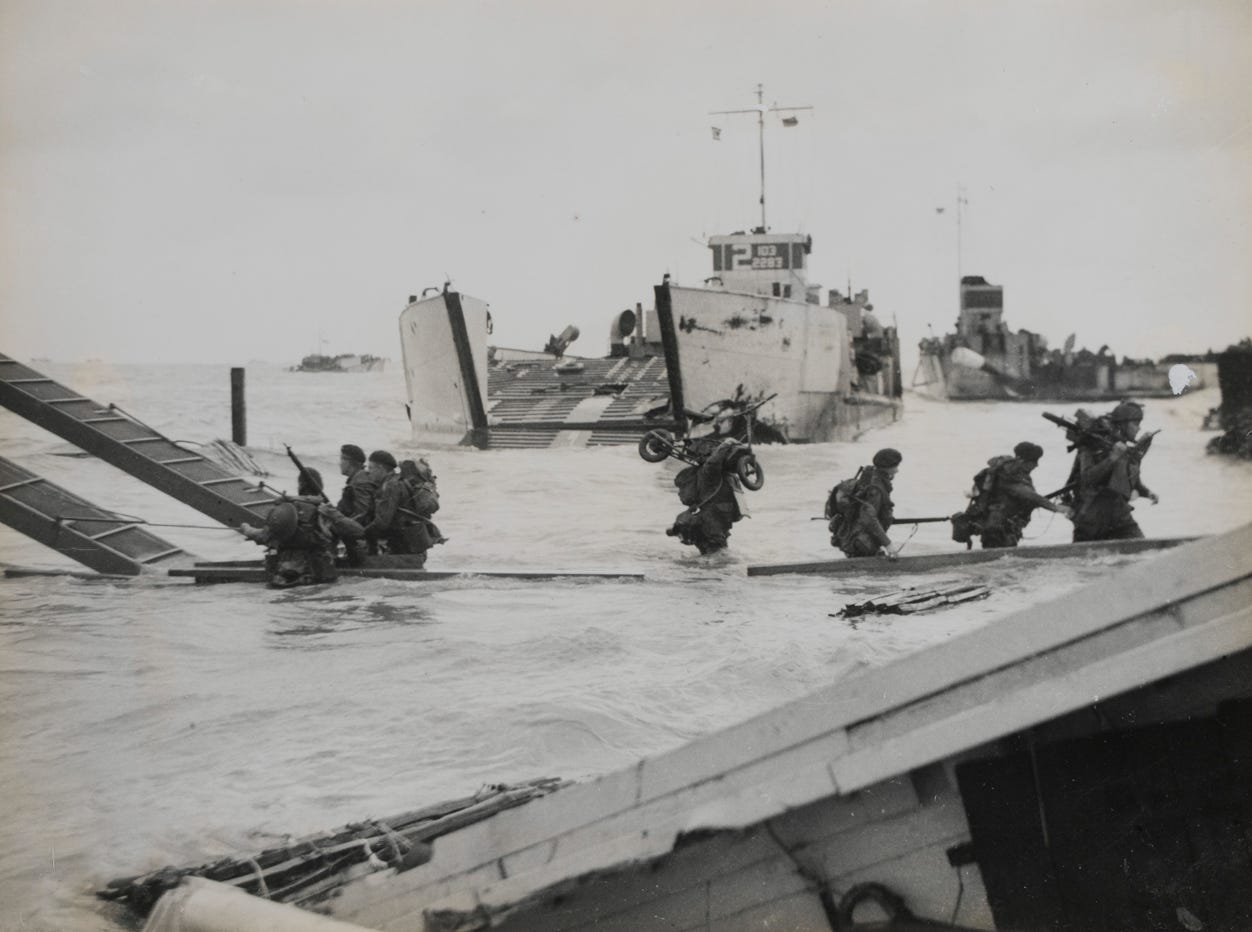
At Saint-Aubin-sur-Mer, the roads leading off the beachfront were too narrow for conventional deployment. The Canadians avoided an Omaha-style slaughter through the aggressive handling of their swimming armour. The Duplex Drive Shermans of the 1st Hussars and the Fort Garry Horse were launched close to shore, riding out the heavy swell to land directly alongside the infantry waves and blast holes through the imposing Atlantic Wall.
Right into this breach stepped the elite shock troops of 48 Royal Marine Commando. Landing on the lethal eastern flank, their landing craft were shredded by hidden obstacles and mortar fire. The Marines leapt into waist-deep water under a hail of lead, losing nearly half their strength before crossing the sand. Reorganising on the fly alongside the Canadian armour, 48 Commando stormed the heavily fortified German strongpoint at Widerstandsnest 28 and began a brutal house-to-house clearing operation to secure the flank.
With the seawalls breached, the Canadians had to clear the coastal towns house-to-house, discovering that the Germans had reinforced the cellars and linked them with subterranean tunnels.
Rifleman Bob Roberts, a 5-foot-2 Bren gunner with the 7th Infantry Brigade, moved through a beachfront home with his partner, Lacroix, a French speaker. Alerted by a local family to a hidden cellar hatch, they went down into the dark and realised the tunnel led directly behind a German machine-gun bunker firing at the beach. Roberts kneecapped the crew from behind with his Bren, and Lacroix finished the position with a portable flamethrower. Ouch!
The Canadians took heavy casualties on the wire, but as an all-volunteer outfit, as usual, they punched far above their weight. By midday, they had famously driven deeper inland than any other Allied unit on June 6.
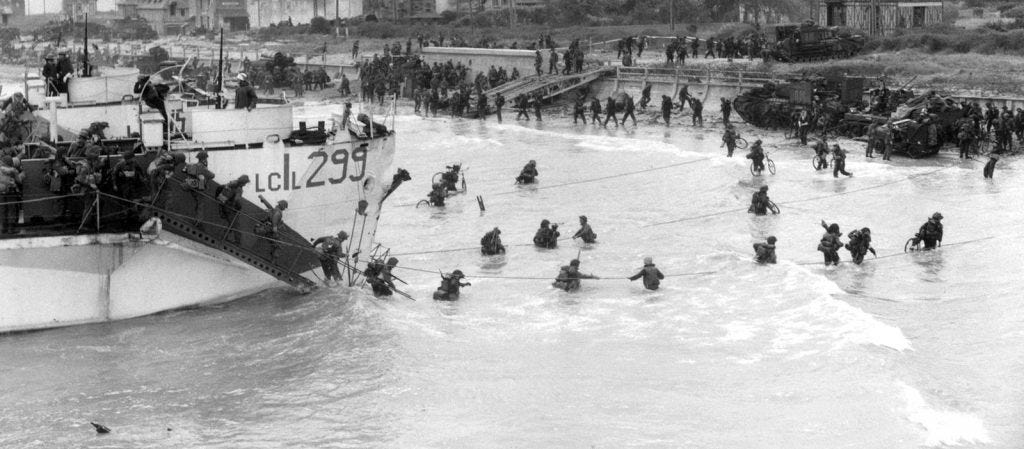
Sword Beach was the easternmost anchor of the invasion, and a geographic choke point. Because of dangerous offshore shoals, the British 3rd Infantry Division could land only a single brigade of 3,000 men—the 8th—in the initial assault wave.
Lord Lovat’s 1st Special Service Brigade landed in the second wave, smashing straight into a treacherous crossfire. Standing waist-deep in the surf, Piper Bill Millin hesitated. The War Office had strictly banned bagpipers from the front lines to prevent pointless casualties. Lovat dismissed the bureaucrats completely:
“Ah, but that’s the English War Office, Bill. You and I are both Scottish, so that doesn’t apply to us.”
With that, Millin marched through the blood-streaked water in his kilt, piping “Highland Laddie” over the roar of the explosions to rally the Commandos. It was a razor-thin line between suicidal bravado and ancient proven genius.
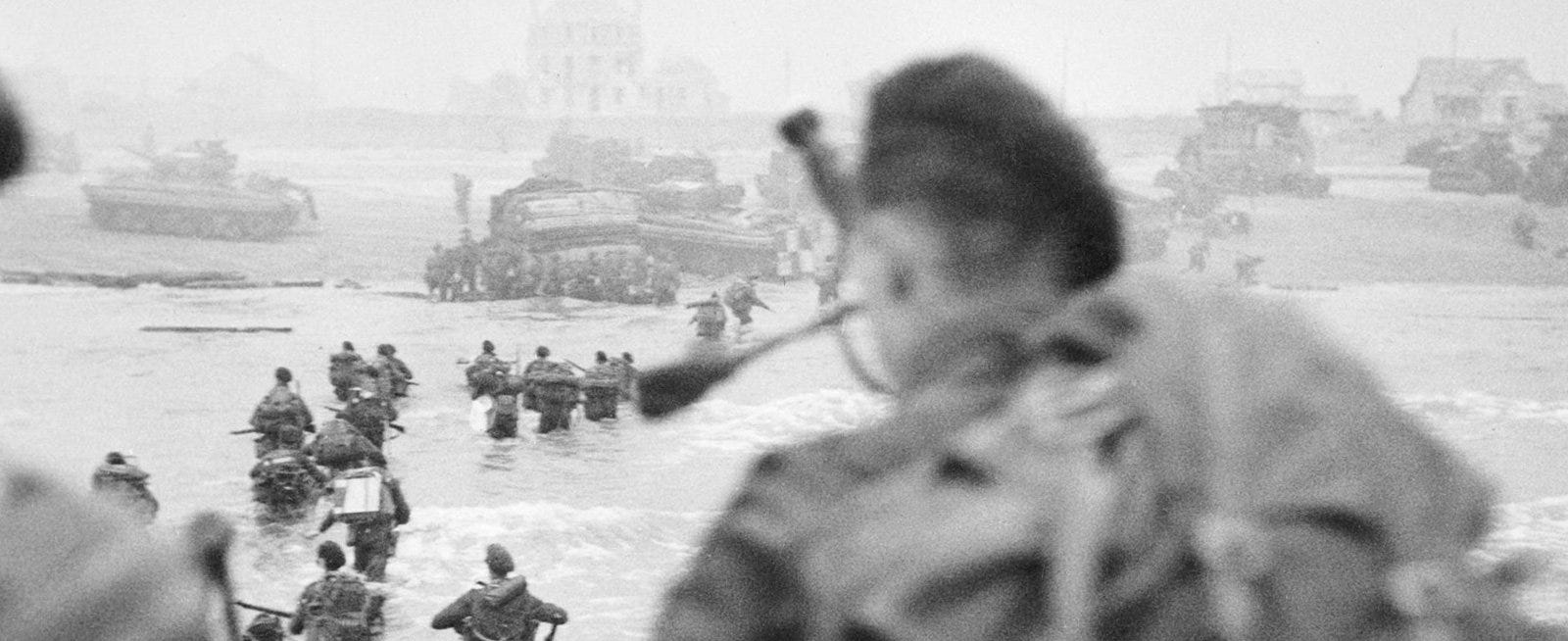
While Lovat’s main force sprinted for the inland bridges to relieve the airborne, the bloody, room-by-room clearing of the coast fell to No. 4 Commando. Leading the vanguard were 177 Free French Commandos under Commander Philippe Kieffer—men fighting with the fury of exile to liberate their own soil.
Their immediate obstacle was Riva-Bella: a heavily fortified concrete strongpoint built over the ruins of a former luxury casino. The concrete bunkers resisted everything the commandos threw at them. The deadlock broke only when a bleeding Kieffer rushed back to the beach, commandeered a Sherman tank from the Hussars, and guided it through the rubble. At point-blank range, the tank punched high-explosive shells through the casino windows.
With the casino cleared, the Commandos swarmed inland to link up with John Howard’s airborne troops at Pegasus Bridge precisely on schedule.
But the wider advance for Caen ground to a sudden, violent halt. The British ran straight into “Hillman”—a massive subterranean command bunker complex situated on a slight but dominating ridge blocking the road. More critically, the Allies faced the nightmare they had feared: a coordinated German armoured counterattack.
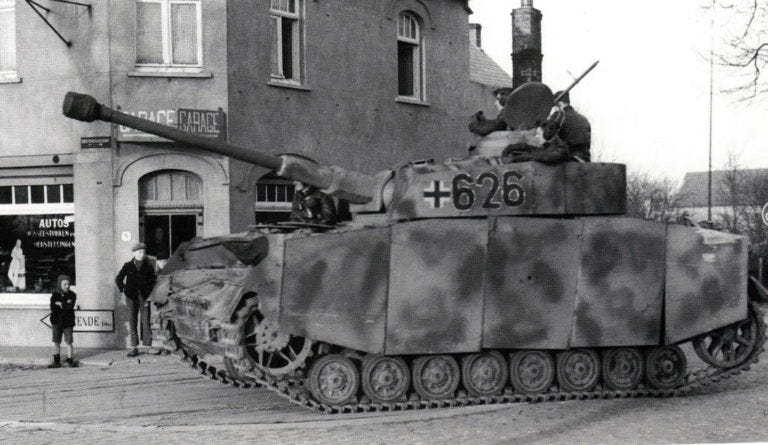
At 16:00, Major General Edgar Feuchtinger finally organised the 21st Panzer Division for a massive thrust against the beachhead. Led by the aggressive Oberst Hermann von Oppeln-Bronikowski, a column of ninety Panzer IV tanks and mechanised grenadiers exploited a three-mile-wide gap between Juno and Sword beaches.
Oppeln-Bronikowski’s panzers tore through the thin British infantry screen, driving straight over the ridgelines. A company of six Panzer IVs actually managed to pierce all the way to the coast at Lion-sur-Mer, looking out over the English Channel.
The threat on the surface was terminal; if the 21st Panzer could dig in on the coast, they would split the Commonwealth landing zones in two.
But the German triumph was short-lived. The armoured wedge lacked the weight necessary to sever the landing beaches, and it possessed absolutely no shield against the monstrous naval shells being accurately directed onto its flanks. It was a valiant, briefly successful sprint doomed by contingency and the weight of Allied firepower.
Just as the panzers reached the coast, the sky filled with the roar of hundreds of British gliders bringing in the 6th Airborne Division’s reinforcements. Terrified of a massive vertical envelopment cutting them off from behind, and pinned under relentless fire from British Sherman Fireflies and offshore naval guns, Oppeln-Bronikowski had no choice but to order a fighting retreat back toward Caen, having lost 70 of their 124 tanks. The armoured wedge was blunted, but it did have some effect: the British advance to Caen, a day 1 objective, was frozen; it would take time to reorganise and get back on the attack, allowing further German reinforcement of Caen.
When pop culture thinks of a D-Day “Band of Brothers,” it usually conjures images of American paratroopers wafting down into the dark. But Hollywood’s obsession with airborne outfits obscures an unglamorous reality: outfits like Easy Company or the British equivalent were by necessity only in active combat for a fraction of the campaign. If you want to see the real, unrelenting brutality of the war, you look at the Sherwood Rangers Yeomanry (SRY).
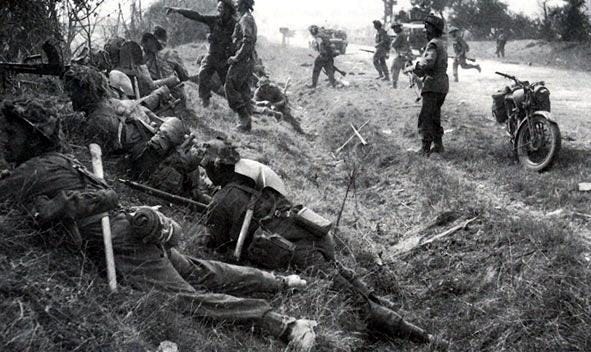
The SRY went from the blood and oil-slicked sand of Gold Beach straight into the claustrophobic trap of the Normandy bocage—ancient stone villages connected by steep-sided sunken paths and a maze of small fields surrounded by impenetrable hedgerows. As an independent armoured regiment under the 8th Armoured Brigade, their job wasn’t to look for a clean breakthrough; they were the immediate, heavy muscle permanently welded to the 50th (Northumbrian) Infantry Division. Because the infantry needed to grind through the German strength before a breakout was possible, the SRY was always in the line.
The operational plan for June 6 was simple. Hit the sand. Punch through. Advance. Seize Bayeux—the historic, vital road hub—before the enemy could patch together a coherent defensive line.
Major Stanley Christopherson, commanding A Squadron of the SRY, executed the breakthrough doctrine flawlessly. His Sherman tanks bypassed the brutal, ongoing infantry slugfest at the Meuvaines Ridge, ignoring isolated concrete pillboxes of the German 716th Static Infantry Division, and rattled right to the northern outskirts of Bayeux by early evening. His scouts sent back the word: the German garrison had completely pulled out. The streets were quiet. Bayeux was wide open for the taking.
But inside Christopherson’s command tank, the mood wasn’t triumphant. It was haunted.
The regiment was already counting its missing. Out in the choppy expanse of the English Channel, young Lieutenant Stuart Hills and his four-man crew from C Squadron had watched their DD swimming tank founder and sink beneath the six-foot waves. Miraculously, every single man had scrambled out of the hatches before she went under. Right at that moment, they were stranded back on the chaos of the beachhead—alive, soaking wet, smoking borrowed cigarettes, and waiting for replacement hulls. They were one of the lucky ones.
Others hadn’t even made the sand. Sergeant Bill Digby, a rugged desert veteran and second-in-command of B Squadron, had survived the water, only to be torn apart by mortar splinters on the shale of Gold Beach. Word was filtering through the radio nets: Digby had just succumbed to his wounds. The Sherwood Rangers were inland, but the bill was already being paid.
Then came the systemic friction that choked their momentum.
A severe flaw in the British command structure paralysed the advance. Under the independent brigade system, tank commanders were permanently outranked by the infantry they supported. Down in the dirt, Christopherson—a Sabre Squadron Major—was at the mercy of the infantry battalion holding his leash, commanded by a Lieutenant Colonel.
The infantry commander looked out at the darkening Norman houses and refused to risk an evening push into an unreconnoitered urban maze. He overruled Christopherson’s tactical advice to move quickly. He ordered a halt, dug his infantry into defensive positions for the night, and forced the Shermans to leaguer up. His men understandably were tired, and they felt they had done their part, but still, a big prize was left dangling in the dark.
The SRY finally entered Bayeux the following morning, June 7 (D+1), taking the city with only sporadic skirmishing against retreating German rearguards.
The transition from the blood-slicked chaos of the coast to the medieval interior of France was jarringly surreal. As Christopherson’s Shermans rumbled through the untouched historic centre, a bright red French fire engine hurtled past them down the main street. Its brass bell clanged furiously to attend a localised fire. Five miles behind them, the beaches were still choked with burning landing craft and dead men like Bill Digby. Right in front of them, French municipal civil life carried on as if the greatest invasion in human history was nothing more than a local traffic disruption.
Bayeux was captured mostly intact, but the twelve-hour delay had given the retreating Germans exactly what they needed: time to dig deep into the brutal, ancient hedgerows just south of the city. The mobile phase of the invasion ended right there, and the butcher’s bill was about to skyrocket.
While the Allied airborne and amphibious machine operated with brutal flexibility, the German high command spent June 6 in a state of administrative paralysis that bordered on comedy. The German defence structure was built on Hitler’s deliberate policy of institutional chaos—overlapping authorities, competing commands, and absolute centralisation of structural decisions in his own hands.
Field Marshal Erwin Rommel was not even in France. Believing the storm in the Channel precluded any landing, he had travelled to his home in Ulm, Germany, to celebrate his wife’s birthday and present her with a pair of shoes he bought in Paris.
At his conveniently splendid headquarters in La Roche-Guyon, his Chief of Staff, General Wilhelm Speidel, had spent the night of June 5 drinking brandy with the philosopher Ernst Jünger. At 06:15, with thousands of Allied ships visible from the cliffs, a hungover Speidel received and dismissed the reports, stating that this could not possibly be the main invasion.
Further north, General Hans von Salmuth, commander of the 15th Army, received word of the heavy naval bombardment hitting the coast. Convinced Normandy was just a minor diversion before the “real” invasion hit his own sector at the Pas-de-Calais, he told his staff the Allied landings had already failed and went right back to bed.
The ultimate paralysis occurred within the crucial armoured reserves. The premier counterattack units—the 21st Panzer, the 12th SS Hitlerjugend, and the powerhouse Panzer-Lehr-Division—were held under the direct control of the Oberkommando der Wehrmacht (OKW). They could not move without Hitler’s personal signature.
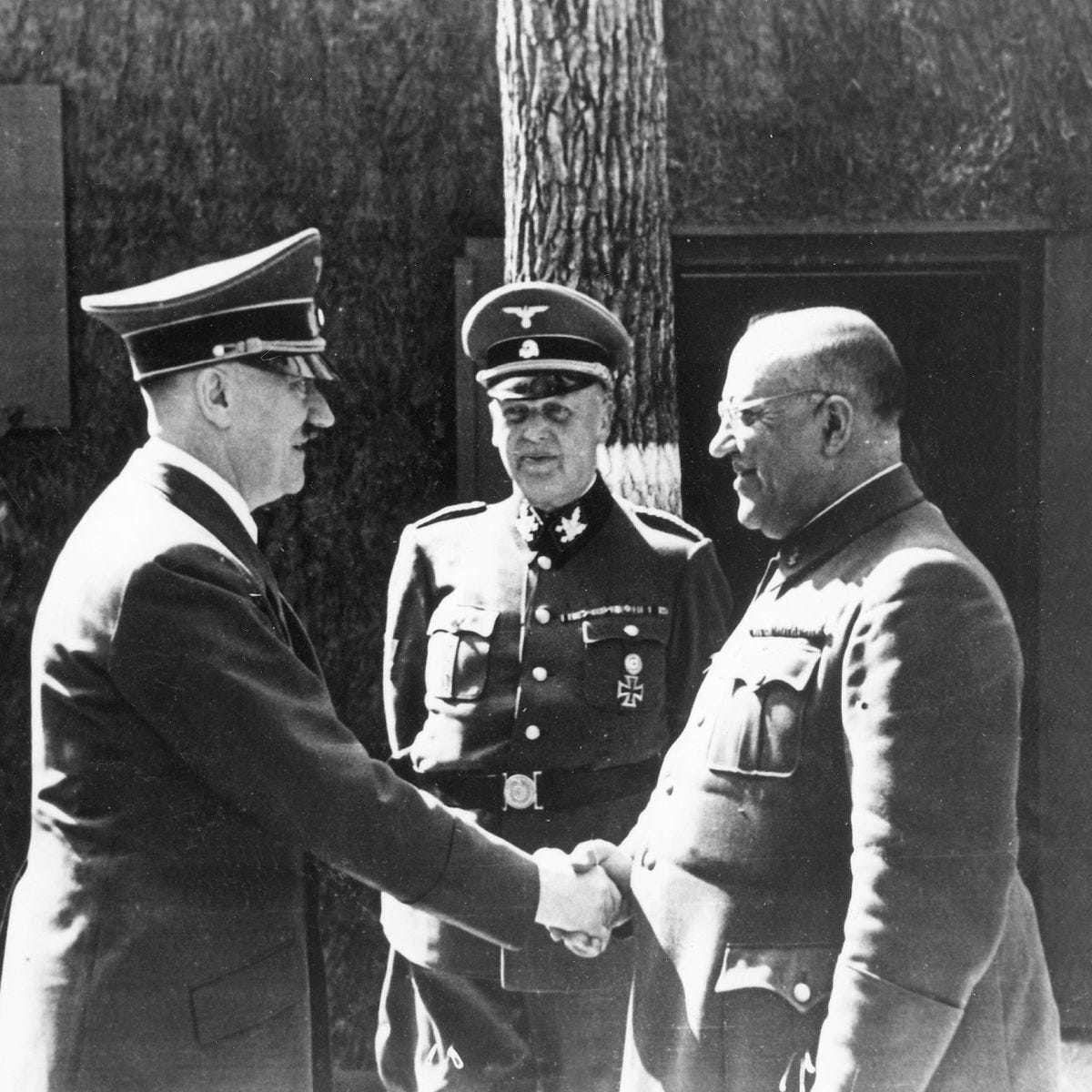
The Führer was dead to the world at the Berghof in Berchtesgaden. He had crashed into a deep, drug-induced sleep after a heavy dose of sedatives and barbiturates, courtesy of his personal physician, Dr Theodor Morell—the “Reich Master of Injections” who kept Hitler operating on a toxic cocktail of amphetamines by day and downers by night. His staff, well aware of his explosive rages, was too terrified to wake him.
It was 14:30—twelve hours after the paratroopers of the British 6th Airborne seized Pegasus Bridge—when the high command finally loosened the leash.
The 12th SS Panzer Division Hitlerjugend and the elite Panzer Lehr were finally granted permission to move toward the beaches. But before they could even enter combat, structural disaster struck. The French Resistance had done its work too well. Sabotaged rail networks, severed communication lines, and blown fuel cars in the rear left the 12th SS hit by severe, crippling fuel shortages.
Worse befell the Panzer Lehr. As their columns of armour and soft-skinned fuel trucks snaked onto the open roads heading toward Caen, RAF Typhoons and American P-47 Thunderbolts swarmed them. Rocket-firing Tiffies tore into the lines, blowing off tank tracks and detonating fuel trucks. Before they even traded shots with an Allied tank, the Panzer Lehr lost over 130 supply trucks, fuel tankers, and prime movers—nearly 30% of their total transport was wiped out in a single afternoon.
The Germans bitterly dubbed the route the Jabo Rennstrecke—the fighter-bomber racecourse. The grand counteroffensive had evaporated into a flaming logistical wreck before the divisions ever caught a glimpse of the English Channel.
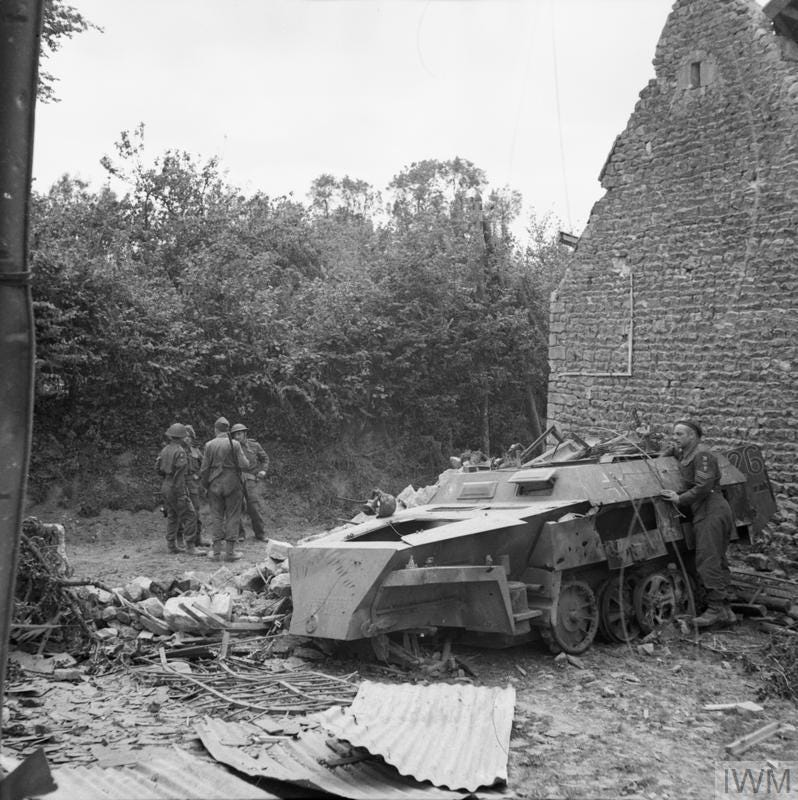
By midnight on June 6, the Atlantic Wall was dead.
The German crust had not just been cracked; it had been pulverised by naval gunnery, engineered out of existence by specialised armour, and bypassed by airborne vertical envelopment. The cost had been high, but within the cold calculations of supreme command, it was manageable—over 10,000 Allied casualties, with nearly 4,000 dead on the beaches and in the marshes.
Still, 156,000 Allied troops were ashore. The machinery of an industrial powerhouse was firmly anchored in French soil. Hitler’s chaotic, divided command had slept through the crisis, leaving its understrength coastal divisions to be chewed up by an industrial war machine.
The long, bloody battle for the hedgerows had begun. Join us next time for the continued battle; we are only just getting started, and it’s Part 4 already!
Many thanks for reading; I would be delighted to know your thoughts!
Ru
No posts
Comments
Nothing yet. Say the first thing.
Sign in to join the conversation.