
The adrenaline of D-Day is gone. The surf is behind us. By the morning of June 7, 1944, the Allied high command looked inland and realised they had traded the Transparent Atlantic Wall for a Claustrophobic Green Hell.
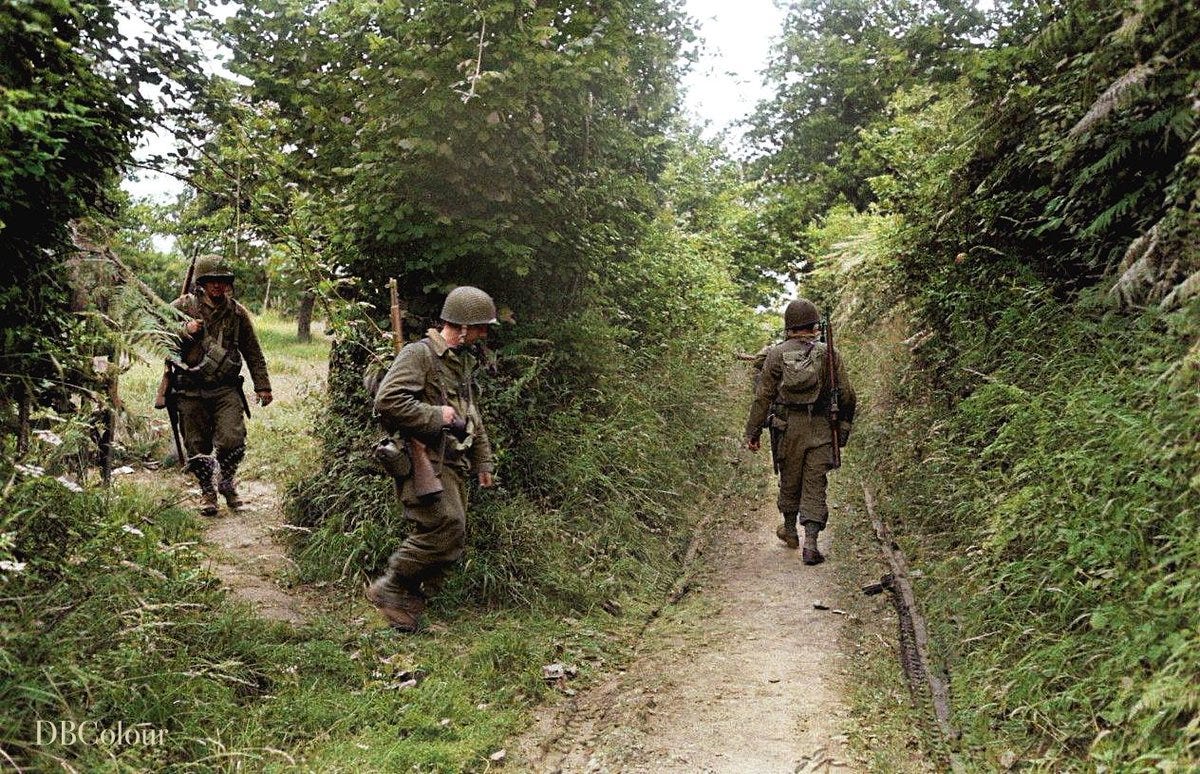
Let’s get one thing straight: the Norman bocage was not a collection of pretty English garden hedges. This was a thousand-year-old tactical labyrinth born out of farming necessity.
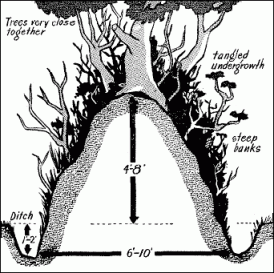
We are talking about ancient earthen walls—five to ten feet thick—reinforced by the intertwined root systems of hawthorn, oak, and ash. Over centuries, local farmers had cleared stones, dirt, and muck from their fields, piling them at their plentiful boundaries to create natural fences. Because the ground in Normandy is naturally soft, centuries of heavy cart traffic and rain eroded the dirt paths connecting the fields and towns, causing them to sink ever deeper into the earth. As a result, the roads between these fields weren’t roads at all; they were narrow, sunken lanes boxed in by impenetrable dirt walls.
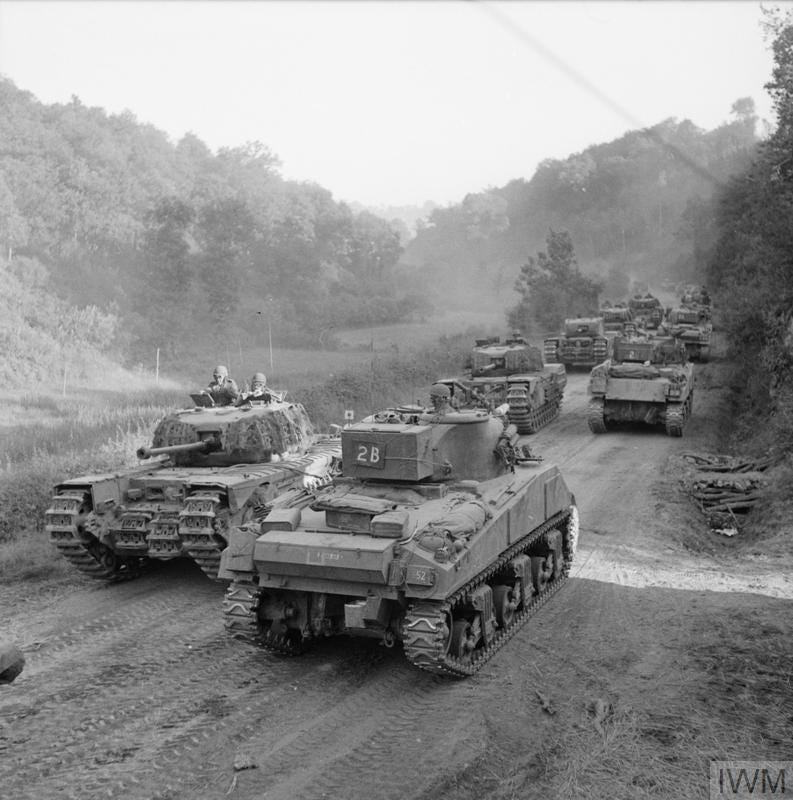
For a modern army built on mechanised speed and mobility, the bocage was a horror show.
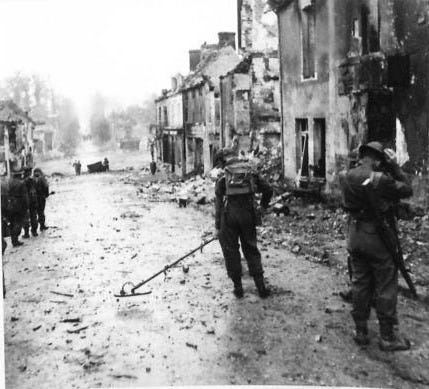
Just imagine you are a squad of Allied infantry. Your objective is an ancient Norman farmhouse just a few hundred yards away. Your corporal is fairly certain it is occupied. Looking ahead, the bocage gives you exactly two choices—and both of them feel like suicide.
Option one: advance down the sunken road. You get dirt cover on both sides, but your visibility drops to zero, and you have absolutely no room to manoeuvre. Option two: advance across a wide, open field and pray there is an uncovered exit on the far side.
Talk about a rock and a hard place.
Your corporal chooses the field. He doesn’t fancy being a fish in a barrel down in the lane. Your squad spreads out, advancing slowly but with purpose through the knee-high grass. Every muscle in your body is clenched. At any second, you expect the world around you to erupt into violence.
But it doesn’t. Not yet.
You are the point man, scouting twenty meters ahead of the main line. Just as you reach the far edge of the field, near a rusted iron gate to your right, you hear it. A sharp, metallic click. The unmistakable sound of a German machine gun being primed.
Instinct takes over. You drop flat into the dirt just as the demonic shriek of an MG42 rattles through your brain. At 1,200 rounds per minute, the gun doesn’t sound like shots—it sounds like tearing canvas. You can feel the very air shaking in terror as a stream of lead rips inches above your helmet and ploughs straight into the rest of your surprised squad.
You need to do something. Their lives depend on it.
In the sudden carnage, the German MG team focuses entirely on the main body of your squad, forgetting about the point man buried in the grass. That mistake gives you a few seconds of borrowed time. You reach into your webbing, pull a ribbed Mills bomb grenade from your pouch, and yank the pin. You let the lever fly, count a heartbeat, and roll it over the earth lip of the hidden nest.
Kablamm.
The blast punches the hearing right out of your ears, but you don’t need ears for what comes next. The shockwave tosses the severed arm of a German Landser and shattered bits of the MG tripod into the grass. You peek over the smoking crater and see the grisly mess of three dead and dying men.
The immediate threat is dead. You gingerly look back across the field, searching through the smoke for your buddies. Three men slowly stumble to their feet. One of them—the corporal—catches your eye and gives you a shaky thumbs-up. You return it, a wave of pure relief washing over you.
Then comes the crump.
It’s the hollow, distinct cough of a German mortar firing from a pit hundreds of yards away. A second later, the sky falls. The mortar shells detonate directly among the survivors. In a horrific instant, your three remaining friends are spinning through the air in a violent mess of limbs, organs, and blood.
The box-barrage immediately seals off the field, preventing the rest of your company from moving up to reinforce you. You certainly aren’t advancing on that farmhouse alone. For what feels like an endless eternity, you crawl into the bloody German machine-gun pit, pull your knees to your chest, and make yourself as small as a mouse.
For these terrifying moments, you are entirely, completely alone in Normandy.
If any unit understood the jarring reality of this transition from surf to shore, it was the Sherwood Rangers Yeomanry (SRY), operating under the 8th Armoured Brigade. These boys had just pulled off the incredible feat of swimming their Duplex-Drive (DD) Sherman tanks through the rough, choppy seas of Gold Beach on June 6 to support the 50th (Northumbrian) Infantry Division. They thought the hardest part was behind them.7
Oh, how wrong they were.
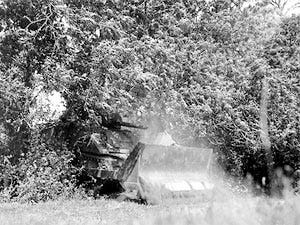
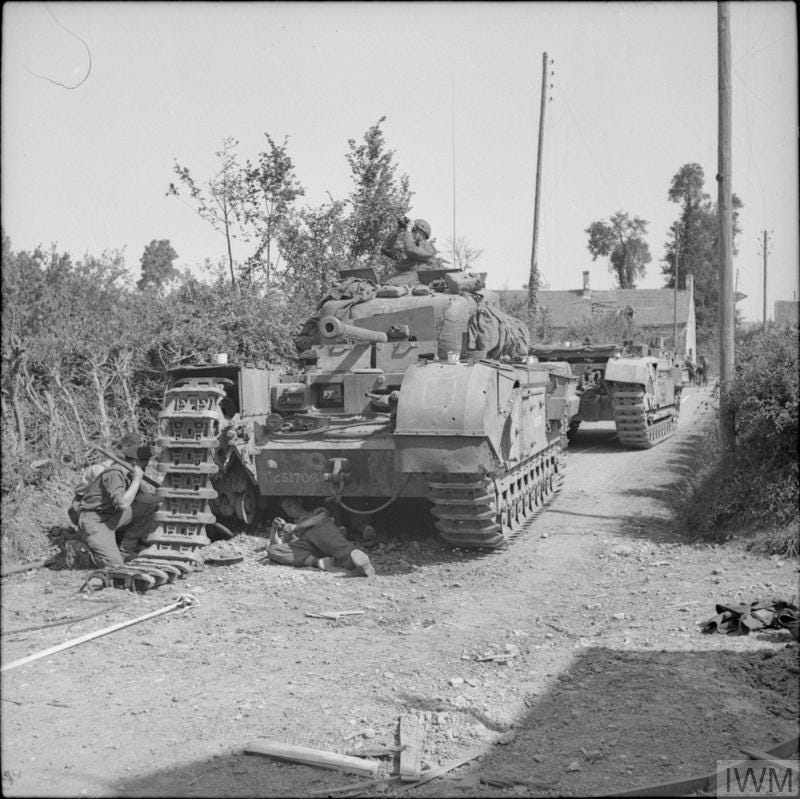
Between June 8 and June 11, the SRY drove inland straight into the meatgrinder of Fontenay-le-Pesnel, Cristot, and Tilly-sur-Seulles. Reality hit them like a freight train. In the bocage, standard armoured doctrine went right out the window.
You have to understand the tactical whiplash these men were experiencing. The SRY was largely made up of desert veterans. The contrast could not have been wider—they had gone from the endless, baking, sandy plains of North Africa, where you could spot the enemy from miles away, to the confined, deceptive beauty of Normandy.
A Sherman tank was designed with space in mind: to manoeuvre, shoot on the move, and exploit wide breakthroughs. Here, like other tanks, it was a loud, obvious target.
This was no place for tanks.
If an SRY commander unbuttoned his hatch to peer over a hedgerow to see where the hell they were, a German sniper was waiting to take his head off. If he stayed buttoned up, he was driving a deaf, blind target. Most chose to ride with their hatches open anyway, gambling their lives just to see the danger coming, ready to duck and slam the steel shut the second the lead started flying.
But the danger wasn’t just in the hatches. The suffocating terrain forced officers to do the unthinkable—get out of the steel entirely.
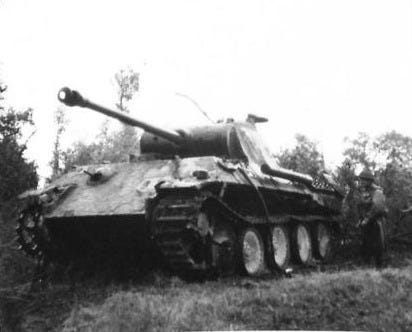
On June 9, near Saint-Pierre-la-Vieille and Audrieu, Captain Keith Douglas—a brilliant 24-year-old tank commander and one of Britain’s greatest wartime poets—bravely dismounted his Sherman to conduct a personal reconnaissance on foot through the thick brush. His unit was pinned down, and he felt he needed to see what lay ahead. As he ran between the hedges, a German mortar shell exploded directly overhead. A tiny piece of shrapnel killed him instantly. In a tragic bit of irony that the poet himself might have noted, the blast left absolutely no visible mark on his body.
Then men were helped in their journey by the brilliant regimental chaplain, who vowed to personally recover and bury all bodies, Reverend Leslie Skinner. Skinnner buried him right there by the hedge. His list of burials to hand on to the grave registry office was growing.
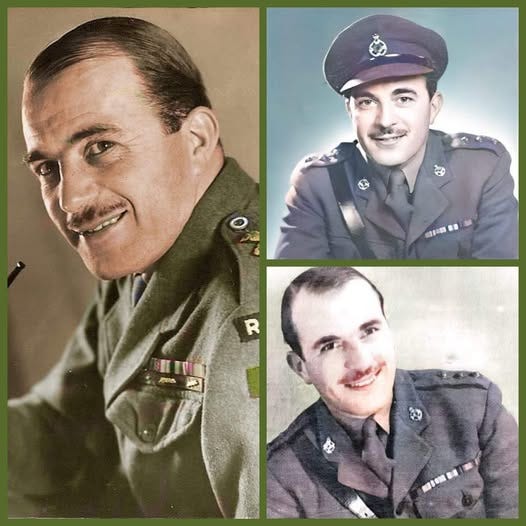
The SRY had to adapt on the fly. To survive the bloody engagements around Tilly-sur-Seulles against the newly arrived elite Panzer-Lehr Division, they ripped up the playbook. They paired standard 75mm Shermans with the long-barreled Sherman Firefly. Armed with a wicked 17-pounder gun, the Firefly could stop any German big cat cold.
But the tactical dance continued. Because the Firefly’s long gun barrel was a high-priority target for German anti-tank crews, the SRY had to hide them at the back of the troop. The standard 75mm Shermans would poke ahead, acting as bait, and the moment a Panther or Tiger revealed itself by firing, the Firefly would find a sightline through the hedges and punch back with a high-velocity shell.
Trying to climb over the hedgerows was no joke, as the Sherman tilted steeply upward to clear the earthen bank, its tracks lost traction, its gun pointed uselessly at the sky, and it exposed its thin, unarmored underbelly straight to any waiting German anti-tank gun or Panzerschreck team hidden in the brush of the next field.
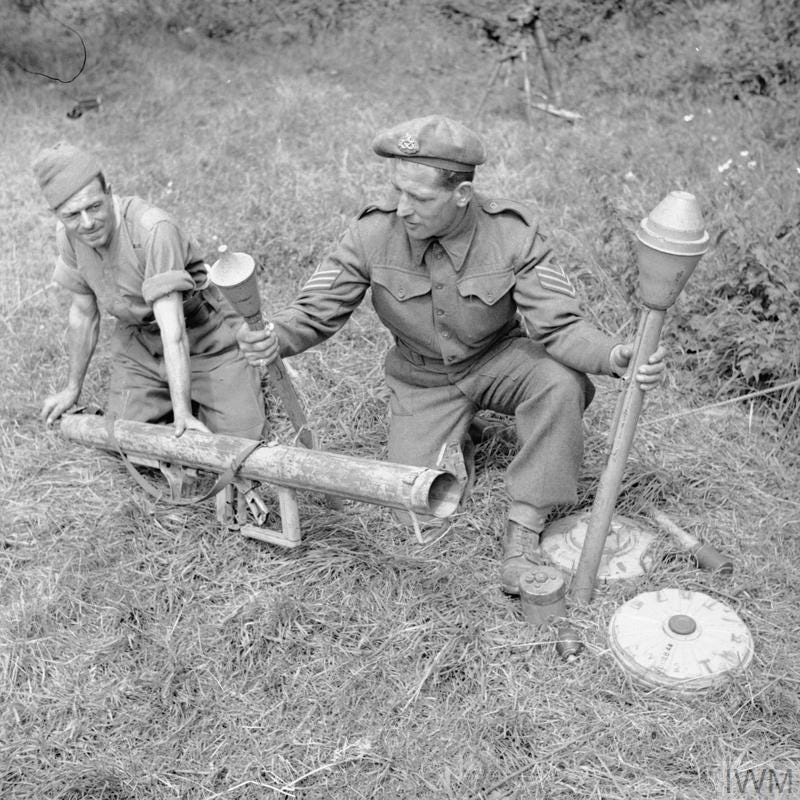
They had to learn a completely new style of warfare: blasting holes through the ancient earthen banks, coordinating with terrified infantrymen they met yesterday and would be gone tomorrow, and moving from field to field. Progress was slow, but progress it was.
The cost was high, and it was completely random. On June 11, a single 105mm artillery shell struck the SRY’s regimental headquarters at St. Pierre. It instantly killed the acting Commanding Officer, Major Michael Laycock, along with his Adjutant and Intelligence Officer. In a flash, the nerve centre of the regiment was completely decapitated.
Stanley Christopherson took his place as CO. Christopherson stepped directly into a command structure hollowed out by grief, tasked with holding together a veteran unit that was slowly being dismantled by an invisible enemy hidden in the greenery.
You didn’t have to be buttoned up in a tank to feel the pain in Normandy.
While the British were grinding into the small fields, the American sector was facing a geographical problem. On June 7, the Allied beachheads were not a unified front line. They were fragmented islands of troops surrounded by hostile territory. This had to change.
The ugliest gap sat right between Omaha and Utah beaches—a 12-mile void centred on the Carentan estuary.
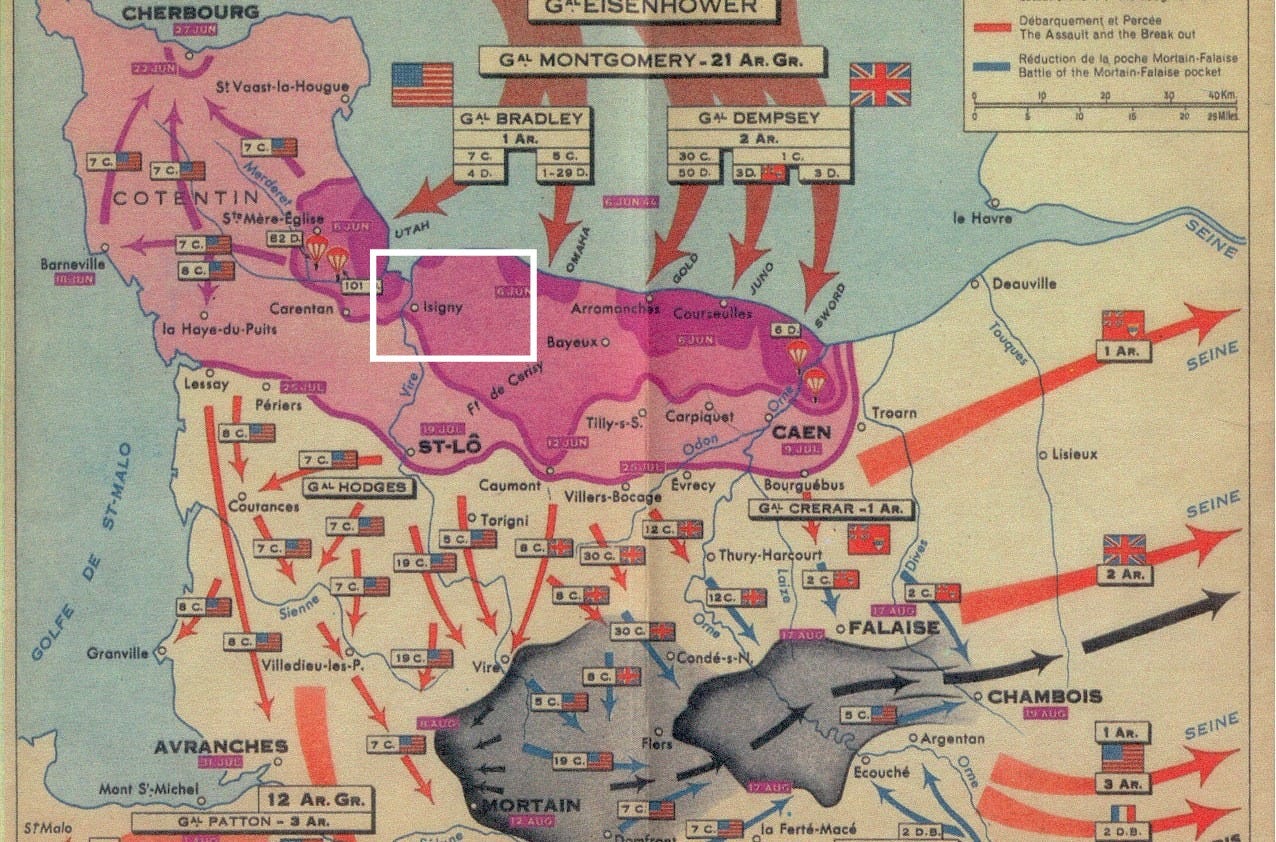
The 29th and 1st Infantry Divisions had survived Omaha, but they couldn’t afford to rest. Their immediate directive was to hammer west, punch through the remnants of the German 352nd Infantry Division, and link up with the 4th Infantry Division breaking out from Utah.
The separation of the beachheads meant that if the Germans coordinated a major armoured counterattack right down the middle of the Carentan estuary, they could split the Allied invasion force in two.
The consolidation operation was a race against the clock. Throughout June 7 and June 8, American infantry, backed by massive 14-inch naval gunfire from the USS Texas, tore through the coastal villages. The fighting was savage, close, and deeply chaotic as US troops cleared out pre-sighted German machine-gun nests and sniper positions, field by field, village by village.
Finally, at 11:00 AM on June 8 (D+2), armoured scouts from the 29th Division linked up with elements from Utah Beach. The critical 12-mile estuary gap was closed, the beachheads were finally welded into a single continuous front, and the Americans could turn their collective attention to pushing south.

Now, let’s look at the big picture. Why were the British and Canadians getting bogged down outside the city of Caen? If you read some of the more impatient newspaper headlines from June 1944, or incessant post-war rubbishing of the Allies, it looked like a failure. In reality, it was exactly what General Bernard Montgomery intended.
Caen was the key to the whole theatre. Both sides knew it; the German High Command looked at the map and panicked: the open plains south of Caen were much better tank country—the direct path to Paris and Germany. If the Allies broke through there, the entire German 7th Army could be encircled and destroyed.
So, Montgomery turned the Caen sector into a giant, irresistible Jerry magnet.
Not by wafting Sausages and Free Beer around, but by launching relentless thrusts toward the city. In doing so, the British Second Army forced the Germans to commit their premier armoured reserves to the eastern side of the landings. Between June 7 and June 10, instead of attacking the beachheads, elite formations like the 12th SS Hitlerjugend and Panzer-Lehr were sucked into a close-quarters battle against British and Canadian forces.
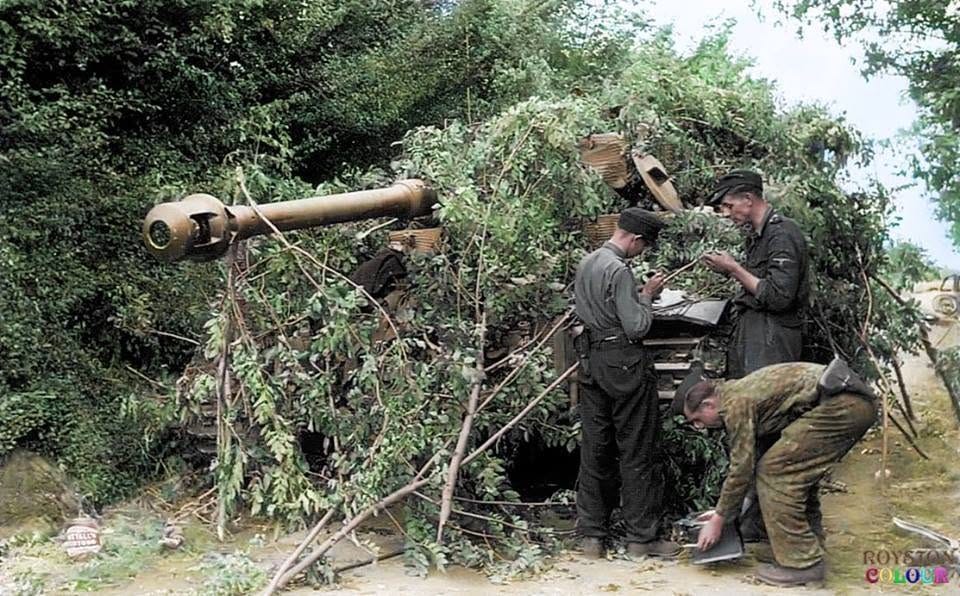
Channelling German heavy armour into built-up areas and narrow choke points where hidden 6-pounder and 17-pounder anti-tank guns were lurking was the plan. It was obvious the Germans would be ordered to obliterate the beachhead, and the British and Canadian forces just had to wait for them to come.
One trap sprang violently on June 8 near the villages of Audrieu and Loucelles. The fanatical panzers of the 12th SS came roaring forward, over ground they did not know, expecting the British infantry to break and run. But because of logistical delays in the rear, their lethal Panther battalion was left completely stranded and out of fuel east of the Orne River. Only the Panzer IV regiment made it to the starting line, clearly impacting their effect.
The gunners of the 245th Battery, Royal Artillery, had buried their low-profile 6-pounders deep inside the dense hedges, covering them in branches and shrubs. The orders were simple: hold fire until you can smell them.
When the German Panzer IVs reached point-blank range—under 150 yards—the hidden guns opened up in a synchronised roar, firing high-velocity, Armour-Piercing Discarding Sabot (APDS)rounds. At that distance, the shells punched through the sides and rear of the German armour like paper. Within minutes, the field was choked with the black smoke of burning panzers, with the 12th SS losing at least six tanks to a single section of guns.
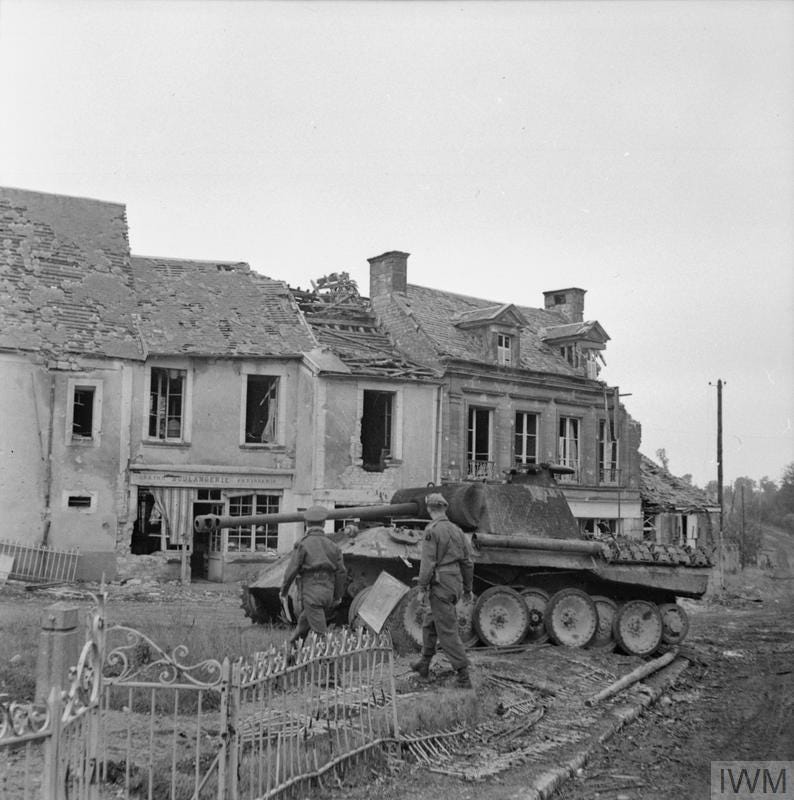
A successful action by the British gunners; however, there were plenty more German tanks coming, and it wouldn’t always be so one-sided.
This bloody anvil was designed to preserve the American right flank, ensuring that when the US First Army finally launched its western breakout, the road wouldn’t be blocked by massed panzer divisions. By then, they would be utterly degraded and no longer a threat to the US advance. This strategy played to each of the allied nations' strength; the British and Canadians had more experience fighting German panzers, and the US forces had shown themself to be excellent breakout forces. Teamwork in Action
By June 12, thanks to the combination of hidden anti-tank screens and the constant attrition from the air, the frontal assault on Caen had turned into a bloody stalemate. Both sides were reinforcing, but neither was strong enough to make ground. Recognising that a direct push was suicide, Montgomery ordered a high-stakes, ambitious “right hook” manoeuvre. The plan was for the battle-hardened 7th Armoured Division—the legendary “Desert Rats”—to exploit a gap in the German front line, bypass the now bloodied Panzer-Lehr Division, and seize the key crossroads town of Villers-Bocage from the flank.
If they took the town, they could cut off the German armour and force a retreat.
On the morning of June 13, the vanguard of the 4th County of London Yeomanry (CLY) rolled casually into Villers-Bocage like they were on holiday. The crews unbuttoned their hatches, had a look around and made some tea, obviously. They parked their Cromwell and Stuart tanks along the main road. They believed the area was entirely clear of enemy armour.
They were dead wrong.
Lurking in the woods just south of the highway was SS-Obersturmführer Michael Wittmann, commander of the 2nd Heavy Panzer Company, 101st SS Heavy Panzer Battalion. He was commanding one monster that the Allied air war hadn’t managed to stop: the Tiger I.
From his hidden vantage point, Wittmann looked through his binoculars and saw the British column completely exposed, strung out along the road like sitting ducks. He didn’t wait for the rest of his company. He ordered his driver to start the engine and drove his lone Tiger straight toward the highway.
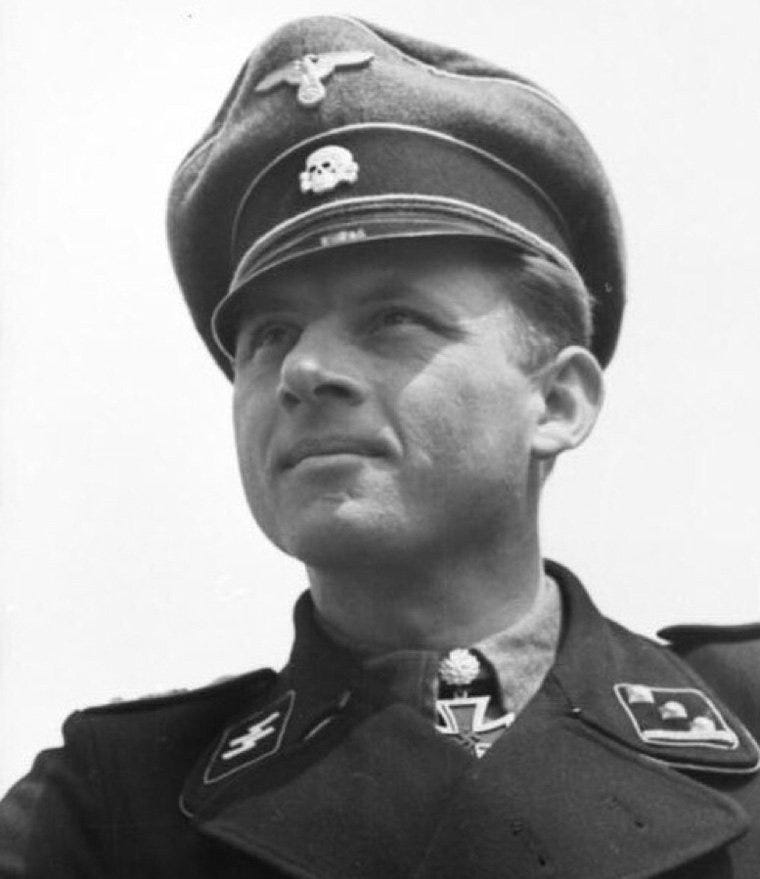
What followed was one of the most devastating single-handed ambushes in armoured warfare history.
Wittmann and his crew slammed the Tiger onto the main road and immediately destroyed the trailing British tank, blocking the line of retreat. Then, they turned the 88mm gun on the front of the column, knocking out the lead vehicle. The British were completely trapped in a narrow street, unable to manoeuvre. Wittmann drove down the line at point-blank range, systematically turning Cromwells, Stuarts, and half-tracks into burning metal coffins. Their complacency is hurting them.
The Desert Rats scrambled to react, but standard 75mm Sherman and Cromwell rounds bounced harmlessly off the Tiger’s thick front armour. By the time Wittmann finally withdrew to get reinforcements, his single Tiger had obliterated nearly an entire armoured regiment’s vanguard in a matter of minutes.
Sometimes, raw recklessness pays off. For Michael Wittmann and his crew, that audacious, lone-wolf gamble at Villers-Bocage cemented their status as legends of the panzer force. But that same overconfidence—the belief that a single Tiger could always terrorise and shatter a column of Allied armour through sheer bravado—would ultimately seal their doom.
Their luck ran out on August 8, 1944, during Operation Totalize. We will get there soon enough.
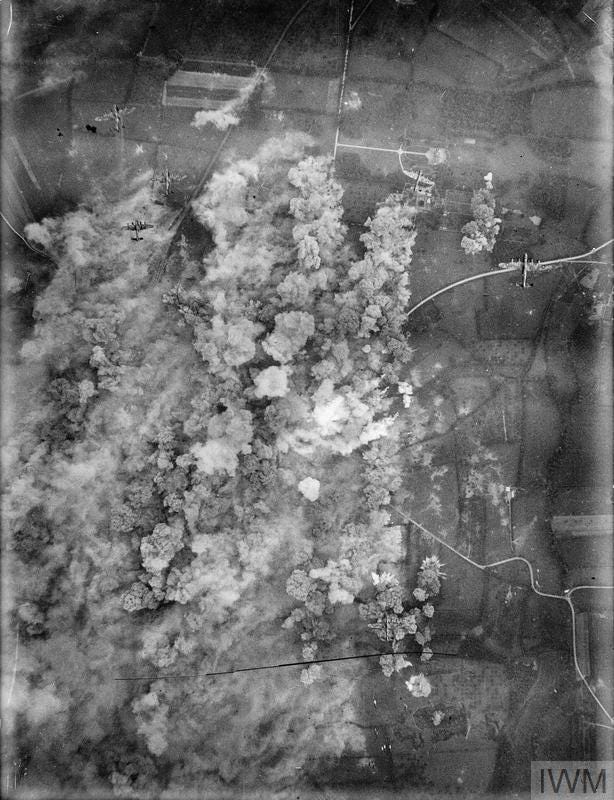
The British right hook had run face-first into a brick wall of heavy German armour. Back to Plan A, Caen was officially turning into a long, bloody war of inches.
We shall see next time how this war of attrition progresses,
Thanks for reading, all the best
Ru
No posts
Comments
Nothing yet. Say the first thing.
Sign in to join the conversation.