
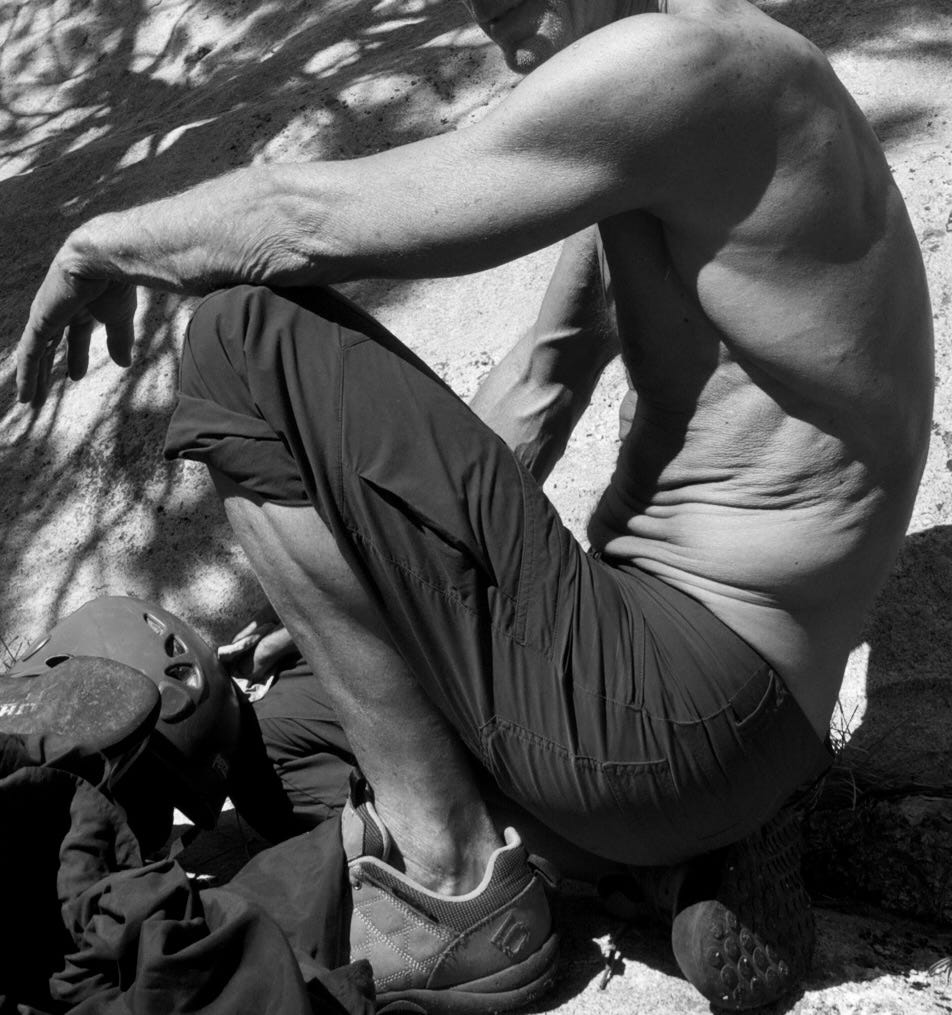
Those first months on the jobsite, I was so stupid tired I didn’t know which way was up. It wasn’t that I wanted to quit but my brain kept explaining to me that quitting was the likely consequence of my accumulating fatigue. I would hit a wall, and that would be that. Somehow, when I had imagined the job of laborer from the comfort of my office chair in the ad agency, I had not comprehended just how thrashed I’d feel at the end of an eight hour day. Nothing in my middle class experience had prepared me, and I could not recall a single evening Dad came home from work too tired to eat. Nonetheless, we were in the process of building a house, which was precisely what I had hoped for when I first hired on with Dee. All day I humped joists and steel for the carpenters, slogging up and down steps pickaxed into the bare dirt hill, stripped to the waist in the blazing heat and sweating like a horse. Several times an hour, it was necessary to cross the treacherous forty-degree slope, carefully picking footsteps with an eighty-pound joist in my arms. If I slipped, the joist would slide a hundred feet to the base of the hill, where I’d have to retrieve it from under the grinning observation of the crew. The only thing greater than my fatigue was my astonishment that men actually lived like this. And I knew, with a certainty in my gut, that something soon would have to give, although I could not then have predicted what it would be. Dee drove me to the job and back to town, where my wife picked me up on a street corner, and I’d sink into the passenger seat, numb, beat, sore, my hands smarting with whatever brand of clumsiness I’d inflicted on them. At home, I nodded over dinner, fell asleep by seven-thirty, and woke the next morning to stunned exhaustion.
Dee in his sixties, however, was perfectly fine. My inexperience was so conspicuous, no one on the job had any difficulty interpreting the meaning of the perpetual amazement on my face. A journeyman, trying to help me, said, “Don’t let the wood push you around.” To which I merely nodded, managing to refrain from a hoarse articulation of my actual feelings. Dumbfounded at the difference between us, I wondered if maybe I just wasn’t cut out to be a carpenter. My audacity in going from advertising writer to laborer was being thrown back in my face and my despair smacked of a larger failure of spirit—of quailing at an opportunity for some greater enlargement of the soul. I had lived out the duration of my twenty-seven years in a permanent state of confusion about what it was that I was supposed to be doing. When the world proposes to a young man that he donate the best eight hours of his day, five days a week, to make a living, the theft of it strikes him as so intimate, he feels compelled to select for himself something that might bring compensation, material or spiritual, for the man he hopes to be. Given that my time was already being appropriated, I was anxious to exercise my prerogative. Dee had miraculously hired me on, and we worked together on side jobs for six months, till suddenly we were building a house, and the only obstacle to the accomplishment of my ambition was the inconvenient fact that I was more tired than I had ever been in my life, and completely ignorant of the process that had me in its grip.
Most of what I remember, and most of what goes into what I think about who I am, is the result of that transition those first few months of building a house. As for the young man at the ad agency, I feel mostly pity, as I would for someone who had died. When I consider the life I might have led, talking with clients on the phone and wearing those slimy olive-green dress slacks with cuffs and creases (emblem of my unconsciousness) I struggle to imagine it. What would I have become? Only the impulse of a lucky guess saved my life by changing it utterly. In the weeks leading to the start of the house, as I bent one nail after another, I remember Dee telling me: “I guess we’ve done so many different things, you can’t do anything at all.” But working on the house would change all that, with its distinct phases of work, each of a duration sufficient to acquire a modicum of proficiency. If that meant the driving of thousands of nails, one after another passing through my blackened hands, I was finally rewarded with the feeling of increasing mastery. Most years the cycles of building were aligned with the cycles of the season, but for a house to start in any season, we always found ourselves rudely deposited on the ground. Being on the ground was the note we always returned to. To get a house off the ground in June merely meant enduring ninety degree days, but January required a desperate struggle on a hillside in the rain. We could work in the rain, or we could stay home to watch it streak the kitchen window as our bank balances puddled. No one liked being on the ground any time of year, but the rains of January filled us with a passion for the house to rise. And when, after a month or two, we climbed out of the mud and onto the first floor, we felt like we’d arrived at the border of a different country: We were no longer mud people. We were floor people. And when the roof was shingled, we became something else again, another repetition of another pattern, cycles within cycles.
I have never attended to the particulars of experience with the perspicacity a writer is supposed to have. The fog that coated the ridges and ravines of the hills through which I drove to work each morning; the men standing on the lumber pile with the breath of their words visible on the freezing air; the drizzle that arrived and departed so many times in a morning that every hour we thought we’d have to pack the tools and go. Instead of noticing and selecting, I was content with delight and drunkenness. And though I tried as diligently as I could to be that kind of writer, the atoms of experience yet drifted past in an undifferentiated stream, part of the great effluvium and formlessness through which I’m now obliged to rummage, all that constitutes what I blithely call “my memory.” I tug on the toe of one remembrance and it dredges up something utterly dissimilar, the linkage between the two a puzzle.—It was never the flow of faces that stayed with me through the years, but the memory of the body, and of our effort in that place, under those skies, as if the landscape, the season, and the weather were the eternal reminders of divinity’s attendance in our lives. Why else would the rain figure so largely in my memory? The tower of clouds? The consoling sun? Having passed through the great middle of my life and into the narrowing corridor of my senility, I admit there’s something at once pathetic and heroic in the relation between an old man and his memory, in his stubborn insistence on trying to make meaning in the teeth of extinction. When I think about the average office worker, I imagine that he is uniquely impoverished in the way that I am a rich man, because everything in my memory is suffuse with infinite versions of the visible sky.
It became second nature for us to appraise a man by how he set about his work: The quickness with which his hammer found his hand. The snap of his tape measure after he had marked a board. The habit of lifting every stick to the scrutiny of his eye. His capability could be found in the habits he’d incorporated to contend with the objects of a task—and his style was in the repetitions as he moved from the lumber pile to the sawhorses to the men leaning from the scaffolding, waiting for the board he’d cut. Eventually, those repetitions became patterns he instinctively employed—even when he was trying to do something entirely new, he always began by imposing the pattern with which he was already familiar. It was about prudence, conserving energy, as well as speed and accuracy, but also, strangely, about pleasure. The physicality of the work and the repetition of patterns made rhythms that reverberated through our days. Flopping plywood down onto the glued tops of joists. Nailing the trimmer stud to its king. Raising a rafter to its ridge beam. We barely thought about what we were doing because we were following a pattern. And through the months and years, it was as if the work itself made a kind of music that we followed with a pleasure in its rhythm, as a dancer does. When a floor we built was particularly remote from the street above, we’d construct elaborate chutes to move an enormous stack of 2x4 studs, with the men on the street above feeding studs into the chute and the men on the floor below stacking a new pile. And a task that normally took two laborers all day was completed in an hour, putting everyone in a party mood, cheering as studs flew down the chute. In those moments, as each man functioned independently within a synchronous whole, a mysterious happiness overtook us, and no man could behave contrarily without suffering himself. Each time a pattern was repeated, and the carpenter returned to his lumber pile, the accomplishment of the house became a bit more complete.
Jobsites changed, but a day for me always began on the bench seat of my pickup. A workman’s truck is a second home, a lunch hour retreat, a haven for private conversation, and more frequently, a refuge from conversation altogether. As I grew in familiarity with my trade, I began to experience a professional detachment in my work, which bestowed on me the wherewithal to enjoy wherever I found myself, even as I focused on the objectives of a task. Those first months were a revelation. With no way of knowing it, or understanding it, I was being born into my own body for a second time. When the change came, it seemed to happen overnight. I had not looked for it or expected it. I was more surprised than anyone, and all the lumber that had once felt absurdly heavy was suddenly light. I felt impossibly renewed, reborn, with a freedom of mind to accompany my newfound vigor. For months, I was getting my butt kicked everyday, and then suddenly I was exactly where I was supposed to be and doing what I was supposed to be doing. As if I’d taken a great gamble and won. And yet I was still only a laborer on a jobsite. Whose life mattered less? Who could have been more insignificant? To be honest, I never considered those questions because I was happy. I had discovered a secret that no one who only saw my ragged jeans and t-shirt could know. As always, Dee was wiser about me than I was about myself. And now it’s my belief that he never came close to firing me. After decades as a foreman, doing Dee’s job, and telling other men what to do all day, I think I know what Dee knew: That few men are fired for making mistakes. That most men are sometimes clumsy. That, if only a man has the will to do the work, that man is formidable.
(Dear Reader: This post was a battle. If you enjoyed it, please let me know. As always, Working Man is 100% AI-free and free to all subscribers. Thank you so much for reading!)
Comments
Nothing yet. Say the first thing.
Sign in to join the conversation.