
Dear Reader, please accept this tiny essay, not meant to be a substitute for what you’ve come to expect from Working Man. Instead, I hope this little format is a place for me to dabble in things I’m interested in that wouldn’t fit my regular substack. The working title of the post after this one is: The Best Adventure. Thank you so much for reading! Working Man
In the last pedestrian chapter of my own mid-life catastrophe, I went to thousands of AA meetings, sometimes twice a day. For awhile, drunks were my dearest friends. Once you stop drinking, you suddenly notice that drunks are everywhere, and you also notice, with some resentment, how encouraged by the culture they are—the same culture that once encouraged you, till you screwed it all up. If all the restaurants lost their liquor licenses tonight, they’d all go broke tomorrow. Cuisine can get you only so far. Most drunks stray just a few drinks over the line—with an obliviousness that can drone on for years without ever ripping the fabric of social decorum. And then something bad happens, as it always does, and you’re down in the hole. If you are are as lucky as I was, you’ll find yourself on a folding chair murmuring the Serenity Prayer. All AA meetings are part revival, part confessional, the same everywhere, on purpose. If you fly to Cancun, you’ll find a meeting. I suspect it’s not hard to imagine how naturally I took to the AA format, given my inclination for confession. When the time came for me to tell the group my story—or “check-in” as we always said in “the rooms”—I was on it, and ready for the compositional challenge.
Yes, I went to thousands of meetings, and I “shared” in most of them. I must have also been witness to thousands of other drunks talking about the worst moments of their lives. As a result of this exposure, I became an aficionado, a self-styled arbiter of AA “shares”— and naturally I applied my habitual aesthetic reflex onto those confessions as if I were listening to poems. But more interesting, over the years, I developed a habit of listening to the stories of others in a special way: by blocking out all the meaning of the words in my mind, and listening only to the intonation of the voice. This was surprisingly easy to do: to listen to someone speaking, as if hearing a bird chirping soulfully, except that they were not birds, but human beings, and their voices made sounds and noises that I was intimately familiar with, that I intuitively understood very easily, without even trying. In fact, I discovered that this way of listening would often give me hidden and secret information about the speaker, about how they felt about themselves, and how they felt about what they were saying, always conveying slightly different information from the words they were using, creating a doubling effect. The poet Robert Frost wrote often about this not-often-discussed quality of language, and he called it the “sound of sense.” His extended dramatic dialogues in blank verse like “Home Burial” comprise a significant part of his modernist bonafides, so it’s not surprising that he was especially interested in this quality of voice. He said: “The best place to get the abstract sound of sense is from voices behind a door that cuts off the words.”
And also from Frost’s letters:
“The ear is the only true writer and the only true reader. I have known people who could read without hearing the sentence sounds and they were the fastest readers. Eye readers we call them. They can get the meaning by glances. But they are bad readers because they miss the best part of what a good writer puts into his work. Remember that the sentence sound often says more than the words. It may even, as in irony, convey a meaning opposite to the words. I wouldn’t be writing all this if I didn’t think it the most important thing I know.”
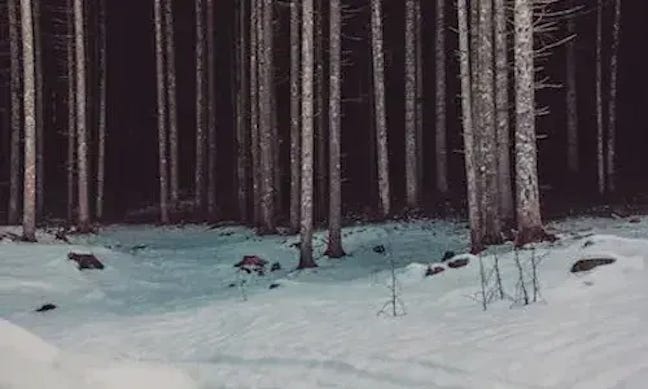
“Stopping By Woods On A Snowy Evening” is only a short lyric, but evokes a moment of a mid-life in which time stretches out vastly, both before and behind the speaker: “He will not see me stopping here/To watch his woods fill up with snow.” Some have called it a perfect poem because what it wants to mean, it means, and what it wants to leave unsaid is eloquently unspoken. The poem is self-contained, and I think there is something rare and startling about a work of art that has no use for explanation. We’ve become so accustomed to the utility of critics and criticism, we almost wonder if something is lacking in a work of art that has no use for them. But isn’t that what art is supposed to do—to separate itself off from the world by creating its own? And what kind of art needs an instruction manual, anyway? “Stopping By Woods On A Snowy Evening” is written in iambic tetrameter with an interlocking rhyme scheme, but its technical surface has the stillness of a glassy lake upon which the wind plays. And Frost wants us to know that the music of the meter and rhyme is overwritten by another, more subterranean, human music, which is the “sound of sense,” a real language that we all know without knowing that we know.
Stopping By Woods On A Snowy Evening
Text within this block will maintain its original spacing when published
Whose woods these are I think I know.
His house is in the village though;
He will not see me stopping here
To watch his woods fill up with snow.
My little horse must think it queer
To stop without a farmhouse near
Between the woods and frozen lake
The darkest evening of the year.
He gives his harness bells a shake
To ask if there is some mistake.
The only other sound’s the sweep
Of easy wind and downy flake.
The woods are lovely, dark and deep,
But I have promises to keep,
And miles to go before I sleep,
And miles to go before I sleep.
Dear Reader: If you enjoyed this post, please let me know. Working Man is 100% AI-free and free to all subscribers. Thank you so much for reading!
Comments
Nothing yet. Say the first thing.
Sign in to join the conversation.