
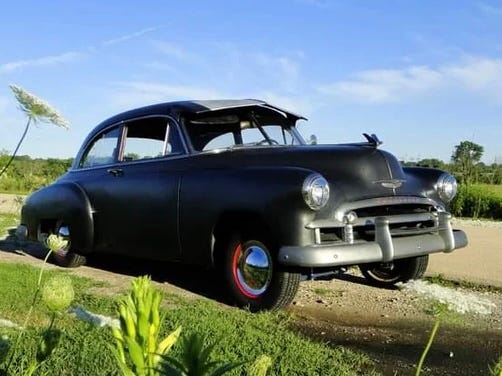
I was four years old, maybe three, and I had left mom in the church courtyard to walk home on my own, apparently. The reason for my excursion has vanished into the black box of reasons children do the things they do, and I’m left with little more detail than I can surmise. All I have is a memory of our bulbous, black-blue, bathtub-style Chevy rolling toward me from a half a block away. I’d been playing with the other kids in the courtyard after Sunday school, during the coffee hour of San Leandro Presbyterian while Mom talked with parishioners and held my baby sister. Dad had to be in his office, resting between services, or he could have been in the courtyard too. He often came out for a few minutes, and my sister and I grew up with a proprietary feeling about our pastor father and the church in general. Hugging that black robe around his knees could give you the feeling of having been momentarily plunged into a dark hole. I can still see the bathtub Chevy gliding nonchalantly toward me with its strange blackish-blue color. The driver, invisible behind the wheel, couldn’t have been mom, so had to be dad. He must have left the church parking lot in the Chevy to find his wandering four-year-old with the minutes he had between the nine o’clock and eleven o’clock service.
Like the families of men whose occupations shape their daily life, religion was the family business. My sister and I shared a lively sarcasm, rife with insider jokes, about our dad who racked up seventy-hour work weeks, often late for dinner because he was visiting someone in the hospital: doing the Lord’s work. After moving to a church in the suburbs, I became a minor princeling of the congregation, of which dad was monarch. I grew up with hymns and bible stories, with dad at the back of the sanctuary, intoning a blessing over the congregation. Everyone knew my name and I knew none of theirs. We lived according to the Christian calendar, and I was baptized and confirmed, attended Sunday school and more adult services than I could count. All our friends were church members or other pastors—my blood ran Presbyterian. As I got older, I thought of myself as a shrewd critic of sermons. My sister and I never questioned whether dad was doing good but we were none the less resentful for having to share him. In our innocence, we probably resented him as much for his goodness as for his absence, and if you remarked that our resentment was incompatible with Christian charity, we would have laughed in your face. When I grew too old for Sunday school, Dad gave me a choice: I could either go to the adult service, or I could choose to stay home to watch Sunday morning cartoons. It was probably a disappointment for him how easily I made that choice. He never said a word. Of my adult sisters, one has since become a spiritualist of uncertain denomination and the other an atheist progressive. For myself at seventy, I can say that I do believe in a creator of the universe, as well as in the good sense of returning to the church. But how that might be accomplished with an undivided heart seems to be the trick of it. For me my Christian upbringing was an innoculation against faith.
Frequently in the ordinary life of the church, I would meet a complete stranger who held a special love for my father, usually for some act of grace my dad had offered at a difficult moment in their lives. This affection was often marked by a talkativeness that was especially annoying when they would go on and on for minutes, obviously moved and sincere. For that reason, I think you could fairly call my dad a great man. Perhaps most sons would like to think similarly of their dads, and yet how many men, not movie stars, are actually loved by hundreds of people? Some men struggle to conform to an idea they have fixed for themselves, but dad’s modesty was as much a part of him as an arm or a hand. Mom always likened him to Lincoln, which we automatically understood to be a reflection of her pride. And yet Dad possessed an unusual seriousness of mind. And if Lincoln was homely at best, Dad was tall and rough-hewn with broad shoulders and a singularly massive, but not unhandsome nose. He had big hands like a farmer or a carpenter, and though he didn’t eschew manual labor, neither did he show much interest in it. His father had been a roughneck in the oil fields, and Dad had seen a workingman’s life up close. People intuitively trusted his soundness of spirit, and he was good at talking about the problems of living and Christian faith in a simple but deeply felt way that people related to. He was never glib. His sermons were a masterclass in the plain-style, and he had a beautiful baritone voice, very manly and sincere, that spoke directly to a congregation with empathy and a very masculine moral sense. By sixteen, I had heard the sermons of dozens of other pastors, and to my mind, my dad was by far the best. His habit was to makes notes all week on a yellow pad, and then, while mom fryed him a steak on Sunday morning, he would pull his thoughts together.
The moments I remember of spending time together, just dad and me, were probably working in the garage, or taking our old battered hauling trailer to the dump. When we entered the gate, he would let me get in the back, and bounce around in the bed of the trailer, as the dust flew and we roared down the dump road. On his deathbed, I asked him if he remembered the time the two of us went camping, and he said yes, he did remember, adding wistfully that he wished we had done more of that kind of thing. In his last years at the assisted living center, he came under the spell of progressive UC Berkeley professors who had also taken up residence there. I argued with him till I was red-faced, trying to remind him of his more moderate, younger years. But probably what held the most sway with him was the fact that the national Presbyterian church had also by then moved hard left. The church mattered to Dad, though was less than nothing to me. With a congregation that included many physicists for members, he came to undertake a physicist’s appreciation for the presence of god in the natural world. He retired too early at 65, and acknowledged as much near the end. Mom and he had done some wonderful traveling, but I think he could have given it another ten years with more satisfaction. Near his death he told me, without any prompting, that if he could be anything, he would want to be a Presbyterian minister. It was such an odd and mournful statement. He said it exactly like that: in a pathetic sort of conditional future tense. He never talked much about heaven, or life after death, even in his sermons—as if he didn’t attach much importance to it, although the omission began to tell as his future became smaller. His life had been long and glorious, crowned with a seventy-year marriage, despite the utter brutality of mom’s alzheimer’s and death, which had probably left him feeling alone in the world for the first time in his adult life. They had always seemed to keep us kids a bit to the outside of their union. Toward the end I would read him Psalm 23, a verse he liked and one I never got tired of: “Yea, though I walk through the valley of the shadow of death”—And perhaps I loved it too much for its poetry, because whenever I read it through, I always got the feeling it had somehow stirred a skepticism in him about my faith—in the way sons always feel the disapproval of their fathers. He never said so, but I think he thought that I was little better than an agnostic, and my feelings were too aesthetic to be very pious.
Standing beside dad in the pew of some other pastor’s sanctuary, which often happened in later years, became a familiar memory for me, like the sound of a hundred people rising from their seats, and the coughs and throat-clearings that always preceded the first chords of the organ. Most men think of singing as unmanly, and though they’ll usually turn to the correct page in the hymnal, no actual sound emerges from their throats. In fact if you look carefully around you, you’ll notice half the congregation merely mouthing the words, the enunciation of the church choir providing an effective cover. Naturally, Dad knew all the words without the hymnbook, and I knew most of the first verses. He had a fine voice, which I think he enjoyed, and as he sang the words, his head would tilt slightly from side to side with a pleasure in the rhythm: “A mighty fortress is our god, a bulwark never failing.” From anywhere in the sanctuary you could easily hear his baritone above the others, and when I was singing beside him, you could hear my voice, too. He was not bashful. And you could tell that he believed it was right for a man to be heard when he sang, and that singing was itself an expression of manliness. He would sing so god could hear him, and of course we always teased him about it. But he was so downright, you could tell it was a conviction that he held very deeply. And I was always proud of him for that. Lowering our jaws for the low notes, really singing, louder than the voices around us, I was conscious of the presence of my father in a way ordinary life did not provide, our two voices mingled in the sanctuary air, a memory that’s still precious to me. Late in my middle-age, I became enamored with old-fashioned “rhythm and blues,” the music that preceded rock and roll, and my interest led me to golden-era gospel groups and choirs with names like The Davis Sisters: a kind of music that gives to worship a transcendent physicality—especially compared with the more sedate Presbyterian version. As a consequence of this discovery, I remember once asking dad, who was as ecumenical as they come, what he thought of Southern Baptist gospel music—and he almost shuddered visibly. I was not surprised at his response because, really, isn’t Christianity all over the map about the human body, except for crucifixion itself, whose shape and meaning comes to a point like a dagger— meaning that was confirmed for me personally by the relentlessly cruel un-personing of my father and mother.
So yet, the image of the bathtub Chevy remains ineffably stranded on the beach of my memory, remarkable only for its endurance, although you might reasonably assume it was attached to a feeling of some importance. Through the accumulation of years, you come to realize that the most important thing about feelings is how easily they are removed by the passing of time. And yet, what are we if not our feelings? The essayist closest to my heart is always Montaigne whose high purpose was only to become the best of companions for his reader. When I think about that unsteady toddler on the streets of San Leandro—setting off on his own for unknown reasons—I’m reminded of the mystery without which the world would be intolerable. As far as I know, the eleven o clock service was not cancelled, although it would have been easy, and very much like my mom and dad, to hide that detail from me. Our house, the church manse, was only a few blocks from the church, and Dad found me halfway between church and home, midway between services. He put the Chevy in park, and ran out for me, then set me down in the passenger seat.
(Dear Reader: My idea of Substack is to work on a piece until it is as good as I can make it. As a consolation for this erratic method, Working Man is free to all subscribers as well as 100% AI-free. If you enjoy a post, please like it. Thank you so much for reading!)
Comments
Nothing yet. Say the first thing.
Sign in to join the conversation.