
Parts A and B of Chapter 7 are organized into Challenges, then Lessons Learned, so the content isn’t too long for a Substack post.
This chapter provides “takeaways” from my viticultural endeavors.
The framework of my vineyard pursuits is driven by a desire to produce quality grapes for winemaking, or as I like to put it, from vine to wine.
The heart of my wine encore.
At the beginning of my journey, the information gained came from research. I read books and online sources, participated in online training courses, and spoke with vineyard growers.
The research served me well, but after years of conducting the actual work, there’s one self-evident truism: the vineyard provides its own curriculum.
What follows are the challenges, learned from my preparation, execution, trial and error…and the occasional muttered conversation with a stubborn vine or marauding insect.
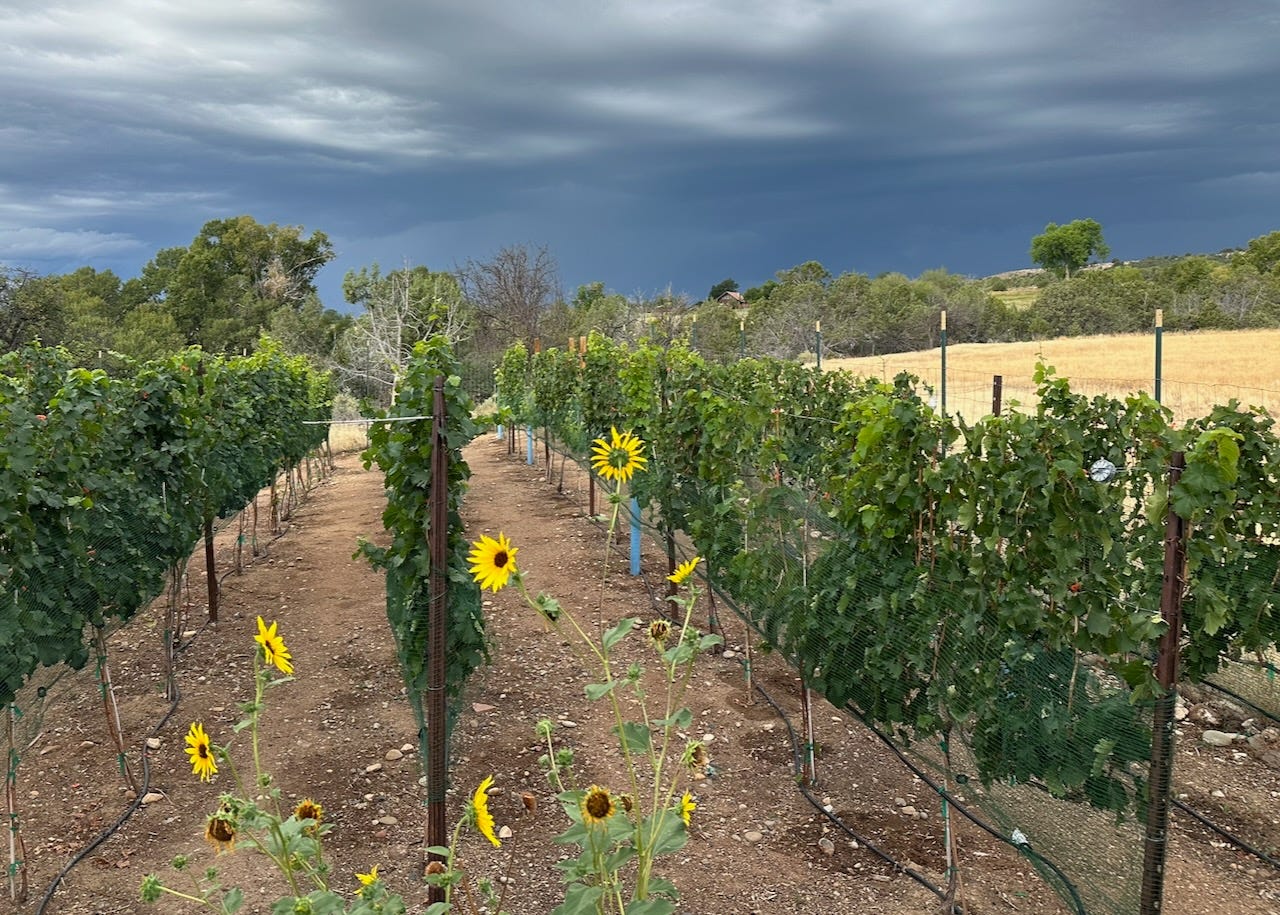
As referenced in earlier chapters, my experiences are shaped by the vineyard’s specific location in the North Fork Valley in western Colorado—high elevation, semi-arid climate, rain all at once, wind-prone mesas, and a cast of local “actors” ranging from yellow jackets, grasshoppers, and leafhoppers, to prairie dogs, rabbits, raccoons, and deer.
Growers in other wine-growing regions may face similar categories of challenges, but the details—and the remedies—can differ.
Also worth acknowledging: this is a hobbyist’s journey. I originally came to this as a layperson eager to learn, with limited resources. I’m learning by doing, taking a decidedly DIY approach, and figuring things out one season at a time.
That freedom brings both flexibility and hard knocks.
Two themes run through everything that follows: expect the unexpected…and be prepared to solve it yourself.
There are shared challenges that most vineyards face at different times of the year. Tackling the challenges drives learning, i.e., lessons learned. No season unfolds exactly as planned—if it unfolds according to plan at all.
Pests, wildlife, and biological threats are persistent adversaries.
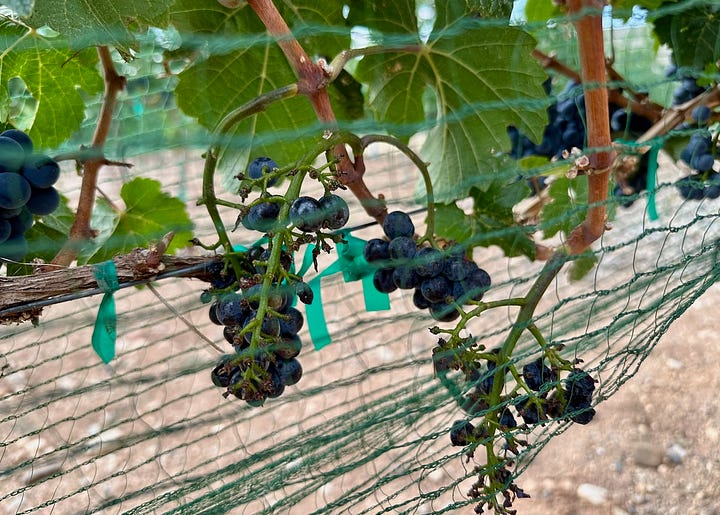
On my semi-arid mesa, yellow jackets, and to a lesser degree wasps, proved especially destructive, capable of wiping out portions of a crop by feeding on ripening grapes. Their behavior shifts with conditions—particularly drought—making them difficult to predict year to year. Grasshoppers proved to be another persistent pest, though their choice of food is leaves.
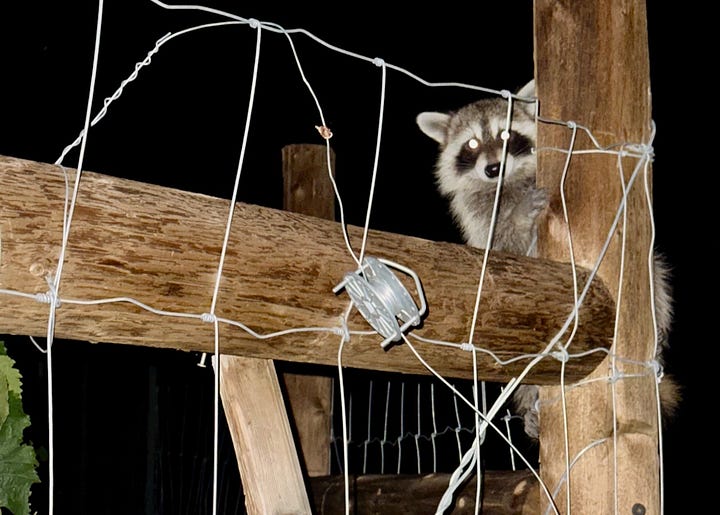
Additional recurring pests included caterpillars, earwigs, leafhoppers, birds…and the occasional raccoon with a taste for late-night harvest sampling.
Powdery mildew has been a constant fungal threat every season. In other regions and vineyards, downy mildew, botrytis bunch rot, and black rot are commonly found.
While different wine-growing regions come packaged with their own unique collection of threats, the one universal worldwide nuisance is a tiny aphidlike insect known as grape phylloxera. If present, phylloxera eventually kills Vitis vinifera.
There is no known cure.
By and large, hybrid vines (a cross between two or more different Vitis species) are highly resistant to phylloxera. To my knowledge, the louse has not been present in my vineyard, though it has been reported in various vineyards in the valley. As a protective measure when planting my vineyard, I used American phylloxera-resistant rootstock grafted onto European Vitis vinifera vines (Pinot Noir and Riesling) to help keep the insect at bay.
Other wine-growing regions may experience additional insect pests, including Japanese beetles, glassy-winged sharpshooters, mealybugs, grape berry moths, grape rootworm and root borers, and more.
Each requires a different control strategy, and none wait politely for you to figure it out.
Weather variability has been a constant wildcard.
High spring winds caused coulure (wind shatter), reducing fruit set before grape berries could develop. Heavy rainfall caused erosion and minor flooding. A late-spring freeze damaged the vines after budbreak. Significant temperature swings have promoted vine trunk and cordon splits.
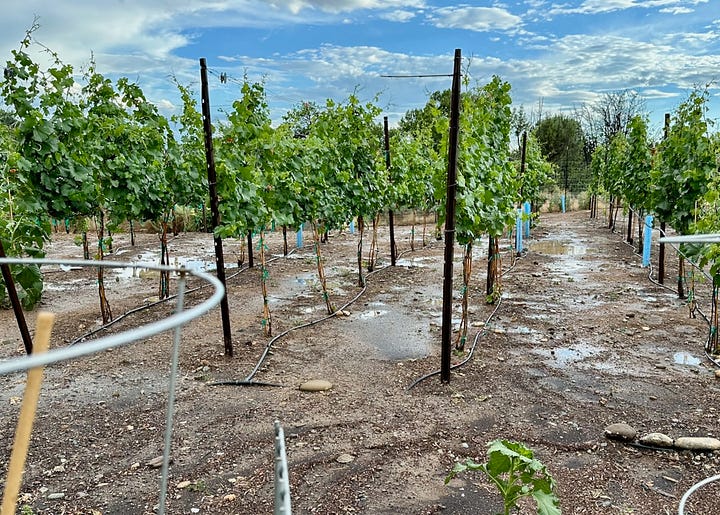
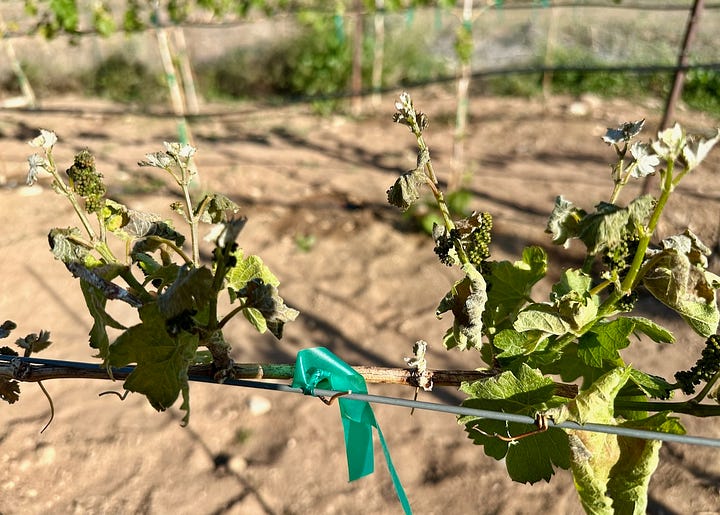
Also, periods of extended precipitation—or, conversely, severe drought—dramatically influenced disease pressure and pest behavior. For example, a fungal disease, powdery mildew, went from nonexistent to problematic in a matter of days when the right weather conditions hit.
As already mentioned, drought drives hangry yellow jackets; hungry and angry.
You can’t control the weather, but you can be prepared.
Vine issues can be easily misdiagnosed.
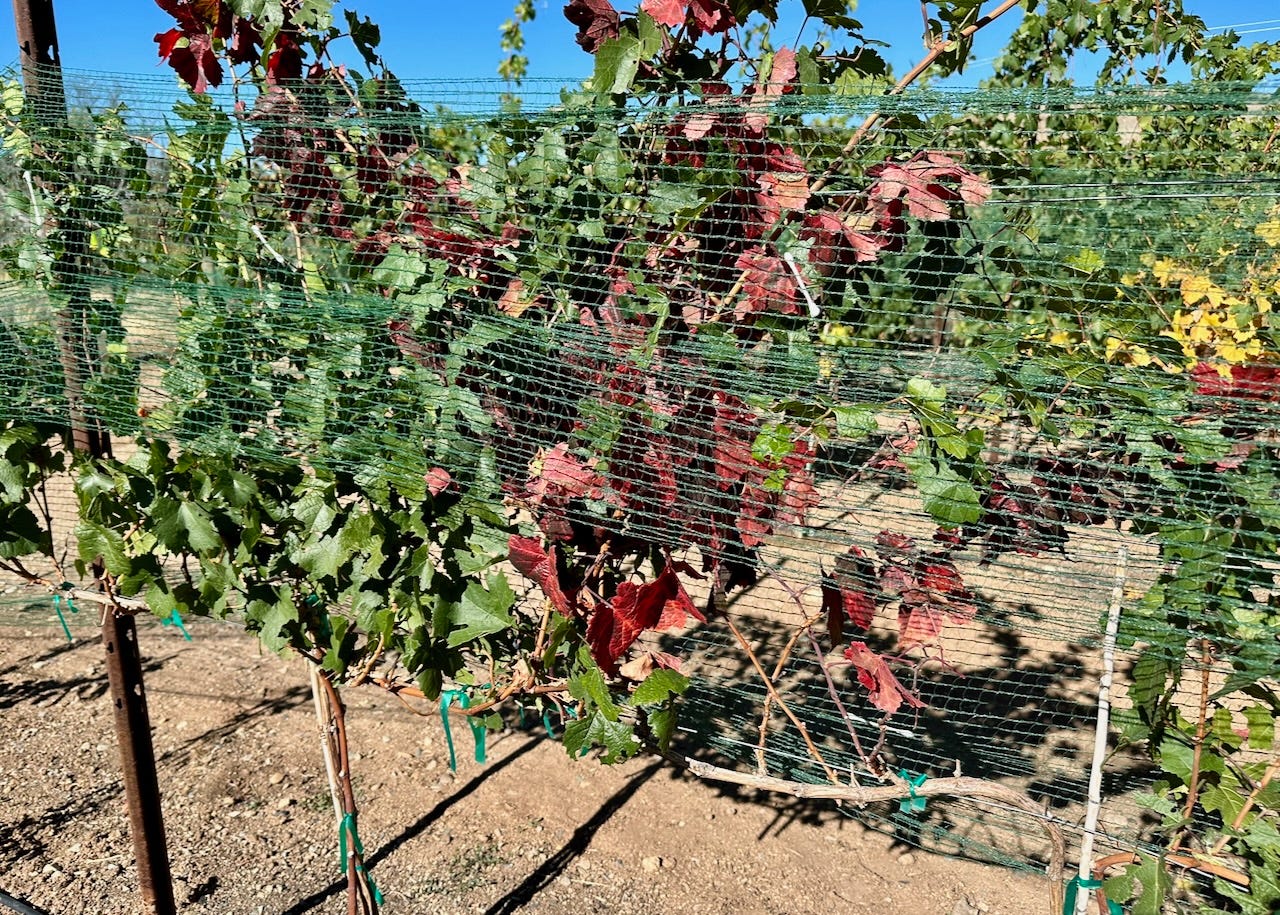
Late one season, dark-red leaves on several vines suggested disease, whether biological or viral. Many of these vines didn’t survive the winter. The situation ultimately suggested irrigation misalignment—roots searching outward for water that wasn’t there.
Although, I’m not yet totally convinced there was another companion actor at play.
In another example, embarrassingly exposing my level of naïveté, white specks on the exterior-facing vine leaves initially suggested damage from wind-driven dust and grit. A not uncommon occurrence on the mesa. After observing the spread of occurrences among the vines over time, a closer examination revealed the presence of leafhoppers.
Remedying issues is made more challenging if problems are allowed to fester.
Infrastructure weakness can become more pronounced as the vineyard matures.
In my situation, the trellis end posts were set too shallowly, and they struggled under an increasing load of vine growth and fruit, requiring ongoing fixes and, eventually, full reconsideration.
The same is true with irrigation, which is a vineyard requirement in many locales. Even if a region receives the ideal annual rainfall for vines (20 to 30 inches, with a greater percentage coming in spring and summer), having irrigation as a backup can be crucial. Knowing a water source’s capacity and reliability, understanding the water requirements based on soil and vine, being aware of the available volume and pressure, and knowing what piping or tubing is needed for a delivery system (such as small sprayers or drip emitters); can help determine whether you’ll succeed or face ongoing frustrations.
Bottomline, do it right the first time, or you might find yourself in the position that: “there is never enough time to do it right, but there is always enough time to do it over.”
Time itself is its own challenge.
Vineyard work is relentless during peak growth. I found that a short absence during critical periods resulted in an overwhelming backlog of vine pruning, training, and maintenance.
Such a peak growth period occurs in the spring after bud break. The vines “spring forth” quite vigorously. In my region, this typically occurs from late May through June. I’ve learned the hard way that being absent for even two weeks during this period significantly increases the effort and time needed to tame the vines.
The vines don’t wait.
And neither should you, but unfortunately, Part B Lessons Learned won’t be available till next week!
No posts
Comments
Nothing yet. Say the first thing.
Sign in to join the conversation.