
Anticipation is the greater joy.
Often attributed to Thomas Aquinas or commonly understood in psychology.
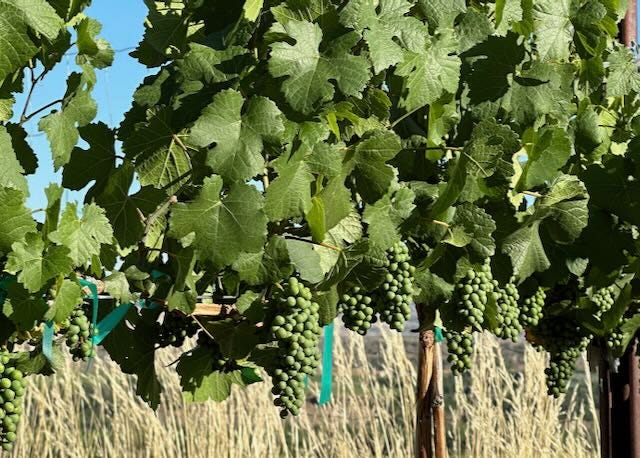
Over the previous two years, I planned, planted, and tended a vineyard of 125 Pinot Noir and Riesling vines.
At the start of year three, two words captured my outlook: anticipation tinged by excitement. For the first time, grapes were part of the equation. This stage felt like a major step toward completing the loop of my Wine Encore—from vine to wine.
What I didn’t realize was that I stood on a kind of precipice, unaware of what truly lay ahead. The work had already been both physically and mentally demanding. I’d learned a great deal and felt confident and well-prepared.
Year three challenged that confidence. Two related factors revived the key lesson from the previous chapter: expect the unexpected.
Grapes: the first factor
Grapes are vulnerable from the moment flowering begins in early spring through the sugar-accumulating ripening period in late summer.
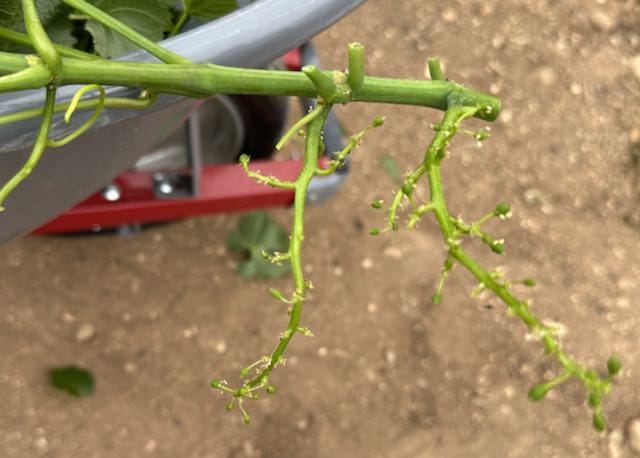
I quickly discovered that coulure, the failure of berries to form after flowering, would be part of my vineyard reality. Coulure can be caused by excessive rain, cold, heat, or wind. In my vineyard, wind was the culprit. Colloquially known as shatter, strong winds blew apart the delicate flowers, leaving only the bare skeleton of what should have become a grape cluster.

At the other end of the season, as the grapes plump up after veraison—the transition from berry growth to sugar accumulation—pests take notice. In my area, birds, wasps, yellow jackets, squirrels, and raccoons all respond to the siren call of ripening fruit.
Vines: the second factor
The vines and leaf canopy share similar vulnerabilities. But in my case, year three seemed to broadcast a message far and wide: fresh vegetation available for the taking. The pests that answered included grasshoppers, caterpillars, and leafhoppers.
Presumably, I’m blessed in my little part of the world because additional likely pests in other wine-growing regions can also include mites, Japanese beetles, mealy bugs, spotted lanternflies, and more.
A fungal threat also emerged. In season two, I had come across small amounts of powdery mildew. Fungal diseases are common in vineyards worldwide (powdery and downy mildew, black rot, Botrytis bunch rot, and anthracnose), so I had been lucky that the vineyard had not experienced a more aggressive fungal breakout.
Recognizing my lapse of attention, I consulted a local organic grower over the winter about his mildew management program. His recommendation was Stylet Oil, a refined mineral oil that kills mildew spores by smothering them. A well-known viticultural adage, “if you see it, it’s too late”, drives a preventative spray practice. I was now prepared to follow a regimen after vine budbreak and repeat it at appropriate intervals until veraison.
As year three unfolded, I continually identified and responded to these threats. Meanwhile, the regular work continued: trellis maintenance, pruning, weeding, and irrigation.
Future seasons in the vineyard followed a similar framework.
Early-season chores
By mid-April, as warmer temperatures became more consistent, I began the season’s initial chores: trellis maintenance and vine pruning.
Trellis maintenance involves checking and securing posts and tightening wires. Early spring pruning requires removing a portion of a vine’s previous season’s wood to encourage new green growth. The technique is straightforward: remove the previous season’s upward-reaching canes, leaving the lower portions near the cordons with two or three buds. These buds produce the shoots that become new canes. Later in spring, flower clusters form along the lower sections of the new canes and, if successfully self-pollinated (see coulure above), develop into grapes.
As the season unfolds, you are also removing unwanted green shoots along the trunks, as well as the cordons, where new growth may crowd healthy existing canes.
My goal is to complete trellis work and pruning by the end of April so I can apply the season’s first mildew spray and get ahead of weeding.
As a side note, pruning doesn’t have to wait till spring; it can also occur mid-winter when the vines are dormant. I’ve taken advantage of winter pruning once or twice, to help me keep ahead of upcoming spring chores and projects.
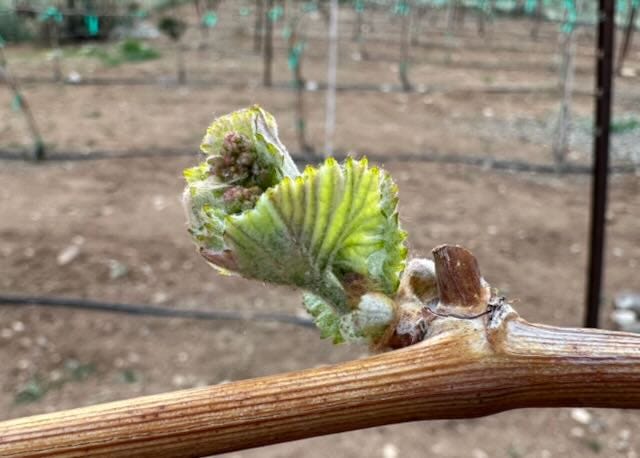
By mid-May, I plant new grafted rootstocks to replace vines that underperformed or died over winter. Around the same time—weather permitting—bud break occurs as buds swell and young shoots emerge.
This is when an early-season freeze can dole out damage.
Managing freeze risk
In our region in the high country of western Colorado, freeze events after extended warm stretches are common. Depending on how cold it gets and for how long, new growth can die back. Severe damage can reduce the eventual grape yield.
During the vineyard’s first three years, the average last freeze date was April 24. In year four, the last freeze was May 14, and in year five, it moved to May 20.
Because of this variability, I use a technique called double pruning. The first prune leaves four or five buds along each shoot rather than two or three. The second pruning—after the risk of freeze events has passed—removes the upper buds, leaving at least two along the bottom near the cordon.
What advantage does this approach bring to vines facing freezing temperatures?
New spring growth occurs first on the upper buds. If a freeze hits, the top buds and any emerging shoots take the brunt of the damage. With luck, as in the temperatures haven’t been too low or long lasting, the lower buds remain viable and can continue growing once things stabilize.


The double pruning approach requires additional time and labor. For this reason, commercial growers employ other freeze defenses, including large wind machines or strategically placed smudge pots or burning wood brush piles between the vine rows. Towering over orchards and vineyards, the wind machines circulate air, helping to keep freezing temperatures from settling among the vegetation.
When the vineyard takes off
From late May through June, vine growth explodes. This is when you start tucking the shoots into the upper trellis wires and pruning back excessive growth. This involves clearing excessive mid-canopy growth, including vine laterals (secondary shoots), and thinning the understory leaf canopy.
The primary purpose of maintaining a tidy canopy is to maintain a healthy airflow. A crowded canopy allows humidity to linger, creating conditions where pathogens such as mildew can thrive. It also lessens the effectiveness of pest and preventive mildew sprays, which can’t fully penetrate the thick tangle of canes and leaves.
I also remove grape clusters if they are too tightly crowded. In the third season, my target is 1 cluster per cane, increasing to 2 clusters in subsequent seasons.
Even in year three, you’re encouraging vine maturity and root growth over fruit.
June also marks the start of pest season.
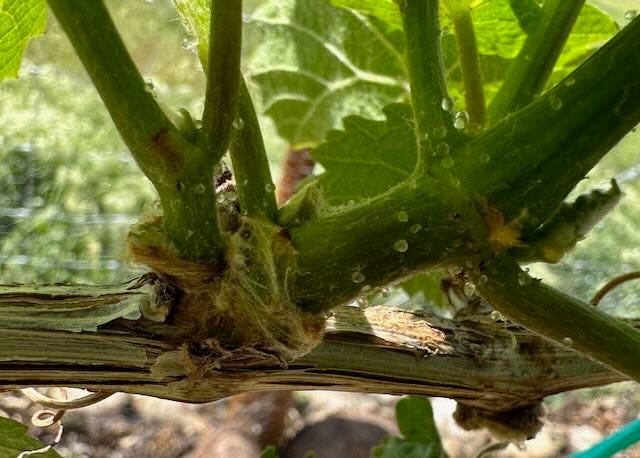
The first pest out of the starting gate, or so I thought, was small, clear globules I kept coming across when pruning. They tended to group under leaves and along the lower portion of vine canes. Worried they could be pest egg sacks, I took a sample to a local vine grower for his examination. Turns out, they were a healthy byproduct of the growth process: vine perspiration.
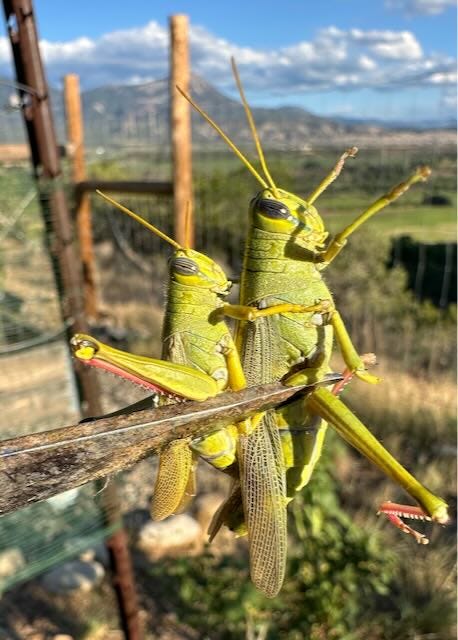
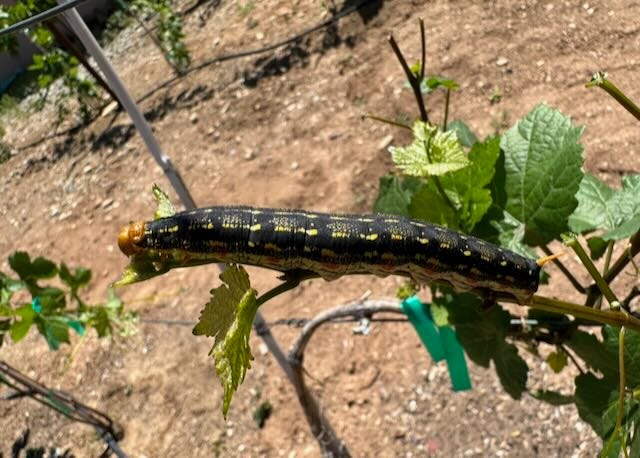
Caterpillars were the first invaders, quickly followed by grasshoppers. Caterpillars chewed on tender growing shoots. Grasshoppers’ food of choice was the leaves, partially or entirely.
Left unattended, I could end up with a vineyard with a limited leaf canopy and reduced grape yields.
Luckily, the number of caterpillars was limited. Each morning, I would walk the rows, removing them by hand and dispatching them with shears. Grasshoppers were a different affair. At first, I also applied shears, but there were simply too many grasshoppers to make a difference. I looked into organic pesticides but found none that were reliably effective. Ultimately, I let the grasshoppers have their share during seasons three and four. Fortunately, the vigorous leaf canopy growth generally outpaced the damage—though the vines didn’t always look their best.
It wasn’t long before another pest joined the battle. I began noticing clusters of tiny white specks on many leaves. I first blamed wind-driven dust damage—a conclusion with no basis. When I realized the pattern was spreading against the prevailing winds, I finally dug into the research.
The culprit was leafhoppers. These tiny insects are difficult to see but can significantly reduce photosynthesis in affected leaves, harming both vines and maturing grapes.
Fortunately, an organic spray called PyGanic killed the leafhoppers and stopped the infestation from spreading.
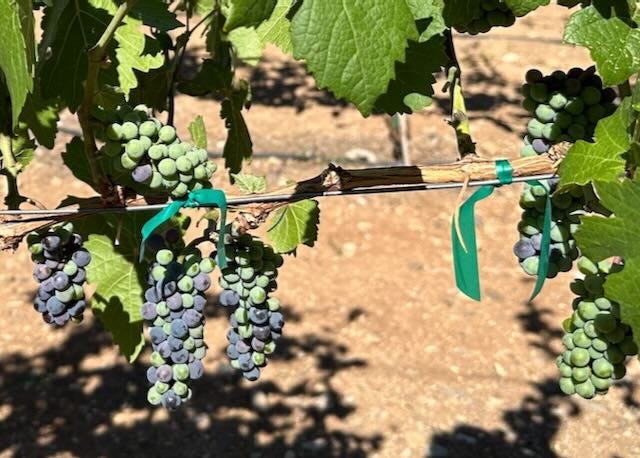
Late-season push
As mid-season in year three waned to summer’s last push, things were going swimmingly.
The vines had been sprayed with Stylet Oil monthly to prevent mildew. The first wave of pests had been dealt with, and veraison passed without incident. Normally, harvest occurs five to seven weeks after veraison, though timing varies by region, grape variety, climate, and desired wine style.
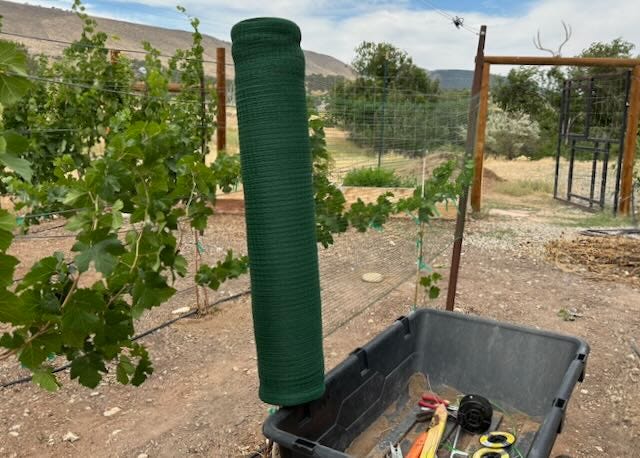
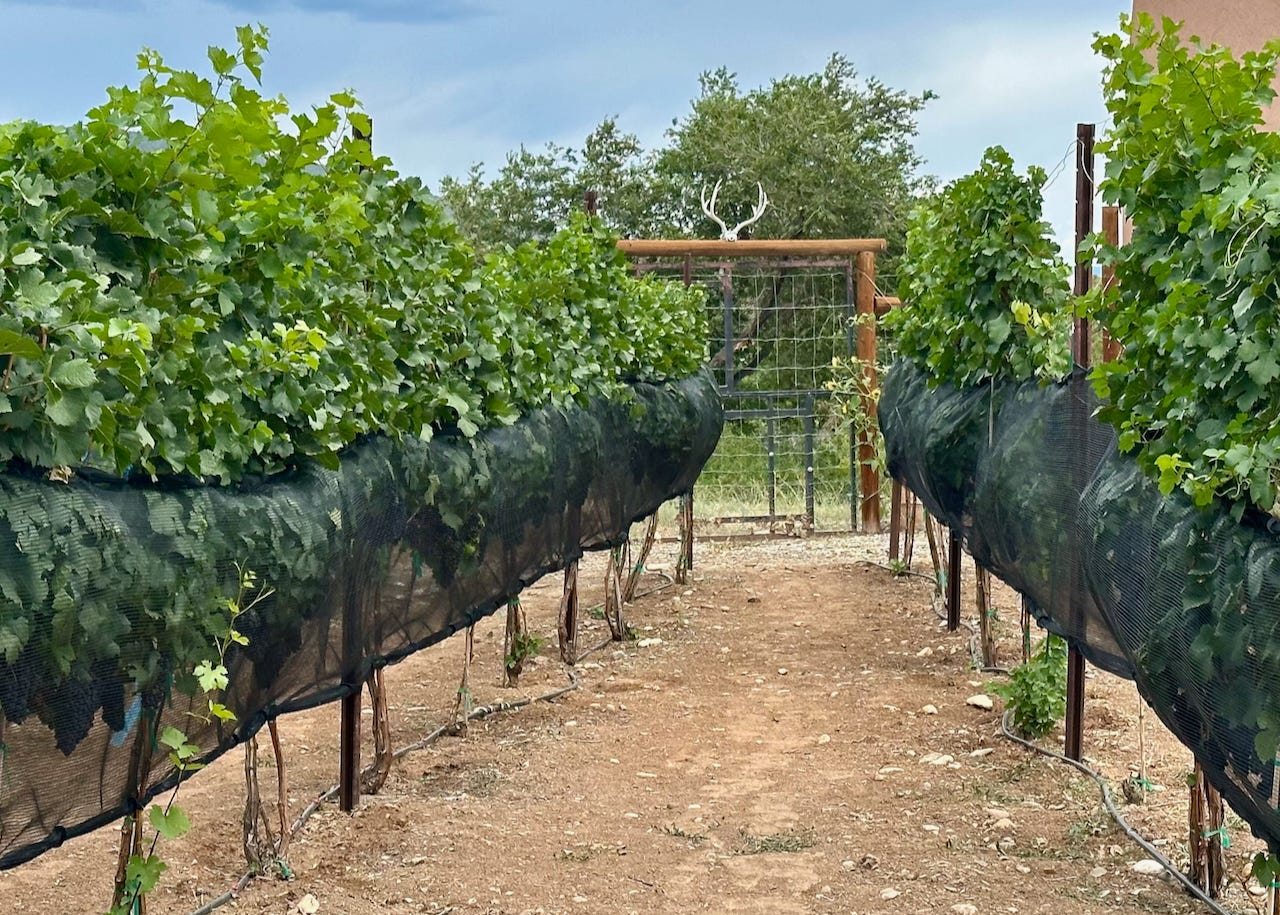
Since birds are a threat to ripening grapes after veraison, I ordered and installed bird side-netting. The nets come in large rolls, several hundred feet in length. I used a wooden post secured to the side panel of my Gorilla Cart to spool out the netting. Simple clips are used to secure the tops and bottoms of the nets.
Bird netting is not a perfect solution. More industrious birds use a technique in which they briefly leverage the net with their claws, then quickly grab individual grapes through the netting. There are additional bird-deterrent approaches used by growers, which include broadcasting wildlife sounds, such as predator calls, and/or installing shiny objects that wave in the wind.
Such discouragements are not warranted for my small vineyard. I found that if I kept the top and the bottom of the side nets tightly clipped, it worked well enough to keep most birds from accessing the grapes.
The apocalypse
In my mind’s eye, it was time to relax and watch the grapes mature to harvest.
Unbeknownst to me, metaphorical storm clouds were gathering.
One morning in mid August, I noticed our Airedale, Bella, shaking her head vigorously, trying to shake off several harassing yellow jackets. It suddenly occurred to me that I should deploy a few yellow-jacket traps in the vineyard. These insects are attracted to the sugar in maturing grapes and, given the chance, will suck them dry.
To this point, I had not observed yellow jackets among the vines, but it seemed prudent to play it safe.
Famous last words.
Deploying a few traps along the wildlife fence quickly changed the dynamics.
Yellow jackets soon began swarming the traps—but they also discovered the ripening Pinot Noir fruit. After a day or two of observing steadily increasing numbers around both traps and grapes, I began to wonder whether the traps had prompted the onslaught or whether their deployment had simply coincided with the insects’ natural arrival.
As I watched the Pinot grapes begin to unravel, I leaned toward blaming the traps. But by then it had become an emotional judgment—and it no longer mattered.
The plague had arrived.
All I could do was deploy additional traps, hoping they would both reduce the number of yellow jackets and draw them away from the grapes. The traps accomplished neither. There were simply too many yellow jackets.

Janine began researching possible home remedy deterrents. One promising option was spearmint oil. According to the literature, yellow jackets dislike mint derivatives. We mixed the oil with water and sprayed the grapes. Janine also soaked cotton balls in the mixture and tucked them into the netting around the grape clusters.
After two weeks of frustration, it became clear our efforts had little effect. The yellow jackets were now turning their attention to the ripening Riesling in the adjoining rows.
After discussing the situation, we decided to purchase individual fruit-protection bags. These fine-mesh bags, secured with drawstrings, easily envelop a grape cluster. The Pinot had already suffered heavy losses, but we hoped a larger portion of the Riesling crop could be saved.
The work was tedious, but after a full day, I had bagged every cluster.
Water pump failure
If the yellow-jacket invasion was not painful enough, the vineyard soon faced another challenge. The solar pump that supplied water to my 1,500-gallon cistern burned out.
It took two weeks to diagnose the cause—a root ball restricting flow to the pump—and to locate a suitable replacement. Installation required another week.
The result: nearly three weeks with no irrigation for the vineyard during the heat of late August. Even more concerning for Janine, our domestic supply had to rely on the steadily dwindling level of water in the cistern.
There was, however, a silver lining.
The failure allowed me to upgrade the pump—something I had considered for some time. The previous pump delivered one gallon per minute to the cistern, making it difficult to balance the competing demands of the vineyard, landscape, and household.
After confirming that the existing solar array could support a larger pump, I installed a replacement capable of delivering 2.25 gallons per minute.
Happy days.
Harvest
By the end of the first week of September, I had reached my limit. It was time to harvest what remained of the Pinot Noir and make a rosé.


Without the ongoing yellow-jacket assault, I would have waited another week or two to allow the grapes to reach higher sugar levels better suited for red wine. Rosé wines, however, are often made from grapes harvested earlier, when sugar levels—and therefore final alcohol—are somewhat lower.
Under the circumstances, the remaining Pinot fruit was perfectly suited for rosé.
I learned an important lesson for growers: field conditions often drive winemaking decisions.
I harvested the Pinot September 9. The first step was raising the lower portion of the netting to expose the clusters. Because of the damage, I harvested using two buckets—one for acceptable fruit and the other for discards.
My selection rule was simple: if less than one-third of a cluster appeared damaged, it went into the winemaking bucket. Anything worse was discarded.
Working quickly down the rows—occasionally dodging yellow jackets—I eventually collected 110 pounds of fruit. Only 80 pounds were usable.
In other words, yellow jackets had destroyed 27 percent of the crop.
This was a small harvest, notwithstanding the yellow jackets. Young vineyards take a few years to realize their potential. The tonnage taken in subsequent years increased, topping 340 pounds in year five.
Despite the ordeal in year three, the fruit was successfully processed into rosé, producing twelve bottles the following year. Considering the circumstances of its birth, the wine turned out quite nicely.
The Riesling vines reached harvest readiness in early October. Riesling vines tend to be more vigorous than Pinot Noir, but their ripening lags by several weeks.
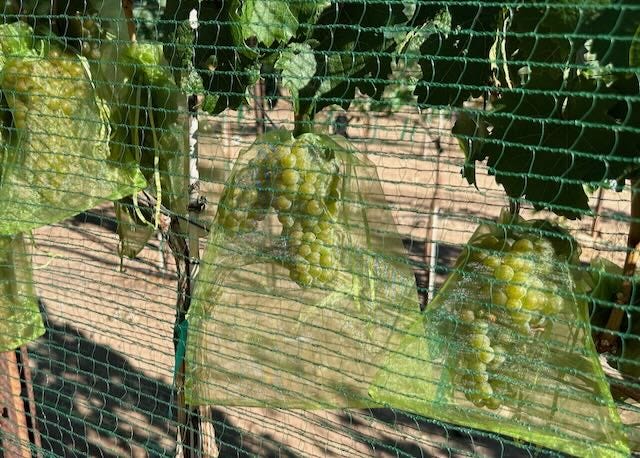
A few yellow jackets managed to breach the protective bags, but overall, the fruit remained in good condition. 100 pounds were harvested, producing fifteen bottles of finished wine.
After harvest
The third year vines had worked hard during the season to produce their first crop. After harvest, they looked exhausted.
It was time to increase irrigation and help them prepare for winter.
During this stage of the season, the leaves continue photosynthesis, producing carbohydrates that are transported to the roots and woody structures for storage. These reserves support winter dormancy and fuel the next season’s bud break.
In early October, I noticed that several Pinot Noir vines had leaves turning red. Initially, I assumed it was simply autumn color.
After a week or two, it became clear that something else might be going on. Research suggested the vines may be experiencing stress due to pathogens, nutrient deficiencies, or root development issues.
I tagged seven vines for close monitoring the following spring.
Season three ended with a freeze on October 30. It doesn’t take much—a light frost is enough. At that point, winter hardening begins, as vines gradually prepare for the upcoming winter. They remain vulnerable for a few weeks if extreme cold arrives before the process is complete.
Fortunately, that year the vines had ample time to harden.
Moving forward
The events of season three were instrumental in shaping a working calendar for future vineyard operations. Seasonal milestones, tasks, and responsibilities became clearer. The season also reinforced the need to remain constantly alert to threats from pests and pathogens.
It took another year or two to fully understand—and develop solutions for—many of the issues that surfaced in season three. And, as with any meaningful endeavor, the process continues to evolve as techniques are refined to improve vineyard health and fruit quality.
Several examples stand out.
Yellow jackets and other sugar-loving pests
My biggest mistake in season three was deploying yellow-jacket traps too late in the season.
The ideal time is early season when queens emerge from winter hibernation. Queens are larger in size than her spawn, making them easy to identify. Eliminating queens early reduces the number of nests—and therefore the number of worker yellow jackets searching for food.
Keeping traps baited throughout the season is essential.
Using this approach, the vineyard saw very few yellow jackets in season four. Paper wasps became the primary stinging pest interested in grape sugar. They are not attracted to traps, so their nests must be located and destroyed. Fortunately, they tend to be fewer in number and less aggressive than yellow jackets.
Year five told a different story. Fewer queens appeared in the early traps, leading me to believe the previous season’s success would continue.
It didn’t.
An extreme drought drove yellow-jacket populations across the region in search of food. They arrived hangry: hungry and angry.
Seeing the warning signs early evidenced by heavy trap traffic, I decided to address the problem more aggressively. I replaced the bird netting with tighter-weave insect netting, designed to block both birds and smaller flying insects.
A few determined yellow jackets still managed to slip through gaps in the netting, but not in numbers large enough to cause serious damage.
My plan moving forward is to continue early-season trapping to minimize populations, with continued insect netting deployment.
Season four also introduced raccoons to the vineyard. One nighttime visit caught by my vineyard cam prompted an immediate trip to the hardware store and the deployment of traps the following evening. I didn’t catch the culprit, though since the visit occurred just before harvest, damage was kept to a minimum. There were no further visits in year five.
Still, I remain prepared.
Early-season insect pests
I have been told that grasshopper infestations often occur in three-year cycles. After three active years in my vineyard, I see no reason to assume they will lessen anytime soon.
Combining research with happenstance, I experimented with a three-spray strategy in year five.
The solution combines two organic products, Venerate and PyGanic, in equal amounts and sprayed directly on the vines. The combination kills insects through both contact and ingestion and is effective against multiple pests, including leafhoppers.
On its own, however, the combined spray is only marginally effective against grasshoppers.
A more comprehensive approach involved using a third, stronger product: Talstar. Because Talstar should not be used on fruit or vegetable crops, it is applied only to surrounding vegetation outside the vineyard perimeter. Grasshoppers feeding on nearby grasses and brush are killed by contact or ingestion for up to three months.
Within a few weeks, it was clear this approach was working. It is now part of my annual vineyard spraying program.
Irrigation lessons
The seven vines I had tagged in the fall of season three died during the winter.
Upon close inspection, I suspected bacterial diseases such as crown gall or damage from split trunks. Still unsure, I sent photos to a fellow grower, who consulted another colleague.
Their feedback revealed a different issue: the placement of drip irrigation emitters.
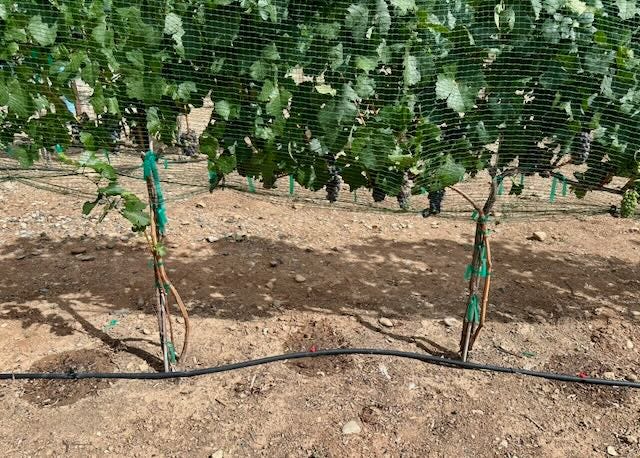
For three seasons, I had positioned drip emitters near the vine trunks. Drip irrigation spreads water downward in the soil in an upside down cone-shaped pattern. The rootstock used in my vineyard—101-14—has a shallow, wide-spreading root system.
The result was a mismatch: roots were struggling to reach the available water.
The solution was to reposition emitters between vines along the rows, encouraging roots to spread laterally in search of water sources—even reaching diagonally toward neighboring rows.
Lessons learned
It is impossible to tend a vineyard for several years without learning a few valuable lessons.
Ideally, those lessons can help other hobbyists who share the passion for growing grapes for winemaking. Whether the accumulated knowledge eventually qualifies as wisdom remains to be seen. I’m not ready to make that claim—at least not yet.
In the next chapter, we’ll explore the broader lessons I’ve taken away from my ongoing viticultural Wine Encore journey.
No posts
Comments
Nothing yet. Say the first thing.
Sign in to join the conversation.