
Welcome! This bi-weekly newsletter, published by the Windfall Trust, curates the most important developments in AI economics research and policy. Each issue features key research and updates, along with in-depth analysis and quick links to relevant opportunities and recent news.
A new growth model by Forethought, Columbia, and Virginia predicts that AI R&D automation could accelerate AI’s economic impact, driven by economic and technological feedback loops. They model an AI research sector that spans software and hardware and calibrate it using estimates of AI software and hardware progress, such as Moore’s Law.
Current measures of AI R&D automation are limited, and existing benchmarks saturate quickly. The think tank GovAI proposes a framework combining experiments, surveys, operational tracking, and organisational metrics to address this gap.
AI automation might also accelerate as task chains are automated contiguously. This might overturn comparative advantage in some cases, as firms prefer to automate a task when AI is sufficiently good at it to save labor costs, while end-stage verification costs remain fixed.
Anthropic released a new paper on AI’s labor-market impact that introduces “observed exposure,” a measure that combines theoretical model capabilities with real-world usage data, giving greater weight to automated and work-related uses. But this isn’t theoretical usage versus actual usage, only changes in relative usage.
Multiple economists noted that Dwarkesh Patel’s application of the Alchian-Allen effect is misleading. He argued that AI companies’ margins increase as fixed compute costs rise. It ignores the fact that higher compute costs could reduce overall AI demand, as some users might drop AI entirely rather than trade up to premium models.
David Oks revisits the debate over bank teller employment following the advent of ATMs and iPhones. While the former increased employment, the latter decreased it by replacing entire workflows. These workflows are modeled by a new working paper discussed below.
Debates about AI writing code for its next version have flared up, as AI lab researchers claim AI writes 100% of their code. At the same time, forecaster Ajeya Cotra (METR) confesses that she has underestimated AI’s capability gains and believes that automating AI R&D is possible this year with 10% probability.
Tom Davidson (Forethought) and coauthors from Virginia and Columbia try to answer the question: When does automating AI research lead to explosive growth?
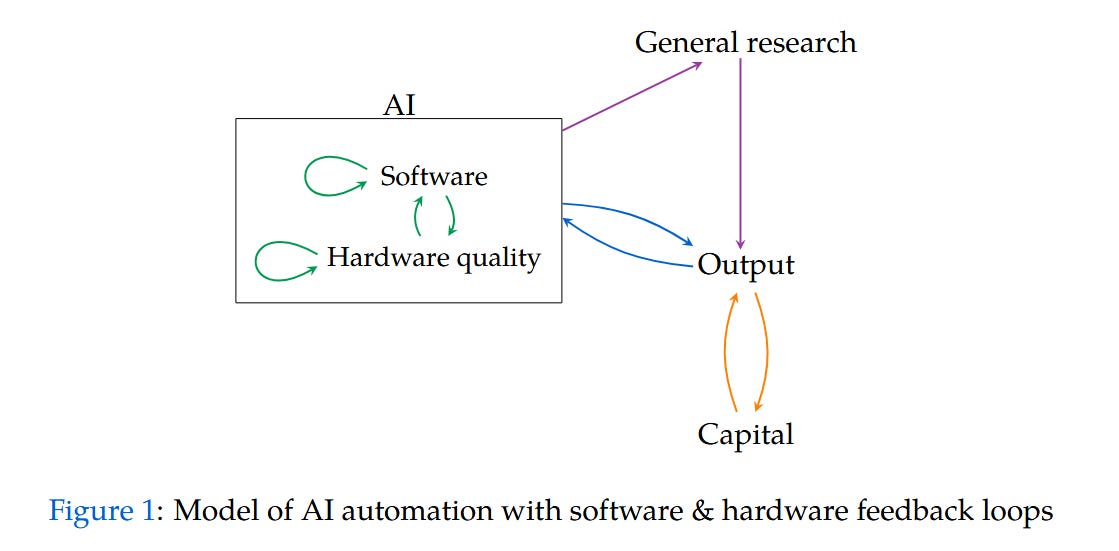
Source: Davidson et al. (2026)
They explore three ways in which AI could overcome diminishing returns in a growth model featuring an AI software and hardware sector, where long-run growth depends solely on research productivity and population growth: First, technological feedback loops directly offset diminishing returns. For example, AI might speed up chip design, and these better chips help to create better AI models. Second, economic feedback loops might enable larger AI investments. If AI improves productivity, more resources can be accumulated and reinvested in AI development. In contrast, human labor can’t be accumulated. These feedback loops might even reinforce each other when, e.g., increased investment further accelerates AI research.
Third, automation of research tasks creates new feedback loops that amplify the first two. When AI replaces human researchers with compute, it converts a non-accumulable input into an accumulable one. Higher GDP does not produce more human scientists, but it does fund more chips and AI instances in this model — creating a feedback loop that did not previously exist. This feedback loop is especially powerful in hardware R&D, where diminishing returns to research effort are far weaker than elsewhere in the economy. According to estimates from Bloom et al. (2020), each percentage-point increase in hardware productivity contributes roughly five times as much to explosive growth as the same increase in software or general production automation.The model suggests that hardware R&D automation has disproportionately large effects on growth — making chip design a critical bottleneck
The main result is that AI might initially have a slow impact on growth, but a rapid growth explosion is possible, according to their model. According to their preferred specification, the automation needed to double growth (8%) is already more than half the level required for a growth explosion (13%).
Our analysis: While the feedback loops outlined in this paper can overcome diminishing returns to R&D investments, other bottlenecks may still prevent an explosion in growth, such as regulatory, physical or data bottlenecks. Furthermore, the critical assumption that differs between this paper and the “weak links” paper explored in Brief #6 concerns the relationship among tasks within the same industry. The model assumes that within each sector, tasks can substitute for one another freely — so explosive progress in automated tasks alone can drive explosive overall growth, without being bottlenecked by tasks that remain human-performed. But it seems more likely that tasks are generally complementary, as the “weak link” paper suggests, where non-automated tasks bottleneck the economy. Thus, the extent of complementarity between tasks within a sector remains the core empirical question that determines AI-driven growth dynamics.
The explosion threshold from Davidson et al. depends on the automation of both production and R&D. However, robust metrics to track this currently remain scarce. The think tank GovAI proposes a framework for tracking AI R&D automation, arguing that researchers currently lack robust ways to measure its extent and effects.
The authors propose 14 distinct metrics across four categories to measure AI R&D automation, as current benchmarks for AI R&D quickly saturate. Experiments can estimate model behavior in controlled environments, such as RCTs on AI R&D tasks comparing humans and AI. In contrast, surveys could ask staff about the productivity boost AI can offer as a quick, rough measure. Another fast approach is operational metrics, such as tracking researchers’ time across different tasks. At a macro level, organizational metrics, such as the share of R&D spending allocated to labor, can measure this.
Conceptually, they create a framework that distinguishes three quantities that determine the societal impacts of AI R&D: the direct measurement of R&D automation, its effects on AI progress, and its effects on the gap between the required and provided oversight for policymakers to keep pace with the technology.
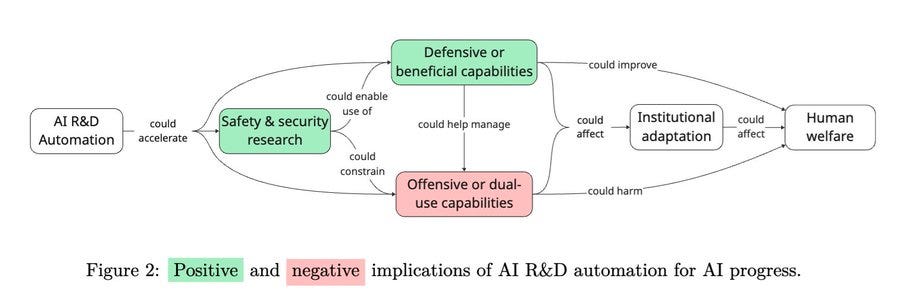
Source: Chan et a. (2026)
Our analysis: The various measures would capture R&D automation well, but could give policymakers a false sense of security. Even if fully implemented, the proposed framework would track levels of AI R&D automation but not the proximity to growth thresholds that Davidson et al. identify as critical. As the authors acknowledge, these metrics are mostly lagging indicators.
AI automation might also accelerate in non-linear leaps — not because of macro feedback loops, but because of how firms structure workflows. Mert Demirer (MIT) and coauthors from MIT, Microsoft, and Yale study how agentic AI reshapes workers’ tasks and jobs. Their model predicts that firms choose to automate tasks in the same sequence. Thus, the AI’s execution of neighboring steps increases the likelihood of automation and changes the entire workflow.
Crucially, the authors distinguish between steps (the primitive units of work) and tasks (bundles of steps assigned to a worker). Each step can be executed manually, augmented by AI (requiring human verification), or fully automated by AI (requiring no direct human oversight). AI enables “chaining” of steps by delegating a run of consecutive steps to AI. Humans check only the chain’s final output.
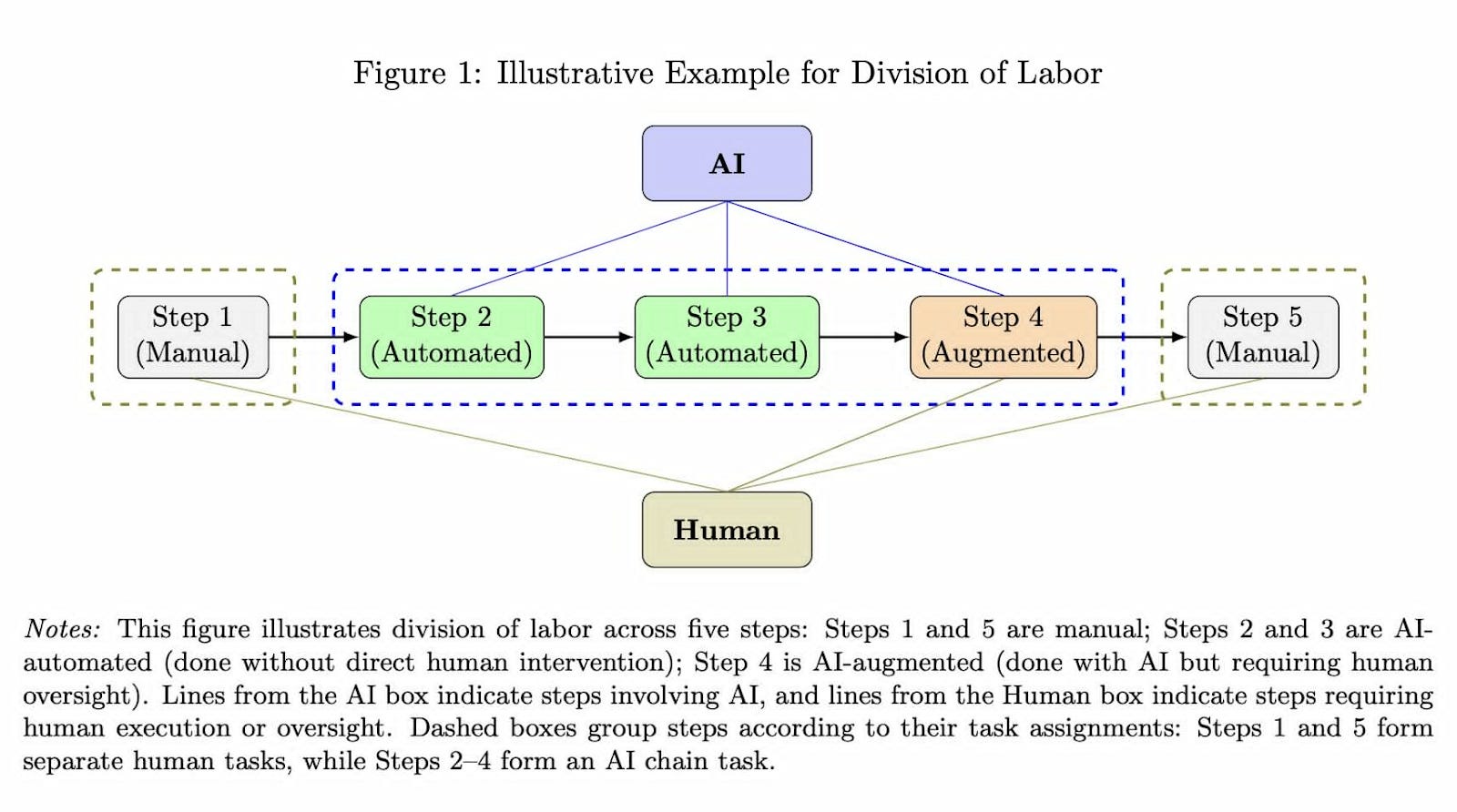
Source: Demirer et al. (2026)
This has multiple implications according to their model: it enables significant cost savings because human oversight is a fixed cost only in the chain’s last step. The model also potentially overturns standard comparative advantage logic: If the AI is reliable enough at the marginal step, it incurs no additional verification cost, making it profitable to automate even if a human could perform that specific step more cheaply in isolation. If the steps AI can perform are clustered, longer AI chains are possible, and the effects of AI automation are greater. Conversely, if human oversight is often needed, as AI-executed tasks don’t cluster, then AI will save little time and hardly increase productivity.
The authors empirically validate multiple model predictions: Jobs with 10 percentage points higher AI exposure exhibit 1.2 to 6.6 percentage points higher AI execution. When holding exposure fixed, jobs with more fragmented workflows adopt AI less.
Our analysis: The workflow chains might explain why AI adoption differs fundamentally from AI exposure scores, as AI usage depends on the automation of neighboring steps. This should also affect predictions about future workforce impact: Not the most exposed jobs, but those closest to the next reorganization threshold will be most affected by future AI automation. More speculatively, this might also explain why AI reduces the barrier of entry for occupations: Verification might be easier than doing the steps yourself.
While this model is consistent with many empirical findings, some limitations remain: it neglects potential AI-driven task creation and relies on the Anthropic Economic Index to measure realized AI execution outcomes for firms, even though these reflect only consumers’ AI usage from a selected sample. Additionally, soft failures might propagate through longer chains, making verification more costly.
Labor Market & Employment
Lukas Althoff (Stanford) and Hugo Reichardt (Barcelona) predict that AI substantially reduces wage inequality by reducing the barriers to entry, while increasing average wages by 21%.
Magnus Lodefalk (Örebro) and coauthors from Kiel and Aarhus show that AI exposure shifts hiring away from junior workers, while restrictive monetary policy reduces job postings overall.
The ECB published new evidence on AI and hiring in Europe. Using firm survey data, it finds that euro area firms that use or invest in AI are, on average, more likely to be hiring, while firms that use AI specifically to reduce labor costs remain a minority.
AI Capabilities & Infrastructure
We outlined a roadmap for an economic transformation driven by AI in the AI Collective Newsletter.
Daron Acemoglu (MIT) ‘s new working paper, “AI, Human Cognition and Knowledge Collapse,” argues that while agentic AI can improve decision-making in the short run, it may also weaken human learning incentives and erode the social production of knowledge over time.
Research Opportunities
The UK government announced a new AI Economics Institute to research the impact of AI on jobs and productivity, similar to its AI Security Institute.
Schmidt Sciences grants up to $200k for field experiments on the workforce effects of new AI tools.
The Center for AI Safety hosts its AI and Society Fellowship in San Francisco from June to August for postdocs and PhD students. Deadline: March 24
On October 8-9, Chicago will host an AI in Social Science Conference. Deadline for papers: May 1.
The Microsoft AI Economy Institute is accepting proposals on “Frontier Firms and the Transformation of Work in the AI Economy” until March 23.
NBER Summer Institute 2026, Digital Economics and Artificial Intelligence. Paper submission deadline: March 26, 2026, 11:59 PM Eastern.
The Jobs and Development Conference accepts papers until March 20.
The OECD’s International Conference on AI in Work, Innovation, Productivity, and Skills will run online from March 30 to April 1, 2026.
The OECD is also hosting a workshop on March 24 on AI diffusion, focused on how policy can help move AI from innovation to broad-based economic impact.
Thanks to Deric Cheng, Suchet Mittal, and Joel Christoph for contributing to the creation of this week’s edition of the newsletter.
Comments
Nothing yet. Say the first thing.
Sign in to join the conversation.