
Welcome! This bi-weekly newsletter, published by the Windfall Trust, curates the most important developments in AI economics research and policy. Each issue features key research and updates, along with in-depth analysis and quick links to relevant opportunities and recent news.
AI exposure from ChatGPT may have reduced job postings by 6.1% across 39 countries through October 2025. Especially countries with less digital readiness and stronger labor market protection seem to be affected.
A new Harvard model could explain this paradox: AI increases labor supply by lowering barriers to entry while simultaneously boosting productivity. These forces cancel out the overall effect on wage inequality, but the upper-middle class faces the greatest increase in competition.
The three economists Autor, Korinek, and Sarin agree on wage insurance and universal basic capital (UBC) as tools that work regardless of AI’s trajectory, even while disagreeing on AI’s timeline.
This week’s announcement of a 40% headcount cut at Block (Jack Dorsey) raised suspicions of “AI-washing”, as Block’s profits were on a positive trajectory and the layoffs increased its stock price by 15%.
Citrini’s viral market scenario of a global intelligence crisis in 2028 introduces the concept of “ghost GDP”, which is output that bypasses households entirely. This scenario moved markets by hundreds of billions of dollars, indicating major uncertainties about how AI will affect equity prices. If AI-driven productivity gains increasingly accrue to owners of AI infrastructure rather than workers, the policy responses discussed below, such as wage insurance and universal basic capital, become increasingly urgent.
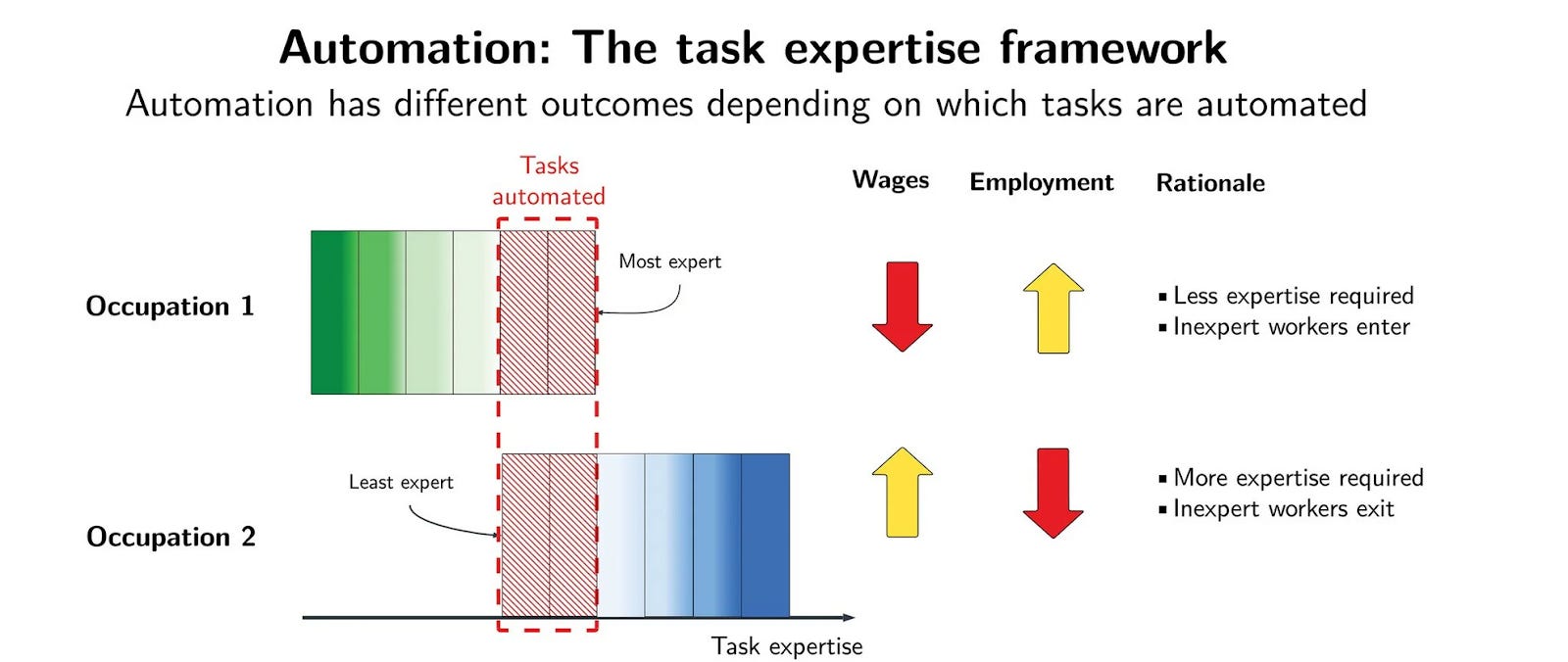
Source: The Digitalist Papers
Bouke Klein Teeselink (KCL) and Dan Carey investigate the influence of expertise on AI automation across 39 countries, using hundreds of millions of online job postings as a measure of labour demand. Their study finds that AI exposure reduces job postings in affected occupations by 6.1%, particularly in countries with stricter employment protection and lower digital readiness.
This paper is the first empirical application of Autor and Thompson’s expertise framework to AI automation. Its 39-country design, which controls for sector-specific changes over time, is designed to be robust to popular alternative explanations, such as interest rates. They combine online job postings with an LLM-generated prediction of AI-driven changes in task-level expertise.
The expertise framework predicts that when automation raises skill requirements, wages should rise while employment falls. Klein Teeselink and Carey find that the wage prediction holds partly: occupations in which AI increases expertise requirements have higher wages, while expertise-lowering automation doesn’t affect wages.
The employment results are even more nuanced. Expertise change alone does not predict job postings. One explanation is that rising skill requirements displace incumbent workers even as they shrink the applicant pool, generating offsetting pressures. But expertise does shape how much AI exposure translates into displacement: occupations where AI lowers expertise requirements lose 7.3% of job postings, compared to only 4.9% where AI raises them. When remaining tasks demand scarce human skill bundles, firms have less ability to substitute AI for labour — a dynamic the next paper explores further.
Overall, the effect of AI exposure on hiring is broadly negative: 31 of 39 countries show declines in job postings, 14 of them statistically significant
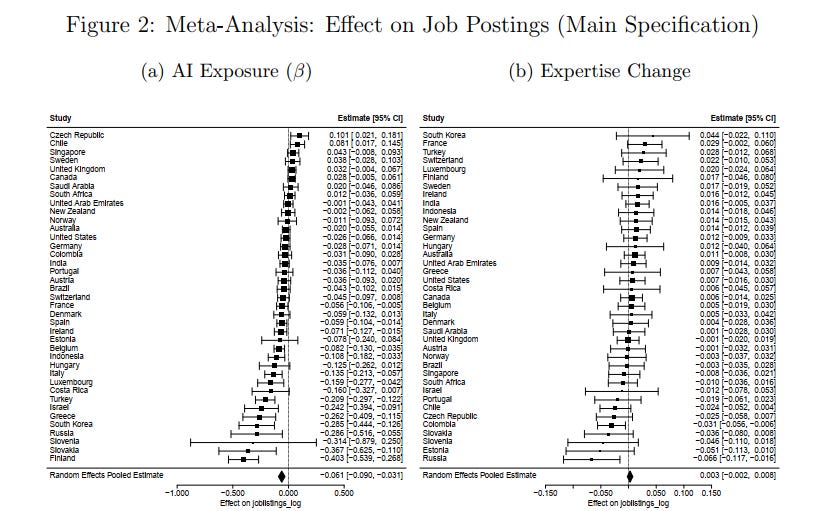
Source: Klein Teeselink & Carey (2026)
While Klein Teeselink & Carey empirically demonstrate the importance of expertise composition, Seyed Hosseini and Guy Lichtinger (Harvard) explain theoretically how expertise matters through their productivity-scarcity race framework.
In their model, each job has an expertise threshold that workers must meet to qualify for it. AI affects the labor market through two competing channels: first, it increases productivity, thereby increasing labor demand, as they assume that occupational outputs are substitutable. Second, and more novel, it reduces occupational barriers and increases labor supply, thereby eroding wage premiums for professionals by increasing competition.
To estimate their countervailing forces, they construct two empirical proxies via LLM classification: One measuring how much AI boosts worker productivity within occupations, and another measuring how many new workers become qualified as AI lowers expertise barriers (PSS).
Most automation measures ask only whether AI can replace a task entirely; Hosseini and Lichtinger also model tasks that remain human-performed but become easier with AI assistance. This allows more workers to perform certain jobs. As the graph below shows, the upper-middle class faces the most new competitors, whereas low- and top-expertise workers face fewer new job entrants. Meanwhile, the greater the expertise required for the job, the larger the productivity gains.
Overall, these countervailing forces limit AI’s net impact on wage inequality. However, this aggregate finding masks an exception at the top: the highest-expertise workers remain insulated because the talent pool in the extreme right tail is too thin for even a large supply expansion to meaningfully increase competition. For some professionals, occupational licensing, such as for doctors or lawyers, may suppress the supply response and allow protected professionals to capture productivity gains rather than their unlicensed competitors. This may insulate the most talented and protected professionals from new entrants.
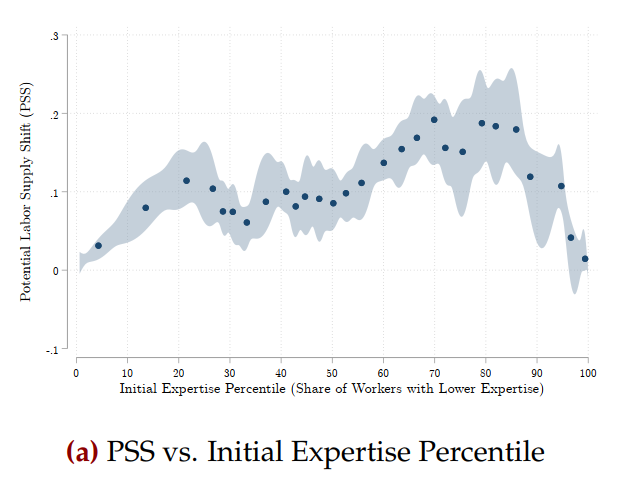
Source: Hosseini and Lichtinger (2026)
Our analysis: These nuances are invisible to aggregate measures. For instance, simple exposure indices, as used by the Yale Budget Lab and the Economics Innovation Group, conflate automation that raises expertise requirements with automation that lowers them. These have opposing effects on wages and different magnitudes of displacement. This heterogeneity, driven by varying changes in expertise, may explain why aggregate exposure measures detect no overall employment effects, although they do detect effects in subgroups such as early-career workers.
The KCL paper reports a reduction in labor demand. Meanwhile, the Harvard paper suggests that AI increases labor supply by reducing entry barriers to many jobs. Both effects are mediated by shifts in expertise due to AI. Collectively, this would imply falling wages, which the data do not yet show: AI automation might potentially raise productivity enough to offset pressure from increased job entrants and reduced labor demand.
While the aggregate distributional effects may be muted overall, one group in particular faces adverse effects: Greater competition for well-skilled jobs places unique pressure on the upper-middle class. This aspirational class of junior lawyers, consultants, and coders benefited from decades of skill-biased technological change that rewarded education and specialised skills, but now faces headwinds in the labor market.
While these papers identify which workers face displacement risk, the policy question remains: What should governments do about it? David Autor (MIT), Anton Korinek (Virginia), and Natasha Sarin (Yale) discussed the future of work and policy responses in the New York Times. While they believe current labor-market effects are ambiguous, Korinek treats the $300 billion in AI infrastructure investment in 2025 and market valuations as a promising bet on transformative AI. To prepare for transformative AI, Korinek wants to build new institutions now, but Sarin questions whether the uncertainty justifies doing so rather than strengthening existing tools.
Autor agrees with Korinek that AI could undermine the indispensable role of human workers in the economy, but he focuses on the short-term changes in skill requirements discussed above. Nonetheless, he suggests universal basic capital (UBC) and wage insurance as solutions. UBC would give every person a stake in productive assets at birth. Unlike UBI, UBC addresses inequality by granting citizens permanent property rights rather than providing recurring transfers. Autor argues UBC would maintain citizens’ status as stakeholders rather than dependents on transfers, which he sees as important for democratic legitimacy. Autor suggests beginning to implement UBC now for future generations.
To cover automation shocks in the short term, Autor also proposes wage insurance. Displaced workers who accept lower-paying new jobs could receive a 50% subsidy on the difference between their previous and new wages. This would support job transitions, thereby reducing the need for unemployment benefits.
Our analysis: UBC and wage insurance could be valuable because they work regardless of AI’s trajectory. UBC would address wealth concentration and unequal access to capital markets, even without transformative AI; wage insurance would ease job transitions and wage rigidity, whether driven by AI or other structural shifts.
Labor Market & Employment
Mert Demirer (MIT) and his coauthors from Yale, Microsoft, and MIT model AI automation as a chain of tasks.
Christian Catalini (MIT), Xiang Hui (Washington), and Jane Wu (UCLA) develop a model that focuses on the verifiability of tasks instead of, e.g., tacit knowledge as the main human bottleneck.
Anson Ho (Epoch) tests frontier AI agents on his real-world work tasks and finds them far less capable than benchmark scores suggest, arguing for subjective task evaluations over standardized benchmarks such as GDPval.
Opus 4.5 automated 3.75% of tasks of the Remote Labor Index, which implies a doubling time of roughly 4 months. This could be a big deal for the economy at the end of the year, according to superforecaster Peter Wildeford.
The Bank for International Settlements estimates a 4% rise in labor productivity in the EU due to AI adoption.
AI Capabilities & Infrastructure
Tom Cunningham (METR) predicts that AI will shift from knowledge sharing to knowledge creation. This would help with AI R&D, increase AI inference variable costs, and make frontier AI less accessible due to more inelastic demand.
Parker Whitfill (MIT) updated a converter that maps compute predictions to the METR time-horizon graph.
Erik Brynjolfsson (Stanford) claims in the FT that AI might start impacting the economy’s productivity.
The FT explores the productivity effects of coding agents.
The German Bundesbank shows that AI-adopting firms are expected to achieve higher productivity gains.
Basil Halperin (Virginia) discussed, on the Justified Posteriors Podcast, leading indicators of transformative AI, conditions for the singularity, and tax policy at the end of history.
Epoch reviews economically useful task benchmarks.
Research Opportunities
The NBER Economics of AI conference will be held by invitation only in Toronto from September 23-24.
Thanks to Joel Christoph, and Ankit Mishra for contributing to the creation of this week’s edition of the newsletter. Disclaimer: Jacob Schaal, co-author of the AI Economics Brief, works with Bouke Klein Teeselink at KCL.
Comments
Nothing yet. Say the first thing.
Sign in to join the conversation.