
The suits so far:
The suit of Suns— Mapping the spiritual realm.
The suit of Spades— Digging out of material reality.
The suit of Hearts— How the mind makes sense.
So much time and effort has been spent by humans trying to define truth. The Greeks were obsessed with it. All varieties — metaphysical truth, mathematical truth, social and political truth, natural truth, scientific truth…the list is endless.
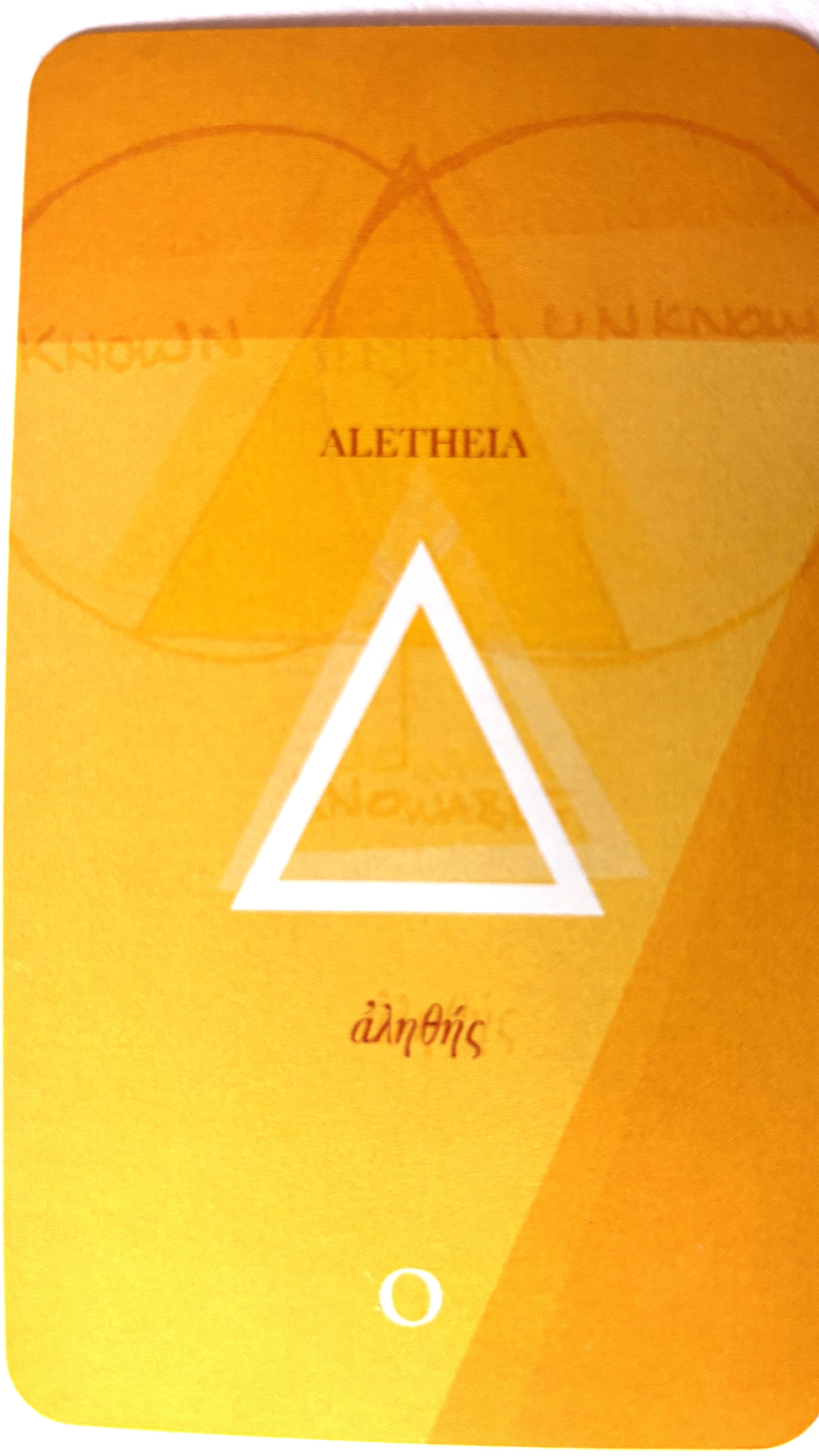
Because of this, I want to start out by identifying the specific kind of truth that the suit of Diamonds from the Aeonology deck is talking about. The Ace of this suit is the card with a single yellow triangle, facing outward. This is the card Aletheia, which means ‘Truth’ and refers to outward, external truths — truths about nature and the world outside ourselves.
The translation of the word Aletheia literally means “that which is to be revealed,” so immediately this is referring to a particular kind of Truth— truths that are unknown and hidden, but possible to know and verify. This is a stark contrast to the unknowable truths I discussed in the suit of Suns (link above), which covers all the unknowable and spiritual truths that require faith.
Because Aletheia is in Syzygy with Nous (mind), it is also the opposite of the mind-dependent truths that I talked about in my precious post (above). The mind-dependent truths are the stories we tell ourselves in order make sense of the chaotic range of inputs we receive — such as logic, reason, creativity, or imagination.
Once again, ancient wisdom had a very specific take on this conundrum. They were realists, believing that external truth existed independently of the mind and was there to be discovered progressively. It was not constructed, not authorized, not invented.
They were also very honest about three central challenges that such a perspective immediately creates:
1. If Truth exists independent of mind, how do you access it given that our minds are fallible and finite? How do you separate what the mind projects onto the world from what the world actually is?
2. What is the hierarchy? There are so many different varieties of truth and the relationships between them seems impossible to untangle—social truths rest on psychological; psychological rest on biological; biological rest on chemical and so on and so forth. Which layer are we looking at and what direction does an explanation of truth flow? Which truths are derivative and which foundational?
3. Given the imperfections of language, how can we express or represent truth accurately? This challenge was famously explored by Martin Heidegger in Being and Time (1927), who argued that the Church’s translation of the word ‘Aletheia’ had lost its original meaning: A — “not”; Lethe — “hiddenness”. The Catholic Church translated it poorly as the Latin veritas, which means something verified or confirmed by authority — an authorised truth. You can see how that worked in their favour.
Consistent with the Hermetic maxim: “as above, so below; as within, so without,” the suit of Diamonds, beginning with Aletheia, seems to mirror the multi-dimensional structure described in the my post about Nous (Mind). On first appearance they seem inconsistent and incoherent, but as you pull back the layers, and understand the relational nature of the aeons, these help us to understand why the surface looks the way it does.
This way of viewing the world is also very consistent with Alchemy, where the deeper you dig into the nature of material objects, the closer you get to the foundational elements of the periodic table. Along the way there are interesting and useful combinations of elements, such as alloys and chemical reactions. These facts about how materials behave are incredibly valuable and undoubtedly true, but to understand why they behave as they do, you need to keep digging until you can go no deeper. It’s a familiar pattern: truths on the surface that initially seem chaotic or contradictory cascade down to deeper truths that explain and support their coherence — surface truths, derivative truths, and foundational truths. Material, psychological, and spiritual. Mind, body, spirit; Father, Son, Holy Ghost. The ‘Tria Prima’ of Alchemy — reactions/interactions; chemicals/alloys; foundational elements of the periodic table.
(As a side note, and not by coincidence, this is also the structure of the Aeon card deck. The Aces of the six suits are the foundational ideas that need nothing else to explain them. The remaining cards exist because of, and by virtue of, combinations of the primary Aeons upon which every card is built.)
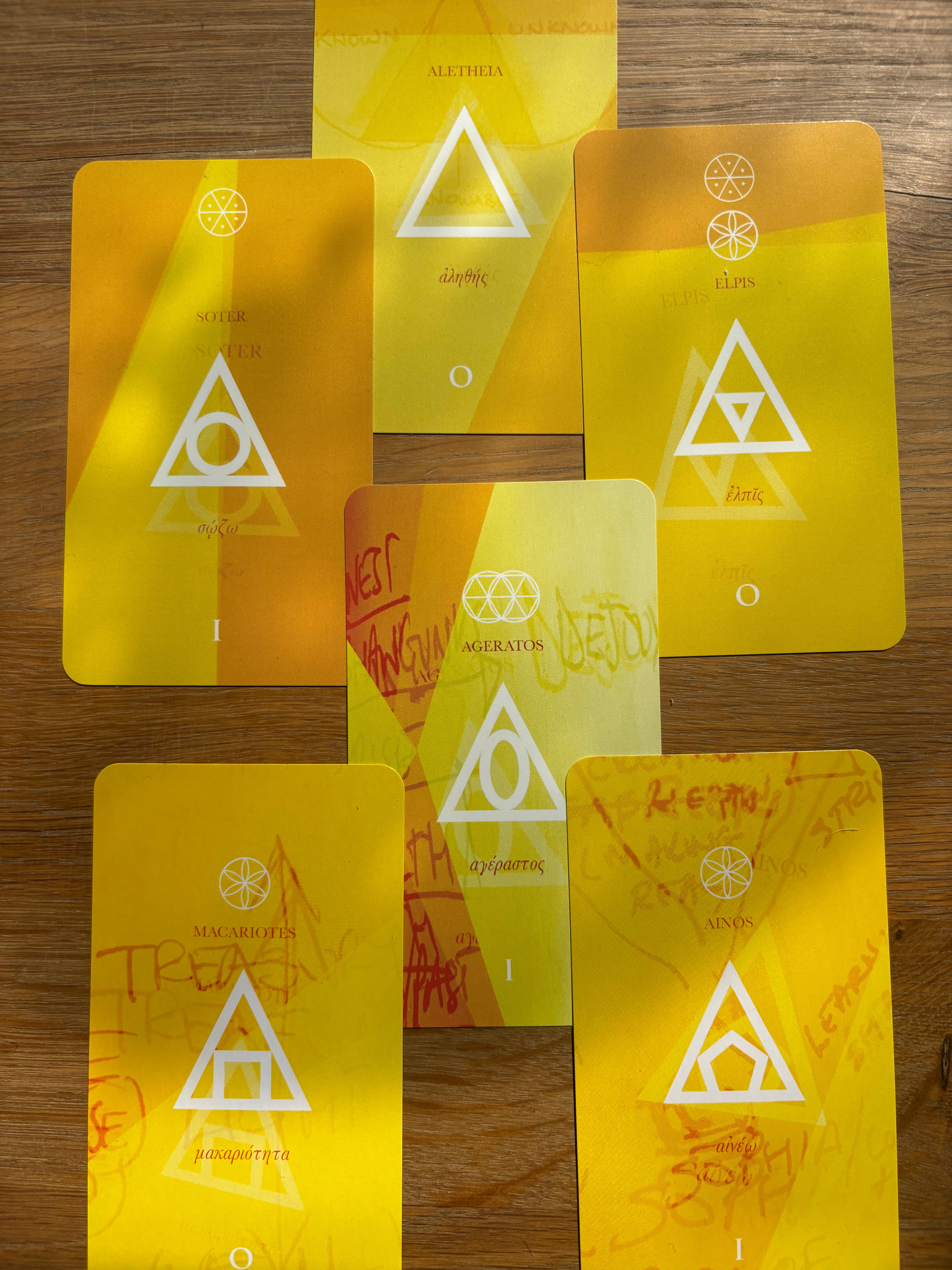
The suit of Diamonds is all about the discovery of ‘mind-independent’ truths. Objective reality. The instinct that, despite the fallibility of the mind, the universe is a layered reality where what appears to be true on one level can be dissolved, revealing deeper structures beneath it. A hierarchy of revelations. This suit follows that descent — from apparent truths to more foundational ones.
William James in The Principles of Psychology (1890) is perhaps the most articulate person I’ve found on this subject. He identifies two completely different ways of knowing. The first he calls ‘knowledge about’ — logical, propositional, built from description and inference. The second he calls ‘knowledge of acquaintance’ — direct, immediate, and felt. The example he gives is simple: you can know every fact about the colour red — its wavelength, neurological pathway, cultural associations — but you will never know red the way someone who has seen it does. An artist who paints it. This direct knowledge, James argues, operates on an entirely different register of knowing. A different phenomenology. It feels less like arriving somewhere and more like remembering where you already were.
This journey from information (assumed fact) to experience is also fundamental in Plato’s cave analogy —where foundational truths are obstructed by a person’s limited vantage point. When a viewer of the shadows on the cave wall walks towards the light, it is not because they have better information than the others but because something within them refuses to accept the shadows as the final truth. The destabilizing of the apparent is where the suit of Diamonds begins.
Aletheia (Truth): The literal translation means “not hidden” — “that which will be revealed.” In many Christian texts, when the Gospels were converted from Coptic/Greek into Latin for use by the Catholic Church, the word Aletheia was translated as veritas, which means ‘verified’. This convenient corruption is why we tend to think of Truth as singular and authorised, rather than as a wonderful, mysterious, and ever-evolving understanding of our surroundings.
The kind of Truth Aletheia identifies is not primarily “knowledge about”. You can gather enormous quantities of facts, descriptions and second hand knowledge but still be only looking at the shadows on the wall. This is exactly the experience many of us are having today with AI— an impressively organized mountain of second-hand facts, but absolutely no experiential knowledge at all. It is 100% factually true, but when you read it, when you scrutinize and question it, it doesn’t feel true at all.
The Truth that the Aletheia card points us towards is this deep felt, foundational Truth. The difference between knowing about the physiology and psychology of love and actually loving someone. Between understanding grief as a staged process and actually grieving. I find a similar distinction between people who know the theoretical, linguistic and theological origins of the Gnostic Aeons and those who actually use them as a practice—actually experiencing them and learning to recognise them in lived experience. A profound difference between unearthing forgotten truths through practice, ritual and lived experience rather than via academic or theological study.
Soter (Saviour): In the context of early Christian texts, it’s easy to think this card is a reference to Jesus Christ. But in Aeonology, we are dealing with pre-conditions to the stories in the Gospels. Soter is the Aeon of protection and rescue — relief from your current state and transportation to something better. What Soter specifically rescues you from is false or insufficient truths that you have settled for. It is this power that allows Soter to transport you away from your pain, suffering, concerns, and anxieties and takes you to a new, more fulfilling starting point. To test an apparent truth by refusing to accept it. It’s a good discipline, because we all tend to try to solve problems by adding things — but sometimes the answer lies in simplifying by subtraction. The simple removal of an apparent truth, such as an obstacle or a concern, can free us from the condition of “problem saturation” and return us to more fundamental goals. This is not scepticism —scepticism removes possibility and leaves nothing. Soter removes something in order to reveal deeper Truth
The history of science is largely a history of Soter. Galileo or Einstein did not arrive at their discoveries by adding to existing knowledge. They refused to accept the scientific conventions of their day and were able to reconfigure the underlying facts in new ways to advance human knowledge. Quantum mechanics emerged because someone asked, ‘What if classical mechanics is insufficient?’ This is the destabilising power of Soter — a willingness to walk away from an apparent truth and sit with it’s absence.
Elpis (Hope): Once a truth has been destabilised, something almost always emerges to fill the void. Not certainty, but possibility. I remember hearing a contemporary life coach or spiritual leader describe a question they put to their clients: “What could you be, in the absence of your concerns?” This question illustrates the dynamic of Soter and Elpis — where Soter removes the obstacle and Elpis fills the void with new possibilities.
I discussed this in detail in the card reading for 2026, where this card (Elpis) was the ultimate outcome. In that post I describe three different ways to interpret Hope — in that reading it was in the context of Abraxas, but the discussion is very relevant here.
In one sense, Hope can be a negative force — a false hope where we double down on an apparent truth because it feels comfortable and we are unwilling to question or challenge it. This can lead to stagnation and disappointment. In the other sense, where Hope is a positive force — especially for someone with a strong grip on reality and truth — Hope can be an energising force that fuels perseverance and resilience. An anticipatory joy that sustains the pursuit of deeper and more fundamental truths. Again, the great scientific discoveries were almost always the result of someone who felt deeply that our current understanding is not final, and that there is a better way to articulate what is real, even when you cannot yet see it.
(Interestingly, comedian Jon Stewart, just did a ‘bit’ about the elections in Hungary where he talked about hope. Not only did it illustrate the positive power of hope, it also went some way to show how the 2026 reading continues to be ‘on point’!)
Elpis is the Aeon that helps you continue when certainty is removed. It is the intuition that Truth can always be improved upon.
Ageratos (Eternal): If Hope drives inquiry, Ageratos ends it. Or rather, Ageratos is what inquiry, if pursued honestly and far enough, eventually turns into.
The challenge raised by the first three cards of this suit is important: if Truth is constantly being improved upon, does it ever end? Are we moving endlessly from one layer to another, never reaching anything that holds its own? This is what Sean Carroll refers to as “turtles all the way down” — a reference to the meaninglessness of infinite regression, of the world being supported on the back of a tortoise, which sits on a larger tortoise…and so on and so forth.
Ageratos is the answer to this question. It is not ‘turtles all the way down’.
There are fundamental and foundational truths that form the bedrock of our reality — and that bedrock is an aeon that does not age, does not shift and does not depend on how many layers you’ve peeled back. In the same way that infinity represents something without limits in mathematics, and ‘true nature’ represents the progression towards your inner-most personal truth, Ageratos represents the ultimate experience of external Truth — an eternal agelessness or divine inexhaustibility. This is an answer that needs no further explanation. It simply is. (There’s much more to unpack here which I’ll save for another post. If you want to find out more, check out Gregory of Nyssa, who describes a theology of infinity he called epektasis.)
Macariotes (Utopia): By now, you may be recognising the structure of these Aeons. The first three or four cards describe the nature of Truth and the forces that drive its discovery, the final cards describe the behaviours that make the journey possible.
In the case of Suns, it was Pistis (faith and determination). In the suit of Hearts, it was the constant refinement of Theletus (perfection). In the suit of Diamonds, the two orientations are towards Macariotes (happiness and bliss) and Ainos (gratitude).
Macariotes carries a very specific promise that the truth is worth seeking and that the pursuit of truth leads to somewhere genuinely ‘good’. Not merely useful or accurate. Good.
Ainos (Praise): The final card of the suit is Ainos which means praise — the recognition of goodness outside of ourselves. A generosity of spirit and a willingness to see good in others —giving credit where credit is due. Ainos asks us to recognize that our own pursuit of truth has been shaped by others, those who went before us, those who inspired us, those who contributed along the way. This is not an act of intellectual integrity, it is a fundamental part of what truth actually is.
Truth, like success, has many authors. We all build on the ideas that have come before us and contribute our own unique perspective. The seeking of truth is a relationship with other people. A great example of this can be found at the end of Sean Carroll’s video “Einstein’s Most Radical Thought.” Although we attribute incredible discoveries to Einstein, modern physics credits its progress towards a better understanding of reality to many different people working together.
Comments
Nothing yet. Say the first thing.
Sign in to join the conversation.