
In case you missed it:
The suit of Suns— Mapping the spiritual realm.
The suit of Spades— Digging out of material reality.
The suit of Hearts— How the mind makes sense.
The suit of Diamonds— Playing games with Truth.
Having explored the dimensions of Mind, Truth, Materiality, and Spirituality, you might ask yourself: what dimensions are left?
Well, between the inner/outer and higher/lower, there are still two more suits. The suit of Shields articulates the nature of embodiment and being—the dynamics of existing as an individual body. The suit of Flags is also about our existence, but this time within social vessels—the communities we exist among.
Our being is split between two different arenas: within and among. In one, life moves through us as we narrow in on what really matters—the foundations of being alive. In the other, we are surrounded by many lives, in many places, with many perspectives and so much social creativity. Our social vessels shape us and sustain us through identity, belonging, partnerships, and exchange. It is not a choice of one or the other, because neither can be escaped.
So, let’s start with the first of these: the suit of Shields. I chose the name “Shields” because so much of this suit is about identifying and protecting the things that really matter to us—prioritization, focus… a narrowing in on our true nature and our true will. The shape on all of these cards is the oval, and it simultaneously represents a shield that protects what matters and a lens that focuses our actions on the importance of those things.
There is a lie that we all live: that each of us is a finished thing. A human being. A personality type. A genetic predisposition to everything. Some believe we are the sum of our past and a precondition of our future. Because we walk, we talk, we make choices and express beliefs, it is often assumed that our being is complete. That we arrive with all our identities and nature pre-fixed. Cogito ergo sum.
All very nice and neat—but ultimately an illusion. An illusion of rational continuity that barely holds water. Any observation of humans—any critical analysis of what we say and what we do—reveals the truth: we are not only incomplete, but deeply divided within ourselves. We are in constant rebellion with our desires, in doubt of our ideas, unwilling or incapable of recognizing or articulating the instincts, passions, and motives that drive much of our behavior.
We might sing from the top of our lungs, “This is my life…”, believing we deal our own deck—but the truth is, our life on our own is not complete. We are not self-sufficient. We are fragmented and ever-changing. Indeed, any pressure toward fixation and stasis is almost always a product of power and oppression.
I have to thank my school friend Alison Tresidder for commenting on my last post about Heidegger and his articulation of human existence as an “openness to being.” Alison also pointed me toward the writings of Michel Foucault, which build beautifully on that idea.
As Alison said:
When you were writing about Aletheia, it prompted me to think of Michael Foucault (Post Modern writer)… I have always related to his writing on truth as not objective but as regimes of truth shaped by our histories, by those who hold power, and the constraints that a society imposes on what we can hold as truths. We can’t separate truths from the very systems that create them, church / politics / culture / family etc. His later writings he introduces “parrhesia,” the courage of truth.
I hadn’t read much Foucault beyond my philosophy studies over 40 years ago. But after this, I revisited his lectures—particularly those given in 1983 at Berkeley, California (towards the end of his life). In them, he describes the long, Greek tradition of giving an account of oneself as a “game of truth”—a game being to tell the truth about oneself and others without succumbing to fixed identities imposed by external forces. A game that he insisted “has to be confronted courageously.”
He goes on to describes the idea of a “true life,” which feels very aligned with Gnostic notions of fullness, Jung’s idea of ‘true nature’, and even Aleister Crowley’s concept of ‘true will’.
While this article is not about truth per se, there is something deeply resonant here with the suit of Shields. The symbolism of the shield and the lens captures this idea of courage: a defense against external pressures to fix on an identity, and a commitment to honesty and frankness in revealing what lies beneath.
I don’t think there has ever been a more critical time to have this conversation than now, given the universal impact of social media.
The importance of honesty and frankness in the “game of truth” that we are each playing on these new, massive digital platforms.
What do we share?
How much do we share?
With whom?
Do we care about the impact of our game playing is having on the privacy of others?—or the consequences of these external projections on our own sense of self?
What Foucault’s lectures made me think was how powerful the digital platforms are in terms of rewarding dishonesty and deception. They incentivize a fixed identity—a personality defined and reinforced by the algorithm. The algorithms within these platforms suppress ordinariness and normality because it doesn’t drive revenue, and instead reward performance, virtue signaling, aggression, outrage, and division.
It has become so bad that we can no longer see the line between who we are and the image we are projecting.
I found myself asking: what is the ‘game of truth’ that I am playing with my writing and my social media posts? Am I the sum of my content, at least in the eyes of the people who see my posts? Am I being true to myself and to others in my representation of myself and others? Or is the '“true William” a secretive and private practice? Is the only true William the one I explore in the safety of my own mind. Would I ever be brave enough to put these private truths out there? Would I be courageous enough to live my whole truth in public, regardless of the consequences? I went through a similar process when I told the world I was gay—but I don’t know if I’m brave enough to ‘come-out’ on everything that is humiliating, embarrassing, socially unacceptable. diabolical and depraved?
I know the “true William” isn’t the one I present to the world. It’s not even the one I present to my friends, family, or community, for fear of consequences. The “true William” is probably the totality of everything I put out there, combined with everything I suppress. This idea—this notion of wholeness as a kind of radical honesty—is where I want to begin the discussion of the suit of Shields.
“Most people do not have sufficient range of consciousness to become aware of the opposites inherent in human nature. The tensions they generate remain for the most part unconscious, but appear in dreams.” Carl Jung, Aion: Researches into the Phenomenology of the Self.
We exist in a highly relational state, not as an object, not even as a ripple, but as a field of different relations: relationships with different parts of ourselves, relationships with others, relationships with nature. We never are, and never will be, a “being” in any static sense. We are beings who only come to know ourselves (and our deficiencies) through our encounters with ‘otherness’.
This is the fundamental idea that Valentinus, in the first century CE, came to and incorporated into his aeonology. He believed that human beings, both collectively and individually, were divided, incomplete, and ignorant, but that through interaction and relationship they could restore themselves to wholeness, fullness, and completion.
“It is not possible for anyone to see anything of the things that truly exist unless he becomes like them.” Gospel of Philip Nag Hammadi Texts.
Later on in the same Gospel of Philip the text states “The existence of the world depends on marriage. Think of sex. It possesses deep powers, though it’s image is filthy.”
This has a profound implication for how we consider Anthropos. The traditional interpretation is that it refers to our state of being as individuals—a soul inhabiting a body. However, Valentinus introduces a more expansive idea. Anthropos is both the state of being of an individual soul and the cumulative contribution that each human being makes to the progress of humanity as a whole. It is both the individual self—will, ego, identity—and a shared sense of being. In these early Christian writings, achievements for ourselves are insufficient; what we achieve must ultimately serve something greater.
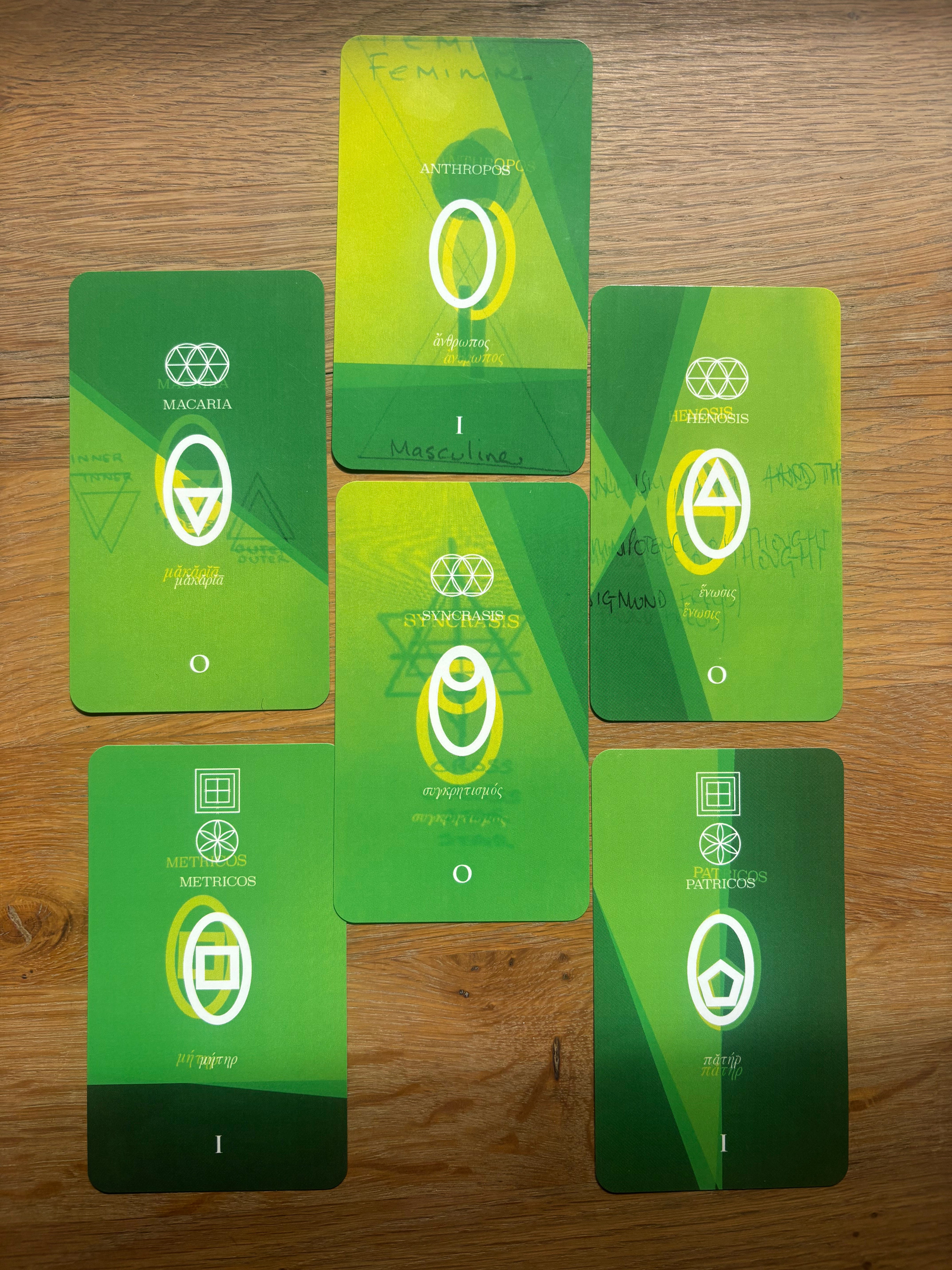
Anthropos (Mankind): The suit of Shields begins with the ace which depicts an oval against a green background. Our being embodied. A focus of will and intention. It suggests an individual contribution or legacy that serves ourselves and, ultimately, all of mankind.
Jung went into great detail about his understanding of the Anthropos which he defined as ‘primordial man’ — a collective pre-conscious state from which both the ego and libido emerge.
In Aion: Researches into the Phenomenology of the Self, he draws a direct parallel between the Gnostic figure of the Anthropos and the psychological ‘self’. Anthropos represents the primordial, unified human being—symbolizing a state of wholeness that encompasses both the divine and human, the spiritual and the material.
Anthropos represents the total personality in potentia, including the deeper unconscious forces that influence behavior and perception. As a result, Anthropos is not our own idea of ourselves— what, or who, we think we are—it is the lived reality as demonstrated through our relations with others. This suit of Shields, like the other suits, reveal a potential pathway to realizing this self but this path is through encounter and intimacy. The aeons within this suit moves us from a state of incompleteness and dividedness to a state of unity.
Macaria (Happiness). The exploration of our different dimensions of sensation and pleasure. Not a singular pleasure but an appreciation of the pleasures that satisfy the different sides of ourselves. This card depicts the shield with the downward (inner facing triangle). Anthoropos with an inner reflection. Know what makes you happy. Find the things that bring you joy. Ultimately, focus in on what you deeply care about.
Happiness is both anticipatory and experiential. Desire and will made real. Acted on, delivered against. Experienced. As some desires dwindle others grow. The card of Macaria reminds us to reflect on our understanding of our own happiness, and constantly deepen that understanding of what makes you happy through experimentation —not only what makes you happy now, but also how you would like that happiness to evolve and grow.
It is also a reminder, as the discussion of Anthropos above, that we are often unaware of the “range of opposites” that are inherent in human nature. The tensions that we hold are often the result of fear to embrace or acknowledge these opposites. A lacking of courage to acknowledge them and act on them, regardless of the societal or relational consequences. Suppression leads to the setting of emotional limits, rigidity, lack of spontaneity and creativity as well as relationship challenges and unexplainable behaviors.
So, you can see why this idea from Foucault of “the courage of truth” really plays out in the card Macaria and the importance of courage to find what makes you happy. Have the courage to explore what happiness truly is, in all its guises. Not only the happiness you admit publicly but also the ones you keep hidden. Throw out all self-limitation to your own happiness.
Henosis (Union). If the card with the inner-facing arrow is happiness, then this card, Henosis, has an outer-facing arrow to represent marriage and partnership. As I said, this whole suit is about our relational selves, but the card of Henosis is not about any old relationship or intimacy. This card identifies specific kinds of relationships that become intertwined with our own sense of being—the relationships that define us in ways that we could not define on our own.
Valentinus wrote a lot about how we are attracted to ‘otherness’, that in our own right each of us is one half of a syzygy, and each of us is not whole in isolation. This incompleteness is what drives us to be on the lookout for those unions of complementarity. This same idea—that each of us is born incomplete—exists in many places: Jung’s own psychological divisions between conscious and unconscious, anima (masculine) and animus (feminine), ego and self. Chinese alchemy also has the idea of zhenwren, which translates as ‘true person’ and requires a reconciliation of opposites within the body. It is only by finding this complementary other that we are able to unite internal and external division and discover we are, in fact, part of something bigger.
I’ve often said this in relation to my partnership with Daniel (my husband), that our partnership is predicated on the fact that Daniel brings out a side of me that I know I would not be able to find on my own. That aspect of myself has not been revealed in other relationships, and it is a version of myself that I really like and that I feel really matters.
Of course, attraction and desire were the first steps toward this union. But where I disagree with Foucault is that he asserts that the otherness disrupts and confronts my projections of myself. I don’t think it’s such a violent or antagonistic experience. Instead, I believe it melts away (rather than confronts) some of the stories I tell myself and reveals an underlying truth about myself that I might not have otherwise found.
More importantly, what Henosis tells us is that this most important relationship in our lives is not ‘interchangeable’—it’s not the case that any relationship will do. Henosis is not about filling some gaps in my being; it is more a process of dissolving boundaries to reveal a very specific way that I am unfinished. The union with a true partner reveals how division can be overcome—how the solution to being divided requires recognition of the contribution, the give and take, with another. Syncrasis teaches us that self-satisfaction alone is not enough, and that greater, truer unity comes with the satisfaction of self and other.
Syncrasis (Intercourse): Of course we have to go here. The give and take nature of relationships and the specific experience of intercourse with a specific ‘other’ is what, for a moment, melts division and delivers a taste of what physical and spiritual wholeness might feel like—climax and release—an experience without which nothing in this world is created.
Syncrasis teaches us that self-satisfaction alone is not enough. Deep within us is a profound need for unity. Desire begins the aspiration but what it uncovers, through intercourse, is not simply a physical appetite for someone else—it reveals am inner insufficiency, just waiting to be made whole. A moment where we feel what it is to be undivided. A moments with another person where everything in us aligns and thought, desire, and action no longer compete.
One undeniable moment of ecstasy starts a journey of knowing and understanding together. A journey where we realize the potential of transcending our limits as individuals and desire to participate in mutual satisfaction and growth. Finding this experience outside of yourself opens the door to even higher-order exchanges, with others and with the universe as a whole.
Valentinus was obsessed with the human search for “divine union”—a yearning to transcend “otherness”. To breach all divisions, even the seemingly irremovable division between male and female. Later Kabbalistic traditions took this same notion of breaching the divisions and crossing seemingly strict lines in order to find unity as the justification to transgress all manner of social and sexual taboos. Aleister Crowley and other sex magicians also used a similar argument.
It’s easy in our puritan and taboo laden culture to dismiss this as an ancient mystification of the physical act of sex. But, the reality is that it is much more than this. Sexual imagery and language has long been used to express the ineffable nature of mystical experience and spiritual vision.
The Hermetic text Asclepius captures this blurring of human sexuality and human spirituality:
“for when the semen reaches its climax it leaps forth. In that moment the female receives the strength of the male; the male for his part receives the strength of the female, while the semen does this.
Paracelsus, a surgeon and chemist during the Renaissance, also used overt sexual imagery to explain the material transformation of salt and sulfur with the use of mercury. He compared this process to the intercourse of man and woman, who are united by semen in order to create a child —A precursor perhaps to a later belief that he orgasm was a means to focus the will and bring about magical effects in the physical world.
Patricos (Father) and Metricos (Mother). It’s impossible to separate these two cards in this rundown of the suit as these two cards are the ancient manifestation of what Jung later termed the Anima and Animus. The divine masculine and divine feminine that exists within each of us. Jung wrote so much about these that it feels unnecessary to repeat this here. The important distinction within this narrative is that what started as a need for ‘otherness’ (or rather a desire for otherness) manifests in a revelation about our own psyche —that we each have within us a father principle and a mother principle.
To Jung’s articulation, the anima is the unconscious feminine side of a man— connecting, relating and nurturing; the animus is the unconscious masculine side of a woman— structuring, ordering, protecting. They are not internal gender identities, but instead functions:
“[Anima and Animus] represent the supreme pair of opposites, not hopelessly divided by logical contradiction but, because of mutual attraction between them give the promise of union and actually making it possible….
…To begin with we mostly meet the Anima and Animus in the negative and unwelcome form, but they are very far from being a species of bad spirits because they have an equally positive aspect.” Carl Jung, Aion— Conclusions.
Interestingly, Patricos and Metricos are not a syzygy. Metricos is paired with Agape (Love) and Patricos is paired with Elpis (Hope). Patricos is our paternal authority that sets boundaries, creates rules and has a strong sense of ownership, duty and responsibility. But the irony of ironies is that the Father is incapable of creating anything alone. As a result the paternal instinct is to take a strong, active interest in protecting what has been born in his name. Metricos on the other hand is the divine feminine, the giver of life, the nurturer and the power of transformation through renewal and empowerment. As mentioned earlier, these dynamics relate not only to how we nurture and protect ourselves, our ideas or our families/groups. The experience of intercourse and partnership with others is what opens our perspective to a bigger responsibility outside of ourselves— to nurture and protect all of mankind.
Comments
Nothing yet. Say the first thing.
Sign in to join the conversation.