
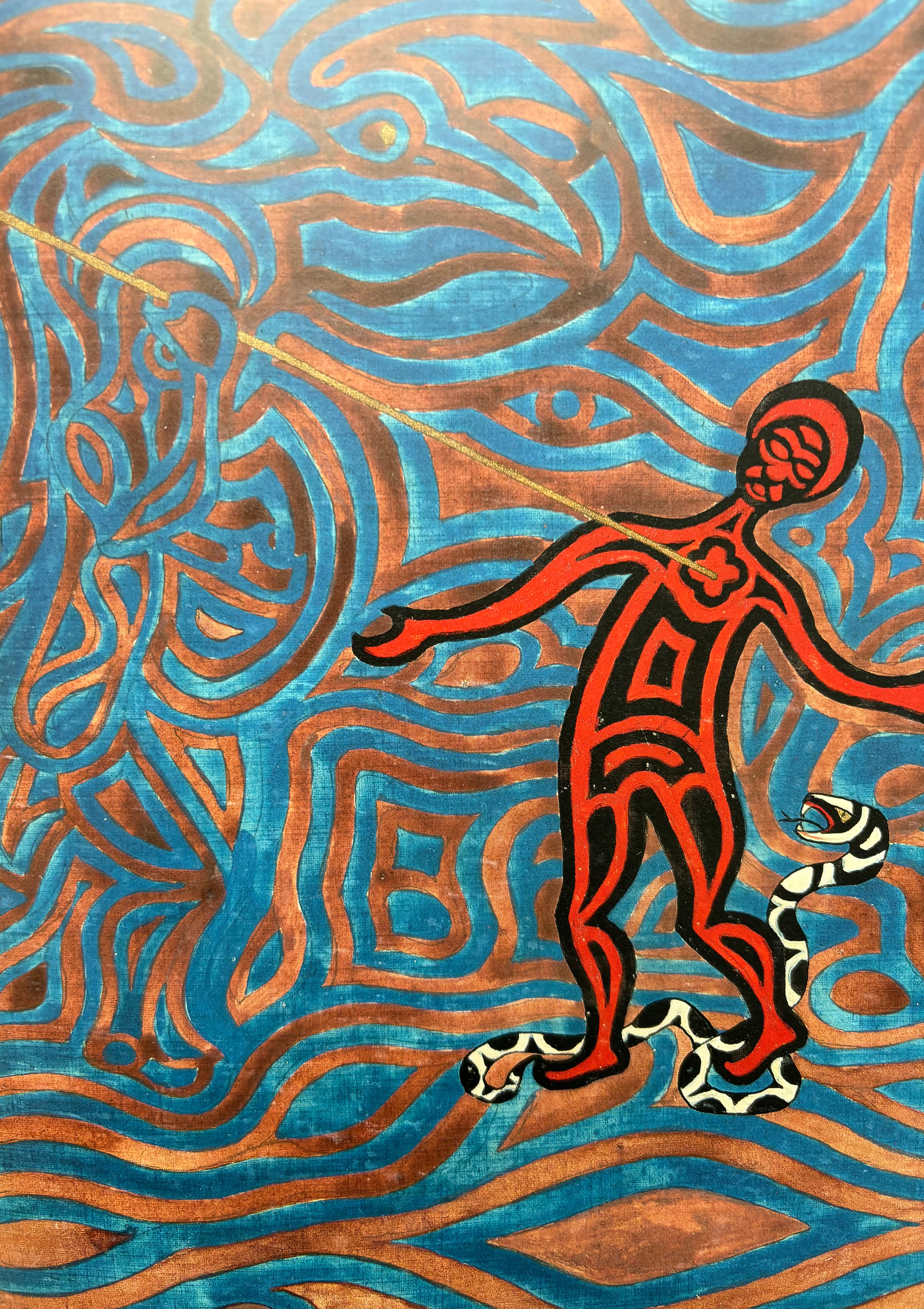
The first two suits of cards have demonstrated the primary layers of reality that exist for us—material and spiritual. This week I’m covering the third: the psychological. The layer that mediates between them. The mind is a truly amazing thing, and it’s not surprising that in the first century this was one of the first things to be explored in Valentinus’s Aeonology. Despite the truth that Descartes asserted—that the mind is the only thing we can truly know—it is remarkable how little we actually understand about it. We don’t really know what the mind is, where it is, how it works, or why we even need it. Surprisingly, texts from two millennia ago land on a very specific perspective on the nature of the human mind and its different dimensions.
All ancient cultures recognize our ‘interspace’ existence—“the midst,” as the alchemists called it. A place between two extremes. On one side, the imperfect, chaotic, unending contradictions of the material world. On the other, a spiritual realm that is perfect but unknowable and impossible to fully experience in life. The very existence of the spiritual world imparts in us a sense of knowing—an intuition—that we hold within us the potential to become more balanced, more whole, and more perfect. This divine promise drives us to seek more knowledge so that we might better understand the universe—to discover or perhaps remember (because we are born of it) how it is more coherent than it initially seems.
Unlike some of the Gnostics, I don’t necessarily subscribe to the idea that the material world is abhorrent and must be rejected—although, at times, the ugliness in the world might tempt me in that direction. But on the whole, my experience of nature, relationships, food, and sex are far too good for that to be true. Neither do I feel that you have to be unhappy or feel that you’ve failed in some way in order to seek meaning beyond your current state.
As I’ve mentioned before, I also don’t buy the idea that the material and the spiritual exist in separate realms. It’s why the principles of quantum mechanics appeal to me. Quantum mechanics introduces the idea that irreconcilable opposites can exist simultaneously. Everything is both an object and a force—a particle and a wave. Everything can be itself, its absence, and a superposition of both at the same time. This complexity of a multidimensional reality makes deep sense to me. Things that seem good turn out to be bad. Things that appear black, in different contexts, look white. Sometimes the absence of a thing is more powerful and impactful than the thing itself.
It seems highly reasonable to me that both material and spiritual dynamics are present simultaneously and are, in some ways, just different modes of processing our experiences. One way we process things is through reason—seeing the world as a collection of data, different pieces of information. When looking at the world through this informational lens, we navigate through argument and evidence and are able to identify material truths of ‘what is’ and ‘what is not.’ These truths can be verified and/or refuted. This is the arena of science, mathematics, engineering, logic, and reason.
The other way of organizing our experiences is through the lens of myth and storytelling. We assemble narratives—selecting and weaving together truths about the past, present, and future that inform ‘who we are’ and ‘why we are here.’ It is this storytelling capacity that gives us a sense of potential and possibility. Stories give us our sense of meaning—stories about where we come from, who we identify as, what is expected of us, what people like us care about, talk about, focus on, and aspire to be.
Humans are simultaneously information-processing machines and storytelling machines. We perceive and assess the world through our senses and attention. We identify information and facts about the world and analyze them to arrive at shared conclusions with others about how the world is—what is true and what is not. This is the realm of scientific discovery, rational analysis, and peer evaluation.
At the same time, as we process cognitive facts, our minds also create stories and narratives about how experiences might unfold over time. Our past is projected into the present and into the future—and back again. It’s a process of pattern recognition and pattern bias—gravitating toward what is known and familiar, predictable rather than risky. Stories help us anticipate what is likely to happen based on what has happened before. By reinforcing the stories in our heads, rather than challenging them, we persuade ourselves that the narratives we’ve created internally are externally true.
These comedies and tragedies of the mind inform our hopes and fears. They are also the stories that allow us to imagine new, unexperienced futures. The stories we tell ourselves about ‘who we are’ and ‘why we are here’ are the building blocks of our identity, and these, in turn, inform how we think we should behave.
It’s almost impossible to know who we are or what we believe without reference to stories and narratives. What is a good person or an evil person? How should men and women behave? What is a mother, a father, a brother, a sister, a hero, a villain, a sinner, or a savior? What is success? What is failure? What family, tribe, or country do I belong to? The facts within these stories are, of course, informed by cognition and information processing. However, the true driver of most of our behavior—both conscious and unconscious—is our obedience to a small number of powerful stories that we have created and selectively reinforced about ourselves.
So, between materiality and spirituality lies our psychological realm—the bridge between experience (cognition) and meaning (belief). Cognitive thinking—perception, reason, and analysis—helps us make sense of the world around us. Interpretive thinking and meaning-making, through the construction of narratives and beliefs, help us navigate from chaos to order—from uncertainty to imagined futures.
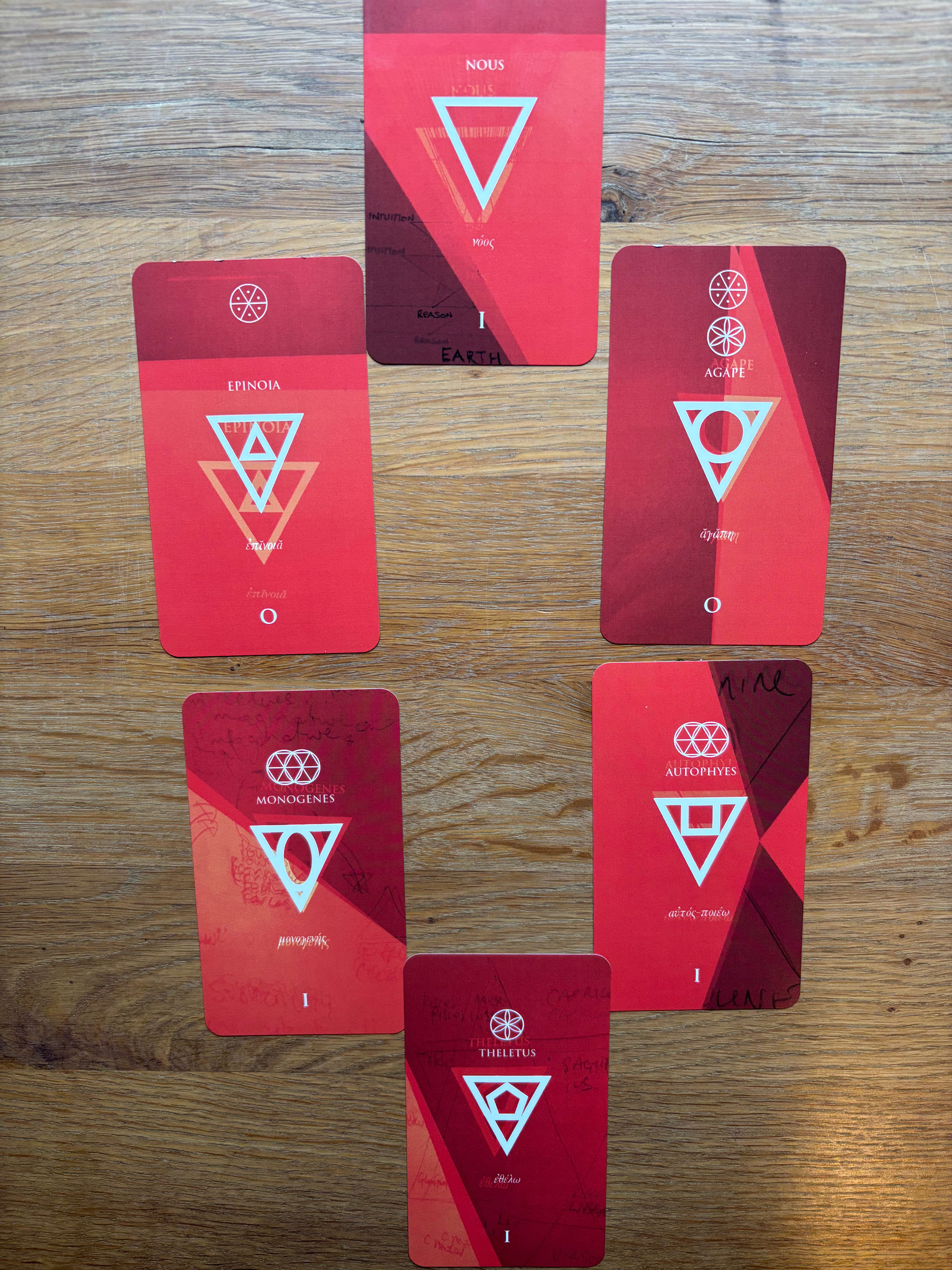
The suit of hearts is poorly named, my fault, because it started off as a reference to looking inwardly —introspection. Internal authority. But as my cards transitioned from behavioral archetypes to Aeonology I understood that the suit of Hearts aligned with the Aeon called—Nous (Mind).
The only good thing about this suit being called ‘Hearts’ is that it intuitively helps to direct people away from the contemporary obsession with logic and reason and instead emphasises the more interpretative—meaning-making—dynamics of the human mind. In ancient times, the notion of Nous or ‘mind’ was at the highest level of intellect. It spanned conscious, unconscious, intuitive, instinctual, rational and emotional. As we will see from the different cards in the suit, it also incorporated mindfulness, self-actualization, creativity and imagination.
Nous: This journey starts by looking inward, with the Ace of Hearts, represented by a single downward (or rather inward) facing triangle on a red background. The ace of this suit is ‘Nous,’ which means Mind.
This card represents the magical (and still difficult to explain scientifically) human capacity to perceive the world around us—to have thoughts, to analyze experiences, and to develop ideas in relation to them. We preserve these observations and emotions in the form of stories, memories, and narratives that we are able to recall and project into the future. Our mind is where our ideas of time and space emerge; without the mind, it is difficult to know if time is even a thing. The mind is a many-splendored thing—a multitude of inner layers mirroring the multitude of outer realities.
What’s interesting about the way Aeonology describes the various layers of the ‘mind’ is that it presents a mind that is fundamentally divided. Much like Carl Jung’s psychology, the mind operates across multiple dimensions that are not necessarily aligned. This dynamic results in a robust and spirited dialogue between its different parts—each of which must be embraced rather than silenced, if we are to move toward coherence.
The ancient texts are clear that this alignment—this sense of wholeness—does not require us to suppress any part of ourselves. Instead, we are asked to live with the inner tensions rather than try to resolve them—to hold contradictions without collapse. Peace is not the elimination of difference, but the capacity to respect it.
Epinoia: The card of creation. A recognition that the mind is not just a perceiving entity, but a creative one—active, not passive. It is the contemplative capacity to construct the ‘self’ through the stories we tell ourselves.
Epinoia describes the way the mind fills gaps with creation. When information is missing, when a pattern is incomplete, the mind is hard wired to imagine the whole. When opposing forces are held too long without resolution, we generate something new—an alternative that has never been seen before. A unique resolution. A third way. Epinoia is inventiveness, ingenuity, and the forward-projecting power of intelligence (reflected in the small forward-facing triangle within the larger inward-facing triangle). It is the power to contrive and fabricate new understanding—a new vision not borrowed from elsewhere, but originating from within.
Epinoia gives us the capacity to imagine futures and to construct the narratives that will help us achieve them. Reality is not something we simply find in the world—it is something we actively participate in shaping. The soul is not handed to us; it is made.
The most familiar aspect of Epinoia is the mind’s capacity to imagine—both voluntary and involuntary. The bringer of dreams, the generator of fears and insecurities, the capacity to ask ourselves “What if?” It is a place of will and action—an active, generative force. The good news here is that you are whatever you think you are. What you believe about yourself, especially what you believe deeply, becomes the framework through which you act and, over time, who you become. The mind is constantly projecting future possibilities and managing your emotions and behavior around them. Epinoia is the ancient recognition that our nature is fundamentally narrative—and that we are the authors of it.
Agape: Means Love. As mentioned before, my original deck had a suit of hearts, which aligned naturally with the Aeons of Nous. If Epinoia is the forward projection of intelligence, then Agape is the core energy of the suit—the fuel that propels us forward and breaks through the hard shell of ego and isolation.
Plato, in his Symposium, argues that love (not romantic love, but a higher form) is the most powerful force shaping the soul. From the appreciation of beauty, to the love of knowledge, to the desire to uncover truth, Agape represents the highest form of human empowerment.
Many philosophers have arrived at a similar conclusion, most notably Bertrand Russell, who defined a full life as one “inspired by love and guided by knowledge.” He writes:
“Although both love and knowledge are necessary, love is in a sense more fundamental, since it will lead intelligent people to seek knowledge, in order to find out how to benefit those whom they love. But if people are not intelligent, they will be content to believe what they have been told, and may do harm in spite of the most genuine benevolence.”
To align this more closely with Aeonology, we might say: A full and meaningful life is inspired by love and guided by understanding— a continuously revised understanding about the world and yourself based on what you believe is ahead of you.
Agape is not a simple or singular form of love. It is a multi-dimensional force that includes intuition, emotional depth, and the non-rational dimensions of the mind—desires, passions, and drives. Love is both spontaneous and a deliberate and conscious act.
Again, Russell recognized this multidimensional nature of love:
Love is a word which covers a variety of feelings; I have used it purposely, as I wish to include them all. Love as an emotion — which is what I am speaking about, for love “on principle” does not seem to me genuine — moves between two poles: on one side, pure delight in contemplation; on the other, pure benevolence. Where inanimate objects are concerned, delight alone enters in; we cannot feel benevolence towards a landscape or a sonata. This type of enjoyment is presumably the source of art. It is stronger, as a rule, in very young children than in adults, who are apt to view objects in a utilitarian spirit. It plays a large part in our feelings towards human beings, some of whom have charm and some the reverse, when considered simply as objects of aesthetic contemplation.
This other-centeredness of love is essential. For all the inward reflection and self-scrutiny that the suit of Hearts requires, there is nothing here that suggests narcissism or egotism. Quite the opposite. Love is something that requires the giving of yourself without the expectation of a return.
And yet, as Thich Nhat Hanh articulates so perfectly in How to Love:
“The essence of loving kindness is being able to offer happiness. You can be the sunshine for another person. You can’t offer happiness until you have it for yourself. So build a home inside by accepting yourself and learning to love and heal yourself. Learn how to practice mindfulness in such a way that you can create moments of happiness and joy for your own nourishment. Then you have something to offer the other person.
The implication of this card is that although love is typically thought of as an outward generosity, it’s origins come from within. Deep love and understanding of ourselves precedes love for (and from) others. Inner cultivation, creativity and love, is not selfish or indulgent, it can be a generous act that ultimately benefits others.
Monogenes: means originality. Monos (only/one); Genos (type/kind)— You are one of a kind. The Aeon of Monogenes is not too different to what Jung called Individuation— a process of self realisation.
The only meaningful life is a life that strives for the individual realization — absolute and unconditional— of its own particular law ... To the extent that a man is untrue to the law of his being ... he has failed to realize his own life’s meaning.” —Carl Jung, The development of personality.
When we are younger, less knowledgeable about ourselves and others, we are guided by norms defined by society, family, and convention. This creates an inauthentic mask that we present to everyone else—we pretend to be something we are not. Over time, with knowledge and understanding, with experience and wisdom, we begin to create our own narratives of who we are. With love of ourselves and of others, with genuine creativity and inner exploration, our true nature is slowly unearthed.
We begin to realize that living by the rules of other people is no way to live. What’s the point if we can’t be true to our passions and the unique gifts each of us has to offer. Monogenes is the Aeon that reminds us that we must live into the unique place we inhabit in the universe. To step away from borrowed, inherited, and otherwise appropriated conclusions, and instead arrive at our own original resolutions—ones that are true and coherent with our inner nature.
Monogenes is not novelty, nor is it standing out to gain attention. It is a profound euphoria we feel when what we’ve created (Epinoia) and what matters deeply to us (Agape) become aligned. Monogenes reminds us that each of us is a unique expression of what it means to be human, and that each of us has the opportunity to discover that uniqueness—our most authentic self.
Autophyes: If Monogenes is the realization of uniqueness, Autophyes, meaning “self-made,” is the commitment to bring that uniqueness into being. To make it real. To manifest that unique perspective and allow others to experience it. To share your gifts and bring them into the world in ways that others can engage with and enjoy.
This is important because it is here that your impact and your legacy take form. How can your unique contribution to the universe be appreciated, recognized, or valued unless it is expressed externally? Your particular way of seeing, thinking, and creating only becomes meaningful when it enters into relationship—with other people, other ideas, and other lives.
Autophyes is the ancient recognition that we are, in a very real sense, responsible not only for our own formation, but for bringing that formation into the world where it can be encountered, challenged, and expanded upon.
As Nietzsche said:
“In this world there is one unique path which no one but you may walk. Where does it lead? Do not ask; take it.” —Friedrich Nietzsche, Schopenhauer as Educator (1874)
Theletus: Means perfection. It might be tempting to think of perfection as an absolute state—the promise of a place that, once discovered, will remain with us forever. But this is not the nature of Theletus. In my original deck, this card was called “the designer,” and it’s important to understand that it refers to a living pattern—one that refines itself through constant attention.
Unlike Aristotle and the rationalists, who saw perfection of the mind (Nous) as obedience to logic and reason, Valentinus understood Theletus more as a craft. Theletus is not a force that maintains what you have achieved—it is something far more dynamic.
So far, the suit of Hearts has given us Epinoia—our powers of imagination—not as an escape, but as a tool of creation. A tool to fashion ourselves into what we want to become, to unearth our true will. Agape helps us orient that creative force toward what truly matters—our passions, our loves, and our service to ideals larger than ourselves. In this process, we learn to hold contradictions within ourselves long enough for Monogenes to generate a third way—a unique place in the universe that only we can inhabit. And then Autophyes shows us how we must live into that vision—to be brave enough to build that vision into a realty and to live the life we remember we were born to live.
Theletus is the energy that makes us restless in the face of stagnation. It is the force that becomes uncomfortable with the status quo. It sharpens our sensitivity to imperfection and prompts us to imagine something better.
If Epinoia tells us to create something new, then Theletus reminds us that we are never finished with what we’ve made. There cannot and will never be a final version of you. Wherever you uncover dissatisfaction or imperfection, it is an opportunity for revision. Where you feel instability, it is a chance to evolve.
Indeed, one of the most wonderful thing about life is this instinct toward constant refinement—a quiet rebellion against settling into a fixed identity or a final state.
Our work on ourselves is never finished. This is not a failure. Without Theletus, everything becomes rigid, static—and that is not the nature of life. That is the absence of it.
Comments
Nothing yet. Say the first thing.
Sign in to join the conversation.