
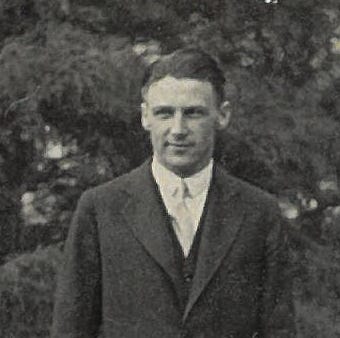
I often think about my grandfathers. I was born in 1962, and they were both born around 1900. They were shaped by a world that was very different from the one in which I grew up. They also differed from each other, but were alike in the ways that mattered. They helped to mold me, and I was very fortunate to have them. And their lives tell us a lot about how America has changed.
Both grandpas lived on farms in Pennsylvania. Grandpa Markley, my Dad’s dad, was a full-time dairy farmer. Grandpa Errett, Mom’s dad, was an electrician. He rented his farm out to a neighbor, and he did some farm work himself. They both appreciated nature, but they didn’t idealize it. I inherited my .22 rifle from Grandpa Markley, who used it to shoot the groundhogs which would have caused havoc otherwise.
Both grandfathers were named Bill, as was my Dad, so that’s how I got my name. When we were all at family gatherings and someone called out, “Bill!,” lots of heads turned.
Grandpa Markley came from a long line of farmers. When my Dad and his brother were boys, they regularly helped with various chores, but Grandpa Markley usually did the hardest, most unpleasant jobs himself. When I was growing up, I spent some time each year on the farm. One of my earliest chores was gathering eggs from the henhouse. I later graduated to more strenuous jobs, but Grandpa never was pushy about it. One task that I enjoyed doing with him was putting up snow fences, so that the snow wouldn’t drift over the road into town. He didn’t talk much, but he still made everyone feel at home. One of his favorite pastimes was playing caroms, which was a bit like pool or billiards, but on a small, wooden table and with wooden rings instead of billiard balls. We played lots of rousing games of caroms.
Grandpa Markley often drove my cousins and I on his tractor, along old logging roads on the ridge behind his farm. Our mothers weren’t exactly happy about us riding on that tractor, as we clung onto its fenders on those bumpy lanes. But no accidents ever happened. Grandpa pointed out the different species of trees as we drove by, and he told us about the old days when miners and loggers were in the area. Unfortunately I didn’t pay enough attention to which tree was which, but I did remember the local history stories. One day, roaming on my own through the woods, I was excited to discover a small pit, which had been the foundation of a cabin. Rooting around, I also found a piece of an old iron stove. I didn’t know what it was, but Grandpa did.
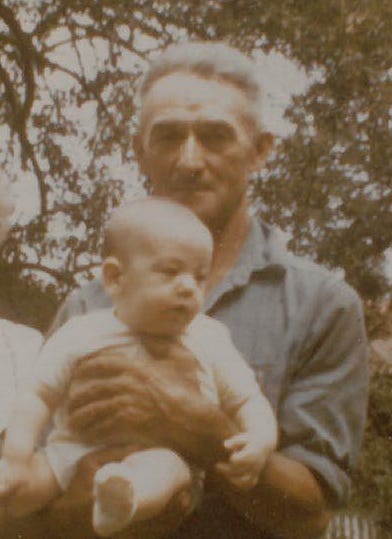
Grandpa Markley worked very hard. He regularly woke up around 4:00 or 5:00 AM. When I visited, I’d sometimes hear him watching “The Rifleman” and other westerns on the TV downstairs, as I was waking up. But he mostly kept very quiet for the sake of us city-dwelling sleepyheads, while he got his coffee and otherwise prepared for the long day on the farm. In the evenings, we’d look forward to hearing him call the cattle in with a sing-song voice, “C’mo-in, C’mo-in, C’mooooooooooo-in….”
Grandpa Errett lived a few hours away, in a beautiful region southwest of Philadelphia. He regularly took Mom, Dad and me on country drives, in a car rather than a tractor, to see the old pioneer, Quaker and Revolutionary War sites nearby. We all eagerly looked forward to it, even though Mom occasionally got a bit carsick on the hilly, winding lanes. It was like wandering through a painting by Andrew Wyeth or one of the other Brandywine artists. We often drove along the Street Road, which was relatively straight, and which dated from the early 1700’s. This sunken road was lined with overhanging trees in some places. We glimpsed many neatly-kept farms and old stone houses, and lots of horses. We marveled many times at the old Penn Oak, from William Penn’s day, which looked benevolently down on London Grove Meeting House. Grandpa Errett gave me several history books for Christmas, which helped instill in me a permanent passion for American and English history. He knew what boys were interested in, and one of the treasures that he passed along was Bruce Catton’s history for young readers of the Battle of Gettysburg. It was filled with pictures and stories of the heroes on both sides.[i]
Grandpa Errett smoked throughout the day, and occasionally liked a bit of booze (Grandpa Markley never touched a drop). When relatives came around, he was very hospitable, but he sometimes was also content, amidst the chattering, to sit in his favorite chair with a cigarette, playing solitaire. I think that was related to growing up with four talkative sisters. Like Grandpa Markley, he was a man of few words, but when he did say something, he was always worth listening to. He experienced some serious hardship during the Great Depression, but eventually managed to establish a small electrical contracting business, and he found contentment on the farm.
Both grandpas were very sociable, in their own understated ways. During their lifetimes, fraternal and service organizations were still very active and popular in America. Local charities, mutual-assistance organizations, hobby groups and social clubs were everywhere, from large cities to remote rural areas. They provided an important balance to the individualism which was emphasized. Grandpa Markley was active in the local Grange, a family-oriented organization which tended to be located in agricultural areas. He and Grandpa Errett were also active in their churches, and both served on school boards. Grandpa Errett was a long-time secretary of his local chapter of the Rotary Club, a service organization. He sang in the church choir and later became its director. Musical activity had been strongly encouraged in his family. He left us a diary from 1918, when he was a young man, and it’s striking to read in it how he and his friends often gathered for sing-alongs.
Grandpa Errett came from a middle-class family in Pittsburgh. His parents valued education very highly. After high school, he worked on a farm in Michigan to earn money for college. It was a profound experience for him. He had to work hard there, but after he returned east, he wrote in his diary that he “yearned” for the farm. And he kept in touch by mail with the family who had employed him, and with their other farm laborers.
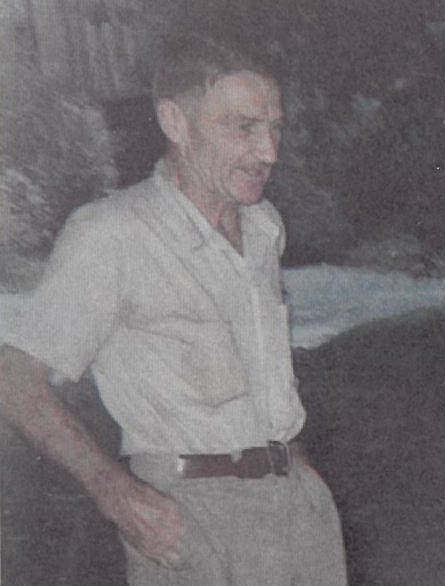
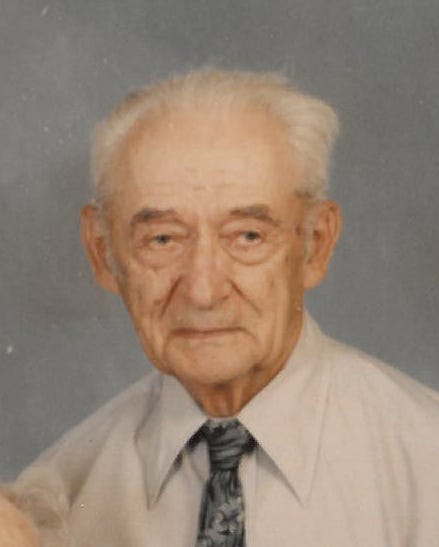
Grandpa and Grandma Markley often hosted students from the Third World who were attending a nearby college. Both grandparents enjoyed getting to know the students, learning about their countries, and teaching them about life on an American farm. It would never occur to Grandpa Markley, though, to favor transforming America into a country similar to where those students came from. He and Grandpa Errett were both solid patriots.
Grandpa Errett was a little more outspoken politically. He admired Mayor Frank Rizzo of Philadelphia, because of Rizzo’s strong law and order policies. He also knew that Martin Luther King, Jr. was a charlatan, and he didn’t hesitate in saying so. From the 1960’s onwards, both grandpas were concerned about the direction America was going, culturally and politically. They stayed well informed, or at least as well as they could considering the limited news media of the time. Back then, many large cities offered multiple major newspapers, with one favoring the Republicans, and another favoring the Democrats.
I have the impression that Grandpa Errett was a man with very powerful emotions, which he fought mightily to keep under control. Grandpa Markley struggled with worry and doubt. My Dad remembered him pacing back and forth, worrying about how the weather would effect his crops. Otherwise, both men were very successful in being self-controlled. They were always very patient with my cousins, siblings and me. And some of us could be a challenge.
I won’t over-idealize the past. I’m very grateful for the Internet and modern dentistry. We’re not as vulnerable today as our grandparents were to the threats of weather and disease, no matter what the World Health Organization or climate-change activists might say. And there have been social concerns throughout history. A couple of hundred years ago, the Temperance Movement arose in America, because there was a serious problem at that time with drunkenness and the evils associated with it. In the last century, in a supposedly enlightened world, two massively-destructive world wars occurred, and millions of people were murdered by the leaders and followers of various political ideologies. But, we also have lost an awful lot of good from the past.
As Charles Haywood tells us, in a review of a book by historian Christopher Lasch from 1979: “Lasch, no fool in an age of fools, recognized that we had lost the organic reality-based community that made America great.” Lasch argued that, by the late ‘70s, a form of narcissism was spreading throughout American society. A new type of ideal person was being promoted—one who had a very perverted understanding of “freedom” and responsibility…
“Freed from all the old limitations placed on men and women by society, he ‘demands immediate gratification and lives in a state of restless, perpetually unsatisfied desire.’ He rejects any wisdom from, or even reference to, the past, though the past is crucial to any society, ‘a political and psychological treasury from which we draw the reserves that we need to cope with the future…’
“The central element of narcissism is living in the eternal present. Again and again Lasch returns to our loss of the grasp of historical time. ‘The real value of the accumulated wisdom of a lifetime is that it can be handed down to future generations,’ and this is in danger of being entirely lost.”[ii]
Many of us never learned how to plant and harvest wheat, or change a car tire, or wire a home for electricity. That’s alright—such skills can be acquired if necessary. What’s worse is that many today no longer appreciate our great history. Schools and universities assault and distort that history. Libraries are getting rid of older books. AI systems are programmed to have disdain for the past. And ignorant fanatics have been tearing down our statues. But we can still learn about our ancestors with a little bit of effort. They can still talk to us.
There are lots of genealogy resources available now, and so maybe you can find heroes among your own ancestors. If not, you can find them in history books—especially in those written before the last few decades. Such books haven’t all been thrown into the “Memory Hole” yet. Having heroes is healthy, and essential. We have multitudes of them that we can study in European and American history. We all need their voices.
[i] Catton, Bruce, The Battle of Gettysburg (American Heritage Junior Library), New York: American Heritage Publishing Co., Inc., 1963
[ii] Haywood, Charles, “The Culture of Narcissism: American Life in An Age of Diminishing Expectations (Christopher Lasch),” May 16, 2026,
Comments
Nothing yet. Say the first thing.
Sign in to join the conversation.