
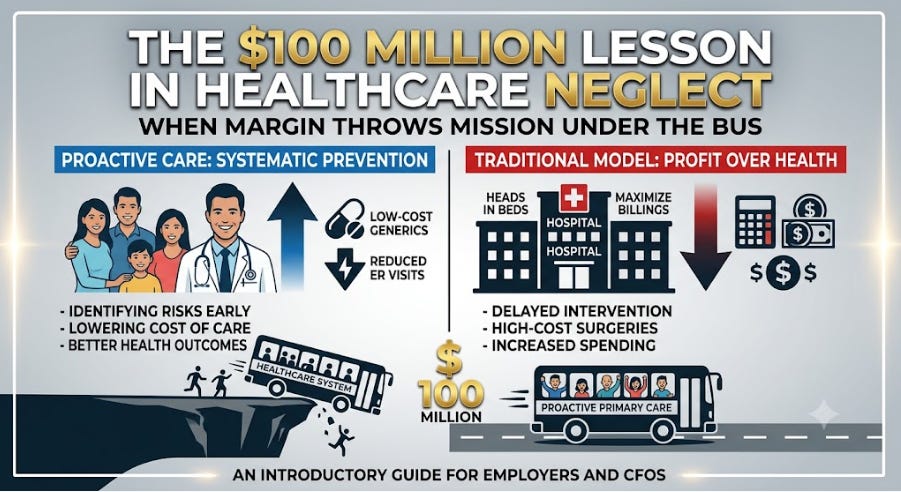
For self-insured employers, CFOs, and health plan fiduciaries, the search for meaningful healthcare cost containment usually leads to a familiar maze of point solutions, wellness apps, narrow networks, or benefit cuts.
In a recent episode of Stacey Richter’s podcast, Relentless Health Value, Dr. Scott Conard—a nationally recognized leader in healthcare quality, and the former leader of a 510-clinician medical network in North Texas—shared the first-person account of what happens when you actually solve the chronic disease puzzle.
Dr. Conard has reviewed and validated the clinical and financial accounting laid out below. It is the story of how a proactive primary care model suppressed regional healthcare spending by $100 million in a single year—and how a hospital system bought the network and deliberately dismantled it to protect its own bottom line.
Early in his practice, Dr. Conard reviewed the charts of three separate 40-year-old patients who suffered sudden, catastrophic cardiovascular events.
None of them were classified as “sick” under traditional fee-for-service benchmarks. Yet, reviewing their records revealed subtle, asymptomatic risk factors left to smolder under standard care: mild insulin resistance, minor lipid particle abnormalities, creeping blood pressure, and silent vascular inflammation.
They weren’t “broken enough” for fee-for-service medicine to intervene, so they were left to progress until they suffered a heart attack.
That experience transformed Dr. Conard’s approach. Over the next two decades, he scaled a proactive primary care delivery network to over 500 clinicians, standardizing clinical workflows to identify and treat rising metabolic and vascular risk before catastrophic events occurred.
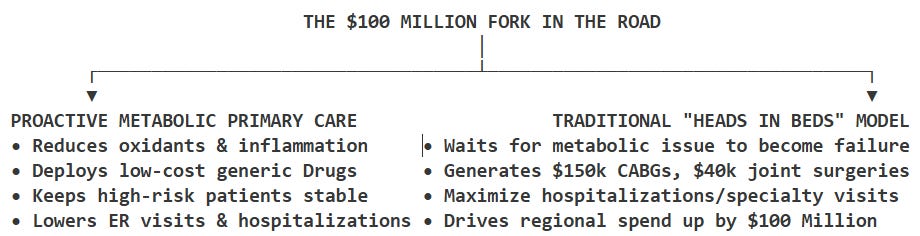
By systematically deploying protocolized, team-based care across 500+ clinicians, Dr. Conard’s network achieved:
Massive reductions in emergency room visits and preventable inpatient admissions.
Regional commercial healthcare spending suppression of $100 Million in a single year (equivalent to $220M–$250M+ in today’s hyper-inflated healthcare dollars).
Then came the “Pelican Brief” moment.
When the medical group was acquired by a major health system, hospital leadership immediately shut down the proactive care management teams. When Dr. Conard directly asked an executive why a demonstrably successful, life-saving program was being eliminated, the executive gave him an unvarnished answer:
“It is my fiduciary responsibility to protect the financial health of the hospitals, and you were taking significant revenue from our hospitals—and it was accelerating. It was our responsibility to stop this.”
The moment proactive care was turned off and patients were returned to standard fee-for-service “usual care,” regional healthcare spending surged by $100 million in 12 months.
The financial loss of $100 million is staggering, but the true cost of dismantling proactive care is measured in human lives.
In the landmark Kaiser ALL/CCCS Trial (Coronary Artery Disease Care Management Service), 1,256 high-risk cardiovascular patients were tracked over 4.5 years:
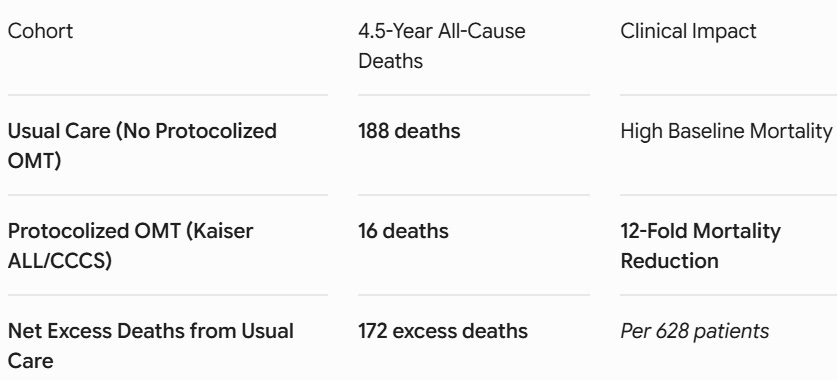
When you project those trial metrics onto Dr. Conard’s 500-clinician network, the lethal reality of shutting down proactive care becomes mathematically unassailable:
The Event Rate: A conservative estimate of 3 preventable cardiovascular events per doctor annually across 500 primary care clinicians yields 1,500 high-risk patients per year.
The Scaling Factor:1,500 \patients divided by 628 =2.388
The Annual Body Count:
2.388 times 172 excess deaths = 410 Excess, Preventable Deaths Every Single Year
A fully loaded commercial Boeing 747 carries roughly 400 passengers. When a health system leadership team deliberately dismantles a proactive medical management program to restore hospital bed occupancy and surgical volume, it predictably condemns 410 innocent human beings to an untimely death every single year—the equivalent of crashing a jumbo jet in the local community annually.
Under ERISA and modern corporate governance mandates, mayors, superintendents, union trustees, and corporate CFOs have an explicit legal and ethical duty to manage health plan assets prudently.
Continuing to fund an uncoordinated, volume-driven hospital ecosystem means subsidizing an administrative business model that monetizes employee illness and relies on “heads in beds.”
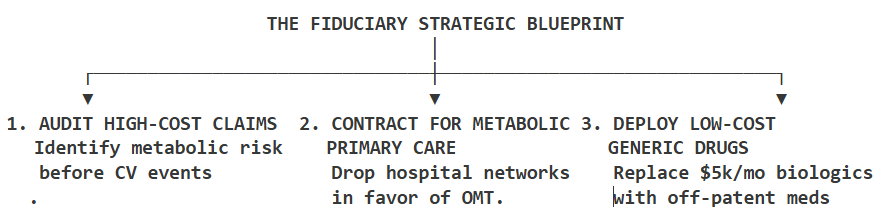
To fix health plan budgets and fulfill their fiduciary duty, plan sponsors must take three concrete steps:
Bypass the “Heads in Beds” Ecosystem: Direct health plan capital away from hospital-owned, volume-incentivized networks and contract directly with primary care platforms that execute protocolized care.
Deploy Low-Cost Metabolic Medical Management: Focus on breaking the inflammatory circuit of disease at the cellular level using foundational, off-patent generic combinations (ACEi/ARBs, Statins, Metformin, Allopurinol, SGLT2i, and low-dose Aspirin).
Align Incentives Around Optimal Medical Therapy (OMT): Eliminate all member copay barriers for foundational generic protocols that keep human beings healthy, out of the emergency room, and off the operating table.
The $100 million lesson from North Texas proves that we do not need expensive new specialty drugs or complex administrative point solutions to fix healthcare. We simply need to align modern systems biology with fiduciary responsibility—and protect the mission of primary care from being thrown under the bus by hospital margin.
(You can listen to Dr. Scott Conard tell his story in detail on Relentless Health Value here.)
No posts
Comments
Nothing yet. Say the first thing.
Sign in to join the conversation.