
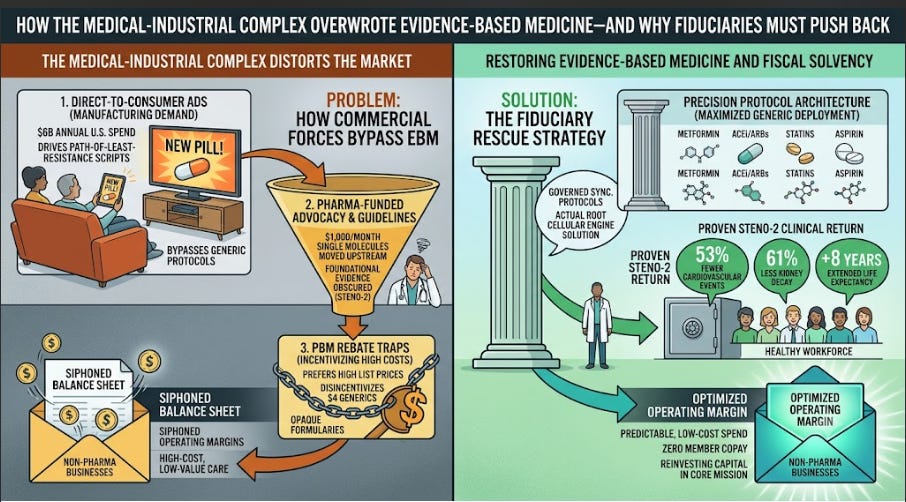
In our previous post, we detailed the remarkable economic pivot of the mid-2000s: Big Pharma quietly abandoned basic cardiovascular and metabolic drug development because first-generation “wonder drugs”—metformin, statins, ACE inhibitors, ARBs, eplerenone, and aspirin—set a clinical and economic bar that new, expensive single-molecule drugs simply could not beat.
By their own actions, pharmaceutical executives proved the superior, unassailable value of these off-patent generic protocols.
So, how did we end up in a world where modern clinical practice guidelines now recommend $1,000-a-month branded medications earlier in the treatment sequence—frequently pushing low-cost generic combination protocols to the background?
How did a delivery system convince clinicians to prescribe drugs that offer a fraction of the clinical risk reduction at twenty times the price?
This didn’t happen by accident. It is the result of a multi-billion-dollar marketing and lobbying apparatus designed to bypass evidence-based medicine and force non-pharmaceutical businesses to foot the bill.
To understand how the market was distorted, self-insured employers, plan fiduciaries, and CFOs must understand the three primary mechanisms used to promote expensive, less effective therapies over proven generic protocols:
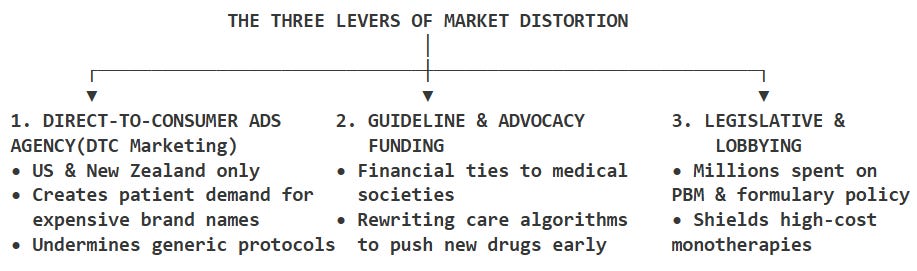
The United States and New Zealand are the only two industrialized nations on Earth that allow pharmaceutical companies to advertise prescription drugs directly to consumers on television and digital media.
In every other developed country, prescription drug promotion is strictly limited to medical professionals to ensure clinical decisions are guided by evidence, not commercial jingles. In the U.S., drug makers spend over $6 billion annually on direct to consumer ads.
These commercials do not feature $4 generic metformin or $10 lisinopril; they market high-cost, single-target brand names. When patients flood doctors’ offices requesting the “new pill they saw on TV,” busy clinicians face path-of-least-resistance pressure to write the brand-name script—bypassing the synchronized generic protocols that actually produce the best results at the lowest cost. They distort medical decision making.
Clinical practice guidelines are supposed to represent the objective gold standard of medical care. Yet, major medical societies and advocacy organizations rely heavily on pharmaceutical industry grants, sponsorships, and consulting fees.
When guideline committees update their treatment algorithms, expensive new agents are increasingly moved upstream to first- or second-line therapy, even when the foundational evidence (like the landmark Steno-2 trial) proved that multi-target generic combination therapy delivers far superior reductions in heart attacks, kidney failure, and mortality.
By subtly altering the sequence of care—recommending high-cost monotherapies before ensuring complete generic protocol deployment—guidelines serve as high-powered commercial funnels.
Through massive legislative lobbying and strategic relationships with pharmacy benefit managers (PBMs), the pharmaceutical industry protects high-margin brand-name drugs through opaque rebate structures. PBMs are incentivized to place high-sticker-price drugs on preferred formulary tiers because higher list prices generate larger manufacturer rebates, while low-cost off-patent generics generate little to no rebate margin.
If you run a manufacturing firm, lead a municipality, manage a public school district, or serve as a union health trustee, your balance sheet is paying for this distortion.
Non-pharmaceutical businesses generate real economic value: they build products, educate children, pave roads, and provide essential services. Yet, every year, a massive portion of their hard-earned operating margin is siphoned off to pay for high-cost, low-value drug regimens that do not keep their workforce healthier than cheap, governed generic protocols would.
Corporate CFOs and plan fiduciaries are being systematically taken advantage of. They are paying $12,000 a year per member for branded therapies while the $20-a-month generic protocols that slash cardiovascular mortality by 50% and kidney decay by 61% sit underutilized.
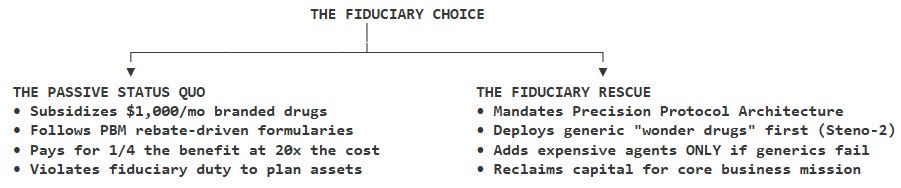
Under ERISA and public corporate governance mandates, plan fiduciaries have an explicit legal and ethical duty to manage health plan capital prudently. Continuing to fund a delivery model that prioritizes heavily advertised, high-cost single molecules over proven, multi-target generic protocols is a direct failure of that duty.
The landmark Steno-2 study proved once and for all that when you deploy a synchronized, governed protocol of off-patent generic circuit-breakers (ACEi/ARBs, statins, aspirin, metformin):
Cardiovascular events drop by 53%.
Kidney disease progression drops by 61%.
Overall life expectancy increases by nearly 8 years.
Plan sponsors must stop passively accepting guideline shifts and PBM formularies designed to maximize drug spend. Instead, they must establish Precision Protocol Architecture:
Maximized Generic Deployment First: Mandate that high-risk metabolic patients are fully titrated on multi-target off-patent protocols (metformin, ACEi/ARBs, statins, allopurinol, aspirin) at zero out-of-pocket copay.
Step-Up Escalation Only on Failure: Reserve high-cost, single-target branded medications strictly for the small fraction of patients who fail to reach clinical targets after verified adherence to the foundational generic protocol.
Bypass the PBM Rebate Trap: Align health plan incentives around true clinical outcomes and total-cost-of-care reduction rather than manufacturer rebate volume.
Big Pharma saw the unassailable value of first-generation wonder drugs two decades ago and shifted its business model to sell high-cost specialty alternatives. Watch what they do, not what they say. They proved by their actions twenty years ago that they know the first generation wonder drug protocol is superior to the new products. There is no comparison in the cost-benefit ratio.
It is time for non-pharmaceutical businesses and plan fiduciaries to see through the marketing noise, exercise their legal authority, and demand the evidence-based, low-cost generic protocols that protect both their employees’ lives and their organization’s bottom line.
Why Optimal Medical Therapy Should Be a Universal Standard of Care https://pmc.ncbi.nlm.nih.gov/articles/PMC4695209/
Multifactorial Intervention and Cardiovascular Disease in Patients with Type 2 Diabetes (2003) https://www.nejm.org/doi/full/10.1056/NEJMoa021778
Effect of a Multifactorial Intervention on Mortality in Type 2 Diabetes (2008) https://www.nejm.org/doi/full/10.1056/NEJMoa0706245
Years of life gained by multifactorial intervention in patients with type 2 diabetes mellitus and microalbuminuria: 21 years follow-up on the Steno-2 randomised trial https://pmc.ncbi.nlm.nih.gov/articles/PMC5506099/
Reduced risk of heart failure with intensified multifactorial intervention in individuals with type 2 diabetes and microalbuminuria: 21 years of follow-up in the randomised Steno-2 studyhttps://pmc.ncbi.nlm.nih.gov/articles/PMC6061176/
No posts
Comments
Nothing yet. Say the first thing.
Sign in to join the conversation.