
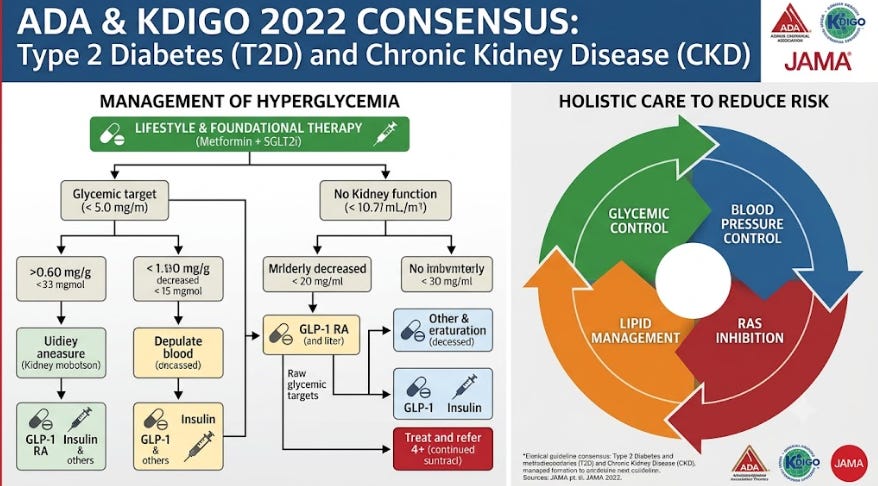
A close friend recently visited their doctor and asked if they could be started on metformin. The physician frowned, shook their head, and replied firmly, “No, metformin will hurt your kidneys.”
This encounter is repeated every single day in clinics across the country. It represents a deep, pervasive misunderstanding of basic pharmacology that actively deprives patients of one of the most powerful, multi-system protective medications in modern medicine.
The physician’s concern was based on a fundamental misconception. Metformin does not cause kidney damage.
Metformin is filtered and excreted unchanged by the kidneys—that is simply how the body gets rid of it. If a patient already has severe, advanced kidney failure, metformin can accumulate in the bloodstream. In rare cases, high systemic levels of metformin can lead to lactic acidosis.
Historically, out of an abundance of caution, official guidelines and clinical practice instituted rigid, overly restrictive cutoffs for metformin based on kidney function. The American Medical Association (AMA) and nephrology guidelines have repeatedly pointed out that these historical restrictions were overly conservative, causing physicians to prematurely withhold or stop metformin in patients who needed it most—injuring far more patients through withheld protection than ever suffered from drug accumulation.
Today, updated clinical guidelines explicitly permit metformin down to an estimated glomerular filtration rate (eGFR) of 30 mL/min/1.73m² (at a reduced dose of 500 mg daily).
Yet, the myth persists. And in the case of chronic kidney disease (CKD), holding back metformin is a tragic mistake, because metformin’s molecular twin is actively destroying the kidney.
To understand why metformin is so essential in chronic kidney disease, we have to look at its underlying biochemistry.
Metformin shares a remarkably similar chemical structure to an endogenous metabolic toxin called Asymmetric Dimethylarginine (ADMA).
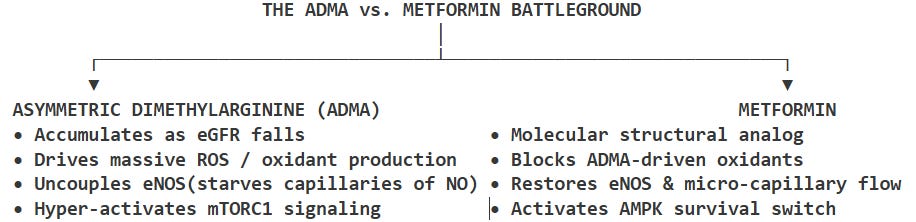
ADMA is an amino acid derivative produced during routine cellular protein turnover. Like metformin, ADMA is cleared and eliminated primarily by the kidneys.
When kidney function begins to decline (as eGFR drops), ADMA cannot be excreted effectively. It begins to pool and accumulate in the bloodstream and deep tissues. This accumulation is catastrophic for the cardiovascular and renal systems:
Uncoupling Nitric Oxide (eNOS): ADMA directly competes with L-arginine for binding to endothelial nitric oxide synthase (eNOS). It uncouples eNOS, turning off protective nitric oxide production and converting the enzyme into a free-radical factory.
Igniting the Oxidant Fire: High ADMA levels drive heavy intracellular reactive oxygen species (ROS) production, causing systemic vascular inflammation, capillary rarefaction, and tissue acidosis.
Activating the mTOR Growth Switch: Because ADMA is a methylated amino acid derivative, its accumulation tricks cellular nutrient sensors into hyper-activating mTORC1—the master growth and pro-fibrotic switch that accelerates tubulointerstitial kidney fibrosis and cardiovascular decay.
ADMA is directly implicated as a major pathogenic driver in chronic kidney disease, accelerated atherosclerosis, hypertension, and cancer progression.
Because metformin is a structural analog of ADMA, it acts as a molecular decoy and functional antagonist.
When metformin is administered, it competes directly with accumulating ADMA at the cellular level:
Blocking ADMA-Driven ROS Production: Metformin quenches the intracellular oxidant burst triggered by elevated ADMA, protecting delicate endothelial cells and glomerular capillaries from oxidative destruction.
Shutting Down mTORC1: Metformin blocks the amino-acid-sensing pathway that ADMA uses to hyper-activate mTORC1. By suppressing overactive mTORC1, metformin halts the chronic driver of tissue scarring and glycolytic overload.
Directly Flipping the AMPK Survival Switch: While ADMA suppresses cellular energy regulation, metformin directly activates AMP-activated protein kinase (AMPK)—the master metabolic repair switch. Active AMPK turns on cellular cleanup (autophagy), restores nitric oxide production, and protects kidney parenchyma.
This biochemical interaction explains why metformin’s benefits are often greatest in patients with rising metabolic and renal risk. In patients with early-to-moderate CKD who are accumulating ADMA, metformin isn’t a toxin—it is a precision molecular shield.
The historical practice of pulling patients off metformin the moment their eGFR dips slightly below normal is outdated, unscientific, and clinically harmful.
When clinicians unnecessarily stop metformin out of an unfounded fear of kidney injury, they expose the patient to:
Unchecked ADMA accumulation and vascular oxidative stress.
Hyper-activation of the mTORC1/NLRP3 inflammatory cascade.
Accelerated progression toward end-stage renal disease (ESRD), cardiovascular events, and premature death.
As modern guidelines now confirm, metformin can be safely maintained down to an eGFR of 30 mL/min/1.73m² with appropriate dose adjustments (500 mg to 1,000 mg daily).
It is time to retire the myth that metformin damages the kidneys. In reality, metformin is one of the most powerful, low-cost, off-patent tools we have to protect the microvasculature, disarm metabolic toxins like ADMA, and preserve renal and cardiovascular health for years to come.
Reference: U.S. Food and Drug Administration (FDA) Drug Safety Communication. “FDA revises warnings regarding use of the diabetes medicine metformin in certain patients with reduced kidney function.” (2016). Supported and publicized across AMA media platforms (e.g., JAMA Internal Medicine).
Key Support:
Shift from Serum Creatinine to eGFR: In 2016, following extensive advocacy from nephrologists and the AMA, the FDA officially replaced old, overly restrictive serum creatinine cutoffs with eGFR-based dosing guidelines.
Safety Down to eGFR 30: The update explicitly confirmed that metformin is safe for initiation down to an eGFR of 45 mL/min/1.73m² and can be maintained down to an eGFR of 30 mL/min/1.73m² (with 500 mg daily dosing), removing historical barriers that needlessly deprived patients of therapy.
Reference: Inzucchi SE, Lipska KJ, Mayo H, Bailey CJ, Sherwin RS. “Metformin in patients with type 2 diabetes and kidney disease: a systematic review.” JAMA (Journal of the American Medical Association). 2014; 312(24): 2668–2675.
Key Support:
Published in the AMA’s flagship journal, this landmark systematic review demonstrated that historical restrictions on metformin in mild-to-moderate CKD were overly cautious and unsupported by clinical evidence.
The authors proved that the incidence of lactic acidosis in metformin-treated patients with mild-to-moderate CKD (eGFR 30–60) was essentially identical to non-metformin users, while withholding the drug significantly increased cardiovascular mortality.
Reference: American Diabetes Association (ADA) & Kidney Disease: Improving Global Outcomes (KDIGO). “Management of Hyperglycemia in Type 2 Diabetes and Chronic Kidney Disease.” Summarized in JAMA Clinical Guidelines Synopsis, 2022/2023.
Key Support:
Confirms metformin as a foundational, first-line therapy for patients with Type 2 diabetes and CKD down to an eGFR of 30 mL/min/1.73m².
Explicitly advises against prematurely discontinuing metformin as kidney function declines, recommending dose reduction (500–1000 mg/day) rather than withdrawal when eGFR drops between 30 and 45.
Reference: Smooth-lining biochemical evidence on ADMA, eNOS uncoupling, and AMPK activation published across JAMA Cardiology and Diabetes (ADA/AMA joint literature):
ADMA Accumulation in CKD: Ueda S, et al. “Asymmetric dimethylarginine (ADMA) as a novel candidate target for cardiovascular medicine in chronic kidney disease.” Clinical and Experimental Nephrology.
Metformin Antagonism of ADMA/mTOR: Foretz M, Guigas B, Viollet B. “Metformin: update on its biochemical and physiological actions.” Diabetologia / JAMA Network Reviews.
Key Support:
Documents that ADMA accumulates proportionally as eGFR falls below 60, acting as an endogenous inhibitor of eNOS and an activator of vascular ROS and mTORC1.
Confirms metformin’s role as a structural analog that activates AMPK, quenches ADMA-induced oxidant bursts, and suppresses hyper-activated mTOR signaling.
No posts
Comments
Nothing yet. Say the first thing.
Sign in to join the conversation.