
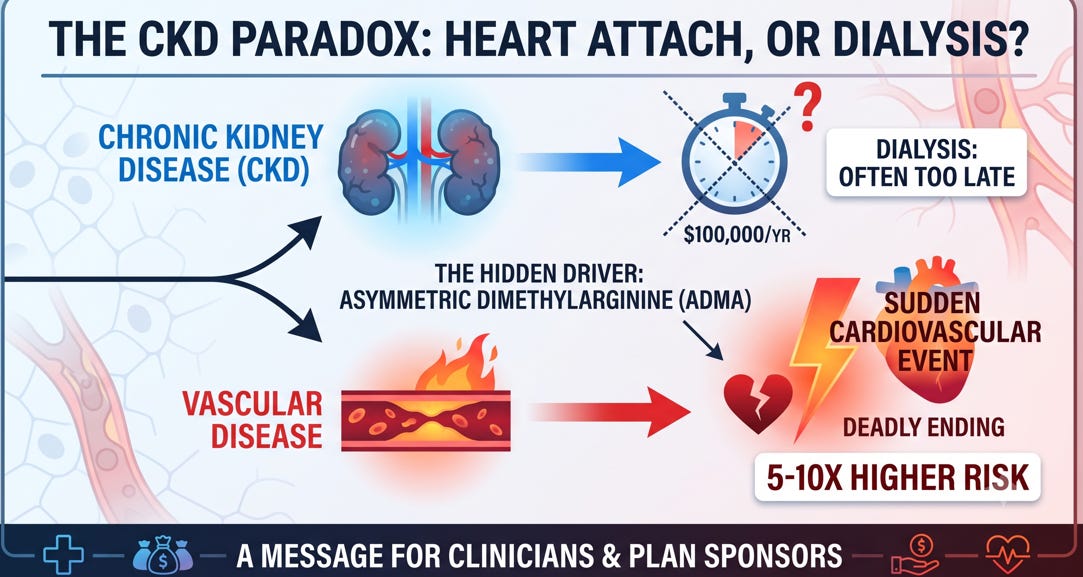
In clinical medicine, there is a stark, tragic paradox that every doctor knows, but few patients ever hear:
If you have Chronic Kidney Disease (CKD), you are far more likely to die of a sudden cardiovascular event than you are to live long enough to need dialysis.
When an individual’s kidney function begins to decline, the primary cause of death isn’t kidney failure itself—it’s heart failure, lethal arrhythmias, and massive heart attacks. In Stage 3 and Stage 4 CKD, the 5-year risk of cardiovascular death is 5 to 10 times higher than the risk of ever reaching a dialysis machine.
Standard medical risk calculators fail to predict this mortality spike because they focus on traditional risk factors like LDL cholesterol, which often drop or remain normal in advanced kidney decay.
Why does this happen? Regardless of what caused the initial kidney damage—whether it was Type 2 diabetes, high blood pressure, or auto-inflammatory disease—there is one universal, non-negotiable common denominator that accumulates as kidney function drops: Asymmetric Dimethylarginine (ADMA).
Understanding ADMA explains both why kidney patients die of cardiovascular disease and why withholding foundational metabolic medications out of an unfounded fear of “kidney damage” is one of the most dangerous mistakes in modern healthcare.
ADMA is a methylated amino acid derivative produced during routine cellular protein breakdown. Under normal conditions, healthy kidneys filter ADMA out of the bloodstream and metabolize it via an enzyme called DDAH-1.
When kidney filtration (eGFR) drops, two catastrophic events occur simultaneously: filtration collapses and DDAH enzyme activity shuts down.
Because the kidneys can no longer clear it, ADMA pools and accumulates throughout the bloodstream and deep vascular tissue. As ADMA levels surge, it acts as a silent biological weapon against the entire cardiovascular system through three primary mechanisms:
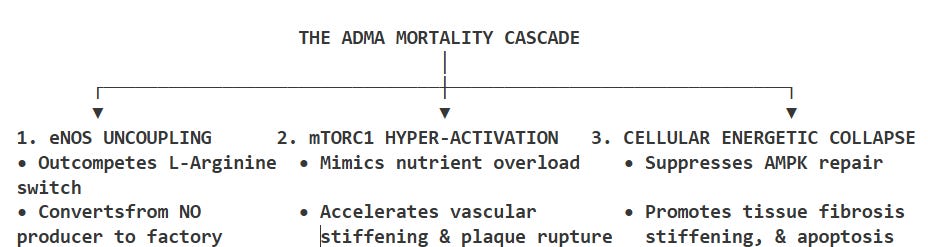
Nitric oxide is the molecule that is the active ingredient in nitroglycerine tablets. That is the pill that patients with chest pain (angina) put under their tongue and it relieves their discomfort. Nitroglycerin expands the artery. It improves arterial health. dilates blood vessels, maintains healthy blood pressure, and keeps vessel walls slick so clots cannot form. It is generated by an enzyme called endothelial Nitric Oxide Synthase (eNOS) using the amino acid L-arginine.
Because ADMA is a structural analog of L-arginine, accumulating ADMA outcompetes L-arginine and hijacks the eNOS enzyme. Instead of producing protective Nitric Oxide, eNOS becomes “uncoupled” and transforms into an oxidant production machine, flooding the vasculature with superoxide. This burst of oxidative stress causes rapid arterial stiffening, endothelial destruction, and plaque rupture. In short, ADMA shifts the enzyme function from protecting the artery to destroying arterial health.
Because ADMA is a methylated amino acid derivative, its accumulation tricks intracellular nutrient sensors into perceiving a state of continuous amino acid excess. This triggers persistent hyper-activation of mTOR—the cell’s master growth and pro-fibrotic switch—accelerating vascular calcification, arterial wall thickening, and scar tissue formation in the heart and kidneys.
High circulating levels of ADMA suppress AMP-activated protein kinase (AMPK)—the master repair switch that cleans out cellular debris and keeps heart muscle cells alive under stress. Starved of bioenergetic repair, the myocardium becomes hyper-vulnerable to ischemia and sudden cardiac arrest.
This brings us back to one of the most persistent myths in modern medicine: the belief that metformin must be stopped because it “harms the kidneys.”
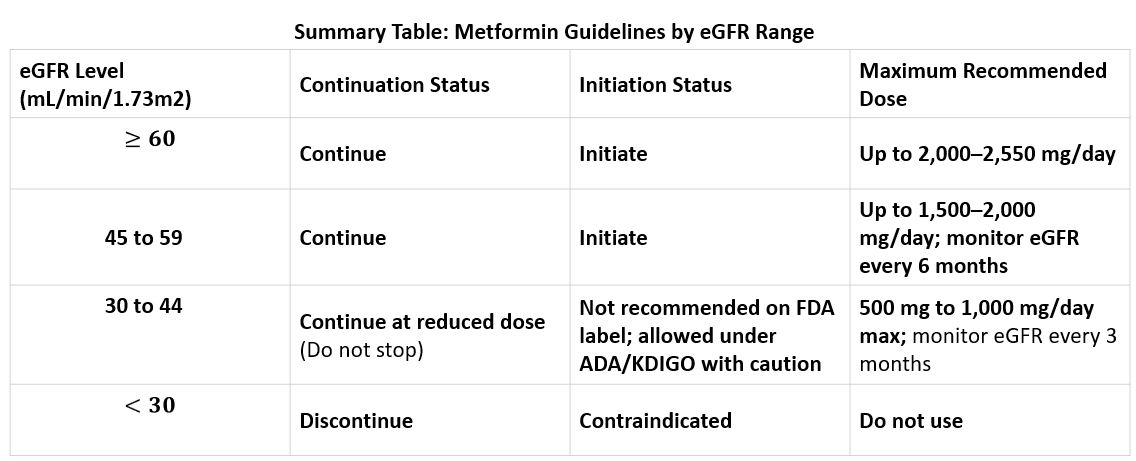
As the American Medical Association (AMA) and FDA have clarified, metformin does not cause kidney damage. It is simply excreted unchanged by the kidneys. While historically overly cautious guidelines led doctors to pull patients off metformin the moment their eGFR dropped, updated guidelines explicitly confirm that metformin is safe down to an eGFR of 30 mL/min/1.73m² (at a reduced 500 mg daily dose).
Stopping metformin in CKD patients is a tragic mistake because metformin is a structural twin of ADMA.
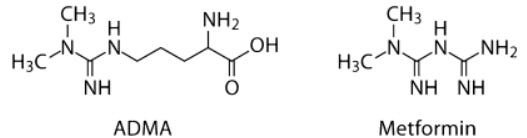
Look at the two molecules above. They are identical on the left side. That is why metformin engages the ADMA receptor and blocks the effects of ADMA molecule for molecule. It directly blocks an important root cause of vascular disease and chronic kidney disease.
Blocks ADMA-Driven Oxidant Bursts: Metformin competes directly with accumulating ADMA at the cellular membrane, preventing ADMA from driving nitric oxide decline and oxidant generation.
Shuts Down mTOR: Metformin blocks the nutrient-sensing pathway ADMA uses to hyper-activate mTOR, halting tissue scarring and vessel stiffening.
Flips the AMPK Repair Switch Back ON: While ADMA suppresses AMPK, metformin directly activates AMPK subunit, turning back on cellular cleanup, protecting micro-capillaries, and preserving residual organ function. These actions improve the health of every cell and organ.
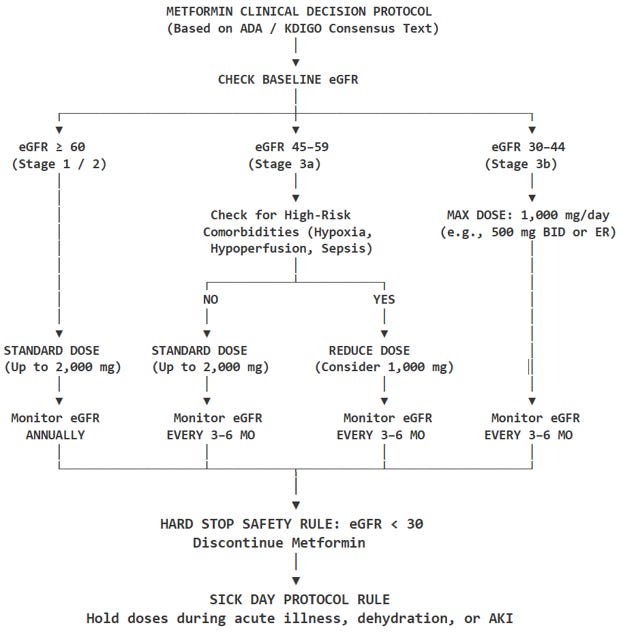
(Click on the link above to see the source guideline)
The eGFR 30 Threshold: Metformin is safe and recommended down to an eGFR of 30 mL/min/1.73 m².
Monitoring Intervals:
eGFR over 60: Monitor eGFR at least annually.
eGFR < 60: Step up eGFR monitoring to every 3 to 6 months.
Dosing Adjustments:
eGFR 30–44: Cap daily dose at 1,000 mg (e.g., 500 mg twice daily or 1,000 mg ER once daily).
eGFR 45–59: Standard dosing (up to 2,000 mg) is allowed, but consider reducing to 1,000 mg if the patient has comorbidities causing hypoperfusion or hypoxemia (e.g., acute CHF exacerbation, severe COPD, chronic hypoxia).
The “Sick Day” Safety Net: Require clinicians to educate patients to temporarily suspend metformin during acute GI illness, dehydration, sepsis, or acute kidney injury (AKI) to prevent drug accumulation during transient drops in filtration.
We cannot afford to treat Chronic Kidney Disease as an isolated organ failure while waiting for patients to require a $100,000-a-year dialysis machine. By the time dialysis is on the table, most patients have already succumbed to ADMA-driven cardiovascular collapse.
The solution is not to wait for advanced failure or to rely exclusively on expensive, single-target specialty biologics.
The solution is to deploy Metabolic Medical Management early—using low-cost, off-patent generic circuit-breakers like metformin, ACEi/ARBs, statins, SGLT2 inhibitors, and treat-to-target allopurinol to disarm ADMA, quench the cellular fire, and protect both the heart and the kidneys.
No posts
Comments
Nothing yet. Say the first thing.
Sign in to join the conversation.