
Imagine going to your doctor, asking for a widely available, $4 generic medication, and having them shake their head and say: “No, that drug will hurt your kidneys.”
This encounter takes place in clinics across America every single day. It happens with metformin—the second most prescribed drug in the country.
The idea that metformin causes kidney damage is one of the most widespread myths in modern medicine. Metformin does not injure the kidneys.
Metformin is filtered and excreted unchanged by the kidneys in your urine. If your kidney function drops, metformin stays in your system longer. Out of an abundance of caution, old medical rules established rigid cutoffs that forced doctors to stop giving metformin far too early. Major medical guidelines—including those from the American Medical Association (AMA) and the American Diabetes Association (ADA)—have updated these rules: metformin is safe to use down to an estimated kidney filtration rate (eGFR) of 30 (at a reduced dose of 500 mg to 1,000 mg daily).
Here is the pharmacokinetic reality that most clinicians overlook:
As kidney filtration (eGFR) slows down, your body struggles to clear an internal metabolic waste product called ADMA (Asymmetric Dimethylarginine). ADMA builds up in the bloodstream, triggering massive oxidant production and severe blood vessel inflammation.
Because metformin is cleared by the exact same kidney pathways, as kidney function drops, metformin concentration naturally increases in step with ADMA.
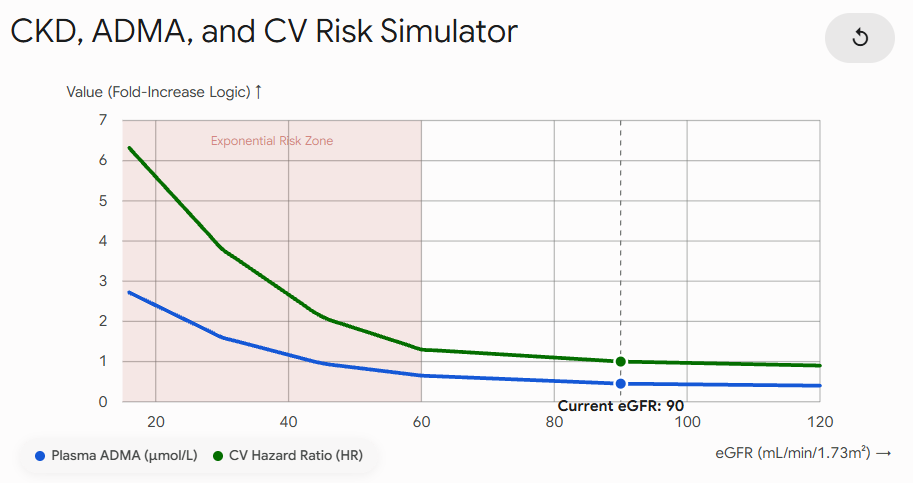
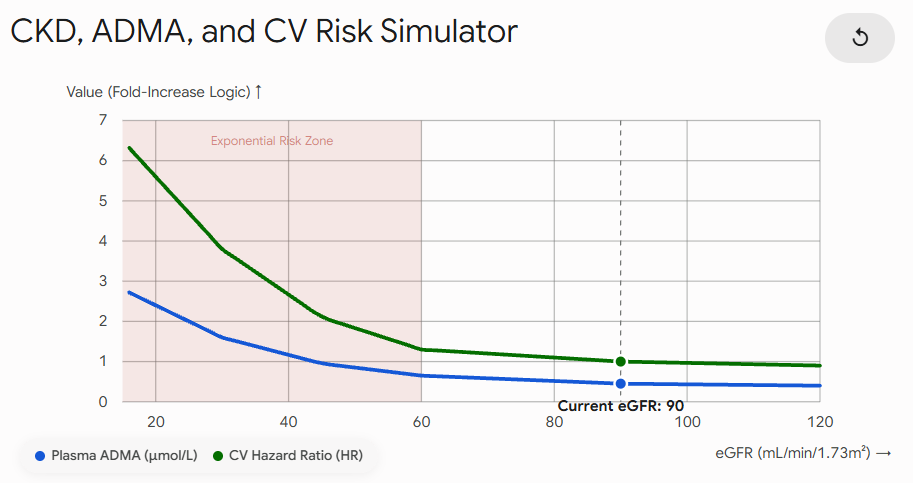
The graph just above is critical. The blue line is the ADMA level in the blood. The green line is cardiovascular risk. The bottom line is kidney function (estimated glomerular filtration rate-eGFR). You can see at a glance that as your kidney function declines moving from right to left, the ADMA level increases and cardiovascular risk increases even move regardless of the cause of decreased kidney function. Metformin blocks ADMA molecule for molecule and its curve is similar to ADMA. Notice that as your eGFR falls below 40, your ADMA level is doubled and your risk of a heart attack or stroke is nearly three times as high.
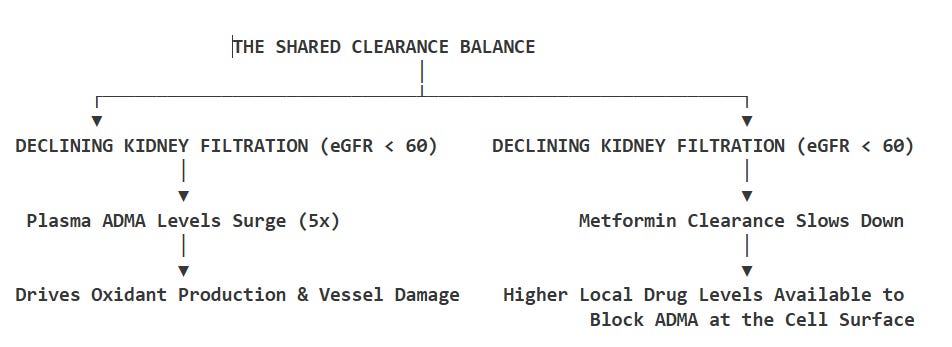
This parallel accumulation is a fortunate biological alignment. Because metformin directly blocks ADMA, the natural increase in metformin tissue concentration provides the exact higher dose needed to neutralize the rising ADMA surge. When doctors reduce the oral dose to 500 mg daily in Stage 3b kidney disease, the drug’s longer half-life maintains steady, protective tissue levels—keeping the molecular shield active right when the body is producing the most oxidants.
The timing of this misconception is tragic. Roughly 30% to 40% of adults with diabetes have chronic kidney disease, but only 10% of them know it.
Because early kidney damage causes no physical pain, millions of people walk around unaware that their kidneys are slowing down. Inside their blood vessels, rising ADMA levels are sparking uncontrolled oxidant production and tissue inflammation.
When physicians pull patients off metformin out of an unfounded fear of kidney damage, they aren’t protecting the patient—they are taking away the single most effective, low-cost molecular shield that disarms ADMA, quenches oxidant production, and protects both the heart and the kidneys.
Inzucchi SE, Lipska KJ, Mayo H, Bailey CJ, McGuire DK. Metformin in patients with type 2 diabetes and kidney disease: a systematic review. JAMA. 2014;312(24):2668-2675. doi:10.1001/jama.2014.15298
Lazarus B, Wu A, Shin JI, et al. Association of metformin use with risk of lactic acidosis across the range of estimated glomerular filtration rate. JAMA Intern Med. 2018;178(7):903-910. doi:10.1001/jamainternmed.2018.0292
American Diabetes Association. 11. Chronic kidney disease and risk management: Standards of Care in Diabetes—2024. Diabetes Care. 2024;47(Suppl 1):S219-S230.
US Food and Drug Administration. FDA Drug Safety Communication: FDA revises warnings regarding use of the diabetes medicine metformin in certain patients with reduced kidney function. Published April 8, 2016.
Fliser D, Kronenberg F, Kielstein JT, et al. Asymmetric dimethylarginine and progression of chronic kidney disease: The Mild to Moderate Kidney Disease Study. J Am Soc Nephrol. 2005;16(8):2456-2461. doi:10.1681/ASN.2005020179
No posts
Comments
Nothing yet. Say the first thing.
Sign in to join the conversation.