
To the Chief Medical Officer, Chief Human Resources Officer, Benefits Director, Family Decision-Maker, and Engaged Employee:
The new science of chronic disease is moving forward at a blistering pace. The opportunity to be healthier longer has never been greater.
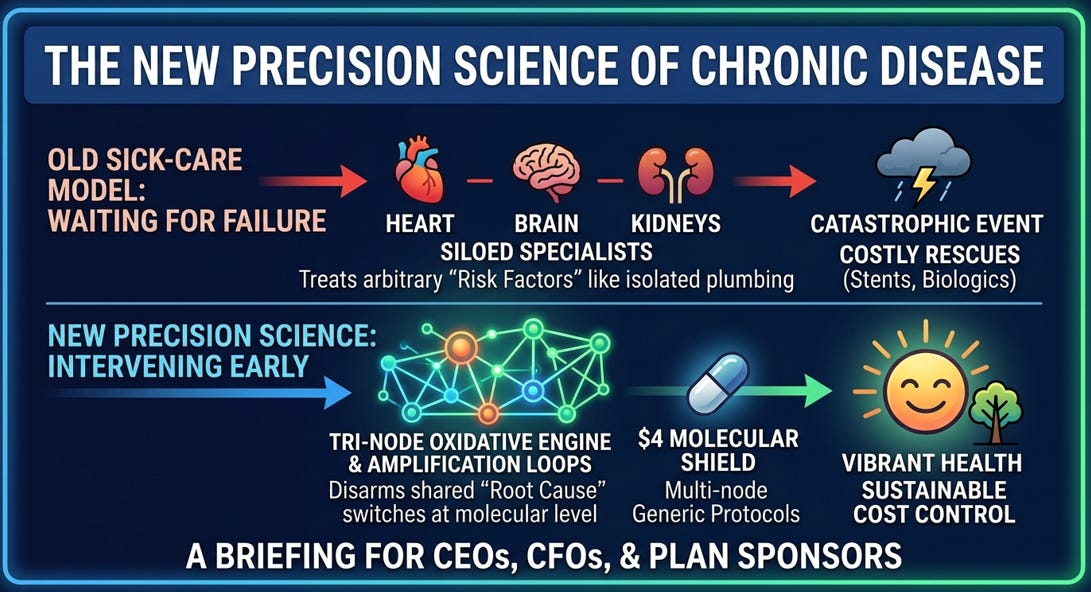
This is the most critical frontier in modern medicine. Chronic conditions account for the vast majority of premature deaths, long-term disability, and 86% of total healthcare expenditures. Whether you are managing an employer health plan, protecting a municipal budget, or caring for your family’s future, how we manage chronic disease determines both financial solvency and human vitality.
For decades, the standard medical model treated chronic illness as a collection of separate, disconnected failures:
The cardiologist managed the heart.
The endocrinologist managed the blood sugar.
The oncologist managed the tumor.
The rheumatologist managed the joints.
Patients were given single drugs in reactive steps after organs had already suffered permanent damage.
Landmark real-world clinical trials prove that this fragmented, reactive approach is obsolete. By understanding the unified cellular biology of human disease and deploying coordinated Metabolic Medical Management (MMM), we can prevent catastrophic organ breakdown and achieve health outcomes that conventional medicine once thought impossible. Clinicians call MMM Optimal Medical Therapy (OMT).
When healthcare systems coordinate care and deliver comprehensive medical therapy targeting root biological switches, the results fundamentally alter clinical trajectories:
In a landmark study of heart attack survivors enrolled in the Collaborative Cardiac Care Service (CCCS) at Kaiser Permanente Colorado, nurse- and pharmacist-led teams ensured patients achieved all goals of OMT concurrently:
Cardiovascular Mortality: After 4.5 years, there were 98 cardiac-related deaths in usual care compared to only 12 in the OMT group—an eightfold reduction in heart deaths.
All-Cause Mortality: The impact on total deaths was even more striking: 188 patients in usual care died of any cause compared to only 16 in the OMT group. Patients on coordinated OMT experienced a twelvefold reduction in all-cause mortality.
This massive reduction in total mortality is the most important finding in any heart-related research in history, and our current model cannot explain it. You have to ask yourself the question: Why would OMT for heart artery disease reduce deaths from other chronic diseases? That is what this series is about. It explains that virtually all chronic diseases have the same root cause, and the new science shows how we can address them precisely to produce much better clinical and financial outcomes.
Lower Healthcare Costs: Because healthy patients stay out of emergency rooms and operating suites, the OMT group reduced subsequent healthcare expenditures by $21,900 per patient per year (Delate et al., 2010; Sandhoff et al., 2008).
A comprehensive study published in the journal Heart evaluated post-heart attack outcomes across clinical centers. Patients receiving complete OMT experienced a 74% reduction in total one-year mortality compared to those on none or only one of the five OMT drugs (Bramlage et al., 2010).
The clinical power of OMT translates directly into employer economics in the real world:
TrueLifeCare Economic Analysis: Working with TrueLifeCare, a detailed economic analysis of OMT adherence was performed on a self-insured employer’s population with arterial disease and diabetes. Non-adherent patients with a cardiovascular diagnosis and diabetes cost $28,744 per year. Patients who were fully adherent with OMT cost only $13,024 per year—a savings of more than 50%. We can perform this exact claims analysis quickly for your organization—benchmarking members receiving full OMT against those receiving fragmented care—to show the precise clinical and financial impact OMT will have on your own health plan.
Vestra Health Worksite Clinics: Vestra Health operates advanced primary care worksite clinics for self-insured employers using protocol-driven OMT as a central clinical anchor alongside direct contracting, surgical bundles, and transparent drug pricing. Because their advanced primary care teams deliver best-practice, protocol-driven care, patients seen in the clinic cost half as much as those receiving fragmented care in the broader community. Because they are healthier, these patients visit the emergency room one-third as often and are admitted to the hospital one-fifth as often.

The studies discussed above compare OMT with usual care—the fragmented care that most patients receive across the United States.
There is an even larger body of cardiovascular literature that compares OMT alone versus OMT plus an invasive metal stent in patients with stable coronary artery disease.
To understand this distinction, we must separate an acute medical emergency from stable disease:
The Acute Emergency (Unstable Angina / Heart Attack): If you have chest pain that lasts longer than 15 minutes and is not relieved by rest or nitroglycerin under the tongue, you must go directly to the emergency room. In an acute heart attack, a blood clot has suddenly blocked an artery, and opening that vessel immediately with an emergency stent saves heart muscle and saves lives.
Stable Heart Artery Disease (Stable Angina): Stable angina is predictable chest discomfort that comes on with exertion and resolves with rest or nitroglycerin. Across fifteen major randomized clinical trials—including the landmark COURAGE, ISCHEMIA, and ORBITA trials published in the New England Journal of Medicine and The Lancet—adding a stent to optimal medical therapy in stable patients did nothing to reduce the risk of dying or having a heart attack.

This brings us back to the fundamental power of medical therapy over procedural rescue.
In the Steno-2 trial, researchers followed 80 patients in the OMT arm and 80 patients in usual care. Because these Type 2 diabetes patients had chronic kidney disease, their risk of heart attacks, strokes, and death was extraordinarily high:
In the usual care group, there were 35 heart attacks; in the OMT group, there were only 9 heart attacks over the same follow-up period.
In the usual care group, 3 patients required 11 stents; in the OMT group, only 1 patient required a single stent.
OMT does not simply match procedural care—it stabilizes the entire vascular tree, preventing the downstream crises that lead to emergency hospitalizations and repeat procedures in the first place. It does not merely prevent heart attack. It prevents stroke and amputation as well.
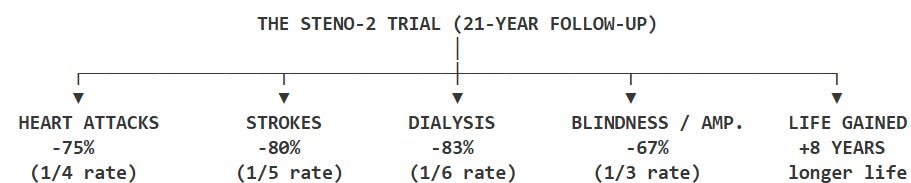
In the landmark Steno-2 study, Danish researchers tested this intensive, multifactorial approach in high-risk Type 2 diabetes patients with early kidney damage. Over a 21-year follow-up, patients on comprehensive multi-node protection achieved equally stunning results:
75% fewer heart attacks (one-fourth the rate of usual care)
80% fewer strokes (one-fifth the rate of usual care)
83% reduction in progression to end-stage kidney failure and dialysis
67% reduction in amputations and blindness
70% fewer hospitalizations for heart failure
An average of 8 additional years of healthy life gained (Gaede et al., 2003, 2008, 2016, 2018).
For decades, the standard medical model has operated under two deeply flawed assumptions:
The Genetic Myth: That chronic disease is hardwired into our permanent DNA code—a fixed fate of inherited mutations or random bad luck.
The Fragmented Specialist Model: That chronic conditions are unrelated failures of separate organs, requiring reactive treatments only after permanent damage has occurred.
The latest genomic science proves both assumptions wrong. Your health future is not hardwired into your DNA. You don’t have to go on dialysis or die young.
Human life is built by a closed library of approximately 500 core developmental genes in a narrow network that manages food supply and growth factors:
In the Womb: These genes act in a perfect symphony to produce a normal infant—directing rapid cell division, building blood vessels, and shaping our organs.
In Healthy Young Adults: Once our organs are fully formed, these 500 construction genes go quiet. They power down into a resting state so our tissues can remain stable and healthy.
In Later Life (The Chaotic Reactivation): Decades of processed foods, visceral belly fat, high insulin, and blood pressure exceeding 130 mmHg send continuous emergency alarms into our cells.
Confused by this constant metabolic strain, these 500 embryonic genes wake back up chaotically in adult tissues.
Instead of building healthy organs, their reactivation unleashes a storm of excess oxidants, chronic inflammation, and damaged “zombie cells.”
In a blood vessel, this chaotic signal makes arteries stiff and thick.
In the heart muscle, it creates rigid scar tissue (heart failure).
In a breast, colon, or skin gland, it commands pre-cancerous cells to divide without stopping and become malignant.
Because these genes are not permanently mutated—they are simply running the wrong software program at the wrong time—we can silence them, quench the oxidants they produce, and restore healthy cellular function.
Under the old model of medicine, a heart protocol reducing all-cause deaths twelvefold or preventing blindness and dialysis makes no sense.
Under the new science of systems biology and molecular signaling, the explanation is clear: our major chronic diseases share the exact same root cellular engine.
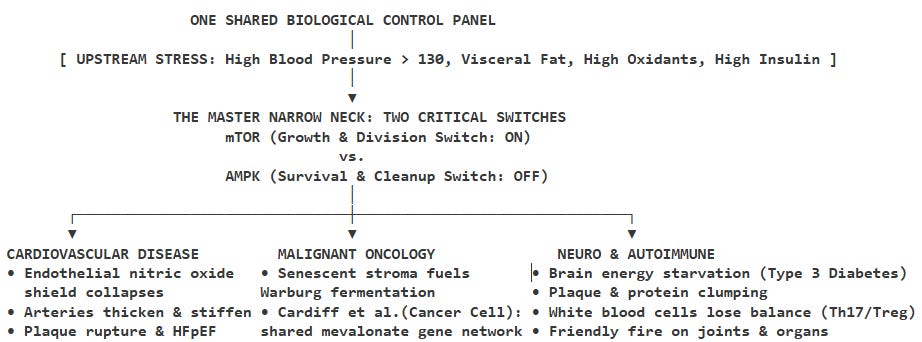
The Shared Transcriptional Network: In a landmark paper published in Cancer Cell, genomic researchers proved that solid tumor malignancies, lipid metabolism, and cardiovascular diseases share a common core gene regulation network (Cardiff et al., 2010).
The Growth vs. Survival Switch: Visceral fat, oxidants, and inflammation jam the master cellular growth switch (mTOR) “ON,” driving abnormal cell division, stiffening tissues, and creating senescent “zombie cells.” At the same time, the master survival switch (AMPK) is shut “OFF,” paralyzing autophagy—the body’s natural cleanup crew that clears damaged proteins, repairs broken DNA via the BRCA/Sirtuin-1 surveillance axis, and protects every cell and organ in the body.
The Microvascular Foundation: When blood pressure exceeds 130 mmHg, delicate microvascular linings lose their ability to produce Nitric Oxide (nature’s non-stick defense). The capillaries stiffen, pour out excess oxidants, and starve tissues of oxygen and vital nutrients.
The inexpensive generic medicines utilized in Optimal Medical Therapy are not passive symptom-blockers. They are precision molecular modulators that block the root causes of chronic disease:
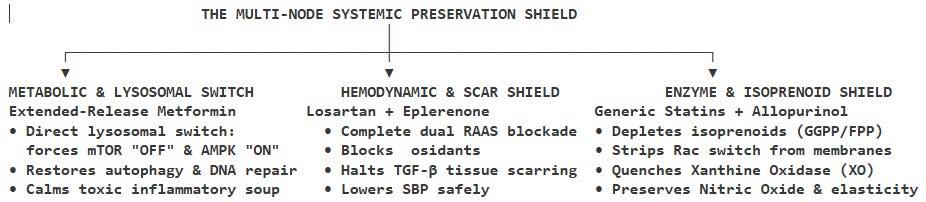
Extended-Release Metformin: Acts directly to inactivate mTOR and activate AMPK. It restores the body’s internal recycling system, reactivates DNA cross-link repair, cuts off abnormal glycolytic fermentation, and shuts down the toxic inflammatory soup poured out by senescent cells.
Losartan + Eplerenone: Dual blockade of the AT1 and mineralocorticoid receptors halts hormone-driven oxidant production, preserving microvascular Nitric Oxide and preventing dense scar tissue from replacing functional tissue in the heart and kidneys.
Generic Statins & Allopurinol: Statins deplete the anchors that inflammatory and cancer switches require to dock onto cell membranes, halting abnormal proliferation and stabilizing vascular walls, while Allopurinol reduces oxidant production and inflammation.
The Difference Between Fragmented Longevity Trends and Coordinated Care
Today, a growing chorus of academic advocates and wellness influencers points to oxidants, chronic inflammation, and mTOR as the engines of aging and disease. They promote an endless checklist of isolated solutions: dietary antioxidants, anti-inflammatory supplements, rapamycin, metformin, NAD+ boosters, resveratrol, cold plunges, and boutique diets.
But human biology is a dynamic, multi-node network, not a collection of individual puzzle pieces. Taking a single supplement or chasing an isolated longevity trend does not stop complex organ damage. The massive survival advantages seen in landmark trials like Steno-2 and Kaiser CCCS did not come from any single intervention—they came from all of these critical nodes being targeted simultaneously in a disciplined, coordinated, and protocol-driven fashion. True health preservation is not an uncoordinated buffet of biohacks; it is an integrated clinical system.
Over the coming weeks, this publication will break down the new science of chronic disease in a clear, structured, and accessible format.
We will demonstrate step-by-step why treating root metabolic switches is the most clinically effective, economically sound approach to healthcare available today:
Parts 1–5 (Foundations): The core biology—how increased oxidant production, decreased antioxidant defense, inflammation, growth factor activation, the ~500-gene developmental funnel, and senescent zombie cells drive a feed-forward vicious cycle. This explains why one person develops multiple, seemingly unrelated, expensive comorbidities.
The Clinical Deep Dives (Pillars 1–5): How proactive generic therapy prevents and reverses Cardiovascular Disease, halts Malignant Transformation & Cancer, defends the brain against Alzheimer’s & Parkinson’s, restores balance in Autoimmune Conditions, and shields the kidneys from End-Stage Renal Disease.
By replacing the fragmented, reactive current system with an advanced primary care health preservation model, employers protect plan solvency, clinicians practice the highest standard of medicine, and families safeguard their health, vitality, and longevity for pennies a day.
Bramlage P, Messer C, Bitterlich N, et al. The effect of optimal medical therapy on 1-year mortality after acute myocardial infarction. Heart. 2010;96(8):604-609. doi:10.1136/hrt.2009.188607
Sandhoff BG, Kuca S, Rasmussen J, Merenich JA. Collaborative cardiac care service: a multidisciplinary approach to caring for patients with coronary artery disease. Perm J. 2008;12(3):4-11. doi:10.7812/tpp/08-007
Delate T, Olson KL, Rasmussen J, et al. Reduced health care expenditures after enrollment in a collaborative cardiac care service. Pharmacotherapy. 2010;30(11):1127-1135. doi:10.1592/phco.30.11.1127
Gaede P, Vedel P, Larsen N, et al. Multifactorial intervention and cardiovascular disease in patients with type 2 diabetes. N Engl J Med. 2003;348(5):383-393. doi:10.1056/NEJMoa021778
Gaede P, Lund-Andersen H, Parving HH, Pedersen O. Effect of a multifactorial intervention on mortality in type 2 diabetes. N Engl J Med. 2008;358(6):580-591. doi:10.1056/NEJMoa0706245
Gaede P, Oellgaard J, Carstensen B, et al. Years of life gained by multifactorial intervention in patients with type 2 diabetes mellitus and microalbuminuria: 21 years follow-up on the Steno-2 randomised trial. Diabetologia. 2016;59(11):2298-2307. doi:10.1007/s00125-016-4065-6
Oellgaard J, Gaede P, Rossing P, et al. Reduced risk of heart failure with intensified multifactorial intervention in individuals with type 2 diabetes and microalbuminuria: 21 years of follow-up in the randomised Steno-2 study. Diabetologia. 2018;61(8):1724-1733. doi:10.1007/s00125-018-4642-y
Cardiff RD, Hwang ST, Varki N, et al. A transcriptional signature and common gene networks link cancer with lipid metabolism and diverse human diseases. Cancer Cell. 2010;17(4):348-361. doi:10.1016/j.ccr.2010.01.022
Packer M. SGLT2 inhibitors produce cardiorenal benefits by promoting adaptive cellular reprogramming to induce a state of fasting mimicry: a paradigm shift in understanding their mechanism of action. JACC Heart Fail. 2020;8(12):969-977. doi:10.1016/j.jchf.2020.08.008
Pavlides S, Whitaker-Menezes D, Castello-Cros R, et al. The reverse Warburg effect: aerobic glycolysis in cancer associated fibroblasts and the tumor stroma. Cell Cycle. 2009;8(23):3984-4001. doi:10.4161/cc.8.23.10238
Zhang CS, Li M, Ma T, et al. Metformin activates AMPK through the lysosomal pathway. Cell Metab. 2016;24(4):521-522. doi:10.1016/j.cmet.2016.09.003
Kalender A, Selvaraj A, Kim SY, et al. Metformin, an antidiabetic agent, suppresses the central regulator of translation initiation, mTORC1, in a Rag GTPase-dependent manner. Cell Metab. 2010;11(5):390-401. doi:10.1016/j.cmet.2010.03.005
Wang Y, Zhang S, Rostad J, et al. AMP-activated protein kinase is involved in the activation of the Fanconi anemia/BRCA pathway in response to DNA interstrand crosslinks. Oncotarget. 2016;7(43):70207-70219. doi:10.18632/oncotarget.10686
Li J, Bonkowski MS, Moniot S, et al. A conserved NAD+ binding pocket that regulates protein-protein interactions during aging. Science. 2017;355(6331):1312-1317. doi:10.1126/science.aad8242
Wang RH, Sengupta K, Li C, et al. Impaired DNA damage response, genome instability, and tumorigenesis in SIRT1-deficient mice. Cancer Cell. 2008;14(4):312-323. doi:10.1016/j.ccr.2008.08.015
Yuan Z, Zhang X, Sengupta N, et al. SIRT1 regulates the function of the BRCA1-associated genome surveillance complex. J Biol Chem. 2011;286(10):7943-7952. doi:10.1074/jbc.M110.188441
Keane M, Semeiks J, Webb AE, et al. Insights into the evolution of longevity from the bowhead whale genome. Cell Rep. 2015;10(1):112-122. doi:10.1016/j.celrep.2014.12.008
Kulkarni AS, Gubbi S, Barzilai N. Benefits of metformin in attenuating the hallmarks of aging. Cell Metab. 2020;32(1):15-30. doi:10.1016/j.cmet.2020.04.001
No posts
Comments
Nothing yet. Say the first thing.
Sign in to join the conversation.